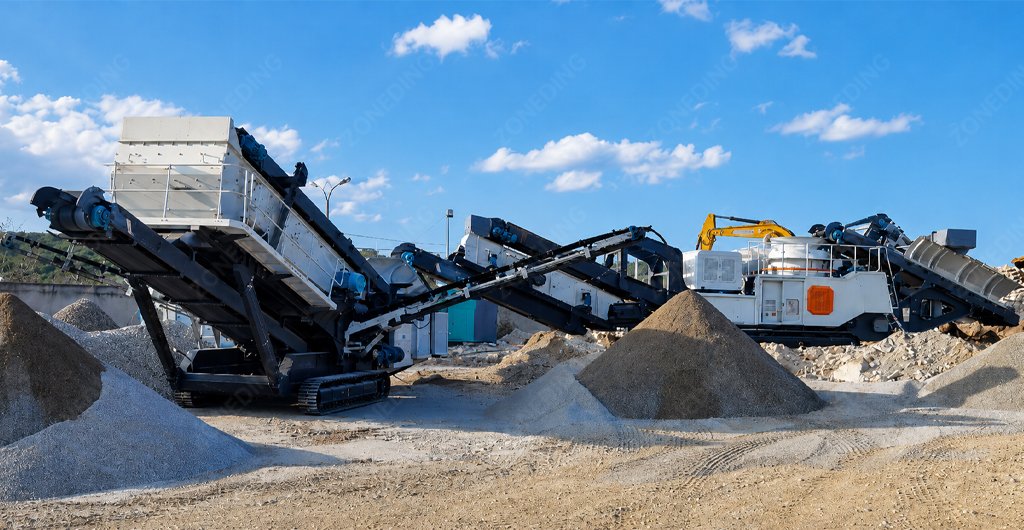
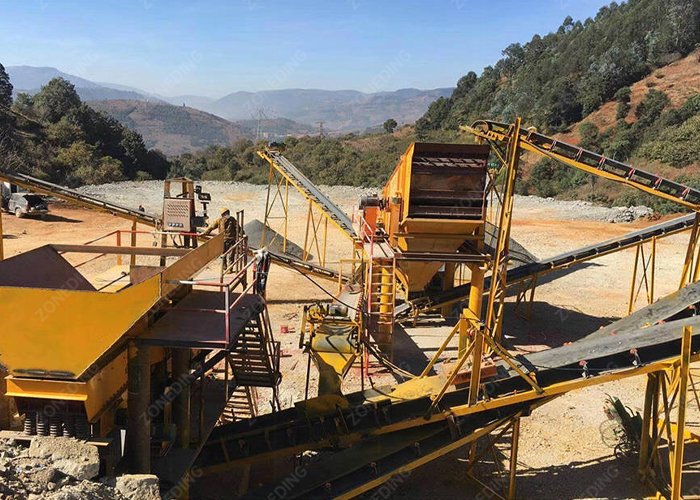
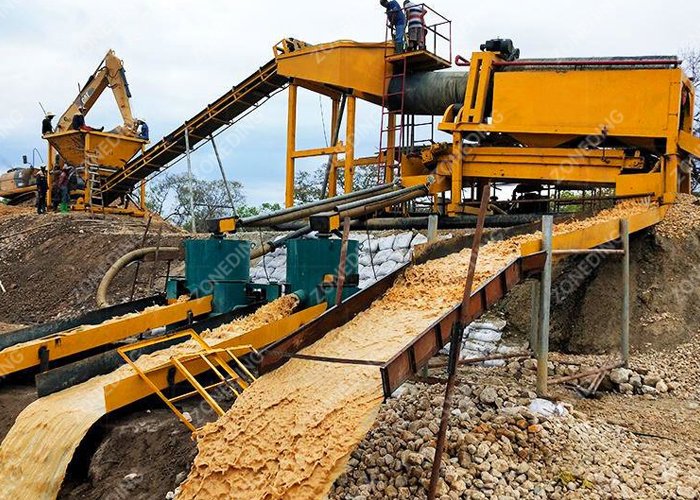
A mobile crusher plant price in South America may range from approximately USD 80,000 to more than USD 900,000. The final amount depends on whether the quotation covers one crusher or a complete crushing and screening line.
Capacity alone cannot define the price. A 150 TPH mobile jaw crusher used for primary reduction costs much less than a 150 TPH closed-circuit plant containing a jaw crusher, cone crusher, screen, return conveyor, generator, and spare parts.
Buyers should therefore compare the process, equipment scope, power system, transport requirements, and responsibilities included in each proposal. This guide explains the main cost boundaries and how to prepare a realistic mobile crushing project budget.
How Much Does a Mobile Crusher Plant Cost in South America?
The following figures are preliminary equipment-budget references. They are not fixed selling prices or delivered project costs.
Reference Capacity
Typical Mobile Configuration
Preliminary Equipment Budget
50–80 TPH
Compact mobile jaw, optional screen
USD 80,000–180,000
80–150 TPH
Mobile jaw plus secondary crusher and screen
USD 180,000–450,000
150–300 TPH
Heavy-duty jaw, cone or impact stage, screen and return circuit
USD 350,000–900,000+
A plant near the lower end of a range may have a wheeled chassis, basic controls, grid-electric drive, and fewer conveyors. A plant near the upper end may include tracked units, diesel-electric power, pre-screening, closed-circuit screening, remote controls, dust suppression, magnets, and an extended wear-parts package.
The prices above normally refer to equipment supplied from the manufacturer. They may exclude:
Ocean freight and marine insurance
Import duties, taxes, and port charges
Inland transport to the project
Crane or unloading services
Site preparation and access roads
Local electrical work
Installation and commissioning
Fuel, transformer, or external generator
Long-term spare and wear parts
The equipment budget should not be confused with the total investment required before commercial production begins. Buyers comparing mobile and stationary systems across a wider capacity range can use the separate 50–500 TPH stone crusher plant price guide.
What Is Included in a Mobile Crusher Plant Quotation?
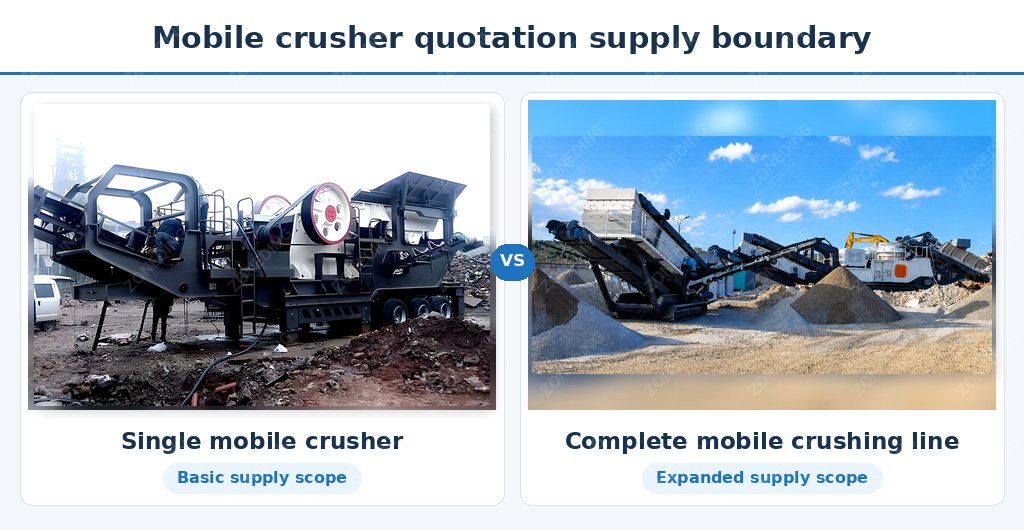
Two quotations can both state “150 TPH mobile crusher plant” while covering very different equipment.
mobile-crusher-quotation-supply-boundary
A single mobile crushing unit commonly includes:
Receiving hopper
Vibrating feeder or grizzly feeder
Main crusher
Mobile chassis
Discharge conveyor
Hydraulic system
Electrical or diesel control system
Safety guards and access platforms
A complete production line may also include:
Primary and secondary mobile crushers
Mobile screening plant
Oversize return conveyor
Finished-product conveyors
Pre-screen or soil-removal section
Metal detector or magnetic separator
Central control and communication system
Generator or diesel-electric power unit
Dust-suppression equipment
Initial spare and wear parts
Quotation Item
Basic Crusher Unit
Complete Mobile Line
Feeder and primary crusher
Included
Included
Secondary crushing
Usually excluded
Included when required
Product screening
Usually excluded
Included
Oversize recirculation
Excluded
Included in a closed circuit
Generator
Optional
Optional or integrated
Finished-product conveyors
Limited
Included according to product sizes
Installation support
Depends on supplier
Should be clearly defined
Spare-parts package
Basic or optional
Project-specific package recommended
The proposal should identify the exact model, installed power, machine weight, shipping dimensions, crusher setting, expected capacity conditions, and every optional component.
It should also state what the buyer must arrange locally. Unclear supply boundaries are one of the main reasons a low initial quotation later becomes an expensive project.
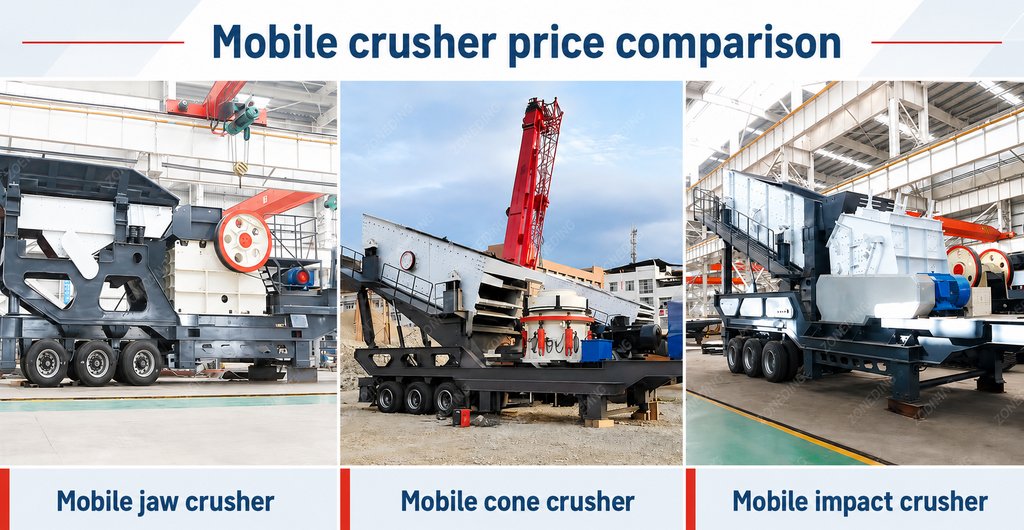
Why Do Jaw, Cone and Impact Mobile Plants Have Different Prices?
The crusher type affects the initial price, power requirement, wear-parts cost, and equipment needed around it. The lowest-priced crusher is not automatically the least expensive option per ton.
Mobile jaw cone and impact crusher configuration and price comparison
Mobile jaw crusher
A mobile jaw crusher is normally the primary unit. It accepts large rock and reduces it before screening, transport, or secondary crushing.
A jaw-only configuration costs less than a complete aggregate line. However, it cannot usually produce several tightly controlled, cubical aggregate sizes by itself.
A mobile cone crusher is commonly selected after the jaw crusher for granite, basalt, river stone, copper ore, and other hard or abrasive materials.
Cone equipment often has a higher initial cost than a basic impact unit. The line may also need controlled feeding, closed-circuit screening, and a return conveyor. However, compression crushing normally provides more predictable wear costs on abrasive rock.
For hard-rock projects, the mobile cone crusher price guide for Chile covers chamber selection, closed-side setting, circulating load, liner consumption, and high-altitude operation.
Mobile impact crusher
A mobile impact crusher suits limestone, sandstone, clean concrete, road material, and other low- to medium-abrasive feed.
It can provide a high reduction ratio and good particle shape. Recycling configurations may also require a pre-screen, magnet, and material-sorting system.
Crusher selection must begin with material properties and required products. Choosing an impact crusher only because its initial price is lower may create excessive wear on basalt. Likewise, using a cone crusher for soft limestone may add cost without creating enough operating benefit.
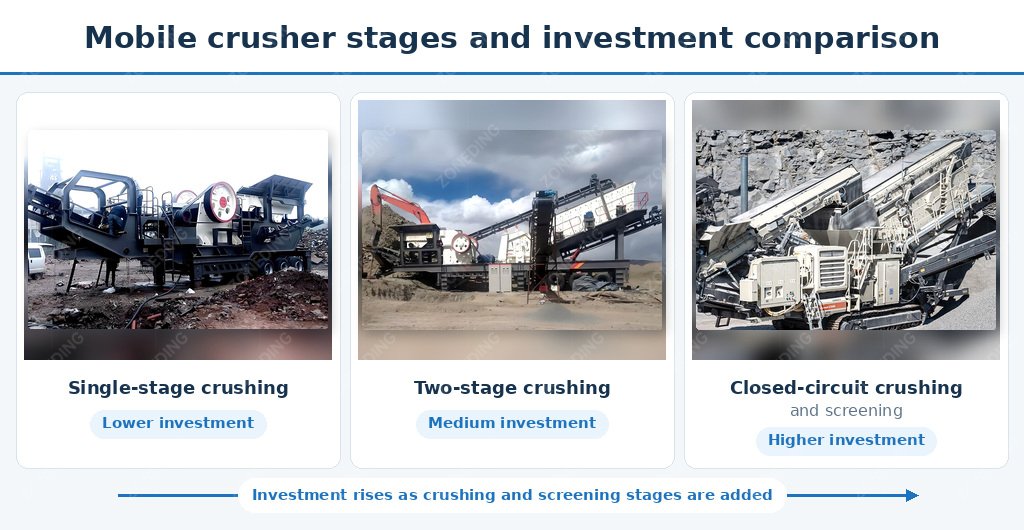
How Do Capacity and Crushing Stages Change the Price?
Plant capacity affects much more than the main crusher size. Higher output may require a larger feeder, wider conveyors, more screen area, stronger chassis, higher installed power, and greater stockpile capacity.
However, the required finished products often influence price more than the feed rate.
Consider two plants that both receive 100 TPH:
Plant A produces one broad 0–40 mm road-base material.
Plant B produces 0–5, 5–10, 10–20, and 20–40 mm aggregate.
Plant B normally needs secondary crushing, a multi-deck screen, additional conveyors, controlled recirculation, and separate product stockpiles. Its equipment cost will be higher even though the hourly feed rate is the same.
Mobile crusher plant capacity and crushing stage comparison
Production Requirement
Likely Process
Relative Investment
Primary-crushed material only
Mobile jaw crusher
Lowest
One broad road-base product
Mobile jaw plus screen
Low to medium
Cubical limestone aggregate
Mobile jaw, impact crusher, and screen
Medium
Hard-rock commercial aggregate
Mobile jaw, cone crusher, and screen
Medium to high
Several products with controlled oversize
Two-stage crushing, multi-deck screen, and return circuit
High
Aggregate plus manufactured-sand feed
Additional fine crushing or shaping
Highest
A 50–100 TPH project can sometimes begin with one primary crusher and add screening or secondary crushing later. The 50–100 TPH small quarry guide explains when phased expansion is practical.
At 100–200 TPH, the crusher, screen, conveyors, power, and circulating load must be balanced as one system. The 100–200 TPH aggregate plant cost guide compares representative limestone, granite, and aggregate-plus-sand configurations.
Advertised crusher capacity should not be treated as guaranteed saleable output. Moisture, clay, feed grading, crusher settings, screen efficiency, return load, wear, and operating utilization all affect continuous production.
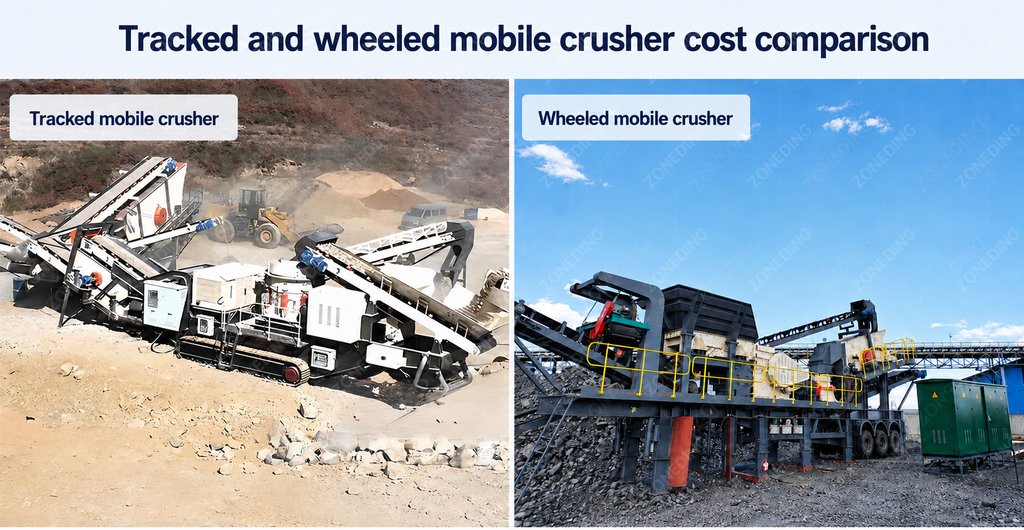
How Do Tracked and Wheeled Chassis Affect the Cost?
Tracked and wheeled plants use similar crushing principles, but their chassis, relocation methods, and site requirements differ.
Tracked equipment generally has a higher initial price because it contains crawler drives, hydraulic travel systems, and a heavier integrated structure. Its value comes from repositioning within mines, quarries, demolition sites, and road projects.
Wheeled equipment normally costs less and can be practical on prepared sites. It may need support legs, leveling work, towing equipment, and suitable road access.
Tracked and wheeled mobile crusher plant cost and mobility comparison
Cost and Operation Item
Tracked Mobile Plant
Wheeled Mobile Plant
Initial equipment cost
Usually higher
Usually lower
Movement inside rough sites
Better
More limited
Long-distance transport
Low-bed trailer normally required
Easier when road rules permit
Site preparation
Lower in many applications
Prepared and level area preferred
Hydraulic travel maintenance
Required
Less complex
Best value condition
Frequent on-site repositioning
Planned relocation between prepared sites
Tracked does not mean the plant can travel long distances on public roads by itself. Machine weight, width, height, axle restrictions, local permits, and low-bed availability still need to be confirmed.
If the crusher will remain in the same position for most of the project, paying more for crawler mobility may not create a financial return. If the quarry face moves regularly, a cheaper wheeled unit may create higher relocation and civil-work costs.
How Should Shipping and Installed Project Costs Be Calculated?
The factory price is only the starting point. A realistic budget should follow the equipment from the manufacturer to stable production at the final site.
A useful calculation is:
Installed project cost = equipment price + export packing + freight and insurance + import costs + inland transport + site work + installation + commissioning + initial operating support
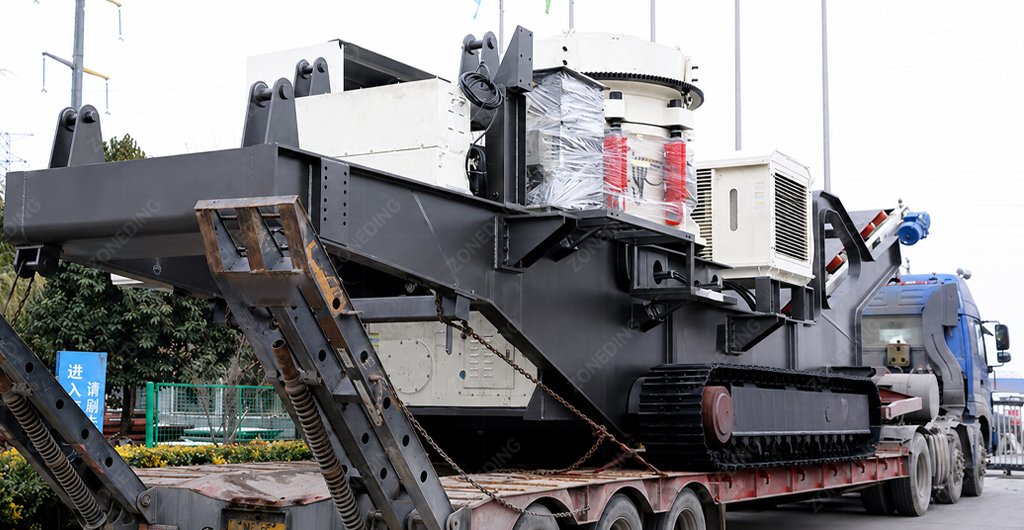
Mobile crusher plant prepared for shipment to South America
The final amount changes with:
Number of mobile units
Total weight and shipping dimensions
Containerized, flat-rack, or break-bulk shipment
Destination port and sailing route
Port handling and temporary storage
Import duties and local taxes
Distance from the port to the project
Bridge, tunnel, curve, gradient, and axle restrictions
Low-bed trailer and escort requirements
Crane capacity and unloading method
Local labor and technical-service scope
Before shipment, the supplier should provide equipment weights, transport dimensions, lifting points, packing lists, and unloading instructions. The buyer or local logistics company should verify the route from the port to the working site.
Installation costs also depend on the configuration. A single tracked jaw crusher may require limited setup. A multi-unit wheeled line can require leveling, supports, conveyor connections, electrical cabling, dust-control piping, stockpile planning, and trial production.
Remote mining projects may need additional investment in generators, fuel storage, transformers, communication, lighting, workshops, and larger spare-parts inventories. High-altitude projects may also require engine or generator derating.
No fixed percentage should be added to every project. Current freight, import, inland transport, and local-service quotations should be collected separately before the purchase decision.
What Information Is Needed for an Accurate Final Quote?
A useful quotation requires more than a capacity number. “Mobile crusher, 150 TPH” does not define the material, final products, equipment stages, or delivery scope.
Required Information
Why It Affects the Price
Country, destination port, and site location
Defines shipping and inland transport
Material name and photographs
Supports the initial crusher choice
Hardness and abrasion test data
Affects crusher type and wear parts
Maximum and normal feed size
Defines feeder and primary crusher size
Required saleable output
Determines actual plant capacity
Final product sizes and percentage split
Defines secondary crushing and screening
Moisture, clay, soil, and natural fines
Shows whether pre-screening is required
Operating hours per day
Supports power and wear-parts planning
Site altitude and temperature
Affects engines, cooling, and lubrication
Available voltage and frequency
Defines motors, generators, and controls
Terrain and relocation frequency
Guides tracked or wheeled selection
Existing equipment
Prevents unnecessary duplication
Required delivery and service scope
Defines quotation boundaries
Buyers should also request the following information from each supplier:
Complete process flow
Equipment model and quantity
Design-capacity assumptions
Installed power and power source
Machine weights and shipping dimensions
Screen decks and product conveyors
Initial wear and spare parts
Installation and commissioning responsibilities
Warranty terms and service scope
Items specifically excluded from the quotation
Cost can often be controlled without reducing useful production. Practical options include beginning with a primary mobile jaw and reserving connections for later expansion, using grid power where reliable, avoiding unnecessary crawler mobility, and selecting screen capacity according to actual product demand.
However, removing a required secondary crusher, selecting an undersized screen, or reducing critical wear parts only transfers the cost to low output and future downtime.
The best quotation is not necessarily the lowest total on the first page. It is the proposal with a clear process, balanced capacity, complete supply boundary, realistic logistics plan, and predictable operating requirements.
Mobile Crusher Plant Price FAQ
How much does a complete mobile crusher plant cost in South America?
A preliminary equipment budget may range from approximately USD 80,000 for a compact primary unit to more than USD 900,000 for a heavy multi-stage tracked line. The final price depends on capacity, crusher type, screening, power, mobility, and included equipment.
Is a mobile crusher cheaper than a stationary crusher plant?
Not always. Mobile equipment may have a higher machine cost because of the chassis and integrated systems. It can reduce foundation work, installation time, and relocation costs. Stationary plants may provide better value for long-term production at one permanent site.
Can one mobile crusher produce several finished aggregate sizes?
A crusher alone cannot separate several calibrated products. A mobile screen and separate conveyors are required. Secondary crushing may also be necessary to improve particle shape and control the top size.
Why are two quotations for the same TPH so different?
One quotation may cover only a primary crusher, while another includes secondary crushing, screening, return conveyors, power, controls, dust suppression, spare parts, and technical support. Compare the equipment list and supply boundary, not only the stated capacity.
What costs are usually excluded from the equipment price?
Ocean freight, insurance, import duties, port charges, inland transport, cranes, site preparation, local electrical work, installation, commissioning, fuel, and long-term spare parts may be excluded unless they are specifically listed.
A reliable mobile crusher plant budget begins with a clear process and an itemized supply scope. Capacity, material, final products, mobility, power, shipping, and local installation should all be confirmed before comparing final quotations.
Mobile crushing technology offers the most direct path to reducing operational costs and increasing profit margins in the mining industry. This article explains how a mobile unit eliminates the need for expensive civil works and reduces truck haul...
Mineral screening equipment performs the vital task of size separation in mining. This process occurs after crushing to ensure only the correct stones proceed. Efficient screening prevents the recirculating load from overwhelming the system. In 20...
Starting a gold mine requires a clear budget. Total alluvial gold plant cost ranges from $30,000 for small setups to over $500,000 for industrial lines. Equipment price is only part of the investment. Shipping, power, and labor also impa...
We use cookies to ensure that we give you the best experience on our website. If you continue to use this site we will assume that you are happy with it.
Privacy Policy
Send us a message
We would love to hear from you
Submit your question and our team will respond to the email provided as soon as possible.
 Zoneding Machine