Search the whole station Crushing Equipment
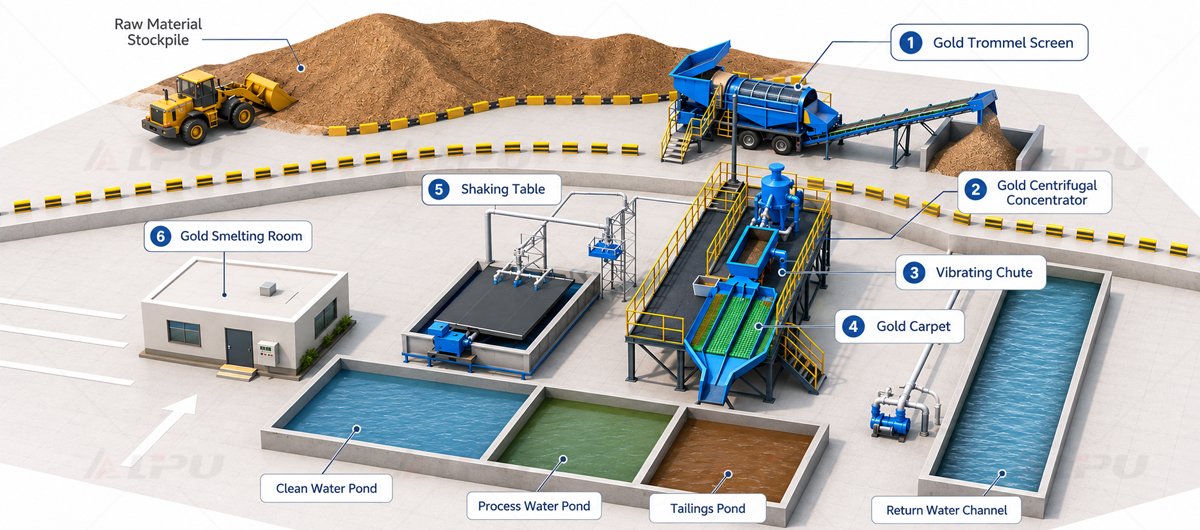
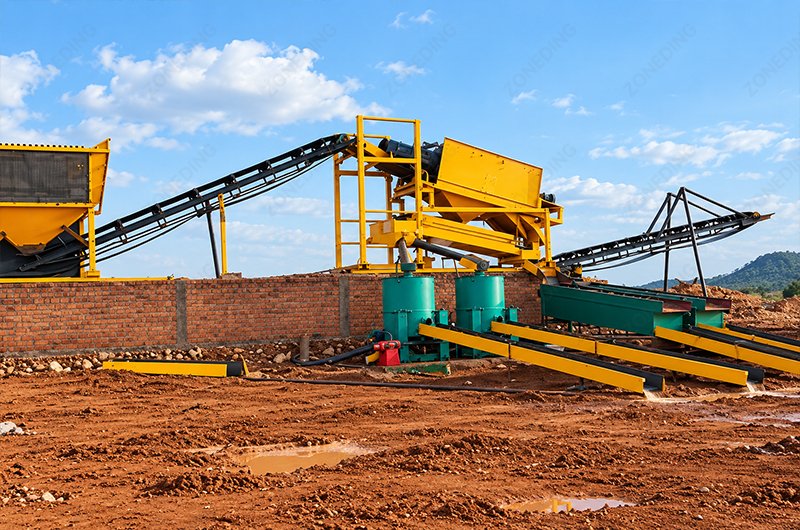
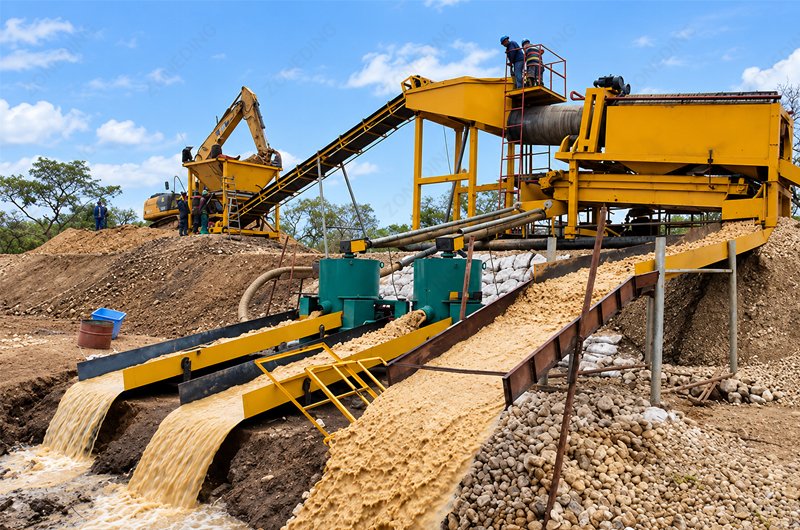
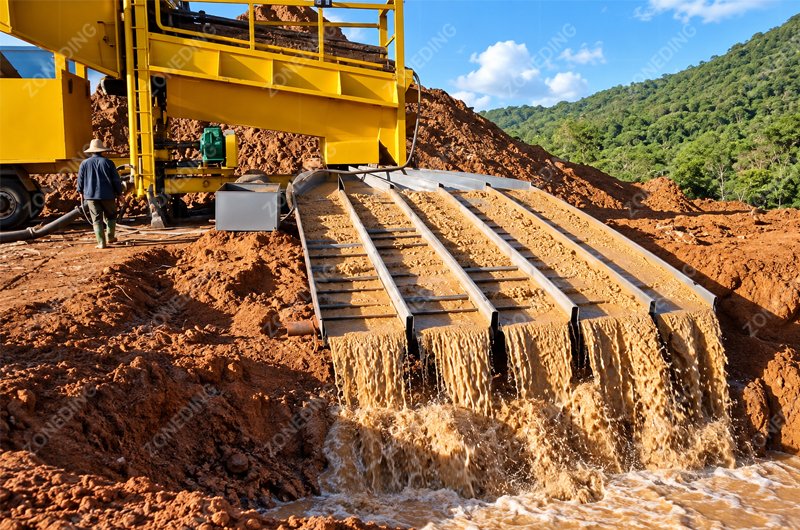
A gold wash plant is a complete processing system used to wash, screen, classify, and recover free gold from alluvial and placer deposits.
The correct plant depends on more than throughput. Clay content, maximum feed size, gold particle size, water availability, site conditions, and mobility requirements can all change the flowsheet.
A free-washing placer deposit may need only feeding, screening, and gravity recovery. Sticky clay-rich material may require intensive scrubbing, while deposits containing finer free gold may need more careful classification and staged gravity concentration.
A gold wash plant is mainly designed for deposits where gold is already liberated or can be released through washing and size separation.
Typical materials include:
The plant removes oversized waste, washes away clay, controls particle size, and sends suitable material into gravity recovery equipment.
This is different from simply using one gold trommel.
A trommel may perform washing and screening, but the complete wash plant may also include:
If the gold remains locked inside competent hard rock, washing alone may not provide sufficient liberation.
In that case, the project normally requires crushing and grinding before recovery. ZONEDING’s gold processing line covers the broader processing routes used for hard-rock and more complex gold ores.
For placer deposits, the wider mining and recovery process is covered in the placer gold mining solution.
A gold wash plant generally works through five connected stages.
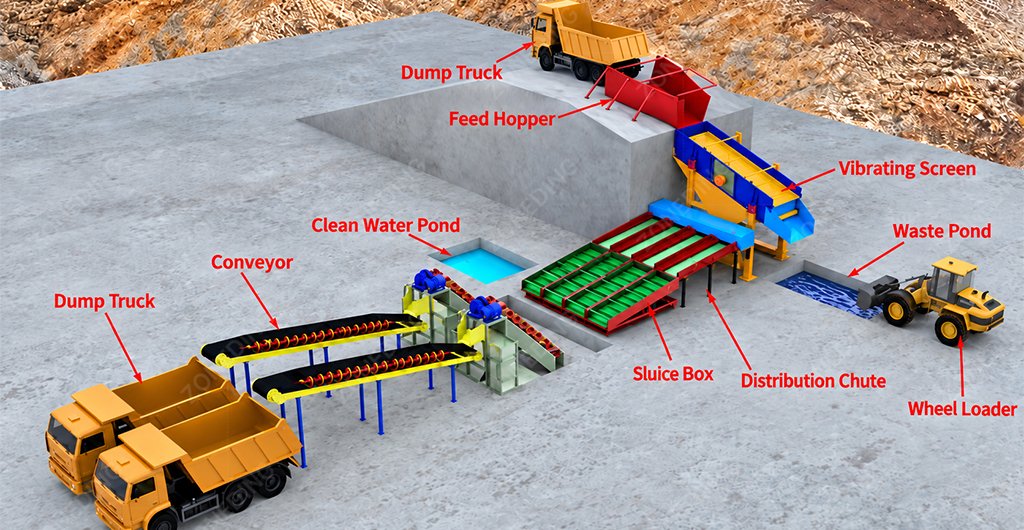
Raw material enters through a hopper or feeder.
The feeding system should maintain a stable flow instead of allowing large surges to enter the washing circuit.
Consistent feeding helps:
The feeder should therefore match both the required throughput and the capacity of the equipment downstream.
Washing removes loose soil and fines.
When sticky clay is present, more aggressive scrubbing may be required to break down compacted material and release trapped gold-bearing particles.
Clay can create several problems:
This means washing is not simply a cleaning step.
It is part of mineral liberation.
Screening removes oversize material and controls the size range entering the recovery circuit.
Typical equipment includes:
A gold trommel is especially common in alluvial operations because washing and screening can be combined in one rotating unit.
For a more detailed explanation of this stage, see Gold Trommels Explained: Screening & Classifying Ore for Better Recovery.
Classification improves gravity recovery by separating material into more suitable particle-size ranges.
This matters because very coarse and very fine particles do not behave the same way in gravity separation equipment.
A controlled feed size can help improve the stability of:
Classification becomes increasingly important when the deposit contains a wide particle-size distribution.
Once the material is washed and correctly sized, gravity separation is used to recover free gold.
The recovery circuit may include:
These machines perform different duties.
A well-designed plant assigns a clear particle-size range and recovery role to each machine.
There is no single gold wash plant flowsheet that should be copied for every deposit.
Ore condition should determine the process.
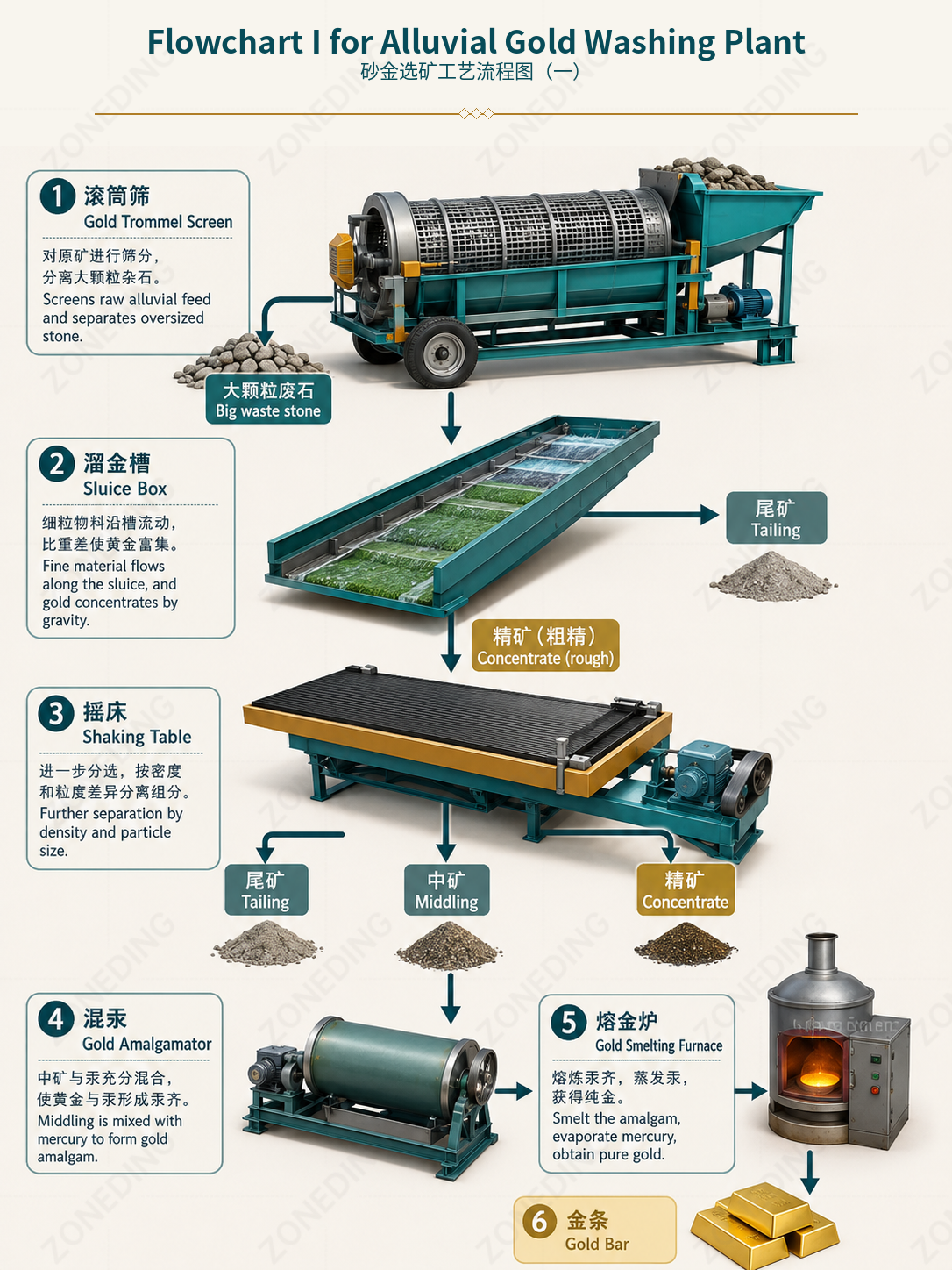
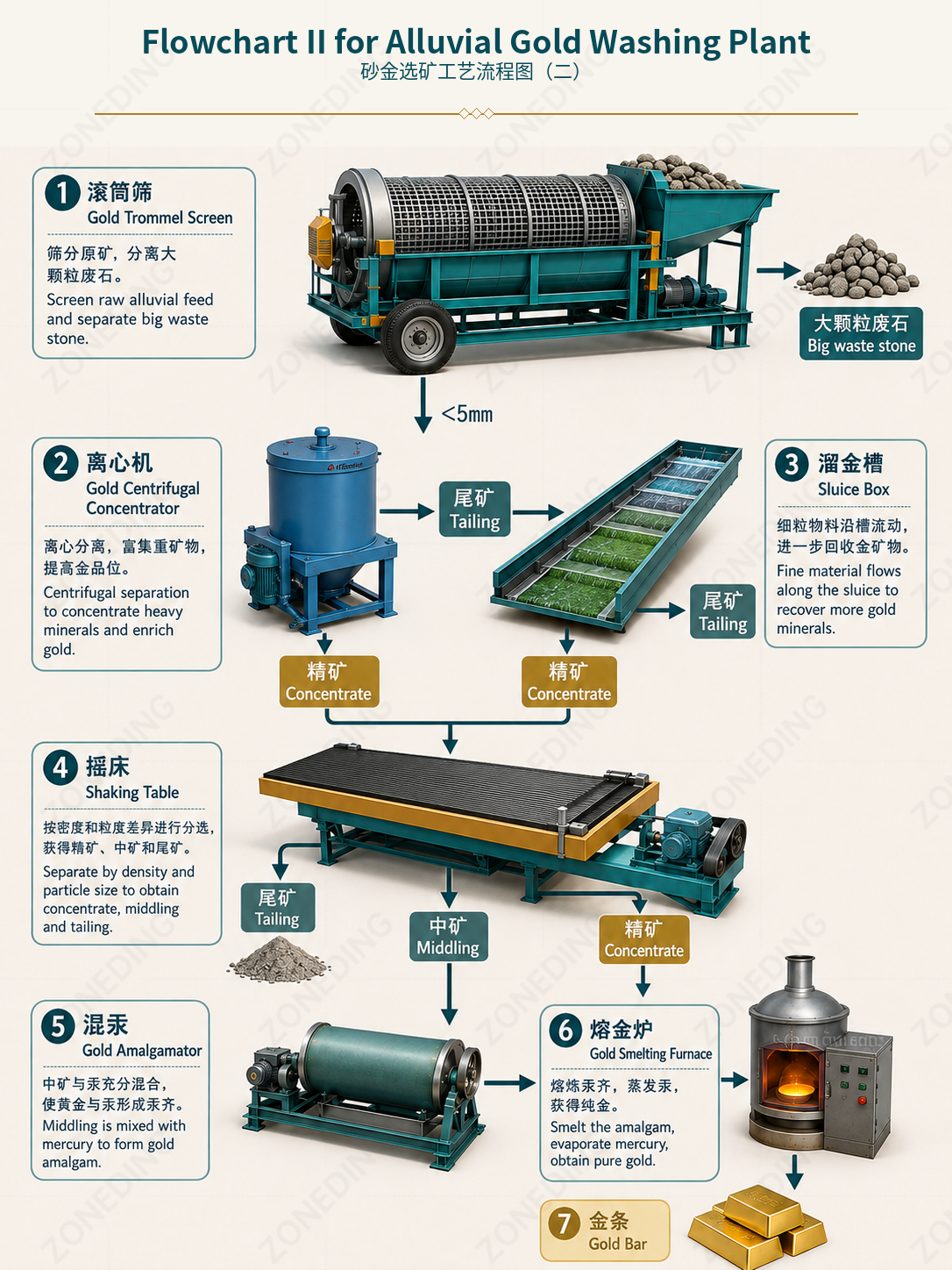
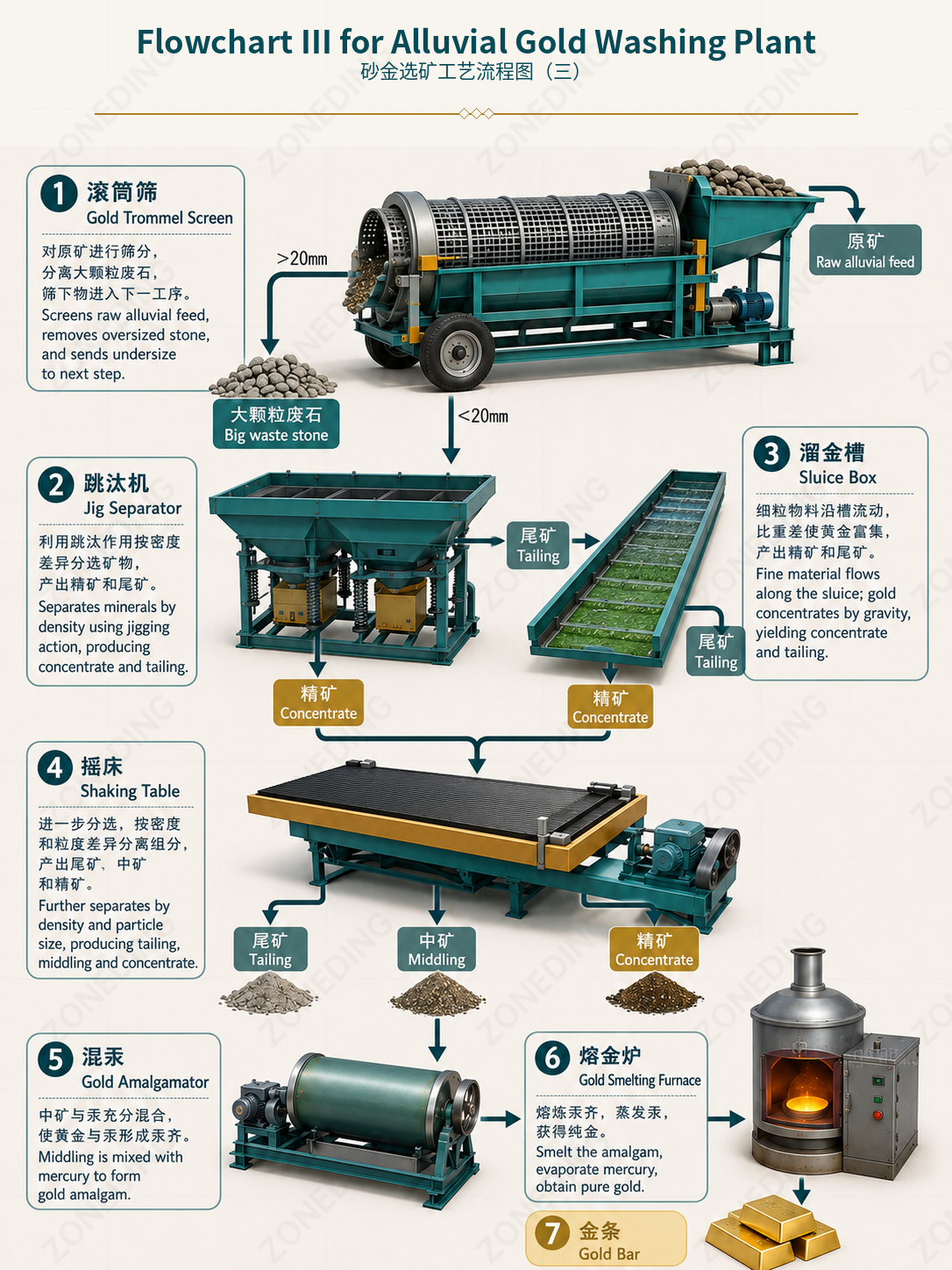
Some alluvial deposits contain loose gravel and sand with relatively little sticky clay.
A simplified flowsheet may be:
Hopper → Feeding → Trommel Screening → Gravity Recovery → Concentrate
The main objectives are:
Important design inputs include:
Even a simple wash plant needs balanced feeding, screening, and gravity capacity.
Sticky clay requires a different process.
A typical flowsheet may be:
Hopper → Feeder → Scrubber → Screening → Classification → Gravity Recovery
The scrubber breaks down clay before screening.
Without sufficient scrubbing, gold may remain trapped in clay or report incorrectly with the oversize stream.
The plant should therefore be designed around the actual clay condition rather than simply adding more water.
For projects where sticky clay is causing gold loss, see Alluvial Gold Washing: Solving Gold Loss from Sticky Clay.
Deposits containing finer free gold usually require better classification.
A possible process is:
Washing → Screening → Classification → Coarse Gold Recovery + Fine Gold Recovery → Concentrate Cleaning
One possible duty split is:
The exact circuit should be based on the gold particle-size distribution whenever test data is available.
Two deposits with the same throughput can require very different recovery circuits if the gold occurs in different size ranges.
The equipment should be selected according to process duty.
| Process Stage | Typical Equipment | Main Function |
|---|---|---|
| Feeding | Hopper / Vibrating Feeder | Stabilize raw ore feed |
| Scrubbing | Trommel Scrubber | Break down clay and wash material |
| Screening | Trommel Screen / Vibrating Screen | Remove oversize and control particle size |
| Classification | Classifier / Hydrocyclone where applicable | Prepare suitable recovery fractions |
| Coarse / Medium Gold Recovery | Jig Concentrator | Gravity concentration |
| Fine Gold Recovery | Centrifugal Concentrator | Recover finer high-density particles |
| Concentrate Cleaning | Shaking Table | Upgrade gravity concentrate |
| Water Handling | Pump / Settling System / Thickener | Supply and recycle process water |
| Tailings Handling | Pump / Dewatering Equipment | Handle final tailings |
Not every gold wash plant needs every machine in this table.
Adding more equipment does not automatically improve the process.
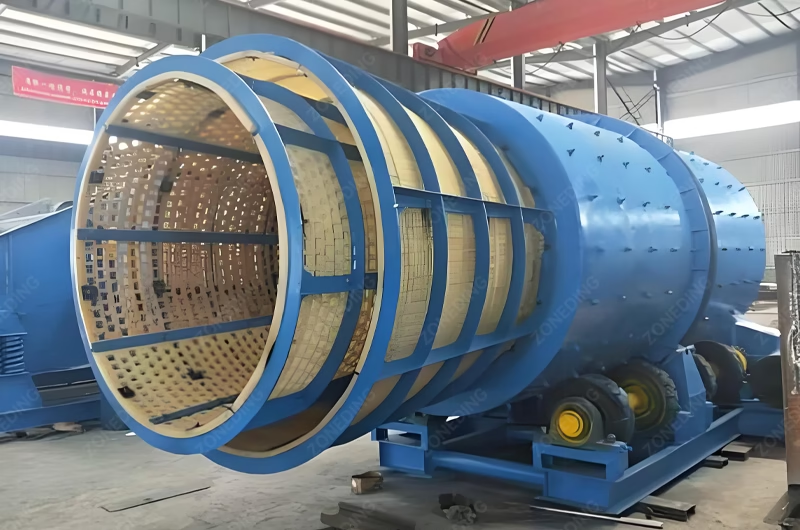
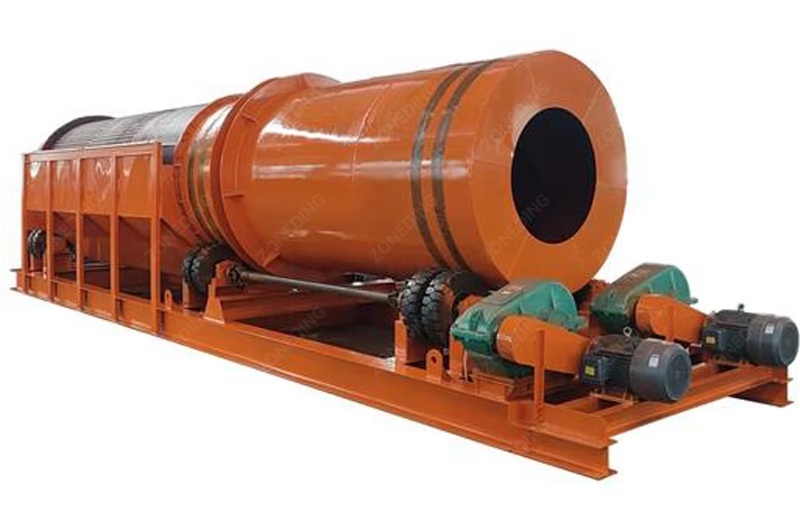
A trommel scrubber is useful when the feed contains sticky or compacted material.
Its main function is to break down clay and release gold-bearing particles before screening and recovery.
Selection should consider:
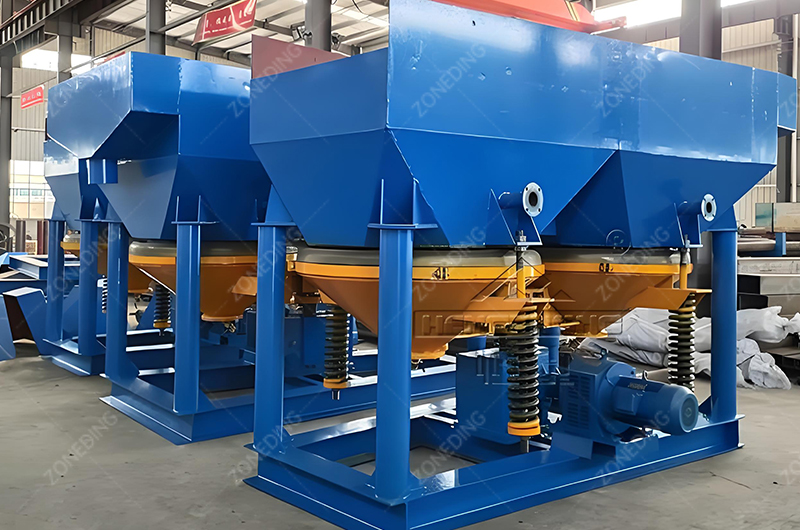
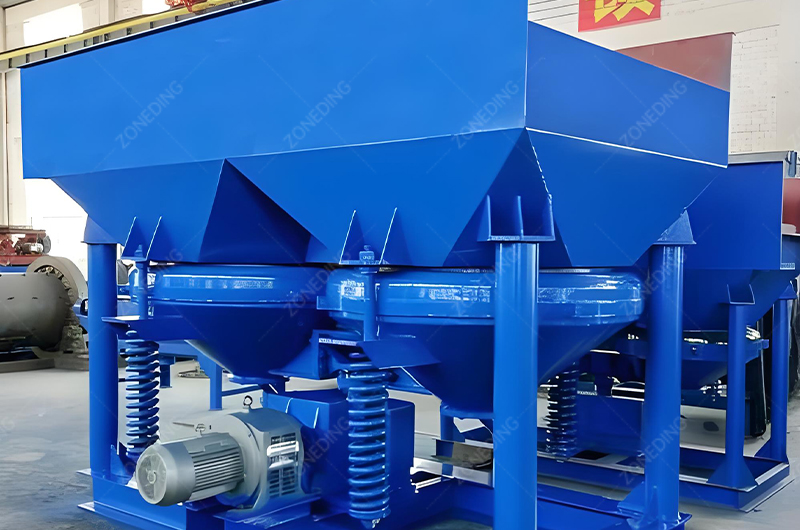
A jig concentrator can be used to recover suitable coarse and medium gravity-recoverable particles.
Its performance depends strongly on feed preparation and particle-size control.

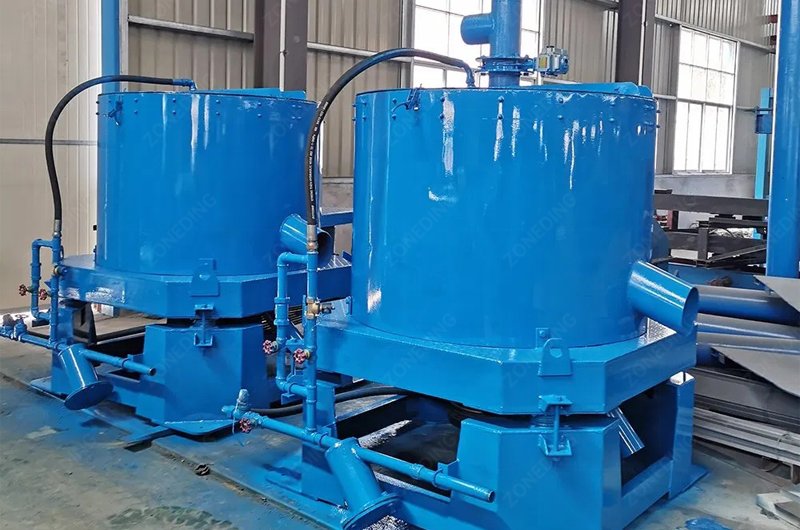
A centrifugal concentrator is often considered when finer free gold requires stronger gravity separation.
It should receive properly washed and classified material rather than uncontrolled raw feed.
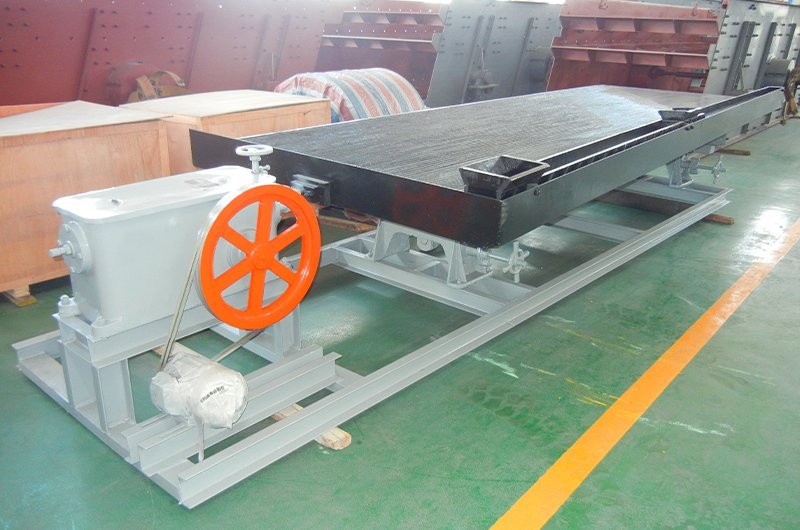
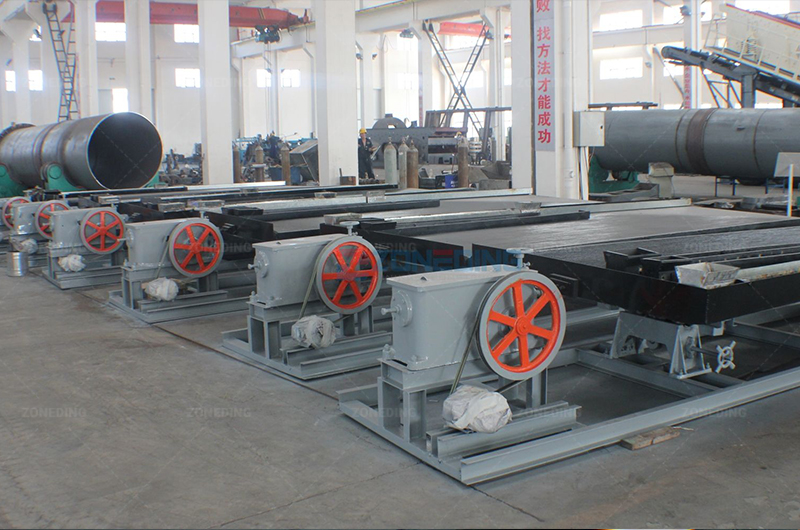
A shaking table is generally more suitable for upgrading gravity concentrate than for treating the full raw feed of a large plant.
A common arrangement is:
Primary Gravity Recovery → Concentrate → Shaking Table → Cleaner Concentrate
Capacity is important, but it should never be considered alone.
Two plants processing the same tonnage can require different equipment because of:
Smaller systems often prioritize:
If the ore is free-washing, the process may remain relatively simple.
If clay is present, even a smaller plant may still require dedicated scrubbing.
As throughput increases, equipment balance becomes more important.
Typical priorities include:
Capacity should be checked against more than dry solids throughput.
The plant also needs to handle:
A plant may appear large enough in TPH but still be restricted by screening or water handling.
Gravity equipment should be selected according to the gold particle-size range and feed characteristics.
| Gold / Feed Condition | Equipment Usually Considered |
|---|---|
| Coarse to medium free gold | Jig concentrator |
| Finer free gold | Centrifugal concentrator |
| Gravity concentrate cleaning | Shaking table |
| Wide particle-size distribution | Classification + staged gravity recovery |
The key question is:
What particle-size fraction is each machine responsible for recovering?
If that role cannot be clearly defined, the circuit may be unnecessarily complicated.
A jig, centrifugal concentrator, and shaking table may all appear in the same plant, but they should not simply duplicate each other’s duty.
For more information on placer gravity equipment, see Equipment for Placer Gold Purification & Processing.
A gold wash plant cannot be designed without considering water and tailings.
Water demand depends on:
Clay-rich material generally needs more effective washing than clean gravel.
Where fresh water is limited, a return-water system may be considered.
A simplified circuit is:
Process Water → Gold Wash Plant → Tailings / Slurry → Settling / Clarification → Return Water → Gold Wash Plant
Depending on the project, this may include:
The plant should define separate routes for:
Oversize Waste → Conveyor / Stockpile
and:
Fine Tailings → Slurry Handling / Settling / Dewatering
Tailings design should begin together with the processing plant rather than after installation.
A practical layout should consider:
Compact does not always mean better.
Equipment must remain accessible for inspection and maintenance.
Gold washing plants can be mobile, modular, or stationary.
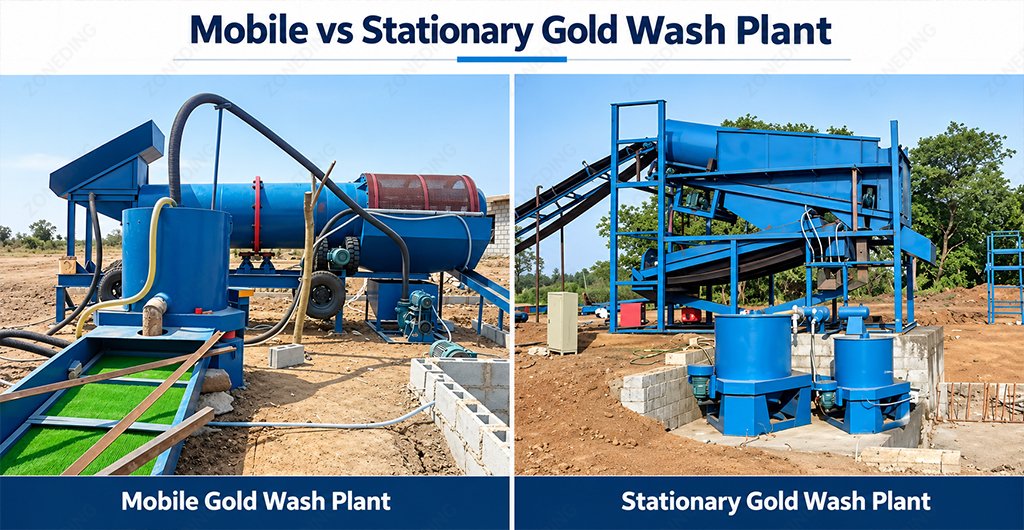
| Factor | Mobile Gold Wash Plant | Stationary Gold Wash Plant |
|---|---|---|
| Relocation | Easier | Limited |
| Installation | Usually simpler | More site preparation |
| Site life | Shorter / changing deposits | Long-term |
| Expansion | More limited | More flexible |
| Capacity | Often modular | Easier to scale |
| Water system | Usually simpler | Easier to build complete recycling |
| Maintenance space | Compact | More flexible |
Mobile does not automatically mean cheaper.
Transport, chassis design, generators, pumps, and water systems can all affect total project cost.
A stationary layout provides more flexibility for adding screens, parallel concentrators, pumps, settling systems, and dewatering equipment.
What is the difference between a gold wash plant and a gold trommel?
A gold trommel is one machine used for washing and screening. A gold wash plant is the complete processing system, which may include feeding, scrubbing, screening, classification, gravity recovery, water handling, and tailings equipment.
Can a gold wash plant process hard rock gold ore?
A gold wash plant is mainly suited to alluvial, placer, or weathered material where gold can be recovered after washing and size separation. Hard-rock gold usually requires crushing and grinding before recovery.
What equipment is used to recover fine gold?
Fine free gold may require controlled classification and suitable gravity equipment such as a centrifugal concentrator. The correct equipment depends on particle size and ore characteristics.
Do all gold wash plants need a trommel scrubber?
No. Free-washing gravel with little sticky clay may not require intensive scrubbing. Clay-rich material may require a dedicated scrubber before screening and gravity recovery.
Should I choose a mobile or stationary gold wash plant?
Choose mobile when relocation and lower fixed-site infrastructure are important. Choose stationary when long-term production, higher capacity, water recycling, expansion, and more complete tailings management are priorities.
A practical gold wash plant should be designed around the ore, not around a fixed equipment package.
ZONEDING can configure feeding, scrubbing, screening, classification, gravity recovery, water handling, and tailings equipment according to project requirements.
Please provide:
The more accurately the ore condition is defined, the more accurately the gold wash plant can be configured.
 Zoneding Machine