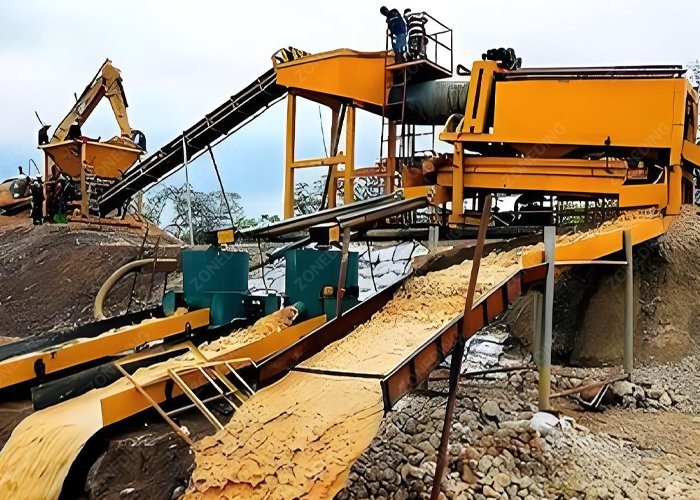
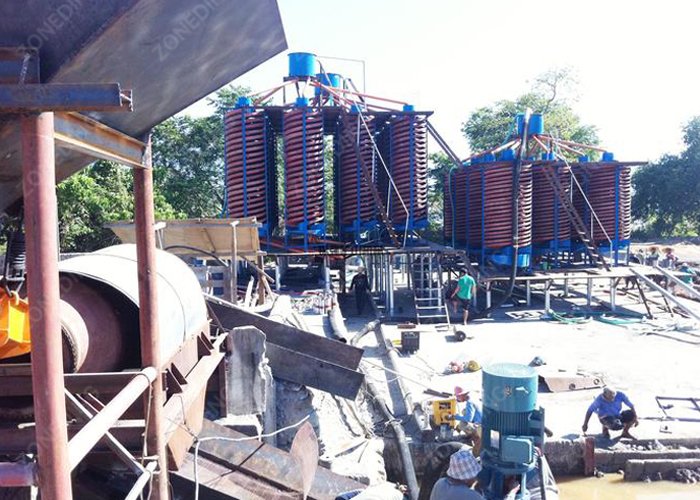
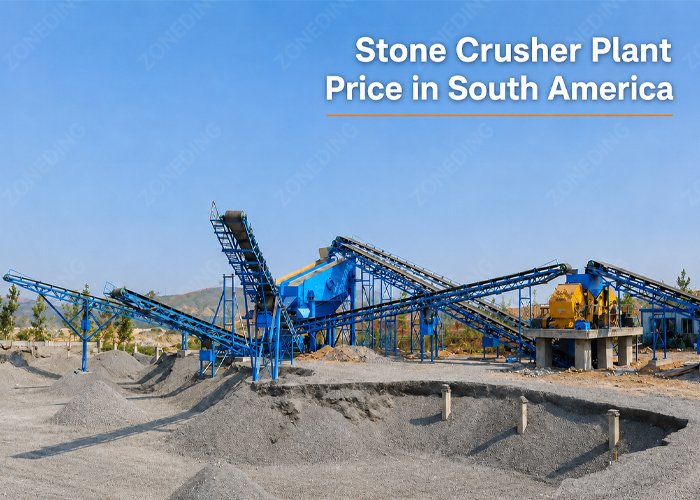
With over 50 years of experience in mineral processing, ZONEDING observes that many placer gold operations lose more than 50% of their fine gold. This loss comes from technical errors in the beneficiation process, not natural causes. Purification begins at the washing plant, not just the smelting room. This article explains the equipment needed to capture fine gold and upgrade the recovery process.
Why do traditional simple sluice boxes result in massive fine gold loss?
Traditional simple sluice boxes result in massive fine gold loss because they cannot control the water turbulence caused by large rocks. This turbulence scours fine gold particles out of the riffles. Additionally, simple sluices lack mechanisms to prevent the bedding material from packing solid, which stops the trapping of sub-millimeter gold.
A simple sluice box relies on gravity and river flow. When you feed unscreened material into a sluice, large rocks create unpredictable water currents. These currents generate lift forces that are stronger than the settling velocity of fine gold. The gold particles stay suspended in the water and exit the sluice box. Another issue is “packing.” The spaces between the riffles fill with heavy black sand (magnetite). Without mechanical agitation, this sand forms a hard layer. New gold particles cannot penetrate this layer to settle at the bottom. They slide over the top of the packed sand and are lost in the tailings. You must classify material by size before concentration to prevent this.
Washing and Screening: Facing high clay content ore, how does a trommel scrubber achieve complete separation?
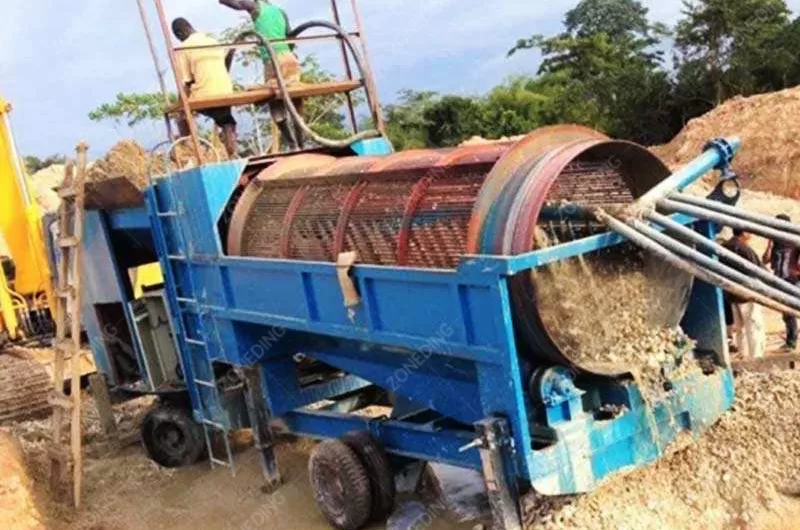
A trommel scrubber achieves complete separation in high-clay ore by using internal lifting plates and the weight of the rocks to mechanically break down clay balls. The rotation drops rocks onto the clay to dissolve it into a liquid slurry, releasing the trapped gold particles before screening occurs.
trommel-scrubber-clay-separation
trommel-screen
Clay reduces recovery rates significantly in placer mining. Sticky clay forms solid balls in water. These balls encapsulate gold particles. If the clay does not dissolve, the gold remains inside and leaves the plant with the waste rock. A standard screen washes the surface of rocks but does not break down plastic clay. The trommel scrubber functions like a washing machine for rocks. It has a long, solid drum section lined with rubber or steel. The drum lifts the material and drops it. This creates stone-on-stone friction. We control the retention time to ensure all clay turns into slurry. The material only moves to the screening section after the clay is liquid. This process liberates the gold so gravity separators can recover it.
Optimization Tips for Washing
[Water Pressure]: Install high-pressure spray bars inside the drum to assist in breaking up clay.
[Retention Time]: Decrease the slope of the drum to keep material inside longer for difficult clays.
[Screen Mesh]: Match the exit screen size to the feed requirement of your Jigging Separator Machine.
Roughing Equipment Comparison: What are the advantages of Jigging Machines vs. Pulsating Sluice Boxes for high throughput?
Jigging machines allow for the recovery of coarse and medium gold from unsized feeds and tolerate fluctuating feed rates. In contrast, pulsating sluice boxes provide a higher concentration ratio and consume less water, making them superior for recovering finer materials that have already been screened.
Jigging Separator
Jigging Separator
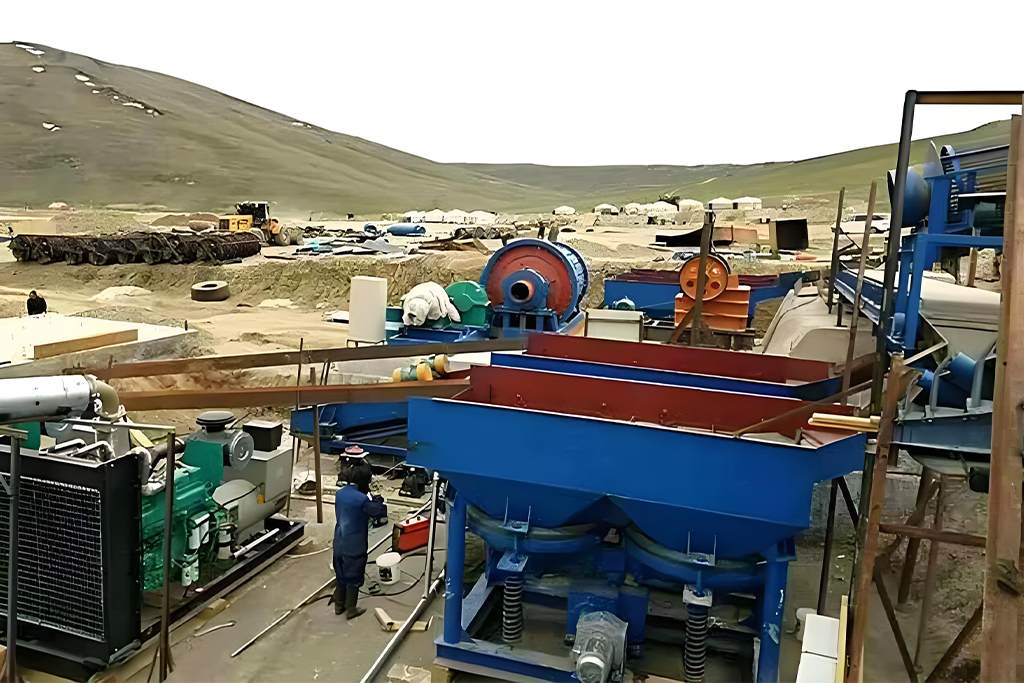
The jigging machine uses a diaphragm to create a vertical water pulse. This pulse lifts the material bed. Heavy gold settles faster than light sand during the downward cycle. Jigs handle a wide particle size range (1mm to 20mm) and are robust against surges in ore supply. They are ideal for the primary separation stage. The pulsating sluice box improves on the static sluice by adding a drive mechanism. This mechanism vibrates the floor or pulsates the water column. This movement keeps the black sand bed loose (fluidized). Gold particles can sink through the loose sand to the mat. Pulsating sluices work best on material smaller than 6mm. They produce a smaller volume of concentrate than jigs, which reduces the workload for the final cleanup stage.
Operational Comparison
[Jigging Machine]: Best for coarse gold (>2mm), high water usage, handles variable feed.
[Pulsating Sluice]: Best for fine gold (<2mm), lower water usage, requires steady feed.
Enhanced Gravity Concentration: Why is the Water Jacketed Centrifugal Concentrator a must-have weapon for fine gold recovery?
The Water Jacketed Centrifugal Concentrator is necessary for fine gold recovery because it generates a centrifugal force up to 60 times stronger than gravity. This force amplifies the weight difference between fine gold and sand, allowing the machine to capture micron-sized particles that standard gravity equipment loses.
Centrifugal concentrator process
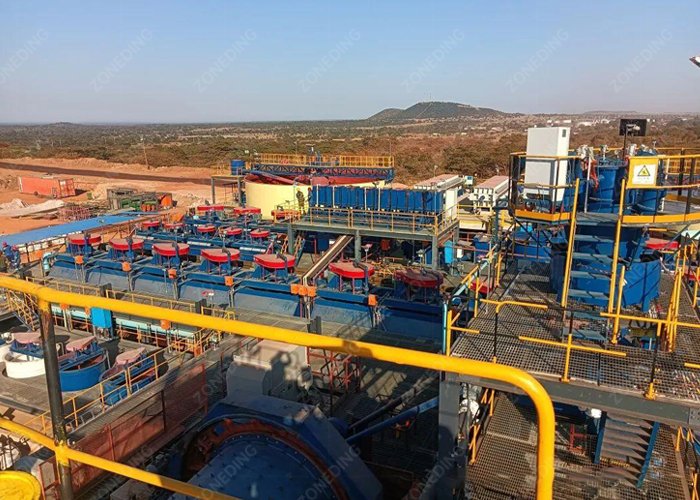
Centrifugal concentrator site
Fine gold (flour gold) has a small mass. In normal gravity (1G), water current easily washes it away. The Centrifugal Concentrator spins the ore at high speed. This pins the heavy gold against the bowl wall. The key feature is the fluidized water jacket. Water injects through small holes in the bowl wall from the outside. This back-pressure prevents the sand from packing solid. It keeps the bed active. Lighter sand flushes out, while the heavy gold overcomes the water pressure and stays in the riffles. You must filter the fluidization water to prevent clogging the small holes.
Essential Adjustments
[G-Force]: Higher speeds increase G-force for finer gold but require cleaner water.
[Back Pressure]: Adjust pressure until the discharged concentrate is loose, not packed hard.
[Feed Size]: Screen material to -2mm before feeding to avoid wear and blockage.
Refining and Purification: How does the 6-S Shaking Table separate high-purity gold concentrate from heavy sands?
The 6-S Shaking Table separates high-purity gold from heavy sands by using an asymmetrical reciprocating motion combined with a thin film of cross-flowing water. This creates a specific gravity separation where gold travels to the far end of the table while lighter sands wash down the side.
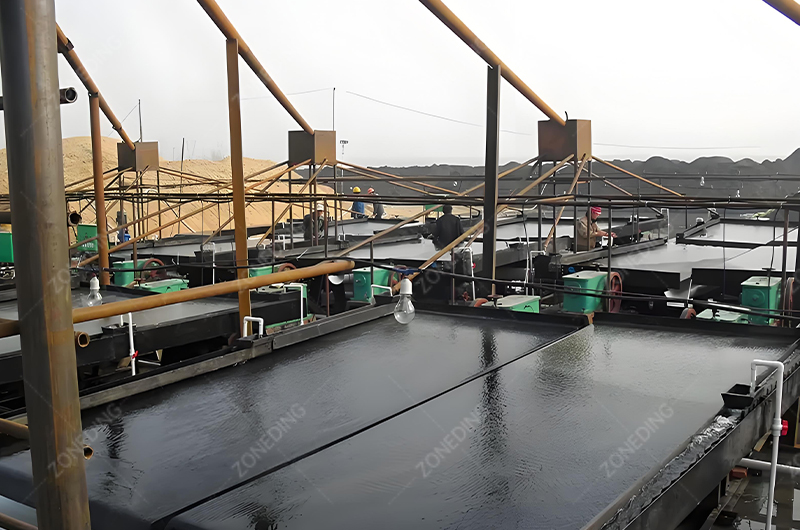
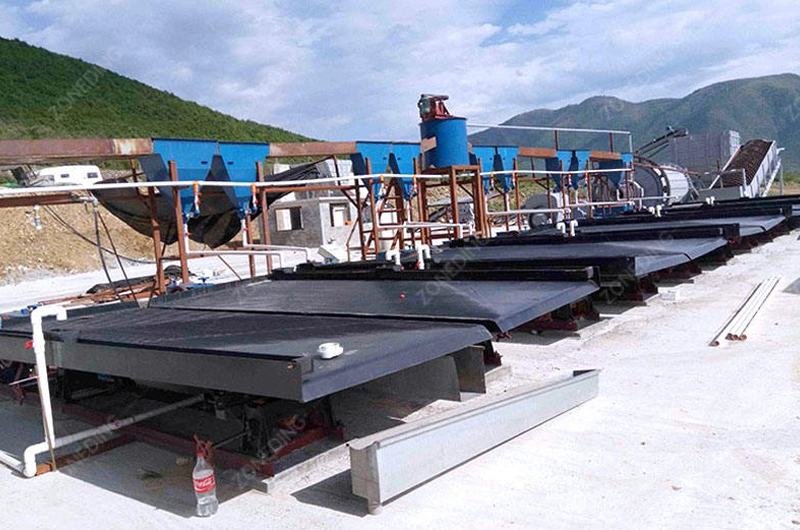
Gold recovery using a shaking table.
Gold recovery using a shaking table.
After roughing concentration, you have a mix of gold and black sand. The Shaking Table performs the final separation. The deck moves forward slowly and retracts quickly. This motion pushes heavy particles longitudinally along the riffles. Wash water flows across the deck. It washes the lighter sand over the riffles. Because gold has a specific gravity of 19.3 and black sand is around 5.0, they separate into distinct bands. You can see a clear line of yellow gold. Operators place splitters to collect the pure gold band directly. This method is physical and requires no chemicals.
Amalgamation and Smelting: How to safely and efficiently process gold concentrate into final ingots?
The safest and most efficient way to process gold concentrate is to avoid mercury amalgamation and use direct smelting of high-grade table concentrates. You use high-frequency induction furnaces or gas furnaces with flux to melt the gold and remove impurities as slag.
Mercury is toxic and illegal in many regions. Modern equipment like the shaking table produces a concentrate that is often 90% gold or higher. This grade allows for direct smelting. You mix the concentrate with fluxes like borax, sodium carbonate, and silica. The mixture goes into a crucible. The furnace heats the material to above 1064°C. The flux lowers the melting point and binds with the iron and sand impurities. These impurities float to the top as slag. The heavy molten gold settles at the bottom. You pour the liquid into a mold to form an ingot. For lower grade concentrates, chemical leaching in a controlled tank is a safer alternative to mercury.
Mobile Gold Stations: How to design modular production lines for remote and complex terrain?
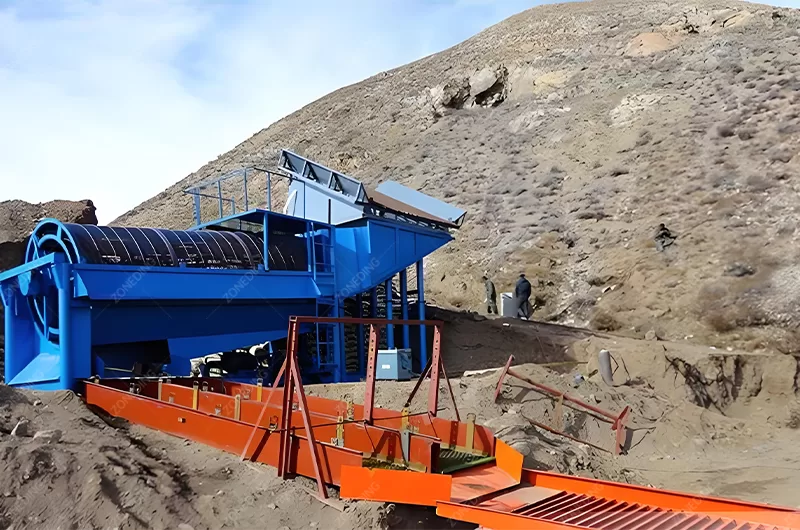
Designing mobile gold stations for remote terrain involves mounting independent washing, screening, and concentration modules on wheeled or skid-based chassis. This modular design allows you to move the plant with excavators as the mining face advances, reducing hauling costs.
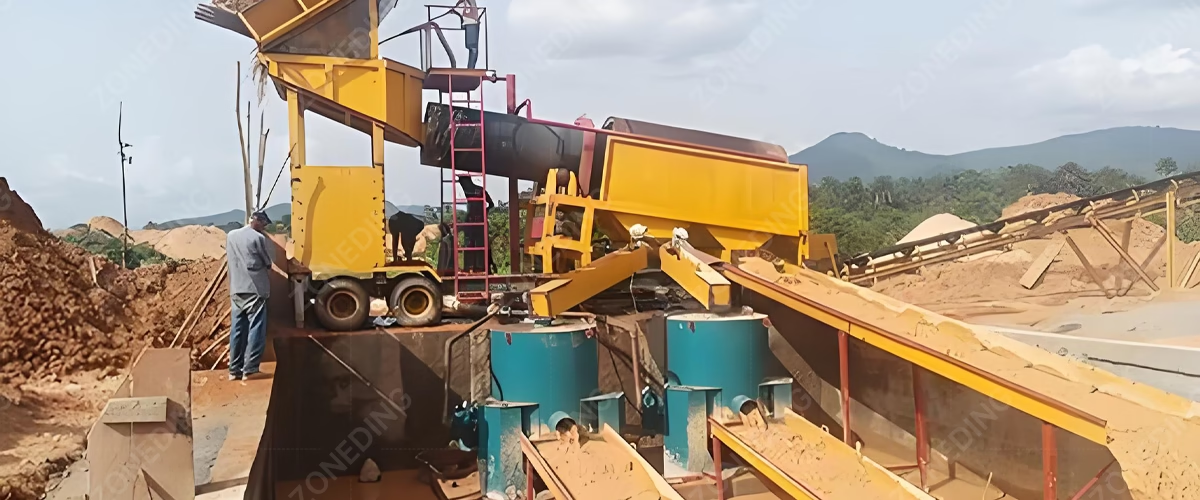
Mobile gold mining equipment
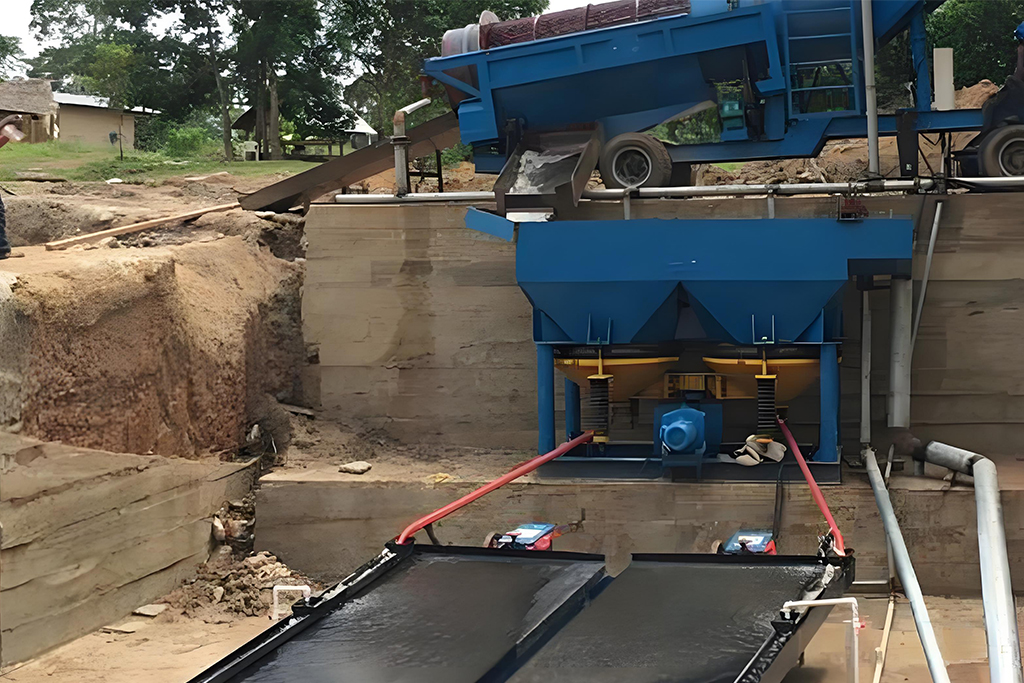
Remote placer deposits often lack infrastructure. A fixed plant increases truck transport costs. We design Mobile Crushing and Screening Plant concepts adapted for gold. Module one contains the hopper and trommel scrubber for washing. Module two holds the jigs or sluices for roughing. Module three is a secure container for the centrifugal concentrator and shaking table. Diesel generators power these units. When you finish mining one area, you disconnect the cables and hoses, and drag the units to the next site. This flexibility is essential for riverbed and alluvial mining.
Frequently Asked Questions
Question 1: Why is water clarity important for fine gold recovery? Turbid water has high viscosity and density. This prevents fine gold from settling effectively. You must use a settling pond or High Efficiency Concentrator to clarify water before recycling it. Question 2: What should I do with the black sand after removing the visible gold? Black sand often contains locked gold particles. You should grind the black sand in a Ball Mill to liberate the gold and then process it again on a shaking table. Question 3: Can I process hard rock gold with placer equipment? No. Hard rock gold requires crushing and grinding to release the gold from the quartz. Placer equipment is designed for free gold that is already liberated by nature. You need a Jaw Crusher for hard rock. Question 4: How often should I clean the sluice box? It depends on the amount of black sand. If the riffles pack with black sand, you lose gold. In high black sand areas, you may need to clean it every 2 hours. Question 5: What is the capacity of a mobile gold wash plant? Capacities vary by design. ZONEDING manufactures mobile units ranging from 10 tons per hour for small operations up to 200 tons per hour for large scale mining.
Summary and Recommendations
To increase placer gold recovery, you must upgrade from simple sluices to a system based on physical classification. Use a scrubber to wash clay. Classify material by size. Use jigs for coarse gold and centrifugal concentrators for fine gold. Finish with a shaking table for a chemical-free product. This equipment chain maximizes yield.
Do not rely on guesswork. Send a sample of your ore to ZONEDING. We will analyze the particle size distribution and washability. We will design a customized process to recover your fine gold.
About ZONEDING
ZONEDING is a mineral processing equipment manufacturer based in China. We have over 20 years of experience in designing gold recovery plants. We build everything from scrubbers and crushers to shaking tables in our 8000 square meter factory. We provide installation and technical support globally.
Contact ZONEDING today to discuss your gold mining project. Let us help you select the right equipment to stop gold loss and increase your profits.
High-yield tin ore recovery depends on a design that respects the brittle nature of cassiterite. Traditional plants often lose over 40% of metal because they grind the ore into useless dust. A scientific tin processing flow design i...
Many investors consider alluvial operations simple dirt-washing tasks. However, commercial-grade operations face severe technical challenges daily. A successful demands precise engineering to match the physical ore characteristics. This guide reve...
Chrome gravity separation represents the most cost-effective method to produce high-grade chrome in 2026. Experience in South Africa and Turkey proves that mineral density remains the strongest profit driver. This process uses the natural weight o...
We use cookies to ensure that we give you the best experience on our website. If you continue to use this site we will assume that you are happy with it.
Privacy Policy
Send us a message
We would love to hear from you
Submit your question and our team will respond to the email provided as soon as possible.
 Zoneding Machine