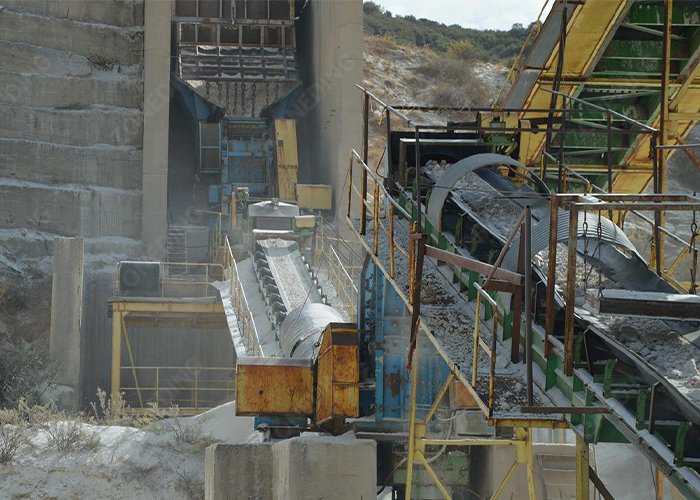
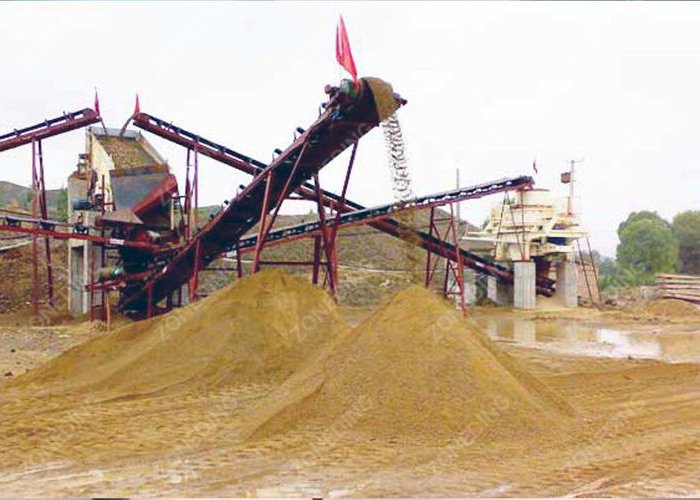
Choosing the right aggregate screen mesh size is essential for producing consistent stone sizes and maintaining efficient quarry operations. An unsuitable screen opening can allow oversized particles into finished products, increase recirculating loads, or reduce screening capacity.
However, the correct aperture is not determined by finished aggregate size alone. Feed gradation, particle shape, moisture, screen inclination, and screening media all influence separation performance.
For quarry operators, the challenge is to balance product accuracy, throughput, and screen service life without unnecessary equipment adjustments.
This guide explains how to select screen apertures, verify screening results, compare screening media, and prepare the information needed before ordering replacement screens or configuring a new aggregate production line.
Why Screen Mesh Size Matters in Aggregate Production
Screening separates crushed stone and natural aggregates into different size fractions. In a typical quarry, a vibrating screen receives material from the crushing circuit and classifies it according to the required product specifications.
Particles must reach the screening surface and encounter suitable openings before they can pass through. Therefore, even a correctly sized aperture may perform poorly when the screen is overloaded or the feed contains excessive near-size particles.
The consequences extend beyond the screening machine. Oversized particles can contaminate finished products, while usable material retained on the deck may return to the crusher unnecessarily. Both situations affect plant efficiency and product consistency.
A suitable screen opening should support three objectives: meeting the specified aggregate gradation, handling the required feed rate, and maintaining reliable operation under actual quarry conditions.
Before selecting an opening, buyers must understand how screen dimensions are specified.
Screen Mesh Size vs. Aperture Size: What Is the Difference?
Mesh count and aperture size describe different characteristics of screening media.
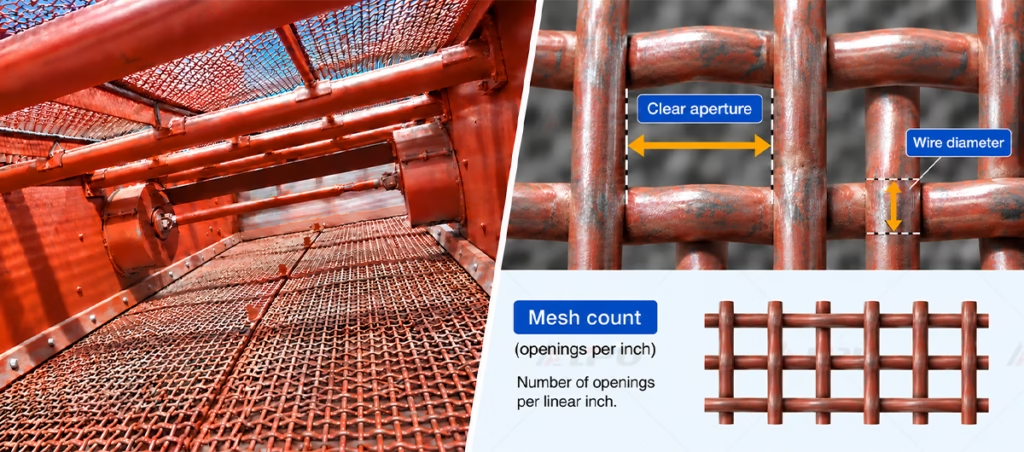
Mesh count generally indicates the number of openings per linear inch in woven wire material. Aperture size describes the clear opening available for particles to pass through.
For coarse aggregate screening, specifying the opening in millimeters is usually more practical than using mesh count alone.
Clear aperture, wire diameter, and mesh count are key factors when selecting woven wire screening media
Parameter
Meaning
Selection importance
Mesh count
Openings per linear inch
Common in woven wire specifications
Clear aperture
Actual opening between wires or panel edges
Defines nominal particle passage
Wire diameter
Thickness of screening wire
Affects strength and open area
Open area
Percentage of surface available for passage
Influences screening opportunity
Aperture shape
Square, rectangular, or slotted
Affects particle passage and plugging
Why Mesh Count Alone Is Not Enough
Two woven wire screens with the same mesh count may have different clear openings if their wire diameters differ.
Thicker wire can provide greater mechanical strength in suitable applications, but it also reduces the clear opening when the wire spacing remains unchanged. This creates a trade-off between durability and screening performance.
For example, requesting a 10 mm square aperture with a specified wire diameter and panel size is more informative than ordering by mesh count alone.
Buyers should also confirm the screening material, mounting arrangement, and compatibility with the existing screen deck.
How to Select Screen Aperture Based on Required Aggregate Sizes
Screen aperture selection should begin with the finished product specification rather than an assumed opening size.
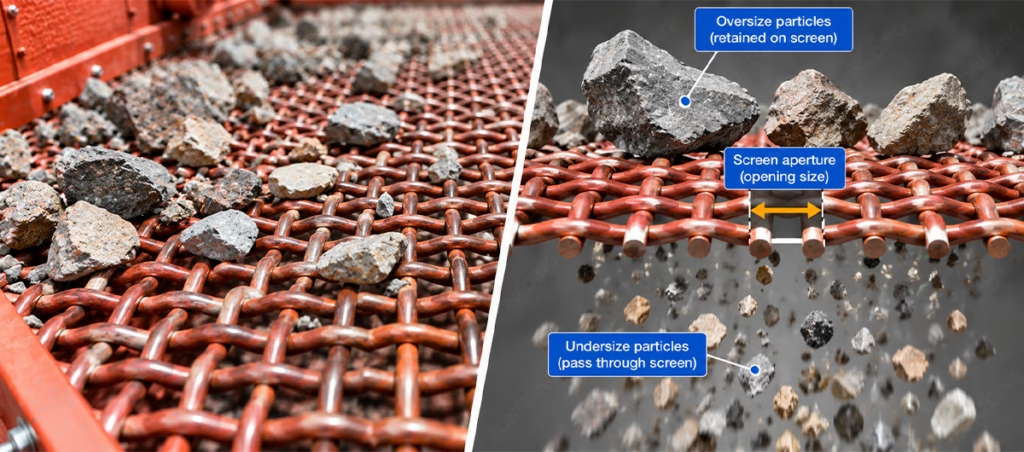
Screen openings separate particles by size, retaining larger material while allowing smaller particles to pass through
A practical process involves five steps.
Step 1: Define the required aggregate products. Identify the target size fractions, grading tolerances, and applicable customer specifications. Different construction applications may require different particle distributions.
Step 2: Analyze the feed gradation. A representative sieve analysis shows how much material falls within each particle size range. Pay particular attention to particles close to the intended separation boundary, as these can be more difficult to screen efficiently.
Step 3: Identify the screening duty. Determine whether the screen performs coarse scalping, intermediate classification, or final product sizing. Final sizing generally requires closer attention to grading accuracy.
Step 4: Select a preliminary aperture. Consider the product specification, particle shape, feed characteristics, screening media, and equipment arrangement. The nominal aperture should not automatically be treated as the effective separation cut size.
Step 5: Verify the result. Collect representative samples from the undersize and oversize streams. Compare the measured gradation with the required specification before deciding whether to adjust the screen opening or operating conditions.
Example: Selecting Screen Openings for Multiple Aggregate Fractions
Consider a hypothetical quarry producing four aggregate products:
Target product
Nominal size range
Fine aggregate
0–5 mm
Small aggregate
5–10 mm
Medium aggregate
10–20 mm
Coarse aggregate
20–40 mm
A multi-deck screening arrangement may separate these fractions using progressively smaller openings. Larger particles are retained on upper decks, while smaller material passes to subsequent separation stages.
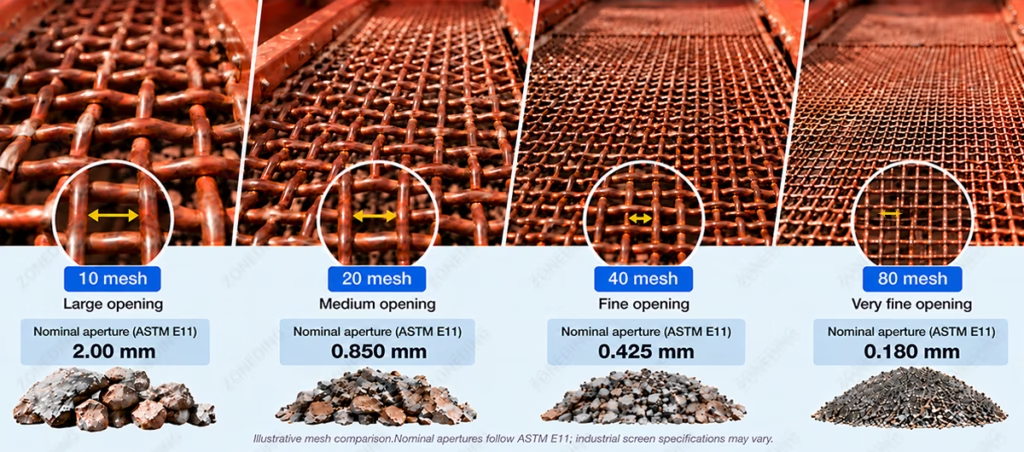
Comparison of 10–80 mesh screen sizes and nominal apertures
However, these product boundaries are not universal aperture recommendations. Actual openings must be selected and verified against the required grading standard.
Suppose a preliminary screen configuration produces excessive oversized particles in the 5–10 mm product. The operator should first confirm the sampling results and inspect the screen for damaged panels, incorrectly sized openings, or material bypassing the screening surface.
If the screen is intact, the next step is to examine particle shape, feed distribution, and operating conditions. A revised aperture may be necessary, but changing the opening without diagnosing the cause could reduce throughput or create a different grading problem.
Similarly, if excessive undersize material remains in the oversize stream, the operator should investigate near-size content, available screening area, and material residence time before increasing the opening.
This testing process helps buyers move from a preliminary screen specification to a configuration supported by actual product measurements.
The same aperture can perform differently when processing granite, basalt, limestone, river gravel, or manufactured sand. Material characteristics influence how particles move across the deck and interact with the openings.
Particle shape is particularly important. Cubical stones may pass through square apertures more predictably than flat or elongated particles, which can behave differently depending on their orientation.
Moisture and clay also affect screening. Damp fines may adhere to the surface, while sticky clay can form agglomerates that prevent smaller particles from separating effectively. In these conditions, changing aperture size alone may not solve the problem.
Feed gradation creates another challenge. A high proportion of near-size particles can increase the difficulty of separation because these particles may require repeated contact with the screen surface before passing through.
Near-Size Particles, Blinding, and Pegging
Two common problems are blinding and pegging.
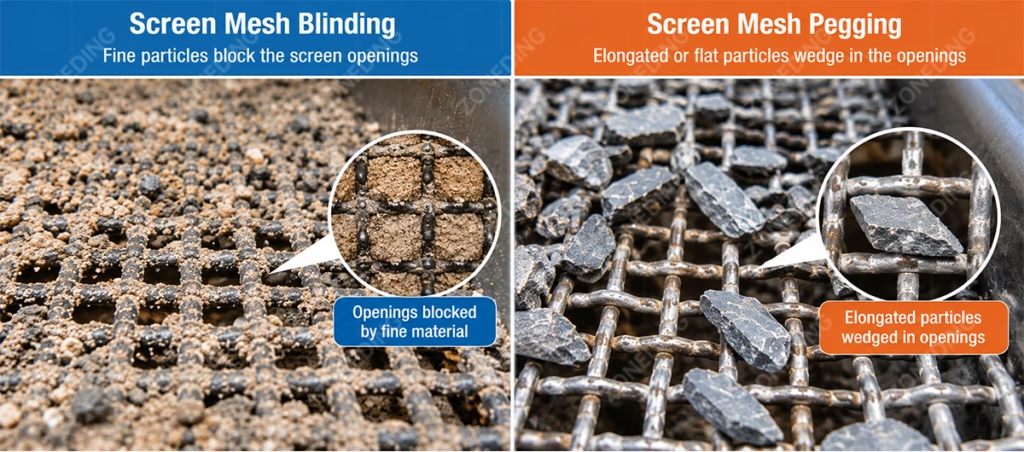
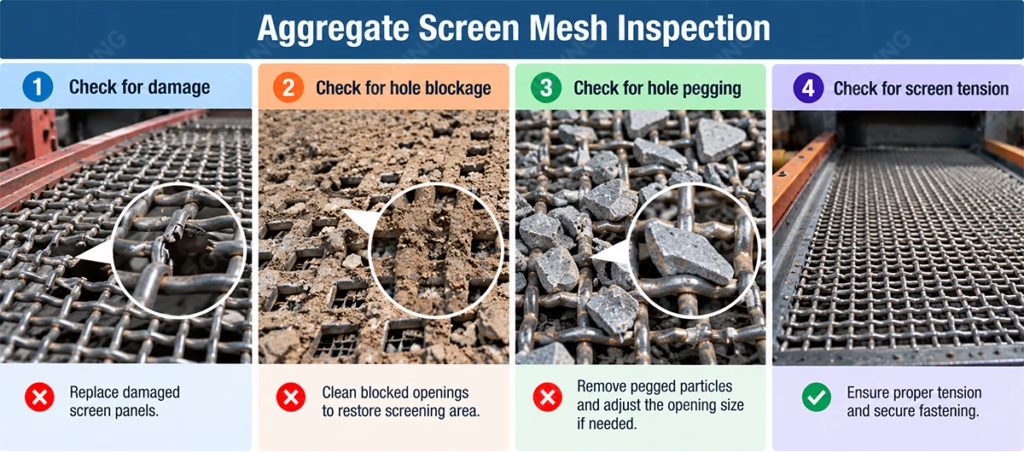
Blinding blocks screen openings with fine material, while pegging traps particles in individual apertures
Blinding occurs when fine, moist, or sticky material covers the openings. Pegging occurs when individual particles become wedged inside the apertures.
Although both reduce effective screening area, they require different investigations. Blinding calls for closer examination of moisture, clay, and fine-particle buildup. Pegging requires attention to particle shape, aperture design, and screen movement.
Depending on the application, flexible or self-cleaning screening media may help reduce these problems. Nevertheless, the appropriate solution should be based on the actual cause rather than a general assumption that larger openings are better.
Choosing Between Wire Mesh, Polyurethane, and Rubber Screens
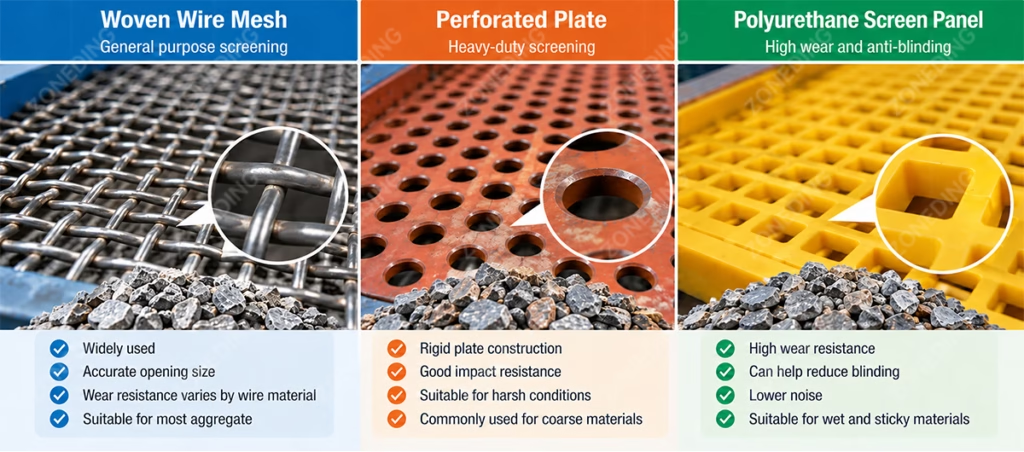
Screen media selection affects separation accuracy, wear resistance, and maintenance requirements. Woven wire mesh, polyurethane panels, and rubber screens are common options, but their suitability depends on the operating conditions.
Three common screen media types for different aggregate screening conditions
Screen media
Potential advantages
Main considerations
Woven wire mesh
High open area and precise aperture options
Wear, tensioning, and pegging
Polyurethane panels
Abrasion resistance and modular replacement options
Panel thickness and open area
Rubber screens
Impact absorption and flexibility
Suitability for required separation
Woven wire mesh is often suitable when high open area and accurate sizing are important. Different wire diameters allow buyers to balance strength with available screening openings.
Polyurethane panels may be useful in abrasive or wet screening applications. Some modular designs allow individual panels to be replaced, although thicker sections can reduce the effective open area.
Rubber screening media can provide impact resistance and flexibility in suitable applications. However, it is not automatically the best choice for fine or highly accurate separation.
The correct material should be selected by comparing product requirements, feed abrasion, impact conditions, available open area, and replacement arrangements.
How Screen Aperture Affects Capacity and Screening Efficiency
A larger screen opening may allow particles to pass more easily, but it can also reduce finished product accuracy. Conversely, a smaller opening may improve size control in some applications while restricting throughput.
This relationship means that aperture size must be evaluated together with the screen’s operating conditions.
Effective open area determines how much of the screening surface is available for particle passage. A strong panel with insufficient open area may limit performance, particularly when processing large quantities of near-size material.
Material bed depth also matters. If the feed layer becomes too thick, smaller particles may not reach the screening surface before leaving the deck. Uneven loading can create similar problems by overloading one section of the screen.
Screen inclination and vibration characteristics influence particle movement, stratification, and residence time. Any adjustments should remain within the manufacturer’s operating limits and be evaluated against the resulting product gradation.
For this reason, increasing throughput should not be the only performance target. The more useful measure is whether the screen can maintain the required capacity while consistently producing acceptable aggregate sizes.
Common Screen Mesh Selection Mistakes in Quarry Plants
Several avoidable mistakes can lead to unsuitable screen specifications or unnecessary replacement costs.
Ordering by mesh count alone. Without a clear aperture and wire diameter, the supplier may not receive enough information to match the required separation.
Assuming aperture size guarantees product gradation. Actual results must be confirmed through representative sampling and sieve analysis.
Increasing openings to solve capacity problems. Larger apertures may improve passage but can introduce unacceptable oversized material into finished products.
Ignoring installation requirements. Replacement panels must match the screen deck dimensions, tensioning arrangement, and mounting system.
Selecting media only by durability. A thicker panel may resist wear but reduce available open area or affect separation performance.
Overlooking changes in crusher discharge. Upstream crusher adjustments can change feed gradation and increase the proportion of difficult-to-screen particles.
These mistakes share one underlying problem: selecting the screening surface without considering the complete operating conditions.
A more reliable purchasing decision begins with accurate technical information.
What Information Should You Provide Before Ordering a Screen?
Whether purchasing replacement screen media or configuring a new aggregate plant, buyers should provide enough information for the supplier to evaluate the required separation and operating conditions.
Four essential screen mesh inspection checks to maintain screening efficiency
Required information
Details to provide
Raw material
Granite, basalt, limestone, river gravel, or other material
Maximum feed size
Largest expected particles
Feed gradation
Representative sieve analysis
Finished products
Target fractions and grading tolerances
Required capacity
Operating throughput in TPH
Moisture and clay
Dry, damp, wet, or sticky conditions
Screen equipment
Manufacturer, model, and number of decks
Panel dimensions
Length, width, thickness, and mounting details
Existing problems
Blinding, pegging, wear, or poor gradation
For an existing screen, photographs of the deck, worn panels, and discharged products can help explain the operating conditions. A new installation should also include the proposed process flow and equipment arrangement.
Buyers planning a complete stone crushing plant should specify the required aggregate fractions and total production capacity. Where mobility is important, a tracked mobile screening plant may be evaluated as part of the overall solution.
A concise inquiry can include the following information:
Sample RFQ: We are processing [material] with a maximum feed size of [mm] and a required capacity of [TPH]. Our target products are [size fractions]. The feed condition is [dry/wet/clay-rich], and our existing screen model is [model, if applicable]. Please recommend a suitable aperture, screening media, and equipment configuration.
Providing these details allows the supplier to evaluate the application before recommending a screen specification.
Frequently Asked Questions
1. What screen mesh size is best for aggregate production?
The correct size depends on the target aggregate gradation, feed characteristics, and screen configuration. Start with the product specification and verify the proposed aperture through representative screening tests.
2. Is screen aperture size the same as finished aggregate size?
Not necessarily. The aperture describes the physical opening, while actual separation also depends on particle shape, screen motion, inclination, and screening efficiency.
3. How does wire diameter affect screening performance?
For a fixed mesh count, thicker wire generally reduces the clear aperture and available open area. The correct diameter depends on the required strength, abrasion conditions, and separation accuracy.
4. Which screen media is better for abrasive aggregate?
Woven steel wire, polyurethane, and rubber may all be suitable in different conditions. Compare wear resistance, open area, maintenance requirements, and product specifications before selecting.
5. How can I reduce screen blinding and pegging?
Identify the cause first. Blinding is commonly associated with sticky fines covering openings, while pegging involves particles becoming trapped inside apertures. Appropriate solutions may include feed preparation, aperture adjustments, or alternative screening media.
Conclusion
Choosing the right aggregate screen mesh size requires a balance between product accuracy, screening capacity, and equipment reliability.
Begin with the required finished aggregate gradation and a representative feed analysis. Then select a preliminary aperture, evaluate the screening media, and verify performance through actual product sampling.
For quarry operators and equipment buyers, this approach supports more consistent screening results and better-informed purchasing decisions.
Contact ZONEDING to discuss your aggregate screening requirements and request an equipment recommendation based on your project details.
Potassium feldspar is an important industrial mineral widely used in ceramics, glass manufacturing, construction materials, and chemical industries. Before potassium feldspar can be used in these applications, it must first be crushed into suitabl...
The construction industry relies on seven distinct types of sand to ensure structural integrity and finish quality. However, natural river sand is becoming scarce and expensive due to environmental regulations. For aggregate producers, the real op...
We use cookies to ensure that we give you the best experience on our website. If you continue to use this site we will assume that you are happy with it.
Privacy Policy
Send us a message
We would love to hear from you
Submit your question and our team will respond to the email provided as soon as possible.
 Zoneding Machine