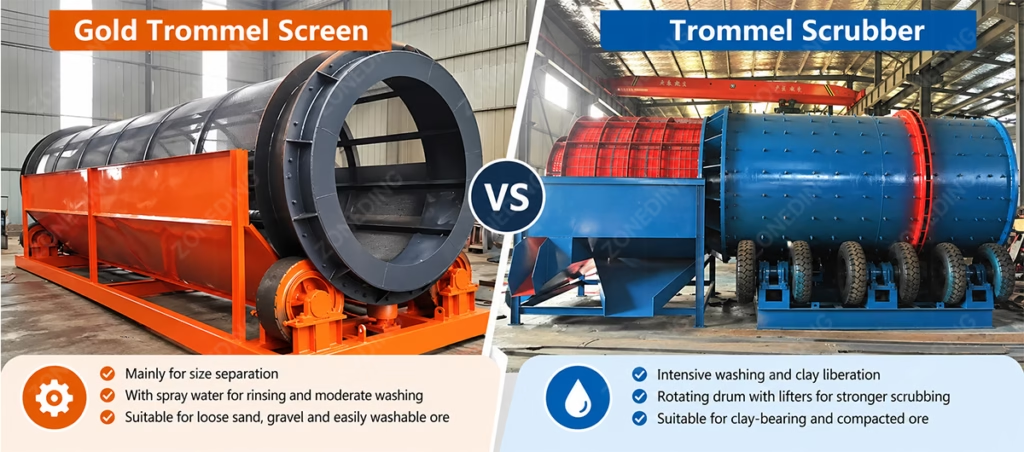
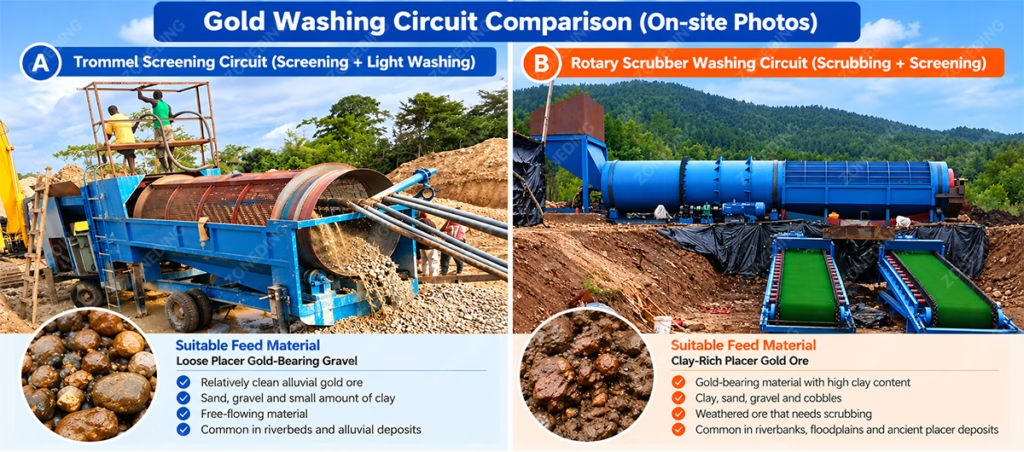
A gold trommel and a trommel scrubber may look similar, but they do not always perform the same job.
Both machines use rotating drums, and both can work with water. However, a gold trommel primarily separates material by size, while a trommel scrubber provides more intensive washing to remove suitable clay and dirt from ore.
For placer gold projects, the choice depends on how the material behaves during washing.
Loose sand and gravel may need only wet screening. Meanwhile, compacted clay or coated stones may require additional scrubbing before the material reaches downstream recovery equipment.
Choosing the wrong machine can leave valuable material trapped in clay, overload the screening stage, or introduce unnecessary operating costs.
This guide compares the two equipment options and explains when a combined washing and screening arrangement makes more sense.
The main difference between a gold trommel and a trommel scrubber is the duty performed inside the drum.
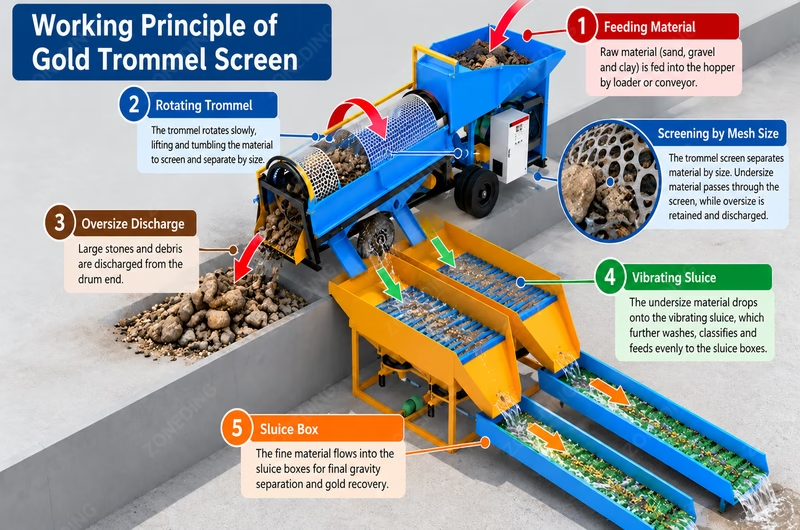
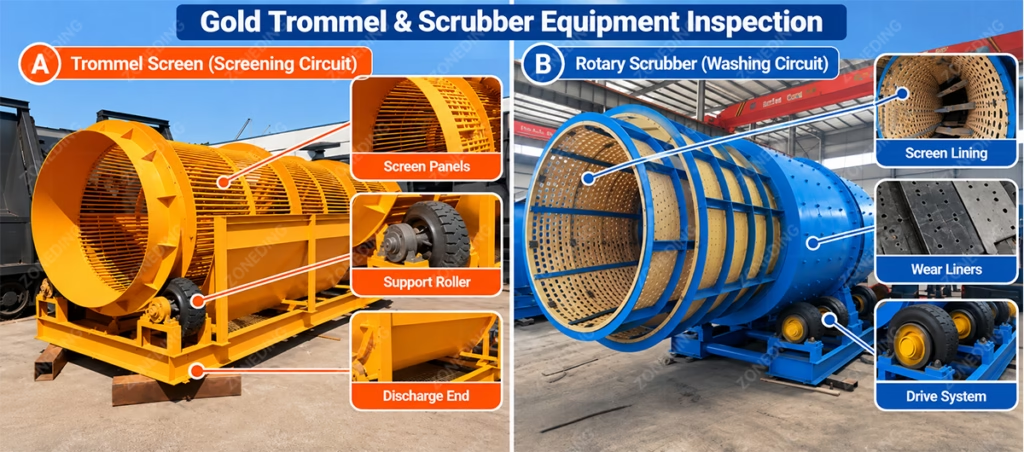
A gold trommel screen separates particles through perforated panels or screening sections. Smaller material passes through the openings, while larger stones move toward the discharge.
Water sprays can rinse material and help loosen dirt. Therefore, a wet trommel may also perform some washing.
However, its ability to break down clay depends on the drum design, water distribution, material behavior, and residence time.
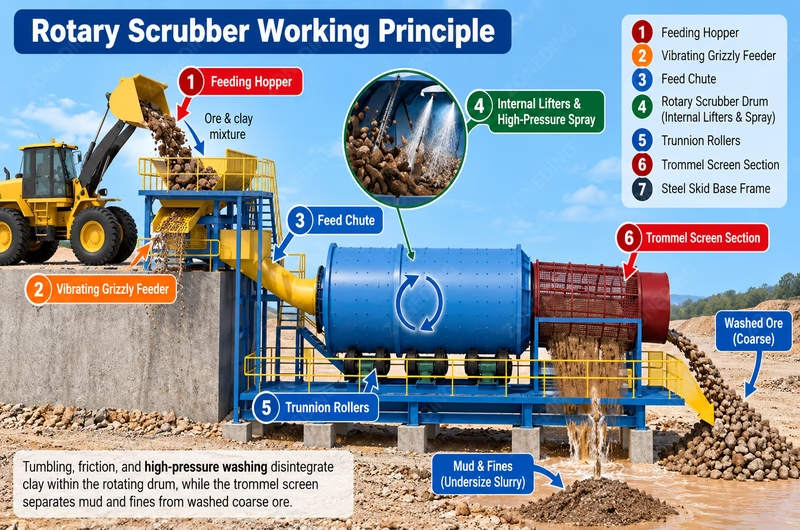
A trommel scrubber uses a rotating washing chamber to tumble the feed and promote contact between particles.
Internal lifters and controlled retention time may help release suitable clay coatings and break down dispersible lumps.
Some scrubbers include an integrated screening section. Others discharge into a separate screen.
Comparison
Gold trommel screen
Trommel scrubber
Main duty
Particle size separation
Intensive washing and clay liberation
Washing action
Rinsing and moderate agitation
Stronger tumbling and scrubbing
Suitable feed
Loose, readily washable material
Material requiring additional washing
Clay handling
Depends on clay washability
Suitable for some cohesive, dispersible clay
Screening
Primary function
Integrated or separate screening
Design priority
Screen cut and screening capacity
Washability, retention time, and capacity
Equipment complexity
Often simpler
May require additional wear protection and process control
These differences are useful, but equipment names alone can be misleading.
Some manufacturers describe a combined scrubber-screen as a gold trommel wash plant. Others use the term rotary washing trommel for equipment that performs both functions.
Before comparing quotations, request a drawing that clearly identifies the washing chamber, screen section, internal lifters, and discharge arrangement.
Which Machine Handles Different Gold Ore Conditions?
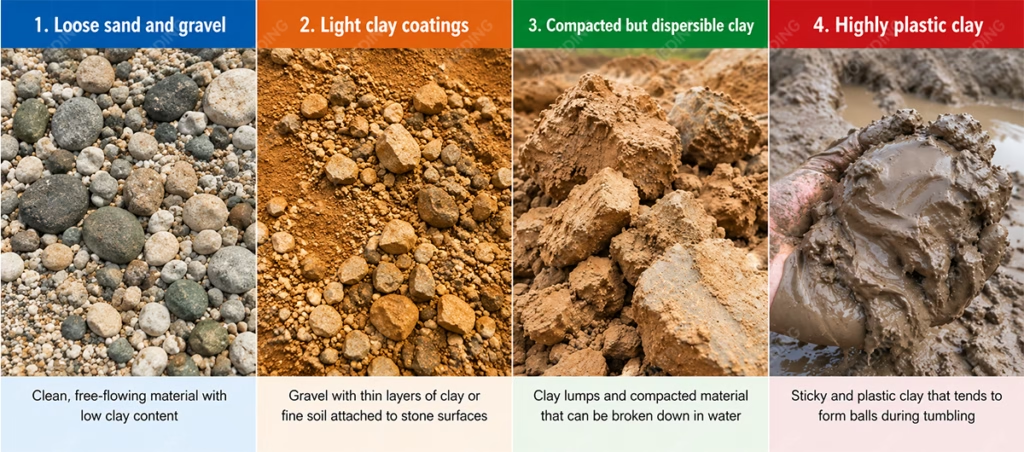
Equipment selection becomes easier when the feed material is divided into practical washing conditions.
The table below provides an initial decision framework.
Ore condition
Preferred starting option
Main reason
What must be verified
Clean alluvial sand and gravel
Wet gold trommel
Screening is the main requirement
Capacity and screen cut
Loose gravel with easily dispersed silt
Wet gold trommel
Spray washing may be sufficient
Washing test
Gravel with moderate clay coatings
Wet trommel or scrubber-screen
Washing intensity depends on adhesion
Coating removal
Compacted, dispersible clay lumps
Trommel scrubber
Additional tumbling may release trapped material
Scrubbing trial
Highly plastic, ball-forming clay
Further testwork
Conventional tumbling may be ineffective
Alternative washing assessment
Mixed large stones and clay-bearing sand
Scrubber with screening
Washing and sizing may require different conditions
Feed top size and separation targets
Variable feed with changing clay behavior
Engineered washing circuit
One operating condition may not suit all ore types
Testing across representative samples
These recommendations are starting points rather than guaranteed equipment selections.
A suitable machine must handle the maximum feed size, required dry-solids throughput, clay behavior, and downstream particle size requirements.
For example, a placer operation processing loose river gravel may use a wet trommel followed by appropriate gravity recovery equipment.
A deposit containing compacted but washable clay may need a dedicated scrubber and screening section.
By contrast, a highly plastic clay deposit should not be assigned to either machine without additional testing.
How to compare ore samples before choosing
Collect representative material from the main mining zones rather than relying on one easily washed sample. Include both typical feed and the most difficult clay-bearing material expected during operation.
First, examine whether the feed breaks apart in water with gentle agitation. Then compare the results with a controlled washing trial using stronger tumbling.
Record whether clay coatings disappear, compacted lumps remain, or sticky material forms new balls. Also examine the oversize and washed fractions for potentially gold-bearing material.
The trial should establish whether additional scrubbing produces a meaningful improvement over wet screening alone.
For variable deposits, evaluate several representative samples. A machine selected for the easiest material may struggle when mining reaches a clay-rich zone.
Practical selection rule: If washing performance is uncertain, conduct a test before committing to equipment size or configuration.
Washing and screening are related, but they solve different problems.
Screening separates particles according to size. Washing removes attached or agglomerated material so that the particles can be classified more effectively.
A trommel may provide good screening while leaving some clay lumps intact.
Similarly, a scrubber may release clay effectively but still require screening to separate the washed material into useful size fractions.
Working principle of Trommel screen
Rotary Scrubber Working Principle
Screening Efficiency and Screen Opening
For a gold trommel, screen opening is one of the most important design parameters.
It determines which particles pass through the screening section and which leave as oversize.
However, performance also depends on screen open area, feed rate, drum speed, inclination, moisture, and the amount of near-size material.
Smaller openings do not automatically improve gold recovery.
An opening that is too small for the intended duty may increase blinding or overload the screen.
An opening that is too large may allow unwanted coarse material to reach downstream equipment.
The correct screen cut should reflect the feed particle size distribution and the requirements of the next processing stage.
Scrubbing Intensity and Residence Time
A trommel scrubber must provide enough washing action to release suitable clay and coatings.
Important factors include drum geometry, internal lifters, rotational speed, solids loading, water addition, and residence time.
More aggressive scrubbing is not always better.
Excessive agitation may increase wear, generate additional fines, or worsen ball formation in highly plastic clay.
A representative washing test should determine whether the ore responds to scrubbing and how much treatment is needed.
How Do Capacity, Water, and Power Requirements Differ?
A machine’s advertised throughput is not enough to determine whether it suits a placer gold project.
The same equipment may handle different capacities depending on feed size, clay behavior, moisture, and required washing quality.
A trommel selected for clean gravel may operate differently when handling sticky material.
Likewise, a scrubber may need longer residence time when clay is difficult to disperse.
Capacity must be evaluated at the required washing and screening performance, not only at maximum feed rate.
When requesting a quotation, specify whether the capacity refers to dry solids or wet feed.
Also provide the maximum feed size, particle size distribution, and expected changes in ore characteristics.
Water requirements
Both wet trommels and scrubbers may require process water.
Actual demand depends on washing intensity, solids concentration, screen rinsing, and downstream processing.
A scrubber with an integrated screen may use water for both washing and rinsing.
However, it would be incorrect to claim that every scrubber consumes more water than every trommel.
Water recycling, settling capacity, and site availability should be considered alongside the equipment.
Power and maintenance
Scrubbers may require additional mechanical energy to achieve the intended washing action.
However, installed motor power alone does not establish actual energy consumption per ton.
Ask suppliers to explain the operating conditions used for their power and capacity estimates.
Also compare liners, screen panels, support rollers, drive components, lubrication requirements, and maintenance access.
The lowest equipment price does not necessarily represent the most suitable long-term option.
How Does Equipment Choice Affect Downstream Gold Recovery?
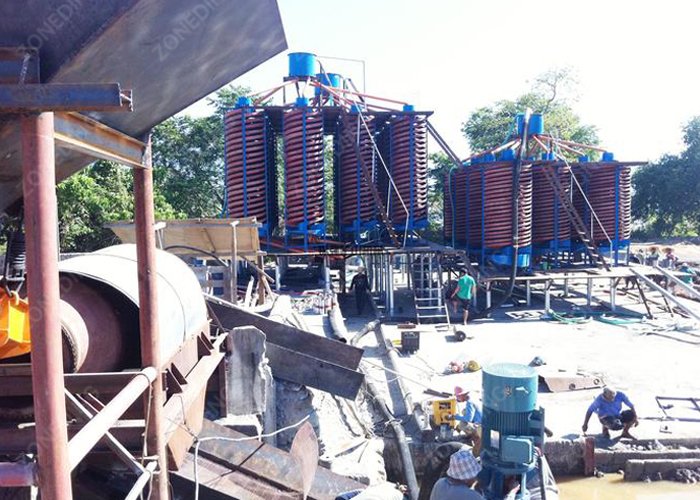
Washing and screening prepare material for downstream gold recovery.
Different feed conditions may require screening alone or additional washing before gravity recovery
If gold-bearing particles remain trapped in clay lumps, they may not reach the intended gravity separation stage in a suitable form.
For example, clay aggregates may leave as oversize even though they contain smaller gold-bearing particles.
Where testing confirms this problem, additional washing may improve material liberation before screening.
However, improved washing does not guarantee higher gold recovery.
Actual recovery depends on gold particle size, liberation, process configuration, and operating conditions.
More intensive washing can also release additional fines and suspended clay into the slurry.
This may increase the load on downstream classification, settling, and water treatment systems.
Therefore, the objective is not simply to remove the maximum amount of clay.
It is to prepare a suitable feed for the next recovery stage without creating unnecessary process problems.
What Should Buyers Check Before Requesting a Quote?
A useful equipment quotation requires more than a target capacity.
The supplier must understand the ore, washing objective, site conditions, and downstream process.
Prepare the following information before requesting a machine recommendation.
Required information
Why it matters
Ore type and deposit description
Defines the washing application
Dry TPH
Establishes the required dry-solids throughput
Feed Top Size
Determines acceptable maximum feed dimensions
Feed particle size distribution
Supports drum and screen selection
Clay Washability
Indicates whether intensive scrubbing is necessary
Gold particle size and occurrence
Supports downstream recovery planning
Screen Cut
Defines the required screening separation
Available process water
Supports washing and water balance design
Operating hours
Helps define equipment duty
Site power and installation conditions
Supports drive and layout selection
Existing recovery equipment
Helps ensure process compatibility
Representative ore samples
Reduces uncertainty in equipment selection
For clay-bearing deposits, collect samples representing both typical material and the most difficult expected washing conditions.
A useful washing trial should assess:
How quickly clay disperses in water
Whether compacted lumps break apart
Whether sticky clay forms larger balls
How much fine material is released
Whether gold-bearing particles remain in rejected fractions
Whether the washed material meets downstream screening requirements
The purpose is to determine the washing duty before selecting the equipment.
What makes two equipment quotations comparable?
Two suppliers may quote machines with similar nominal capacities but very different washing arrangements.
Buyers should examine washing components, screening arrangements, and maintenance access before ordering
One quotation may include only a screening drum and spray bars. Another may include a dedicated scrubbing chamber, an integrated screen, and additional wear protection.
Before comparing prices, confirm that both proposals address the same ore conditions and processing requirements.
Ask each supplier to state the feed characteristics used for sizing, the assumed operating capacity, and whether the quoted system includes necessary screening and discharge equipment.
Check which components are included in the scope of supply. Motors, pumps, screen panels, control systems, support structures, and spare parts should be clearly identified rather than assumed.
Finally, review the installation and maintenance requirements. A compact integrated machine may simplify the layout, while separate units may provide more operational flexibility.
The correct quotation comparison considers the complete washing duty, not just the machine purchase price.
For a broader view of placer mining equipment arrangements, see Placer Gold Mining.
Which Machine Should You Choose for Your Gold Wash Plant?
The final choice depends on the ore’s washing requirements and the role of the machine within the complete process.
A wet gold trommel is often the simpler starting point when the feed is loose, readily washable, and mainly requires size separation.
A trommel scrubber becomes more relevant when suitable clay aggregates or coatings require additional tumbling and washing.
An integrated scrubber-screen may suit projects where washing and rough screening can be completed in one machine.
Separate scrubbing and screening stages may offer more flexibility when washing residence time and screen cut requirements differ.
For highly sticky or plastic clay, further testing should come before equipment selection.
Main project requirement
Recommended starting point
Screen loose placer gravel
Wet gold trommel
Remove easily dispersed dirt
Wet trommel, subject to testing
Break down suitable compacted clay lumps
Trommel scrubber
Combine washing and rough screening
Integrated scrubber-screen
Perform intensive washing and precise screening
Separate scrubber and screen
Treat highly plastic clay
Additional testing and alternative washing assessment
For a complete equipment arrangement, review ZONEDING’s Gold Wash Plant page.
For placer projects in Peru and other mining regions, local ore characteristics should guide the selection.
A machine that performs well with loose river gravel may not be suitable for compacted clay-bearing deposits.
The best choice is the configuration that consistently prepares material for downstream recovery under realistic operating conditions.
Frequently Asked Questions
Is a gold trommel the same as a trommel scrubber?
No. A gold trommel primarily screens material by size, while a trommel scrubber is designed for more intensive washing. Some machines combine both functions, so buyers should examine the actual drum configuration.
Can a gold trommel wash clay-rich placer ore?
A wet trommel may remove easily dispersed clay and dirt. Compacted or sticky clay may require additional treatment. Representative washing tests are needed to determine whether screening and spray water are sufficient.
Is a trommel scrubber always better for sticky clay?
No. Highly plastic clay can form larger balls during tumbling instead of breaking apart. Alternative washing methods may be necessary.
Does a trommel scrubber improve gold recovery?
It may improve material preparation when gold-bearing particles are trapped in washable clay aggregates. However, recovery depends on liberation, downstream equipment, and the complete process. Improvements should be verified through testing.
Should I choose an integrated scrubber-screen or separate machines?
An integrated machine may suit projects where washing and rough screening can be handled together. Separate machines may provide more flexibility when washing residence time and screening requirements differ.
A jaw crusher is the heavy-duty gatekeeper of most mining and aggregate production lines. This primary rock crusher uses high pressure to break large boulders into smaller, manageable pieces. It is the first machine in a crushing plant. Most opera...
Chrome gravity separation represents the most cost-effective method to produce high-grade chrome in 2026. Experience in South Africa and Turkey proves that mineral density remains the strongest profit driver. This process uses the natural weight o...
Many investors consider gold cyanidation extraction a simple chemical reaction. Commercial-grade operations face severe mechanical and metallurgical challenges daily. A successful plant demands precise engineering to match the specific ore chemist...
We use cookies to ensure that we give you the best experience on our website. If you continue to use this site we will assume that you are happy with it.
Privacy Policy
Send us a message
We would love to hear from you
Submit your question and our team will respond to the email provided as soon as possible.
 Zoneding Machine