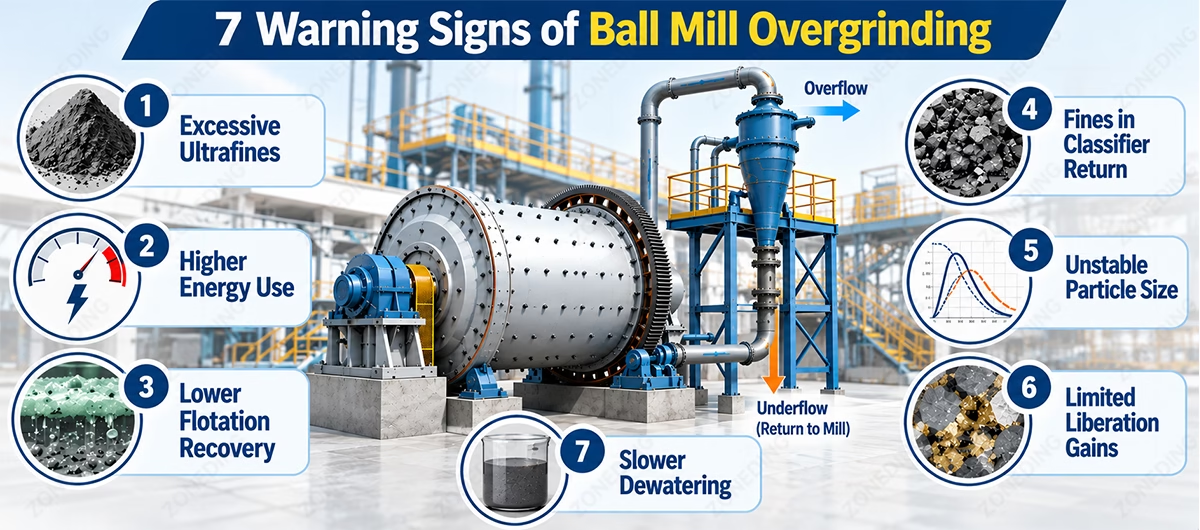
A ball mill can meet its target P80 and still produce more ultrafine particles than a mineral processing plant needs. These unwanted fines may increase energy consumption, complicate classification, and affect downstream mineral recovery.
However, fine grinding is not always overgrinding. Some ores require smaller particles to release valuable minerals from gangue. The problem begins when additional grinding provides little useful liberation or creates particles that are difficult to recover.
Several factors can contribute to this condition, including grinding media, feed characteristics, residence time, classification, and slurry conditions.
This guide explains seven common causes of excessive fines, how to diagnose them using plant data, and when operating adjustments or equipment upgrades may be necessary.
How to Tell If a Ball Mill Is Producing Excessive Fines
Before adjusting the mill, determine whether the fine fraction is genuinely excessive.
P80 represents the particle size below which 80% of the measured material passes. Although useful for describing grinding performance, it does not show the complete particle size distribution (PSD).
Two grinding circuits may achieve similar P80 values while producing different amounts of ultrafine material. Therefore, operators should compare the full PSD with mineral liberation requirements and downstream recovery performance.
Potential overgrinding indicators should be verified through particle size analysis and operating data
Check Particle Size Distribution, Not Just P80
Collect representative samples from the mill discharge and final classified product.
Compare the percentage passing several relevant particle-size limits. The most important fine-size threshold depends on the ore and processing method.
For example, a finer product may be beneficial when valuable minerals remain locked in larger particles. In another ore, the same additional grinding may increase energy consumption without improving recovery.
A useful diagnostic comparison considers three questions: Has the fine fraction increased? Has valuable-mineral liberation improved? Has downstream recovery changed?
If fines increase without a meaningful processing benefit, unnecessary grinding becomes a reasonable concern.
Compare Grinding Fineness With Mineral Liberation
Mineral liberation determines whether additional grinding is useful.
If valuable minerals remain attached to gangue, finer grinding may improve separation. Once sufficient liberation is achieved, further size reduction may offer limited benefits.
Mineralogical analysis and recovery testing can help identify the appropriate grinding range.
The objective is not simply to minimize fines. It is to produce a particle size distribution that supports efficient downstream processing.
Seven Common Causes of Excessive Fines in Ball Mills
Excessive fines rarely result from a single operating problem. Several conditions may interact, making diagnosis more difficult.
The following seven causes provide a practical starting point.
Possible cause
What to investigate
Potential adjustment
Low or unstable feed rate
Feed fluctuations and mill loading
Stabilize feeding
Unsuitable grinding media
Ball sizes, wear, and charge distribution
Review media selection
Excessive effective grinding time
Material retention and discharge
Investigate residence time
Changing ore characteristics
Hardness, feed size, and liberation
Reassess operating conditions
Poor classification
Fine particles returning to the mill
Improve separation efficiency
Unsuitable slurry conditions
Solids concentration and flow behavior
Review water balance
Unstable mill operation
Power, loading, and operating changes
Improve process control
Feed Rate, Residence Time, and Ore Characteristics
A reduction in fresh feed can change mill loading and the grinding energy applied per unit of material.
Under some operating conditions, this may shift the product toward finer sizes. However, lower feed does not always cause overgrinding.
Residence time is another important factor. Particles that remain in the grinding environment longer than necessary may receive additional breakage.
Ore characteristics also influence grinding behavior. Changes in hardness, mineral texture, or feed size distribution can alter the product even when equipment settings remain similar.
Grinding media transfer energy to ore particles through impact and abrasion.
An unsuitable media charge may reduce effective coarse-particle breakage or change the amount of fine material produced.
Mill loading, media wear, and operating speed can also affect grinding behavior.
Operators should examine these variables together rather than assuming that one setting is responsible.
Classification and Slurry Conditions
Classification determines which particles leave a closed grinding circuit and which return for further grinding.
If sufficiently fine material repeatedly returns to the mill, it may undergo unnecessary additional breakage.
Meanwhile, slurry density and water addition affect material transport and classification behavior.
Neither adding more water nor increasing circulating load should be treated as a universal solution.
How Ball Size and Mill Loading Affect Fine Particle Generation
Grinding media selection should reflect feed size, ore characteristics, and the required product size.
Larger balls generally provide stronger impacts for breaking coarse particles. Smaller media can provide more contact opportunities and may be suitable for finer grinding duties.
However, smaller balls do not automatically cause excessive fines.
The result depends on the complete media size distribution, mill loading, feed characteristics, and operating conditions.
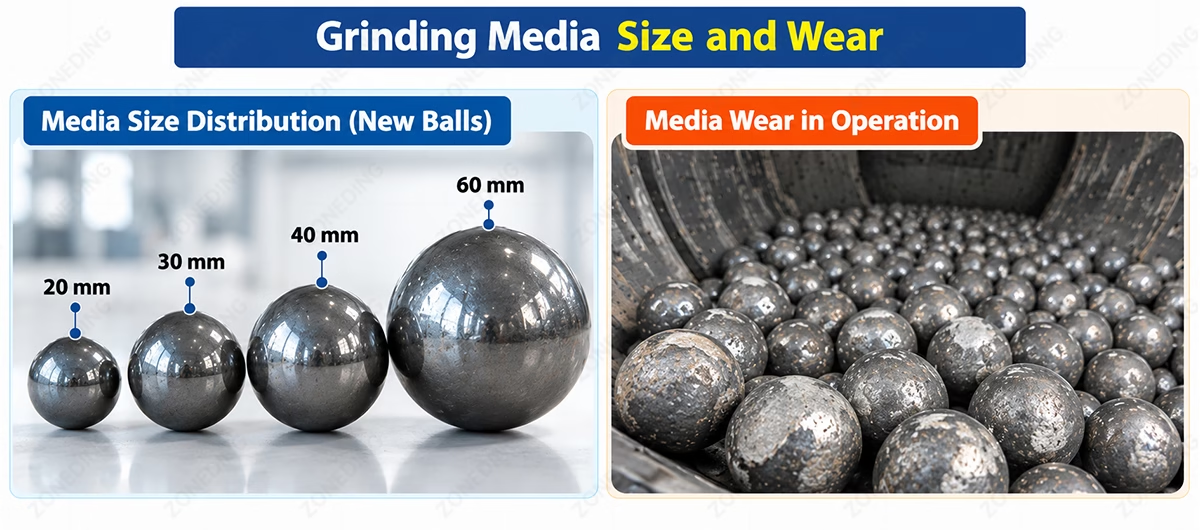
Grinding media size distribution and wear influence breakage behavior and particle size control
Review Grinding Media Size and Wear
As grinding balls wear, the media size distribution gradually changes.
If the charging strategy does not maintain a suitable balance, the mill may operate differently from its intended conditions.
Operators should inspect media wear, review ball additions, and compare the existing charge with current grinding requirements.
An excessive accumulation of worn media may indicate that charging and removal practices need attention.
However, the correct response is not always to replace smaller balls with larger ones. Media selection must consider the particle sizes that require breakage.
Mill loading should also be checked. An unsuitable charge level can change particle movement and grinding efficiency.
Any media adjustment should be evaluated against throughput, product PSD, and energy consumption. For broader selection principles, refer to the site’s grinding media guidance after confirming its current published URL.
How Classification Problems Lead to Overgrinding
Classification problems can contribute to overgrinding when particles that already meet the required size return to the mill.
This issue should not be confused with circulating load alone.
A circuit may operate with a relatively high circulating load without producing excessive ultrafines. Conversely, inefficient classification can return misplaced fine particles even when the overall circulating load appears acceptable.
The key question is whether the classifier removes suitably fine material efficiently.
For hydrocyclone circuits, operators should examine feed pressure, slurry density, overflow and underflow PSD, and equipment condition.
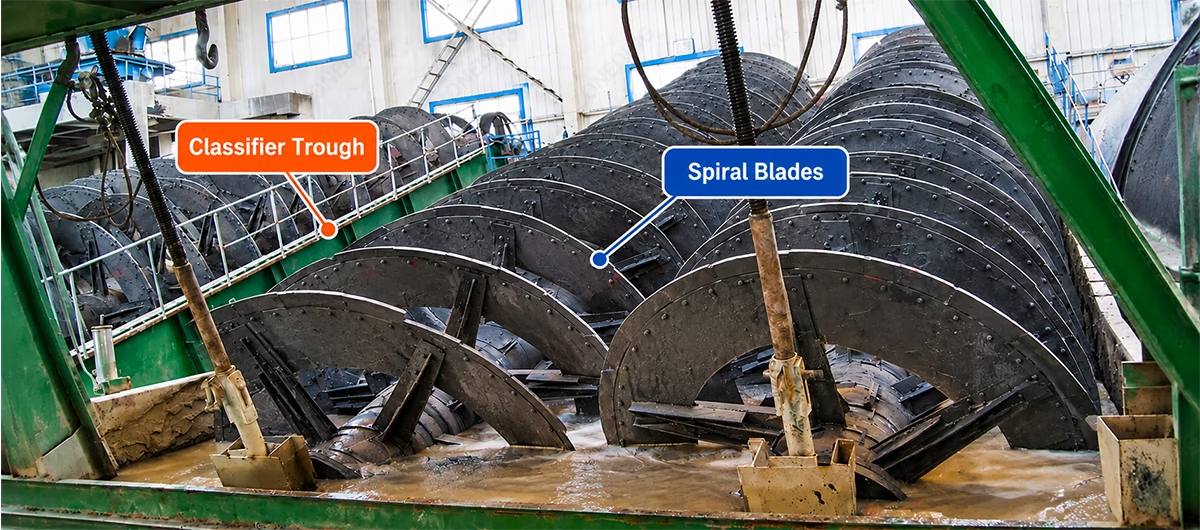
For spiral classifiers, useful checks include overflow characteristics, return-sand size distribution, water conditions, and mechanical operation.
These classifiers operate differently, so their settings should not be treated as interchangeable.
Improving classification may reduce unnecessary fine-particle return while maintaining the required product size and throughput.
How to Diagnose Excessive Fines Using Plant Operating Data
Reliable troubleshooting begins with measurements rather than immediate equipment adjustments.
Before changing grinding media or water addition, establish a stable operating baseline.
Useful measurements include fresh feed rate, feed PSD, mill discharge size, classifier overflow size, return-stream size, slurry density, and available power data.
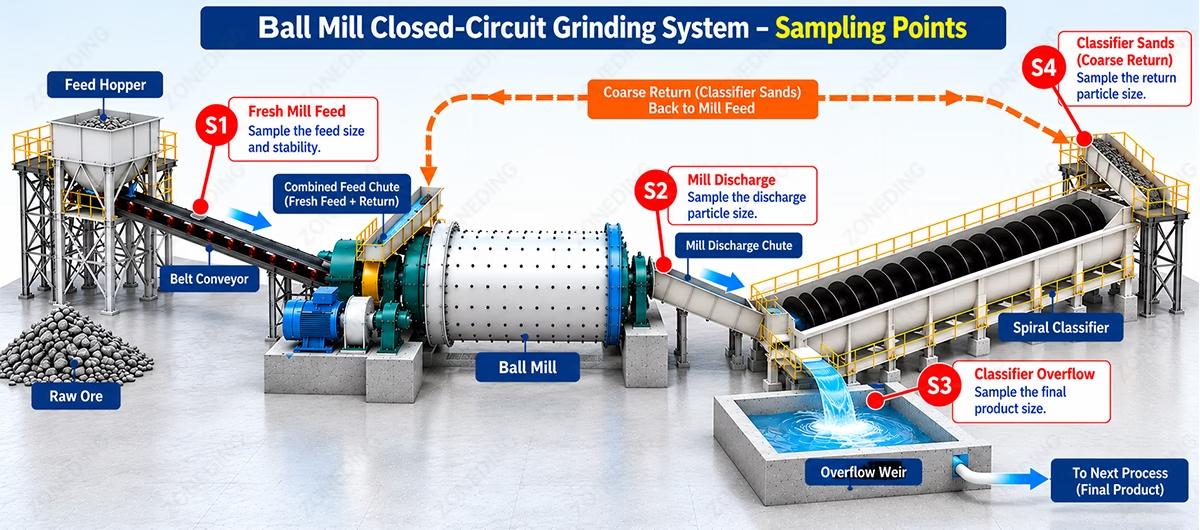
Sampling points at the mill feed, discharge, classifier overflow, and coarse return help identify grinding and classification problems
Sample the Right Locations
A typical closed-circuit grinding system may require samples from four locations:
Fresh mill feed
Mill discharge
Classifier overflow
Classifier coarse return stream
Actual sampling points should match the plant’s circuit arrangement.
Compare the PSD from these locations. If the mill discharge contains an unusually high fine fraction, investigate grinding media, feed conditions, and effective grinding time.
If substantial fine material appears in the classifier return stream, examine classification efficiency and particle misplacement.
However, a single sample cannot establish a reliable diagnosis. Measurements should represent stable operation and be interpreted alongside throughput and other operating data.
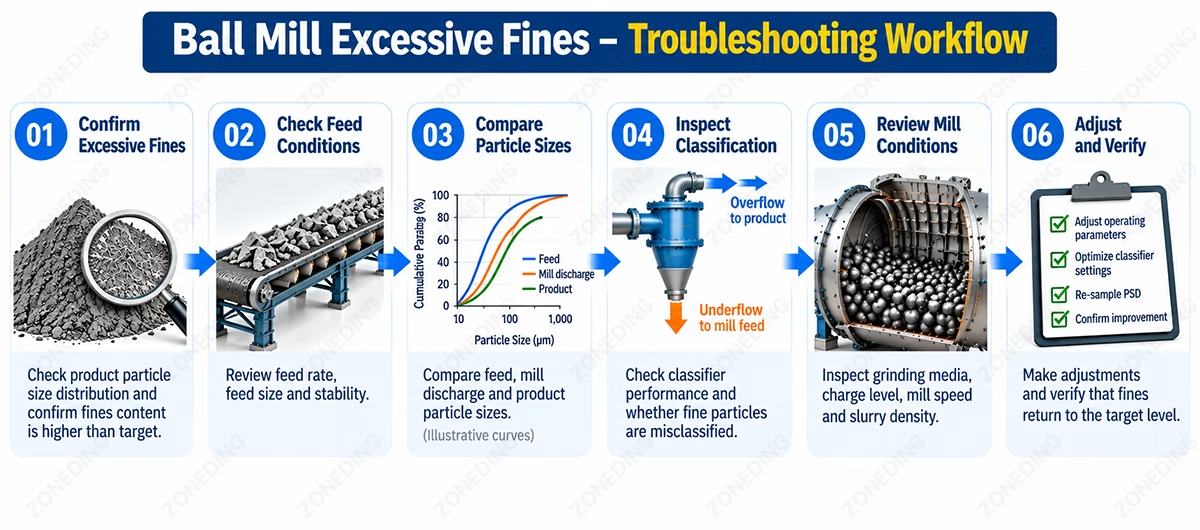
A practical troubleshooting sequence is:
Confirm that the final product contains more unwanted fines than the process requires.
Check whether fresh feed rate, feed size, or ore properties have changed.
Compare mill discharge and final product size distributions.
Investigate fine particles returning through the classifier.
Review grinding media, loading, and slurry conditions.
Adjust one controllable variable at a time and measure the result.
For example, if the final product becomes finer while the feed and media charge remain stable, check whether classifier operation has changed.
If both mill discharge and final product become finer following a feed-rate reduction, investigate mill loading and grinding conditions before adjusting classification.
These patterns are diagnostic clues, not proof of a single cause.
Practical Adjustments to Reduce Unwanted Fines
Once the likely cause is identified, operators can plan controlled adjustments.
The goal is not simply to produce a coarser product. It is to reduce unnecessary grinding while maintaining sufficient mineral liberation.
A structured investigation separates feed, media, slurry, and classification-related causes
Stabilize fresh feed. Review fluctuations in feed rate and feed particle size. Consistent feeding makes grinding performance easier to evaluate.
Review grinding media. Compare the media charge with current ore characteristics and target product requirements.
Investigate residence time. Examine material retention and discharge conditions where the equipment configuration allows.
Improve classification. Identify misplaced fine particles and investigate the causes of inefficient separation.
Check slurry conditions. Evaluate water addition and solids concentration in relation to grinding and classification performance.
Review the target grind size. Confirm that the required fineness is supported by liberation and recovery testing.
After each adjustment, compare the results against the baseline.
Performance indicator
What a successful adjustment should demonstrate
Product PSD
Less unwanted ultrafine material without unacceptable coarse material
Throughput
Stable or improved processing at the required product specification
Specific energy
No unnecessary increase in energy consumed per ton
Classification
Reduced misplacement of suitably fine particles
Mineral recovery
Acceptable recovery and concentrate quality
Operating stability
Repeatable results under comparable feed conditions
An apparent reduction in fines is not a success if valuable minerals remain locked in coarse particles or recovery deteriorates.
Similarly, a change that reduces fines but sharply lowers throughput may not improve the economics of the circuit.
Changing several variables simultaneously makes it difficult to identify which adjustment caused the result.
How Excessive Fines Affect Downstream Mineral Recovery
The consequences of excessive fines depend on mineral characteristics and the recovery process.
In flotation circuits, fine particles may behave differently from coarser particles. Their collision and attachment behavior, surface properties, and interactions with reagents can affect separation.
However, finer grinding may improve flotation performance when additional mineral liberation is necessary.
For example, lead-zinc mineral processing requires suitable liberation of valuable sulfide minerals before separation. Unnecessary grinding may complicate the process, but an excessively coarse product can also reduce liberation.
Gravity recovery depends on particle size and hydraulic conditions.
Equipment designed for relatively coarse particles may struggle to recover very fine valuable minerals. Other gravity devices may handle finer material under suitable operating conditions.
For gold processing projects, grinding and classification should be considered alongside the complete recovery circuit. The 200 TPD Gold Plant Design, Build & Operate Guide provides additional plant-level context.
In thickening and filtration, increased ultrafine content may influence settling, slurry handling, and dewatering behavior.
The most useful grinding target balances liberation, recovery performance, energy consumption, and throughput.
When to Adjust the Circuit or Upgrade Ball Mill Equipment
Excessive fines do not automatically justify purchasing a new ball mill.
If the existing equipment is mechanically sound and can meet the required throughput and product size, operating adjustments may be sufficient.
An upgrade becomes more relevant when measured evidence shows that the current circuit cannot meet processing requirements.
Classification equipment separates finished grinding product from particles requiring further size reduction
Evaluation item
Key question
Ore characteristics
Have hardness, mineral texture, or feed properties changed?
Target product size
Does downstream recovery require the current fineness?
Mill capacity
Can the mill meet throughput at the required grind size?
Grinding media
Is the media charge suitable for current conditions?
Classification
Are suitably fine particles leaving the circuit efficiently?
Energy consumption
Is additional grinding providing useful liberation?
Equipment condition
Are wear or mechanical problems affecting operation?
Potential upgrade triggers include persistent capacity limitations, unsuitable classification performance, major changes in ore characteristics, or test results showing that the circuit arrangement no longer matches the grinding duty.
Before selecting replacement equipment, evaluate representative ore samples, feed size, required product distribution, throughput, and available testwork.
Possible solutions may include classification improvements, revised grinding media practices, circuit modifications, or equipment better suited to the current application.
A larger mill is not necessarily the correct solution if poor classification is the primary limitation.
Likewise, installing a new classifier without addressing unsuitable feed or grinding media may leave the original problem unresolved.
Equipment decisions should be based on engineering evaluation rather than assumptions about fines generation.
Frequently Asked Questions
What causes excessive fines in a ball mill?
Possible causes include unsuitable grinding media, unstable feed conditions, excessive effective grinding time, poor classification, changing ore characteristics, and unsuitable slurry conditions. The actual cause should be confirmed through sampling and operating data.
How can I reduce overgrinding in a ball mill?
First, confirm that the product contains unnecessary fines. Then investigate feed stability, media charge, residence time, classification, and slurry conditions. Make controlled adjustments and evaluate their effects on the complete circuit.
Does a higher circulating load always cause overgrinding?
No. Circulating load alone does not determine overgrinding. Classification efficiency, fine-particle misplacement, residence time, and overall circuit operation must also be considered.
Can smaller grinding balls produce more fines?
Smaller balls can be effective for fine grinding, but they do not automatically cause excessive fines. Their effect depends on ore characteristics, feed size, media distribution, and operating conditions.
How do I know whether my ball mill is grinding too fine?
Compare the complete product size distribution with mineral liberation requirements and downstream recovery results. Additional grinding becomes a concern when it provides little benefit or creates processing disadvantages.
Improve Your Ball Mill Grinding Circuit
Controlling excessive fines requires more than changing a single mill setting.
A systematic review of ore characteristics, grinding media, classification, and operating conditions can help identify unnecessary grinding and support better circuit decisions.
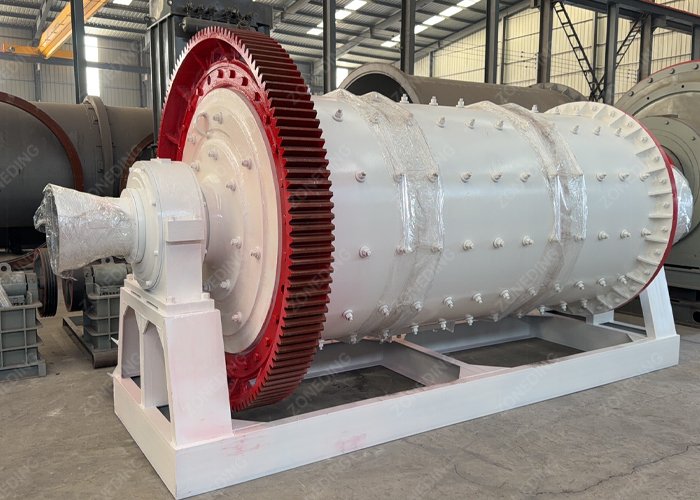
ZONEDING supplies ball mills and related mineral processing equipment for different grinding applications.
If you are planning a new grinding circuit or evaluating an existing installation, provide your ore type, feed size, target product size, required throughput, and available test results for technical discussion.
CTA: Request a Ball Mill and Grinding Circuit Consultation
About ZONEDING
ZONEDING supplies crushing, grinding, and mineral processing equipment for mining and aggregate applications. Equipment selection and circuit recommendations should reflect verified material characteristics, process requirements, and project-specific engineering information.
The stands as the most important machine in a modern gold mine. This heavy equipment grinds raw ore into fine particles to release precious metals. Achieving a high recovery rate depends on the efficiency of this grinding process. If the machine f...
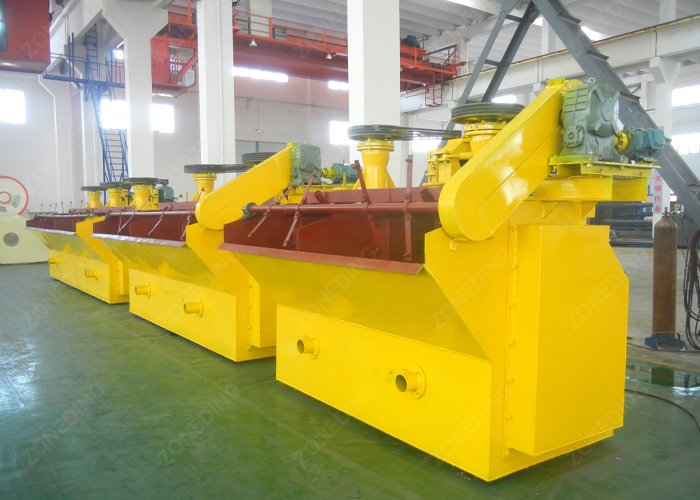
Understanding the main components of flotation machine is mandatory for maximizing profits in mineral processing plants. A flotation cell acts as a highly precise separation instrument. The internal mechanical structure dictates the exact slurry s...
We use cookies to ensure that we give you the best experience on our website. If you continue to use this site we will assume that you are happy with it.
Privacy Policy
Send us a message
We would love to hear from you
Submit your question and our team will respond to the email provided as soon as possible.
 Zoneding Machine