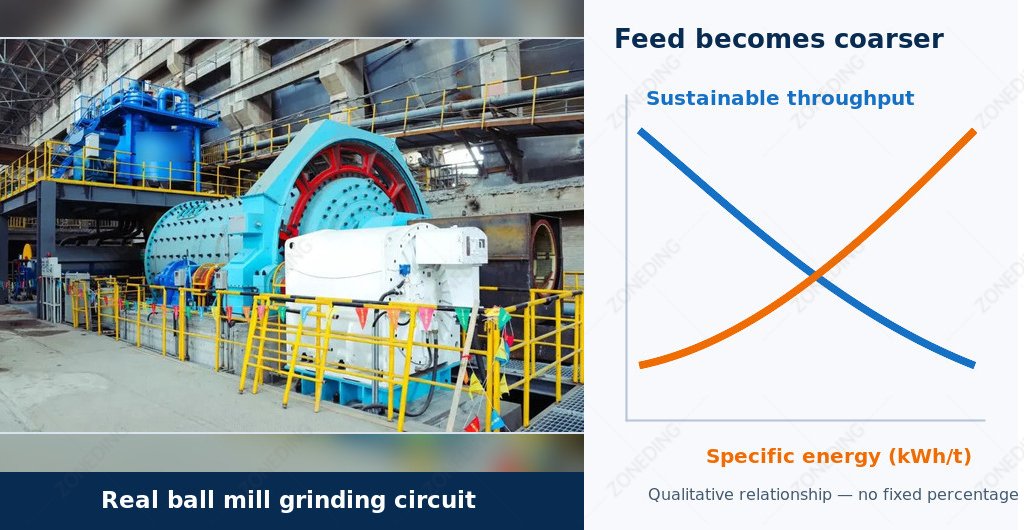
Feed size determines how much size reduction a ball mill must complete before the ore reaches the required product size. When the feed becomes coarser than the circuit was designed to handle, large particles need more breakage events, remain in the mill longer, and can reduce the amount of fresh ore processed each hour. As a result, throughput may fall while energy consumption per ton rises.
However, finer feed is not automatically better. Additional crushing consumes power, increases wear, and may create unnecessary fines. The practical target is a stable feed size distribution that helps the complete crushing and grinding circuit achieve the required capacity and product P80 at the lowest reasonable total cost.
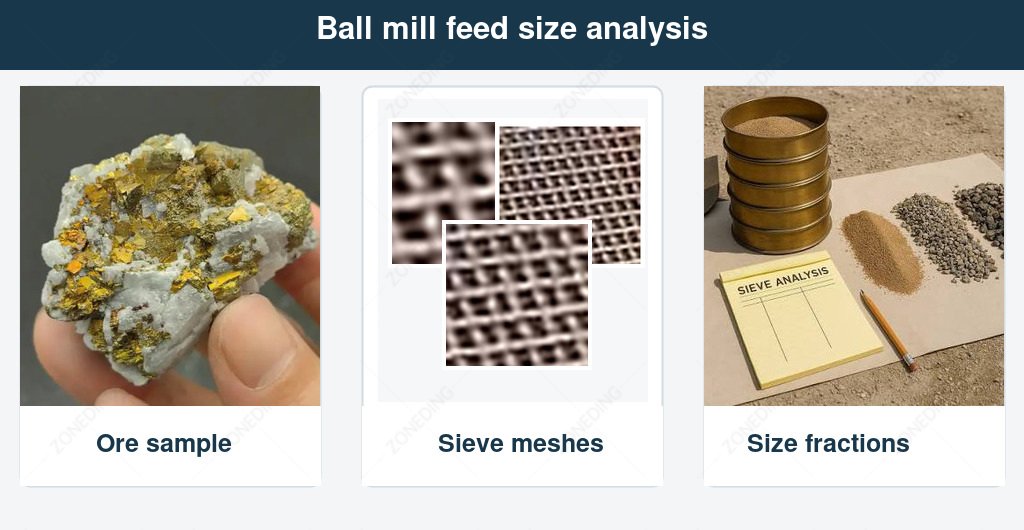
A ball mill receives a mixture of coarse, medium, and fine particles rather than one uniform size. For this reason, three measurements must be distinguished.
Maximum feed size is the largest particle expected to enter the mill.
F80 is the particle size at which 80% of the feed passes.
Feed particle size distribution, or PSD, shows how the full feed mass is distributed across size ranges.
Comparison of maximum ball mill feed size, F80 and complete particle size distribution
Maximum size alone does not describe the actual grinding duty. Two feed samples may both contain a 20 mm particle, yet one may contain only a small amount near 20 mm while the other has a large coarse fraction between 15 and 20 mm. The second feed can place a much heavier load on the mill.
Inside the drum, grinding media must reduce the incoming ore to the target product P80. A coarser F80 increases the size reduction required inside the mill. Larger particles may need repeated impacts before they are small enough to leave through the discharge and classification system.
Feed stability matters as well. A circuit that alternates between fine and coarse feed can experience changing mill load, throughput, slurry conditions, and classifier performance. Therefore, operators should evaluate representative PSD samples over time rather than relying only on the crusher’s nominal discharge setting.
How Does Feed Size Change Capacity and Energy Use?
When feed becomes coarser, the mill must perform more breakage work per ton. Coarse particles can remain in the drum longer and occupy grinding volume that would otherwise process new feed. In a closed circuit, particles that do not meet the target size return through the classifier, increasing the internal grinding load.
Ball Mill Feed Size, Capacity and Energy Use
The typical relationship is:
Coarser Feed → More Grinding Work → Longer Residence Time → Higher Internal Load → Lower Sustainable Throughput
This explains why a mechanically healthy mill can operate below its expected capacity. Before selecting a larger unit, compare the actual feed F80 and PSD with the original design condition. The separate guide on how to calculate ball mill capacity for your ore covers the wider sizing variables.
Energy performance should also be measured per ton, not only by motor power. The basic operating indicator is:
Specific Energy Consumption = Average Power Draw ÷ Ore Throughput
It is normally expressed in kWh/t. If a mill continues to draw roughly similar power but processes fewer tons because the feed is harder to grind, its specific energy consumption rises:
Stable Mill Power + Lower Throughput → Higher kWh/t
Bond’s equation can be used as part of preliminary energy estimation because it relates the work required to F80, P80, and the ore’s Work Index. Its simplified form is commonly written as:
W = 10 × Wi × (1/√P80 − 1/√F80)
Here, W is the estimated specific energy and Wi is the Bond Work Index; F80 and P80 must use the size units required by the selected calculation convention. The equation is not a universal prediction of the output of a specific operating mill. Representative ore testing, correction factors, mill geometry, classification, and circuit conditions are still required.
High kWh/t may also come from harder ore, an unnecessarily fine product target, worn liners, unsuitable media, unstable feeding, or poor classification. The calculation method is explained further in Ball Mill Power Consumption per Ton.
What Feed Size Should a Ball Mill Receive?
There is no single ideal feed size that applies to every ball mill. The correct condition depends on ore breakage characteristics, mill dimensions, media size, installed power, target P80, classification method, and upstream crushing capability.
A catalogue’s maximum feed size is a mechanical or application limit, not automatically the optimum operating F80. Final selection should be based on the complete duty:
Ore Test Data + Feed PSD + Required Throughput + Target P80 + Circuit Configuration
The following table provides a diagnostic framework without imposing an unsupported universal millimetre range.
Operating condition
What it may indicate
What to check first
Feed is coarser than design
More grinding duty and longer residence time
Crusher settings, wear condition, screen efficiency and ore hardness
Throughput is falling
The circuit cannot maintain product P80 at the previous feed rate
Feed F80, ore hardness, mill load and circulating load
kWh/t is increasing
Power is producing fewer acceptable tons
Throughput, feed PSD, product P80 and classification
Coarse fraction changes frequently
Unstable upstream crushing or screening
Feed distribution, crusher loading and screen bypass
Excess fines enter the mill
Crushing may be pushed further than necessary
Closed-side settings, screen apertures and total circuit cost
The best operating target is not the smallest possible crusher product. It is a controlled PSD that allows the mill to maintain the required throughput and P80 without shifting excessive energy, wear, or fines generation into the crushing circuit.
When Should You Improve Crushing Before the Ball Mill?
Upstream crushing deserves investigation when the measured mill feed is consistently coarser than the design basis, throughput falls while product P80 remains unchanged, or grinding kWh/t increases without a new product requirement.
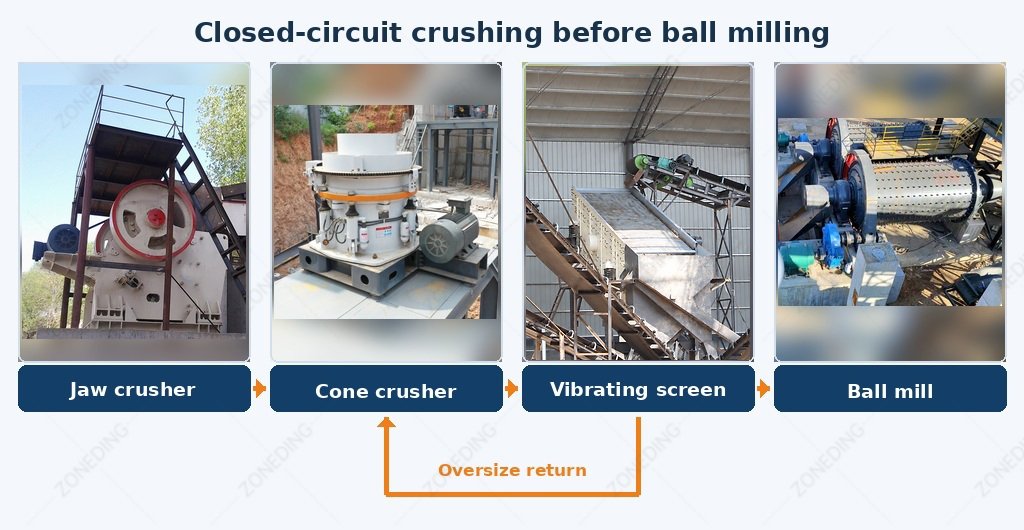
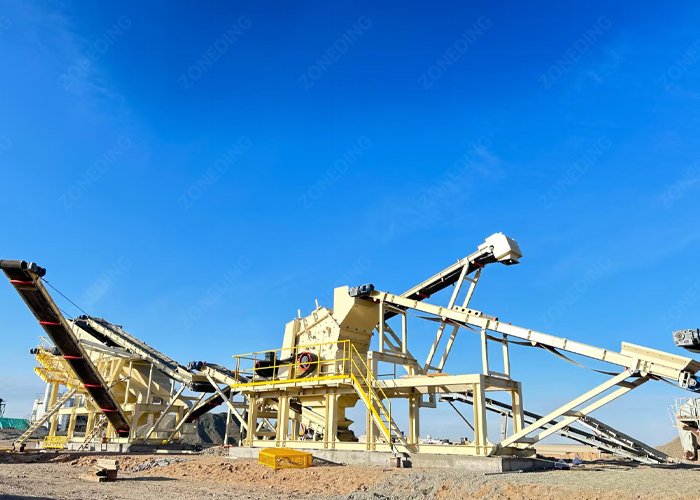
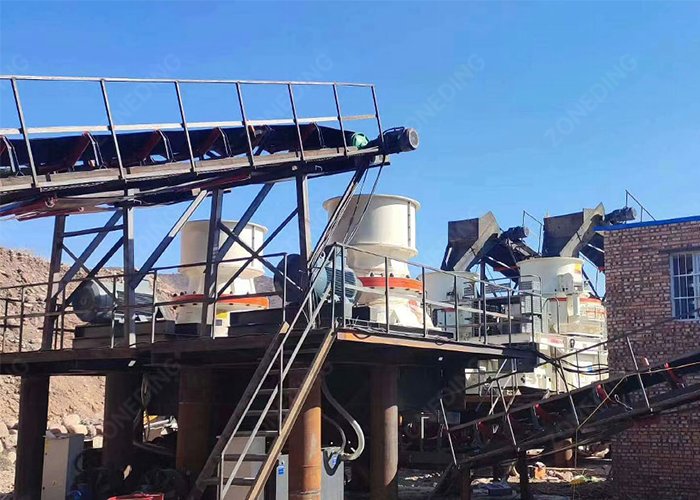
A typical hard-rock route may use a jaw crusher for primary reduction, followed by a cone crusher and screening before the ball mill. In a controlled closed circuit, a vibrating screen sends correctly sized material forward and returns oversize to the crusher.
The broader guide on how to crush stones explains how crushing stages and closed-side settings influence the material delivered downstream.
This arrangement can stabilize the mill feed, but adding a crusher does not guarantee a lower operating cost. The comparison must include additional crusher power, wear parts, screens, conveyors, maintenance, capital cost, and the risk of producing unwanted fines.
The correct economic comparison is:
Total Crushing and Grinding Cost per Ton Before the Change
versus
Total Crushing and Grinding Cost per Ton After the Change
Better crushing may be justified if its added cost is lower than the value of higher mill throughput, lower grinding kWh/t, and more stable downstream performance. If those gains are not demonstrated by a controlled trial, tighter crushing may only move cost from one stage to another.
Which Other Variables Can Change the Result?
Feed size never acts alone. A feed adjustment that helps one plant may deliver a smaller benefit in another because the ore, media, liner, and classifier conditions are different.
Ball mill feed size optimization checks for crushing screening grinding and classification
Ore hardness: Harder or more competent ore generally needs more breakage energy. A new mining zone or ore blend can reduce capacity even when the crusher settings have not changed.
Grinding media: Larger balls provide stronger impacts for coarse particles, while smaller media provide more contact points for fine grinding. Media size and grading must match the ore, feed PSD, mill diameter, and target P80.
Liner condition: Lifter shape controls media motion. A liner can retain adequate thickness while losing the profile needed for effective lifting. The guide to selecting ball mill liners by ore hardness explains this relationship.
Classification efficiency: A classifier should remove material that already meets the target size. If fine material returns to the mill, energy is spent on unnecessary regrinding.
Circulating load: A high return load is not automatically good or bad. It must be evaluated with classifier capacity, product P80, mill load, and fresh-feed throughput. See the closed-circuit grinding circulating load guide for a focused diagnosis.
Feed rate and slurry conditions: Unstable dry feeding, water addition, density, or sump operation can obscure the effect of feed size.
How Can You Optimize Feed Size Without Creating Excess Fines?
Use measurements and controlled trials rather than changing several settings at once.
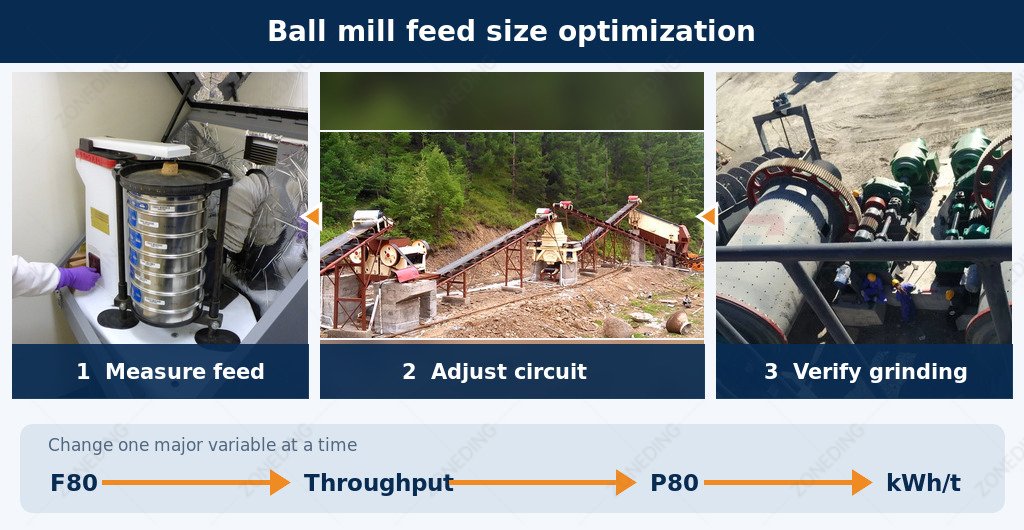
Sample the actual mill feed. Measure the full PSD and calculate F80. Do not rely only on the crusher’s closed-side setting.
Compare it with the design basis. Check whether the current ore and feed distribution still match the conditions used to size the grinding circuit.
Inspect crushing performance. Record crusher settings, wear-part condition, loading, feed distribution, and product PSD.
Check screening. Look for damaged media, blinded apertures, poor feed distribution, or oversize bypassing the intended return path.
Record capacity and energy together. Track feed F80, throughput in t/h, mill power, kWh/t, and product P80 during the same period.
Review classification and circulating load. A finer feed may show little benefit if finished material repeatedly returns to the mill.
Run one controlled change at a time. After each adjustment, compare F80 → Throughput → P80 → kWh/t while keeping other major conditions as stable as practical.
Watch both ends of the distribution. Reducing the coarse fraction may improve grinding, but excessive pre-crushing can increase dust, crusher wear, screening load, and the risk of overgrinding material that was already fine. When the cause remains unclear, review the wider set of factors affecting the ball mill grinding process before tightening the crusher setting again.
The optimization target is a repeatable feed PSD that produces the required P80 at the lowest practical total comminution cost—not the finest feed a crusher can physically produce.
Frequently Asked Questions
What is the ideal feed size for a ball mill?
There is no universal ideal value. It depends on ore hardness and breakage characteristics, mill dimensions, media, target P80, classification, and upstream crushing. F80 and the complete PSD are more useful than maximum size alone.
Does a smaller feed always increase ball mill capacity?
No. A finer feed can reduce grinding duty and may improve throughput, but it also requires additional crushing energy and wear. If crushing is pushed too far, it may create unnecessary fines without reducing total cost.
Why can coarse feed increase energy consumption per ton?
Coarse particles usually require more breakage work. If throughput falls while the mill continues drawing substantial power, fewer tons share that energy, so kWh/t rises.
Can better crushing reduce ball mill operating cost?
Yes, under suitable conditions. The benefit should be confirmed by comparing total crushing and grinding cost, throughput, kWh/t, and product P80 before and after a controlled change.
Should grinding ball size be increased when feed becomes coarser?
Not automatically. Larger media can provide stronger impact, but media selection must also consider ore hardness, mill diameter, product P80, and the required breakage mechanism. Diagnose the full circuit before changing ball grading.
Key Takeaways and Project Information
Maximum feed size, F80, and full feed PSD are different measurements.
Coarser feed can increase residence time and internal grinding load, reducing sustainable throughput.
Similar mill power with lower throughput results in higher specific energy consumption.
Finer feed is not automatically better because crushing also consumes power, wear parts, and may create excess fines.
Ore hardness, media grading, liner condition, classification, and circulating load can change the result.
Before buying a larger mill, verify whether crushing or screening is creating the real bottleneck.
Optimize total crushing and grinding cost per ton rather than either stage in isolation.
For a preliminary grinding-circuit review, provide the ore type, available hardness or test data, maximum feed size, F80 or sieve analysis, required throughput, target P80, wet or dry grinding requirement, current crushing configuration, classification method, mill power data, and project location.
Send these inputs to ZONEDING to discuss a suitable ball mill and connected crushing, grinding, and classification configuration. Any final equipment recommendation should be based on representative material data and the complete process duty.
About ZONEDING: ZONEDING supplies crushing, grinding, classification, and mineral-processing equipment for complete ore-processing circuits. Equipment selection is evaluated as a connected process rather than from catalogue capacity alone.
ZONEDING helps gold plants improve output by controlling the full process, not just one reagent or one machine. A stable gold recovery rate comes from liberation control, classification stability, efficient separation, and strict loss ac...
A 100–200 TPH aggregate crushing plant cost can range from approximately USD 120,000 to USD 350,000 for a standard stationary line. However, a 200 TPH plant that includes tertiary crushing, manufactured sand production, washing, or sever...
One of the first questions buyers ask before purchasing a cone crusher is: How many tons per hour can a cone crusher produce? The answer is not as simple as reading a specification sheet. Many operators discover that actual production differs sign...
Buying mining machinery is the start of a long-term investment. Many buyers focus only on the lowest initial price. However, an unreliable supplier can cause massive losses through downtime and high maintenance costs. A professional procurement st...
We use cookies to ensure that we give you the best experience on our website. If you continue to use this site we will assume that you are happy with it.
Privacy Policy
Send us a message
We would love to hear from you
Submit your question and our team will respond to the email provided as soon as possible.
 Zoneding Machine