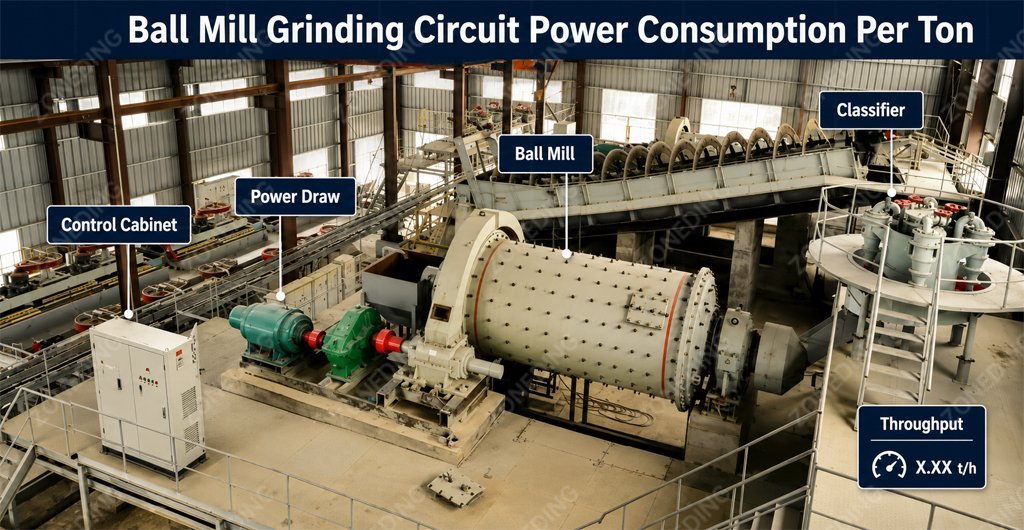
Electricity is one of the largest operating costs in mineral processing.
In many grinding circuits, the ball mill is one of the main power consumers. Even a small increase in energy consumption per ton can affect total operating cost over long production hours.
However, ball mill power consumption per ton cannot be judged by motor rating alone.
The real value depends on ore hardness, feed size, target grind size, ball charge, mill loading, grinding circuit design, and actual operating conditions.
This guide explains how to calculate ball mill kWh per ton, what factors affect energy use, and how to reduce grinding power waste without sacrificing product quality.
What Does Ball Mill Power Consumption per Ton Mean?
Ball mill power consumption per ton refers to the electrical energy required to grind one ton of ore.
It is usually expressed as kilowatt-hours per ton, or kWh/t.
For example, if a ball mill draws an average operating power of 300 kW while processing 20 tons per hour, the specific energy consumption is:
300 ÷ 20 = 15 kWh/t
This means the grinding circuit uses about 15 kWh of electricity for each ton of ore processed.
A lower kWh/t usually means lower electricity cost. However, lower is not always better.
If the mill consumes less power because it is underloaded or producing a coarser product than required, downstream recovery may suffer. Therefore, energy consumption should always be evaluated together with product size, throughput, recovery, and total operating cost.
A complete assessment should include:
Throughput
Product size
Ore recovery
Mill utilization
Grinding efficiency
Total operating cost
The goal is not simply to reduce power draw. The real goal is to reach the required grind size with the lowest practical cost per ton.
How Do You Calculate Ball Mill kWh per Ton?
The basic formula for actual ball mill power consumption per ton is simple:
Specific Energy (kWh/t) = Average Operating Power (kW) ÷ Throughput (t/h)
Always use average operating power, not only the motor nameplate power.
A motor rarely operates at full load continuously. Using the rated motor power may overestimate real energy consumption.
Example Calculation
Operating Item
Value
Average Power Draw
320 kW
Ore Throughput
25 TPH
Specific Energy Consumption
12.8 kWh/t
Calculation:
320 ÷ 25 = 12.8 kWh/t
The grinding circuit therefore consumes about 12.8 kWh for every ton of ore processed.
Daily Electricity Cost Example
Suppose a wet grinding ball mill processes 30 TPH while drawing 420 kW of average power.
Specific energy consumption:
420 ÷ 30 = 14.0 kWh/t
If the electricity price is US$0.10 per kWh, the grinding electricity cost is:
14.0 × 0.10 = US$1.40/t
This calculation helps plant managers compare operating conditions and evaluate energy-saving improvements.
How Does Bond Work Index Affect Power Consumption?
The Bond Work Index, often written as Wi, measures how difficult an ore is to grind.
A higher Work Index means the ore needs more energy to reach the same product size.
A simplified Bond equation is:
W = 10 × Wi × (1/√P80 − 1/√F80)
Where:
W = specific grinding energy, kWh/t
Wi = Bond Work Index, kWh/t
F80 = feed size at 80% passing, μm
P80 = product size at 80% passing, μm
F80 and P80 must use the same unit.
Once the specific energy is estimated, plant capacity can be linked to available grinding power:
Capacity = Effective Power ÷ Specific Energy
This means a harder ore usually lowers throughput if the available power remains unchanged.
For reliable sizing, laboratory grinding tests are better than using ore names alone. Two copper ores from different mines may have very different Work Index values because of quartz content, mineral structure, and ore variability.
Engineer Tip
Do not estimate power consumption from the ore name alone. Representative ore testing is much safer when selecting a ball mill or evaluating operating cost.
What Is a Normal Ball Mill Energy Consumption Range?
There is no single standard energy value for every ball mill.
The required kWh/t depends on ore hardness, feed size, product fineness, mill dimensions, grinding media, and circuit efficiency.
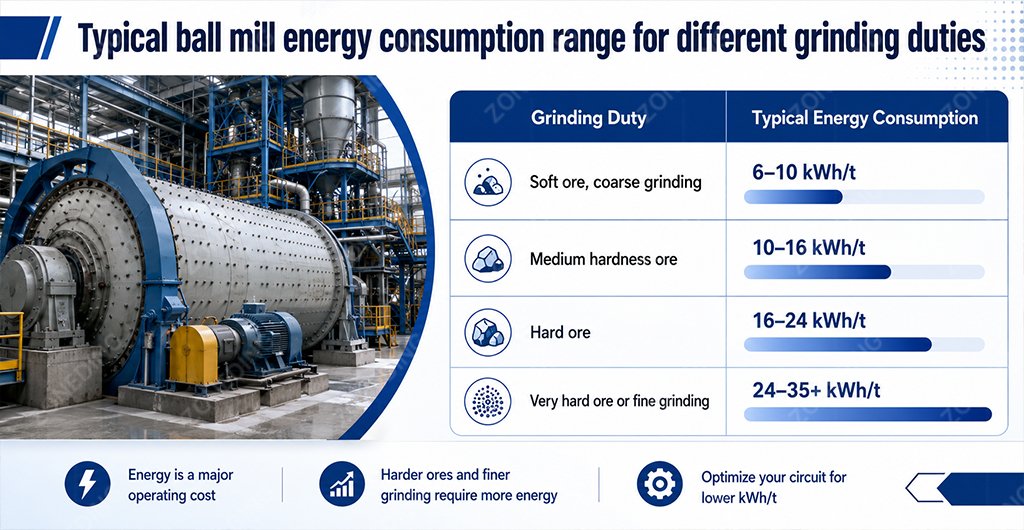
The following table can be used as a preliminary reference only.
Ball mill energy consumption range
Grinding Duty
Typical Energy Consumption
Soft ore, coarse grinding
6–10 kWh/t
Medium hardness ore
10–16 kWh/t
Hard ore
16–24 kWh/t
Very hard ore or fine grinding
24–35+ kWh/t
Actual values should be verified through laboratory testing and plant data.
For example, limestone grinding generally consumes less energy than quartz-rich gold ore. Likewise, grinding to 74 μm usually requires more energy than grinding to 150 μm.
When comparing two plants, make sure they process similar ores under similar conditions.
Comparing kWh/t without considering ore hardness and product size can lead to wrong conclusions.
Why Do Feed Size and Product Size Change kWh/t?
Feed size and product size directly affect grinding energy.
They define how much size reduction must happen inside the ball mill.
Feed Size
A smaller feed size usually reduces the grinding work required.
For example, improving the crushing circuit from a coarser F80 to a smaller F80 can help the ball mill process more material with the same installed power.
However, finer crushing also consumes electricity. Therefore, engineers should optimize the total crushing and grinding circuit, not only the ball mill.
Product Size
Target product size often has a stronger impact on kWh/t.
Grinding ore to 74 μm requires more energy than grinding the same ore to 150 μm. The material must stay inside the mill longer before reaching the finer size.
A finer product usually increases:
Residence time
Grinding work
Power consumption per ton
Grinding media wear
Liner wear
For this reason, grinding finer than necessary should be avoided.
The best product size is the one that achieves the required mineral liberation while minimizing energy cost.
How Do Ball Charge, Mill Speed, and Loading Affect Energy Use?
Even with the same ore, a poorly operated ball mill can consume more electricity per ton.
Ball charge, mill speed, loading, liners, and grinding media all affect how efficiently power is transferred to the ore.
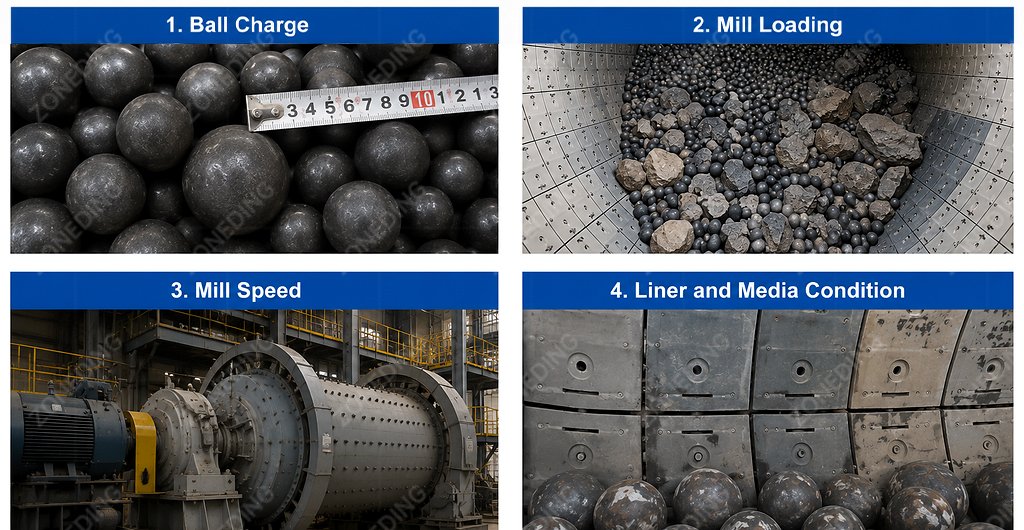
4 Key Factors Affecting Ball Mill Energy Efficiency
Ball Charge
Grinding media transfer impact and abrasion energy to the material.
If too few balls are used, grinding efficiency drops. If too many balls are added, power draw may increase without a proportional gain in throughput.
The ball size distribution also matters.
Large balls help break coarse particles, while smaller balls improve fine grinding efficiency.
Mill Loading
The mill load includes grinding media, ore, water in wet grinding, and void space.
An overloaded mill restricts media movement. An underloaded mill wastes available grinding capacity.
Both conditions can increase kWh/t.
Mill Speed
Mill speed controls the movement of the grinding media.
When speed is too low, the balls mainly roll and produce weaker impact. When speed is too high, centrifugal force may hold the balls against the shell.
The best operating speed depends on mill diameter, liner design, ball charge, and grinding duty.
Liner and Media Condition
Mill liners protect the shell and lift the grinding media.
As liners wear, the lifting action weakens. The mill may draw similar power but produce less finished material.
Regular inspection of liners and grinding media helps maintain efficient energy transfer.
How Does the Grinding Circuit Affect Power Consumption?
A ball mill should not be evaluated as an isolated machine.
Its power consumption depends heavily on the entire grinding circuit.
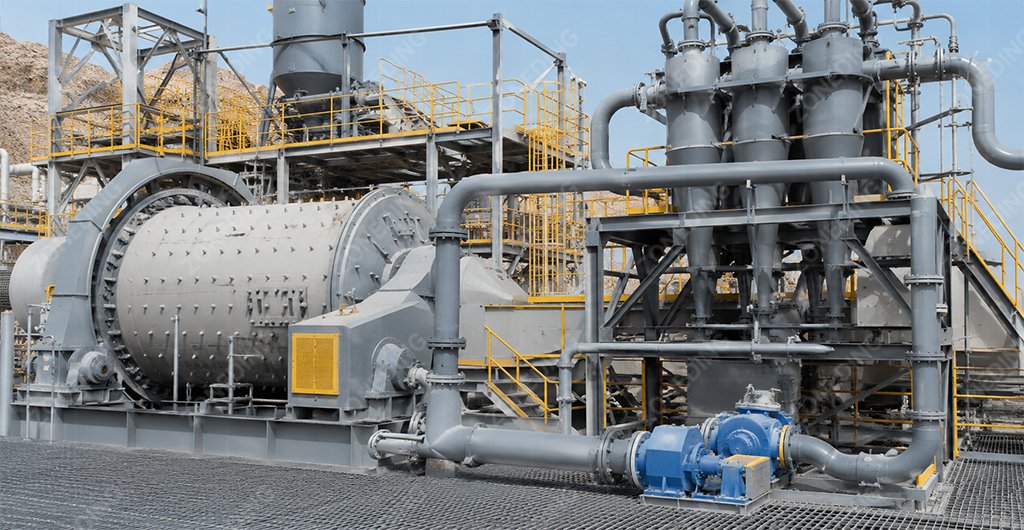
Closed grinding circuit improving ball mill energy efficiency
Open-Circuit Grinding
In an open circuit, material passes through the mill without separation and return.
This layout is simple and usually has a lower initial investment. However, finished particles may continue to be ground together with coarse particles.
That can create unnecessary energy consumption and overgrinding.
Closed-Circuit Grinding
A closed circuit combines the ball mill with a classifier.
Finished particles leave the circuit quickly, while coarse particles return to the mill for further grinding.
This arrangement can improve:
Particle size control
Throughput stability
Grinding efficiency
Product consistency
Energy use per ton
In many mineral processing plants, hydrocyclones are used for classification. Some applications use spiral classifiers depending on particle size, process layout, and operating requirements.
Circulating Load
A moderate circulating load helps coarse particles receive more grinding while finished material leaves the circuit.
However, excessive circulating load increases internal material flow without increasing useful final production.
A stable classifier is therefore critical for controlling kWh/t.
How Can You Reduce Ball Mill Power Consumption per Ton?
Reducing power consumption is not simply about lowering motor power.
The goal is to improve grinding efficiency so that each kilowatt-hour produces more finished material at the required size.
Optimization Method
Main Benefit
Improve crushing feed size
Reduces grinding work
Optimize ball grading
Improves breakage efficiency
Maintain proper circulating load
Stabilizes circuit performance
Replace worn liners
Restores media lifting action
Improve classification efficiency
Reduces overgrinding
Monitor mill loading
Prevents underload or overload
Check gear and pinion alignment
Reduces mechanical losses
Improve process control
Maintains stable operation
In many plants, improving the crushing stage or classifier performance may save more energy than replacing the ball mill.
Mechanical condition also matters.
Worn liners, poor grinding media distribution, misaligned girth gears, unstable feeding, or overloaded slurry conditions can waste power even when the motor and mill size are correct.
For existing plants, start by checking the real bottleneck:
Coarse crusher discharge
Incorrect ball grading
Worn liners
Low classifier efficiency
Excessive circulating load
Unstable feed rate
Poor lubrication
Gear alignment problems
Solving one of these problems may reduce kWh/t at a lower cost than installing a larger mill.
What Information Is Needed for a Power Consumption Estimate?
To estimate ball mill power consumption accurately, prepare complete process data.
Important information includes:
Required Information
Why It Matters
Ore type
Provides the first process direction
Bond Work Index
Indicates grinding difficulty
F80 feed size
Defines starting particle size
P80 product size
Defines target fineness
Required capacity
Sets the throughput target
Wet or dry grinding
Changes material transport
Circuit type
Affects classification and overgrinding
Mill size
Determines volume and power direction
Motor power
Sets available installed power
Ore moisture
Important for dry grinding
Existing crushing size
Shows upstream influence
Downstream process
Defines required liberation size
A single power figure is not enough.
For a useful estimate, engineers need to connect ore data, grinding duty, equipment condition, and circuit design.
Frequently Asked Questions
What is the unit for ball mill power consumption?
Ball mill power consumption is usually expressed as kWh/t, meaning the electrical energy required to grind one ton of ore.
Does a larger ball mill always consume more energy?
A larger mill usually consumes more total power. However, it may consume less energy per ton if it operates efficiently and produces higher throughput.
Why does the same ball mill consume different amounts of electricity?
Energy use changes with ore hardness, feed size, product size, ball charge, mill loading, liner condition, and circuit efficiency.
Does wet grinding consume less energy than dry grinding?
Wet grinding often supports better material flow and classification, but the actual energy difference depends on ore properties and process requirements.
What information is needed to estimate ball mill power consumption?
Provide ore type, Bond Work Index, F80, P80, target capacity, grinding method, circuit type, motor power, and any available test data.
Final Thoughts
Ball mill power consumption per ton is one of the most useful indicators for evaluating grinding efficiency and operating cost.
The calculation itself is simple, but the result depends on many interacting factors. Ore hardness, feed size, target grind size, ball charge, liner condition, mill loading, and circuit design all affect the final kWh/t.
Instead of focusing only on reducing motor power, successful plants optimize the whole grinding system.
Better crushing control, correct ball grading, efficient classification, proper mill loading, and regular maintenance can often reduce energy waste while protecting throughput and product quality.
A reliable energy estimate helps engineers select the right equipment, improve existing circuits, and reduce long-term operating costs.
About ZONEDING
ZONEDING manufactures ball mills, grinding equipment, crushing equipment, and mineral processing systems for mining and industrial mineral projects.
Our engineering team supports ore testing review, process design, equipment selection, grinding circuit planning, installation, commissioning, training, and after-sales service.
If you need help estimating ball mill power consumption for your ore, please send your ore type, Bond Work Index, feed size, target product size, required capacity, grinding method, and project location.
In a large-scale mining project, selecting a is not just about comparing tonnage. While mobility reduces material handling costs, the compact nature of these machines introduces risks in stability, maintenance, and product quality. Success require...
Understanding the mechanical logic of crushing equipment is vital for project profitability. Selecting a machine based solely on capacity ignores the reality of wear and energy costs. Different stones require different mechanical principles—either...
Mobile crushing technology offers the most direct path to reducing operational costs and increasing profit margins in the mining industry. This article explains how a mobile unit eliminates the need for expensive civil works and reduces truck haul...
We use cookies to ensure that we give you the best experience on our website. If you continue to use this site we will assume that you are happy with it.
Privacy Policy
Send us a message
We would love to hear from you
Submit your question and our team will respond to the email provided as soon as possible.
 Zoneding Machine