Producing too many fines is a common problem in ball mill operation.
At first, finer particles may seem useful because minerals must be liberated before separation. However, overgrinding often increases power consumption, reduces throughput, accelerates media wear, and makes downstream recovery less stable.
Many operators notice the symptoms before they know the cause.
The mill may draw more power, the classifier overflow may become muddy, flotation performance may decline, or filtration may become slower.
This guide explains why a ball mill produces too many fines, how to identify overgrinding, and what practical steps can help restore a more suitable product size distribution.
What Does “Too Many Fines” Mean in Ball Mill Grinding?
In mineral processing, fines are particles that are much smaller than the required product size.
For example, if the target grinding size is P80 = 150 μm, but a large share of the product is already below 45 μm, the mill may be producing excessive fines.
Some fine particles are necessary for mineral liberation.
The problem begins when grinding continues beyond the useful liberation size. At that point, the mill consumes more energy but creates little additional process value.
Excessive fines may cause:
Lower grinding efficiency
Higher electricity consumption
Increased steel ball consumption
Faster liner wear
Slime generation
Poor flotation selectivity
Lower thickening performance
More difficult filtration
The goal is not to produce the finest possible material.
Instead, the grinding circuit should produce the right particle size distribution for the downstream process.
Why Is My Ball Mill Producing Too Many Fines?
Overgrinding is usually caused by several operating conditions working together.
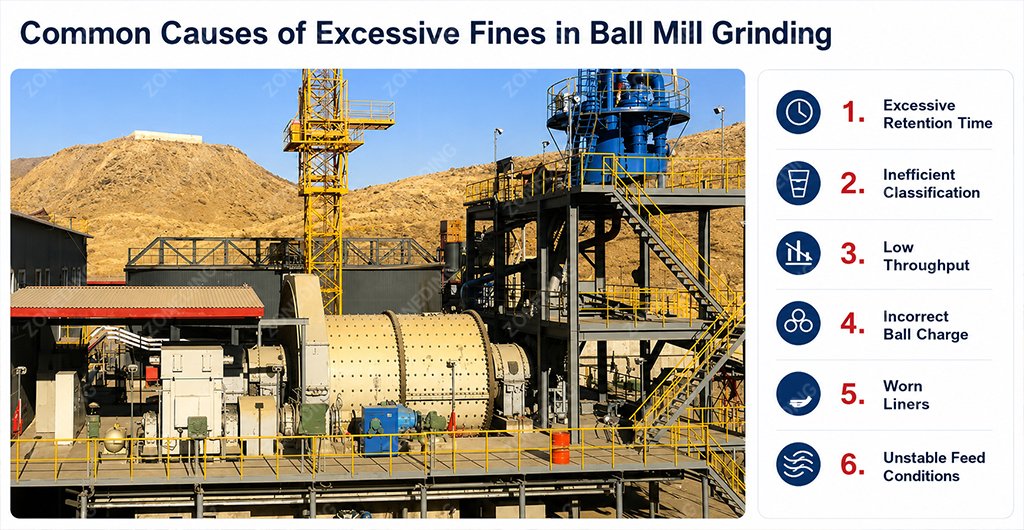
The most common causes include excessive grinding time, poor classification, unstable feed, incorrect ball charge, worn liners, unsuitable slurry density, or low throughput.
Causes of ball mill fines
Excessive Retention Time
When material stays inside the mill longer than necessary, particles continue to be ground after reaching the target size.
This may happen when the feed rate drops but the mill continues operating at the same speed and power level.
As a result, already-ground material receives extra impact and abrasion.
Inefficient Classification
A classifier should remove finished particles quickly.
When fine material returns to the mill repeatedly, it is ground again and again. This increases ultrafine generation without improving useful production.
Low Throughput
Reduced feed rate can increase residence time inside the mill.
Although total power draw may not change much, fewer tons pass through the circuit. Therefore, the mill may consume more energy per ton while producing more fines.
Incorrect Ball Charge
Grinding media size affects the breakage mechanism.
Too many small balls increase abrasion and may create unnecessary ultrafine particles. On the other hand, an unsuitable top ball size may fail to break coarse particles efficiently, causing longer residence time.
Worn Liners
Mill liners do more than protect the shell.
They also lift grinding media and help create the correct impact action. As liners wear, media movement changes and grinding may become less efficient.
Unstable Feed Conditions
Changes in feed size, ore hardness, moisture, or ore type can make product size control difficult.
For this reason, the full grinding circuit should be checked before blaming the ball mill alone.
How Does Feed Size Affect Overgrinding?
Feed size has a direct influence on grinding efficiency and residence time.
Both overly fine feed and overly coarse feed can increase fine generation.
Feed Too Fine
When the crushing circuit sends too many fine particles into the ball mill, many particles are already close to the target size.
Instead of doing useful breakage, the mill continues grinding these particles into unnecessary ultrafine material.
This is especially common when the crushing and screening stage is unstable.
Feed Too Coarse
Oversized feed creates a different problem.
Large particles need more time to reach the target size. During that longer residence time, particles that are already fine may continue circulating and become even finer.
Stable feed preparation is therefore important.
Engineers should control crusher discharge, screen performance, and feed blending before making major changes to the ball mill.
Can Ball Charge, Mill Speed, and Slurry Density Cause Too Many Fines?
Yes. These operating factors directly affect how grinding energy is transferred to the ore.
Ball Size Distribution
Large balls are better for breaking coarse particles.
Smaller balls are more effective in fine grinding. However, too many small balls can increase abrasion and produce excessive fines.
A balanced media charge should match the feed size, ore hardness, and target product size.
Media Condition
Possible Effect
Practical Direction
Too many large balls
May over-break soft material
Review top ball size
Too many small balls
Increases abrasion
Rebalance media mix
Poor media grading
Reduces grinding efficiency
Match balls to feed size
Excessive media wear
Changes breakage pattern
Monitor and replace regularly
Ball Filling Level
An overloaded mill restricts media movement.
An underloaded mill wastes available grinding capacity and may reduce impact efficiency.
Both conditions can create unstable grinding and increase overgrinding risk.
Mill Speed
Mill speed controls media movement.
If speed is too low, balls may roll instead of impacting the ore. If speed is too high, the media may not fall properly.
The correct speed depends on mill diameter, liner design, grinding duty, and media charge.
Slurry Density
In wet grinding, slurry density also affects fine generation.
If the slurry is too dilute, energy transfer may become less efficient. If it is too thick, material movement slows and fine particles may remain in the mill longer.
The target slurry density should be selected according to ore properties, mill design, classifier performance, and downstream process requirements.
Does the Grinding Circuit Increase Fine Production?
Yes. Many excessive-fines problems start outside the ball mill.
A ball mill should be evaluated as part of the full grinding circuit, not as an isolated machine.
Poor Classifier Performance
A classifier should separate finished particles from coarse material.
If fine particles are not removed quickly, they return to the mill and continue to be ground.
This is one of the most common causes of overgrinding.
High Circulating Load
A moderate circulating load can improve grinding efficiency.
However, excessive circulating load increases the number of times particles pass through the mill. This can create more fines without increasing useful final production.
Open-Circuit Grinding
In an open circuit, material passes through the mill without being classified and returned.
This layout is simple, but product size distribution may be wider. Finished particles can remain exposed to unnecessary grinding.
Closed-Circuit Grinding
A closed circuit uses classification equipment to remove finished material and return coarse material.
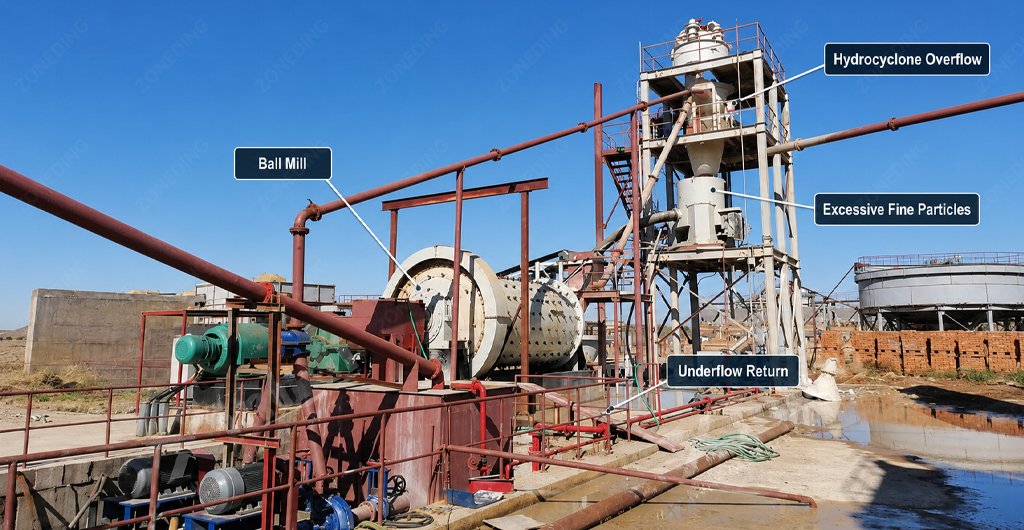
Hydrocyclones are common in many wet grinding circuits. Some applications may use a Spiral Classifier, depending on particle size, slurry condition, and process layout.
Closed-circuit grinding often gives better product size control and reduces unnecessary overgrinding.
How Do You Identify Overgrinding in a Ball Mill?
Several operating symptoms can suggest excessive fine generation.
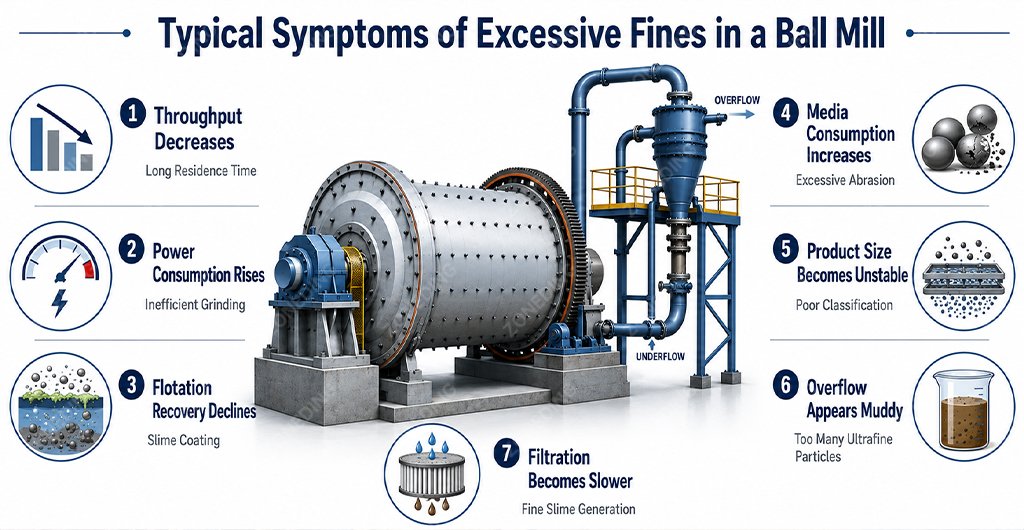
Ball mill overgrinding symptoms
Symptom
Possible Cause
Throughput decreases
Long residence time
Power consumption rises
Inefficient grinding
Flotation recovery declines
Slime coating
Media consumption increases
Excessive abrasion
Product size becomes unstable
Poor classification
Overflow appears muddy
Too many ultrafine particles
Filtration becomes slower
Fine slime generation
Sampling is the most reliable way to confirm overgrinding.
Collect samples from the mill feed, classifier overflow, classifier underflow, and final product. Then compare the particle size distribution with the target P80 and downstream process requirements.
Operating data should also be reviewed.
Important data include throughput, power draw, circulating load, slurry density, feed size, water addition, and classifier performance.
How Can You Reduce Excessive Fine Generation?
Reducing excessive fines requires improving the whole grinding process.
Changing one parameter may not solve the real problem if the classifier, feed preparation, or media charge is still unstable.
Priority
Improvement
Expected Benefit
★★★★★
Improve classifier efficiency
Reduce repeated grinding of fines
★★★★★
Stabilize crusher feed size
Shorten unnecessary residence time
★★★★★
Optimize ball size distribution
Improve breakage balance
★★★★☆
Control circulating load
Stabilize circuit performance
★★★★☆
Replace worn liners
Restore media lifting action
★★★★☆
Maintain stable feed rate
Improve product size consistency
★★★☆☆
Review slurry density
Improve material transport
★★★☆☆
Monitor grinding media wear
Maintain stable grinding action
Start with the highest-impact areas first.
In many plants, improving classification and feed preparation is more effective than simply lowering mill speed or reducing power draw.
Engineer Tip
Many plants try to reduce fines by decreasing mill speed. In practice, this may reduce throughput without solving the real cause.
A better approach is to check classification, feed size, ball grading, slurry density, and residence time together.
What Information Is Needed to Diagnose Excessive Fines?
A useful diagnosis requires both material data and operating data.
Prepare the following information before requesting technical support:
Ore type and mineral composition
Feed size distribution, including F80
Target product size, including P80
Actual product size analysis
Mill throughput
Average power draw
Ball charge condition
Grinding media size distribution
Liner condition
Wet or dry grinding method
Slurry density, if wet grinding
Classifier type and operating condition
Circulating load
Downstream process performance
Recent changes in ore or operation
This information helps engineers locate the real source of excessive fines instead of guessing from the final product alone.
A Ball Mill should always be reviewed together with its feed preparation, media charge, classifier, and downstream process.
Frequently Asked Questions
Are fine particles always bad?
No. Fine particles are necessary for mineral liberation. Problems occur when the mill produces much more ultrafine material than the process actually needs.
Can a worn classifier increase fines?
Yes. Poor classification allows finished particles to return to the mill. These particles continue grinding and may become excessive fines.
Does reducing mill speed eliminate overgrinding?
Not always. Reducing speed may lower throughput without improving product size distribution. The full circuit should be checked first.
Why does overgrinding reduce flotation recovery?
Ultrafine particles and slimes can coat mineral surfaces, consume reagents, and reduce flotation selectivity. This may lower recovery or concentrate quality.
What is the difference between open-circuit and closed-circuit grinding?
Open-circuit grinding offers less product size control. Closed-circuit grinding removes qualified particles sooner and returns only coarse material for further grinding.
Final Thoughts
Producing too many fines is usually a sign of an inefficient grinding circuit, not just a ball mill problem.
Feed preparation, residence time, ball charge, mill speed, slurry density, liner condition, classification, and circulating load all influence the final product size.
Instead of chasing the finest possible product, operators should focus on the particle size distribution required by the downstream process.
By identifying the true cause of overgrinding and optimizing the whole circuit, plants can improve throughput, reduce energy waste, extend liner life, and stabilize recovery.
About ZONEDING
ZONEDING designs and manufactures ball mills, grinding circuits, classifiers, crushing equipment, and mineral processing solutions for mining and industrial mineral projects.
Our engineers analyze ore characteristics, grinding requirements, particle size targets, and plant operating data to recommend practical solutions for improving grinding efficiency.
If your ball mill is producing excessive fines or unstable product size, contact ZONEDING with your ore data, feed size, target P80, throughput, power draw, classifier condition, and particle size analysis.
Field experience in extreme environments reveals the truth about aggregate production in remote areas. Showroom data fails when the site sits 500 kilometers from civilization. Extreme locations lack power grids, clean fuel, and heavy cranes. ...
I have spent 50 years in the mining and recycling industry. I have seen people turn piles of trash into mountains of cash. But I have also seen many people lose everything because they bought the wrong machine. In 2026, urban recycling is a gold m...
Gold mining profitability depends heavily on equipment selection. Choosing the wrong machine for hard rock can lead to massive repair bills or low gold recovery rates. Hard rock gold mining often involves extremely abrasive quartz veins. This guid...
Mineral screening equipment performs the vital task of size separation in mining. This process occurs after crushing to ensure only the correct stones proceed. Efficient screening prevents the recirculating load from overwhelming the system. In 20...
We use cookies to ensure that we give you the best experience on our website. If you continue to use this site we will assume that you are happy with it.
Privacy Policy
Send us a message
We would love to hear from you
Submit your question and our team will respond to the email provided as soon as possible.
 Zoneding Machine