Water is essential in many mineral processing plants. It helps transport solids, control slurry density, support grinding and classification, improve flotation conditions, and move concentrate or tailings through the process.
However, using more water does not always improve plant performance.
Excessive dilution increases slurry volume, pumping load, thickening demand, filtration pressure, and tailings management difficulty. At sites with limited water supply, high fresh-water demand can also restrict production capacity.
A better approach is to manage water as a circulating process stream, not as a one-way consumable.
The goal is not simply using less water everywhere. The real goal is reducing unnecessary fresh-water intake while keeping grinding, classification, flotation, and dewatering stable.
Where Does Water Go in a Mineral Processing Plant?
Before reducing water consumption, operators need to understand how water moves through the plant.
In a typical wet mineral processing circuit, water may enter through fresh water, recycled process water, ore moisture, grinding water, flotation water, washdown water, and dilution points.
A simplified process can be described as:
Ore + Fresh Water + Recycled Water → Grinding → Classification → Beneficiation → Concentrate and Tailings Dewatering → Recovered Water → Process Reuse
Major water users include:
Process Area
Why Water Is Used
Grinding
Maintains suitable slurry density
Classification
Supports particle separation and slurry movement
Flotation
Controls pulp density and flotation conditions
Slurry transport
Moves solids between process stages
Concentrate handling
Transports and dewaters concentrate
Tailings handling
Moves and stores or dewaters tailings
Equipment cleaning
Washes equipment and process areas
Water also leaves the plant in several ways.
Some water remains in concentrate. More may leave with wet tailings. Other losses may come from evaporation, leaks, overflow, washdown, or water retained in process solids.
For this reason, reducing one water valve does not always reduce total plant water consumption.
For example, cutting grinding water without checking slurry density may make pumping or classification unstable. Reducing flotation water without considering pulp conditions may also affect mineral recovery.
A plant-wide water balance is the starting point for reducing unnecessary water use.
It helps engineers understand where water enters, where it leaves, and which streams can be recovered for reuse.
The basic idea is:
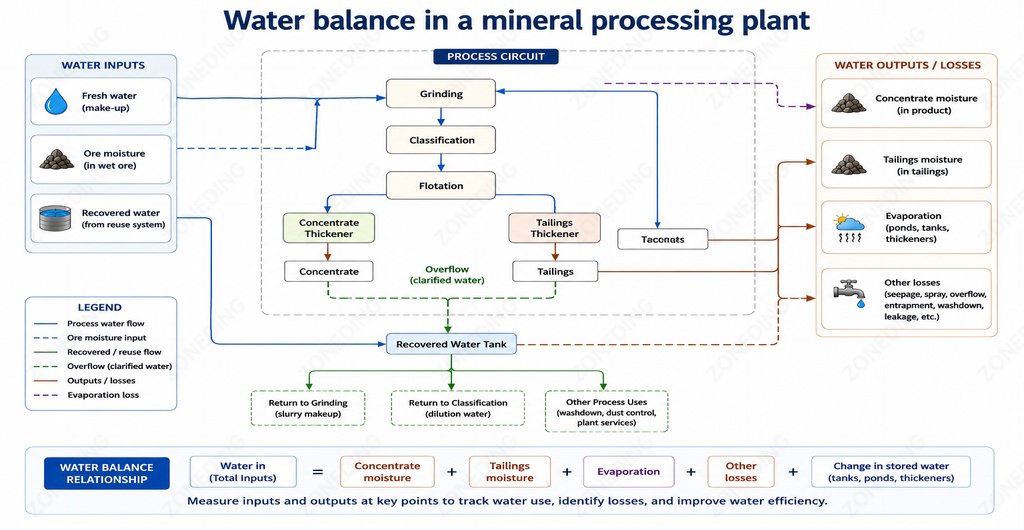
Water In = Water in Products + Water in Tailings + Evaporation + Other Losses + Change in Stored Water
In practice, engineers should measure the main water streams across the plant.
Water balance diagram for mineral processing plant water reduction
These usually include:
Fresh process water
Recycled process water
Water entering with wet ore
Grinding water
Classification dilution water
Flotation water
Thickener overflow
Filter filtrate
Concentrate moisture
Tailings moisture
Washdown water
Evaporation and visible losses
This creates a map of actual fresh-water demand.
One common problem is uncontrolled dilution.
Operators may add extra water to stabilize pumps, classifiers, flotation cells, or pipelines. Each addition may look small, but together they can increase the volume that downstream equipment must process.
Instead of relying only on manual adjustment, plants should monitor:
Slurry density
Solids concentration
Flow rate
Tank level
Classification performance
Thickener performance
Filter performance
The objective is not making every stream as thick as possible.
Instead, the plant should maintain correct process conditions without adding more water than necessary.
A water balance also shows where recycling gives the greatest benefit.
For example:
Thickener Overflow → Recovered Water Tank → Grinding or Classification
Another common loop is:
Filter Filtrate → Recovered Water Tank → Suitable Process Reuse
However, recycled water quality must be considered. Water suitable for grinding may not always be suitable for flotation or other chemically sensitive stages.
How Thickeners Recover Process Water
Thickening is one of the main opportunities for water recovery in mineral processing.
A thickener separates slurry into two streams:
Overflow → Clarified Water
Underflow → Higher-Solids Slurry
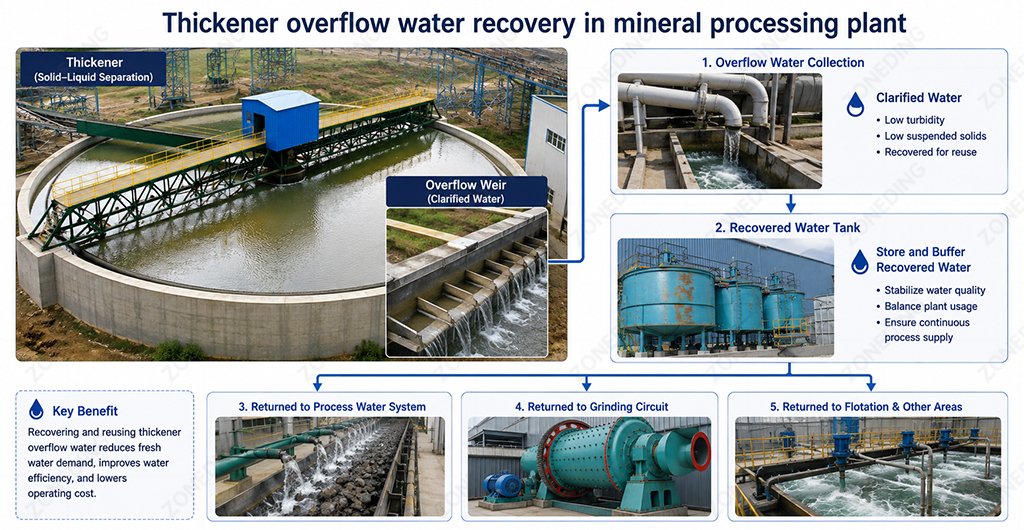
Instead of allowing overflow water to leave the process, it can often be collected and reused in a suitable part of the plant.
A High Efficiency Concentrator can be used in concentrate or tailings handling where thickening is required before filtration, further treatment, or disposal.
Thickener overflow water recovery in mineral processing plant
The amount and quality of recovered water depend on several factors:
Feed solids concentration
Particle size distribution
Mineral characteristics
Flocculation conditions
Settling behavior
Thickener loading
Underflow density target
This is why a thickener should not be selected only by plant throughput.
Poor settling may produce turbid overflow. Incorrect operation may also fail to achieve the required underflow density.
From a water-management perspective, thickening provides two major benefits.
First, it separates reusable water from slurry before that water is lost with concentrate or tailings.
Second, higher-solids underflow reduces the amount of water that downstream filtration equipment must remove.
A practical return-water system may look like this:
Tailings Slurry → Thickener → Overflow Water Tank → Process Water Return
At the same time:
Thickener Underflow → Filtration or Tailings Management
This makes the thickener part of a complete water-recovery system, not only an isolated piece of equipment.
Engineer Tip: Do not judge a thickener only by how clear the overflow looks. Stable underflow density, downstream filtration needs, process-water quality, and the full water balance should be evaluated together.
How Filtration Reduces Water Loss in Tailings
Tailings can carry a large amount of process water out of the active plant circuit.
The wetter the discharged tailings are, the more water remains locked in the solids instead of returning to production.
Filtration can recover additional water after thickening.
The filtrate can then be collected in a return-water tank and reused where its quality is acceptable.
Filtration can be valuable when:
Fresh water is limited
Tailings water recovery is important
Wet tailings storage is undesirable
Lower-moisture tailings are required
The site is considering filtered tailings or dry stacking
However, filtration is not automatically the best solution for every plant.
Filter selection depends on:
Particle size
Clay content
Slurry characteristics
Required cake moisture
Filtration rate
Plant throughput
Operating requirements
Maintenance requirements
Very fine or difficult-to-filter material may require a larger filtration area or different operating conditions.
For this reason, the dewatering circuit should be considered during flowsheet design. It should not be added only after the rest of the plant has already been selected.
The objective is not simply producing a dry filter cake.
A better engineering target is balancing:
Water Recovery + Tailings Handling + Equipment Capacity + Operating Cost + Process Stability
When designed correctly, thickening and filtration work together to reduce water loss in the final tailings stream.
How to Control Grinding, Classification, and Flotation Water
Water recovery equipment alone cannot solve high plant water consumption.
Water addition inside the processing circuit must also be controlled.
Grinding is a good example.
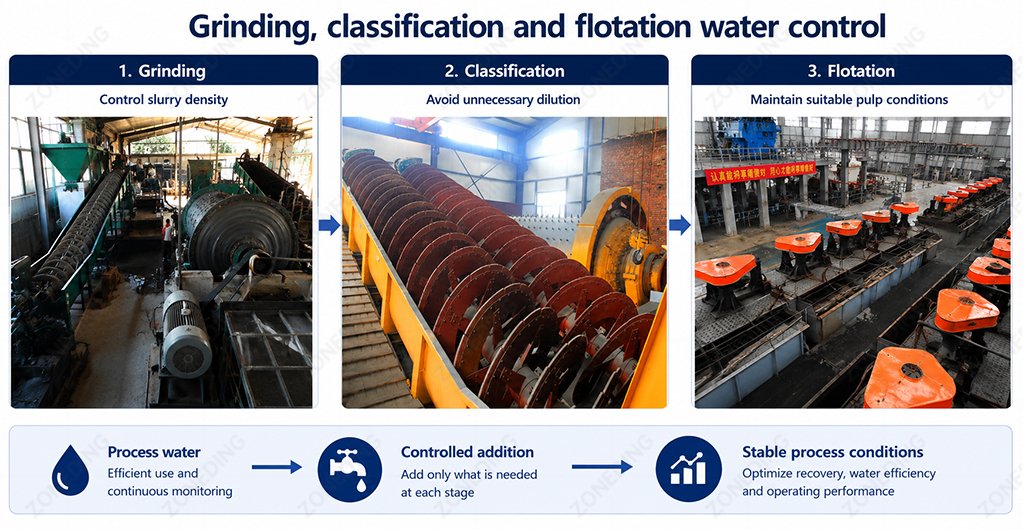
Grinding classification and flotation water control in mineral processing
Water is added to maintain suitable slurry density for milling and material transport. Too little water may make slurry difficult to pump. Excessive dilution increases the volume passing through classification and beneficiation.
A Ball Mill should operate around the slurry conditions required by the ore and grinding circuit, not simply with as much water as possible.
Classification also creates an opportunity for better water control.
Hydrocyclones and classifiers may require dilution to achieve the desired separation. However, unnecessary dilution increases circulating slurry volume and downstream dewatering demand.
Plants should monitor classification performance together with water addition.
The same principle applies to flotation.
A Flotation Machine requires suitable pulp conditions for mineral separation. Reducing water blindly may affect mixing, air dispersion, reagent performance, and mineral recovery.
Recycled water adds another consideration.
Water returning from thickeners and filters may contain:
Dissolved salts
Residual reagents
Fine suspended solids
Metal ions
Other dissolved species
Their impact depends on the ore and process.
Therefore, more recycled water is not automatically better.
Some recovered water may return directly to grinding or classification. More chemically sensitive stages may require better water-quality control or partial fresh-water make-up.
A practical plant should manage both:
Water Quantity + Water Quality
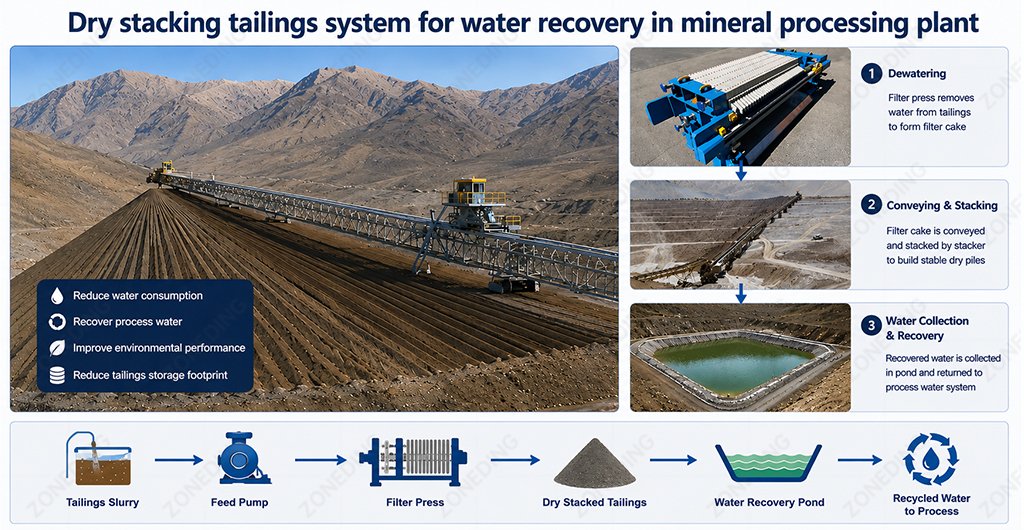
When Does Dry Stacking Make Sense?
Filtered tailings and dry stacking can reduce the amount of water leaving the plant with wet tailings.
Still, dry stacking should not automatically be treated as the best solution for every project.
Dry stacking tailings system for water recovery in mineral processing plant
Recovered water from thickening and filtration then returns to the process-water system.
Compared with conventional slurry disposal, dry stacking can improve immediate water recovery and reduce the volume of water stored with tailings.
It may deserve serious consideration when:
Fresh water is difficult or expensive to obtain
Tailings water recovery is a high project priority
Site conditions support filtered tailings handling
Water storage in the tailings system needs to be reduced
Project or environmental requirements support filtered tailings
However, dry stacking introduces additional equipment and operating requirements.
The plant may need:
Thickening equipment
Filtration equipment
Cake conveying or transport
Stacking equipment
Additional power
Filter cloth and wear-part management
Suitable storage-area preparation
Ore characteristics also matter.
Fine particles, clay-rich tailings, and difficult filtration behavior can strongly affect filter capacity and cake handling.
For this reason, buyers should not select dry stacking only because it appears to be the most water-efficient option.
The better question is:
How much water can the complete tailings system recover at an acceptable technical and operating cost?
For some projects, conventional thickening with effective return-water management may be enough.
Other projects may justify additional filtration and dry stacking.
The answer should come from tailings characteristics, water availability, site conditions, and complete project design.
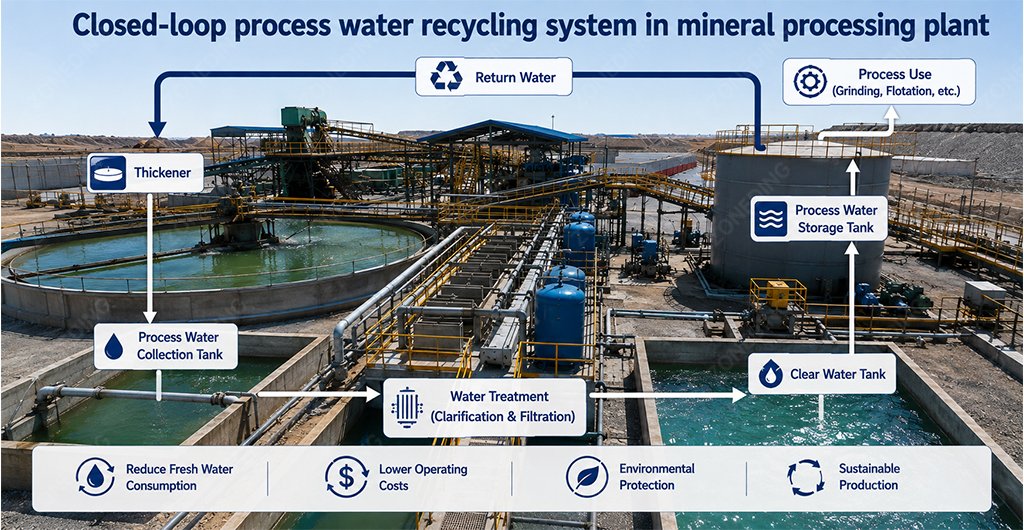
How to Build a Closed-Loop Water Recycling System
A practical water-recycling system connects the major recovery streams instead of allowing each section to manage water independently.
A simplified closed-loop circuit can be described as:
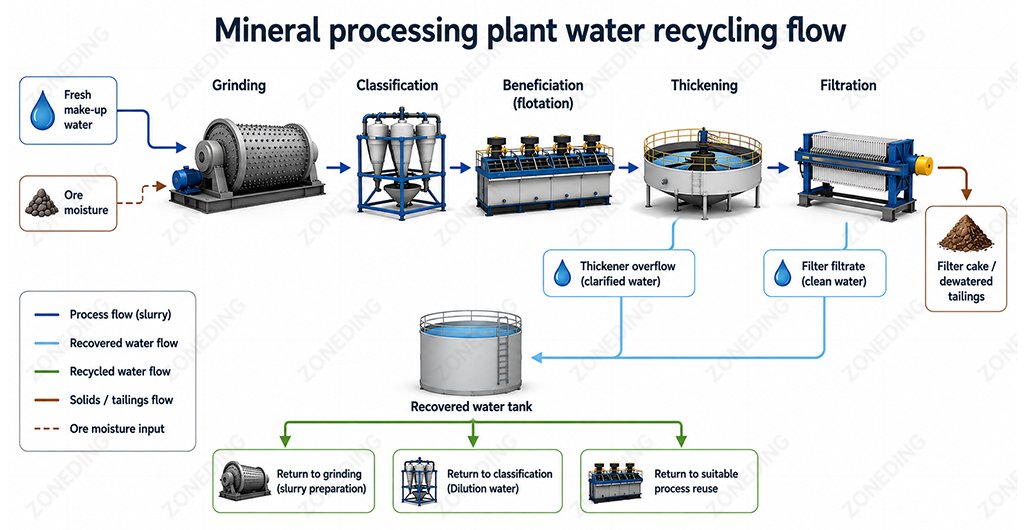
Fresh Make-Up Water → Process Water Tank → Grinding and Classification → Beneficiation → Thickening and Filtration → Recovered Water Tank → Suitable Process Reuse
Closed-loop process water recycling system in mineral processing plant
Fresh water is then added mainly to replace unavoidable losses and maintain required water quality.
A closed-loop design should consider four areas.
1. Water source
Identify fresh water, thickener overflow, filter filtrate, drainage, washdown water, and other recoverable streams.
2. Water quality
Determine where each recovered stream can safely be reused.
Water suitable for grinding may not automatically be suitable for flotation or other chemically sensitive processes.
3. Storage and control
Recovered-water tanks provide buffering between variable water recovery and variable plant demand.
Pumps, level control, flow measurement, and slurry-density monitoring help stabilize the system.
4. Bleed and make-up requirements
A completely closed circuit is not always desirable.
Repeated recycling can allow dissolved salts, residual reagents, fine solids, or other contaminants to accumulate.
Depending on the ore and beneficiation process, part of the circulating water may need treatment, controlled discharge, or replacement with fresh make-up water.
Therefore, the target should not automatically be:
100% Water Recycling
A better engineering target is:
Maximum Practical Reuse + Stable Water Quality + Stable Mineral Recovery
Plants should also investigate simple losses before investing in major new equipment.
Common problems include:
Leaking pipes and pumps
Tank overflow
Excessive washdown
Uncontrolled hose use
Poor slurry-density control
Unnecessary dilution
Poor thickener operation
Inefficient filtration
Return-water system bottlenecks
Correcting these problems may reduce fresh-water demand while improving plant stability.
For plants processing flotation ores such as copper, the water circuit should be considered together with grinding, flotation, thickening, and concentrate or tailings handling. A complete Copper Processing Plant shows why these stages need to be designed as one connected system.
Ultimately, reducing water consumption is not about installing one “water-saving machine.”
It requires a plant-wide strategy:
Measure → Control → Recover → Reuse → Monitor
When these steps work together, the plant can reduce unnecessary fresh-water intake without sacrificing process stability.
Frequently Asked Questions
How can a mineral processing plant reduce fresh-water consumption?
Start with a plant-wide water balance. Then eliminate unnecessary dilution and leaks, recover water from thickening and filtration, and return suitable recovered water to the process. Fresh water should mainly replace unavoidable losses and maintain required water quality.
Can thickener overflow be reused in the processing plant?
Often yes. However, the correct reuse point depends on overflow quality and process requirements. Grinding and classification may tolerate different water characteristics from chemically sensitive flotation stages.
Does a filter press reduce water consumption?
Filtration can recover water that would otherwise remain in wet concentrate or tailings. Its suitability depends on particle size, slurry properties, required cake moisture, throughput, and downstream handling.
Is 100% water recycling possible in a mineral processing plant?
It should not be assumed as the design target. Repeated recycling can concentrate dissolved salts, residual reagents, fine solids, and other substances. Some circuits require fresh make-up water, treatment, or controlled bleed streams.
Is dry stacking always better for water recovery?
No. Filtered tailings can improve immediate water recovery, but filtration, transport, stacking, energy use, and tailings characteristics must also be considered. The best solution depends on the complete project.
Key Takeaways
Reducing mineral processing water consumption starts with a plant-wide water balance.
Unnecessary dilution should be controlled before adding major water-recovery equipment.
Thickener overflow and filter filtrate can become valuable process-water sources.
Grinding, classification, and flotation need controlled slurry conditions, not simply less water.
Recycled-water quality matters as much as recycled-water quantity.
Dry stacking can improve water recovery, but it is not automatically the best option for every mine.
A practical closed-loop system still needs fresh make-up water when losses or water-quality requirements demand it.
The best strategy is to measure, control, recover, reuse, and continuously monitor the complete water circuit.
About ZONEDING
ZONEDING provides mineral processing equipment and plant solutions covering crushing, grinding, classification, flotation, concentration, dewatering, and material handling.
For projects where water availability or tailings management is a major design constraint, the process should be evaluated as a complete system rather than selecting individual machines independently.
Useful project information includes:
Ore type and test results
Required processing capacity
Grinding and beneficiation flowsheet
Slurry characteristics
Fresh-water availability
Existing process-water system
Concentrate and tailings requirements
Site and tailings-storage conditions
Based on these inputs, ZONEDING engineers can evaluate the processing and water-recovery circuits together when developing the equipment configuration and plant layout.
The construction industry relies on seven distinct types of sand to ensure structural integrity and finish quality. However, natural river sand is becoming scarce and expensive due to environmental regulations. For aggregate producers, the real op...
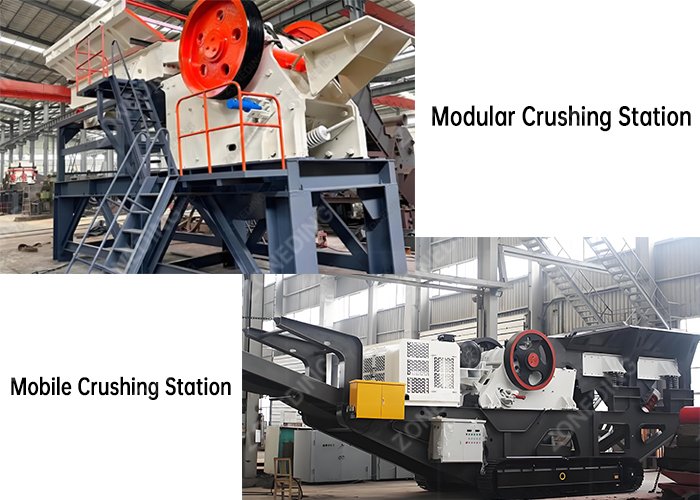
Choosing between a modular crushing station and a mobile crushing plant depends on project duration and move frequency. A mobile plant offers speed for short projects. A modular plant provides stability for long-term production. I have seen many o...
Managing scattered construction sites requires highly adaptable equipment. The mobile crushing plant solves the massive challenge of tight schedules and frequent project relocations. Multi-project contractors deploy these machines to eli...
We use cookies to ensure that we give you the best experience on our website. If you continue to use this site we will assume that you are happy with it.
Privacy Policy
Send us a message
We would love to hear from you
Submit your question and our team will respond to the email provided as soon as possible.
 Zoneding Machine