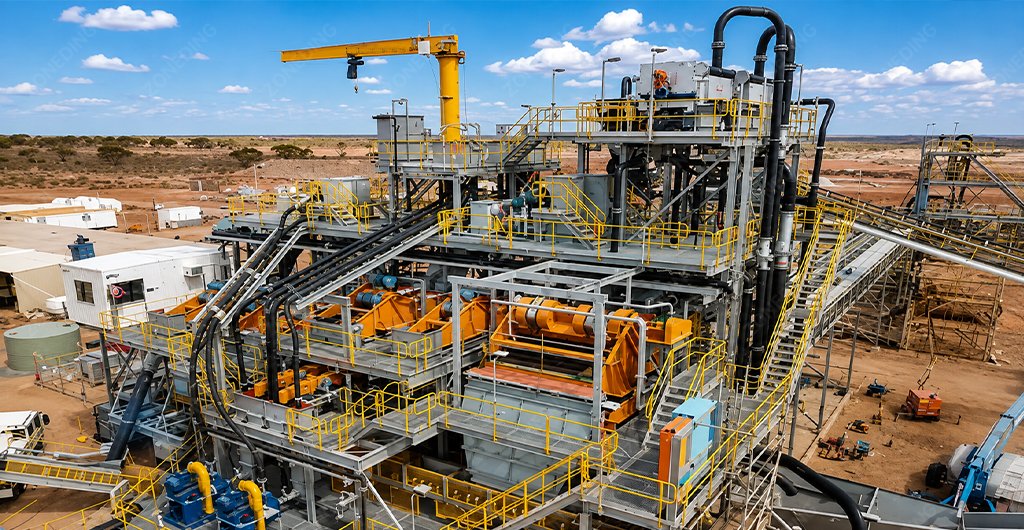
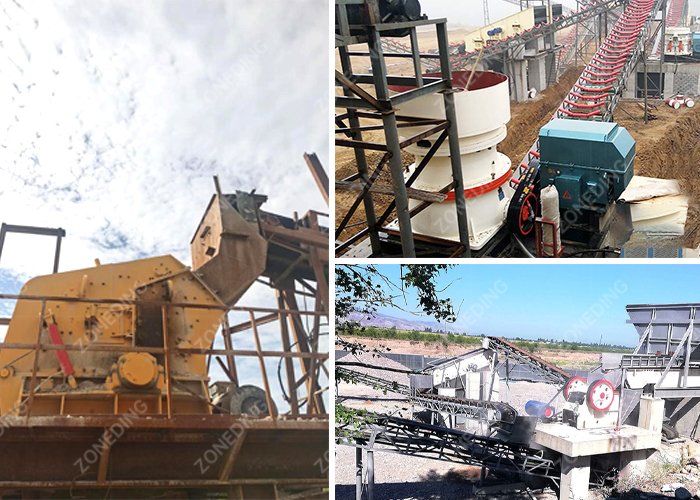
Lithium processing plant cost varies widely because no two hard-rock lithium projects have exactly the same ore, liberation size, capacity, or beneficiation requirements.
A small spodumene beneficiation line and a large commercial concentrator may use similar processing stages, but the equipment size, power demand, infrastructure, and total investment can be very different.
Therefore, the right question is not simply, “How much does a lithium plant cost?” Buyers should first define the ore, required capacity, target concentrate, and process needed to reach that target.
There is no reliable universal price for a lithium processing plant.
Two plants designed for the same throughput may require very different investment because one ore may liberate relatively easily while another needs finer grinding and more complex separation.
Lithium processing plant cost and equipment breakdown
The main cost areas normally include:
Cost Area
Typical Equipment or Work
Feeding and crushing
Feeder, primary and secondary crushers, screen
Grinding and classification
Mill, classifier or hydrocyclone
Beneficiation
Test-defined separation equipment
Dewatering
Thickener, filtration and slurry handling
Material handling
Conveyors, pumps and pipelines
Electrical system
Motors, controls and distribution
Civil works
Foundations, platforms and structures
Engineering and service
Flowsheet, layout and installation support
For this reason, comparing quotations only by total equipment price can be misleading.
One supplier may quote only the main machines, while another includes conveyors, pumps, controls, spare parts, steel structures, and commissioning support.
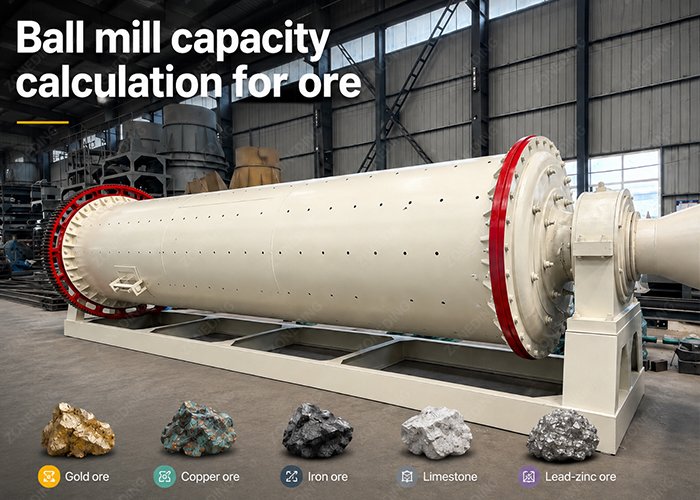
Grinding can also change the economics significantly. If lithium-bearing minerals require fine liberation, a larger or more powerful Ball Mill may be needed, increasing both CAPEX and long-term electricity consumption.
A useful quotation should therefore include:
Ore type
Feed size
Required capacity
Available test results
Target concentrate specification
Site power and water conditions
Why Does Lithium Ore Type Change the Processing Cost?
Lithium-bearing hard-rock ores do not all respond to the same process.
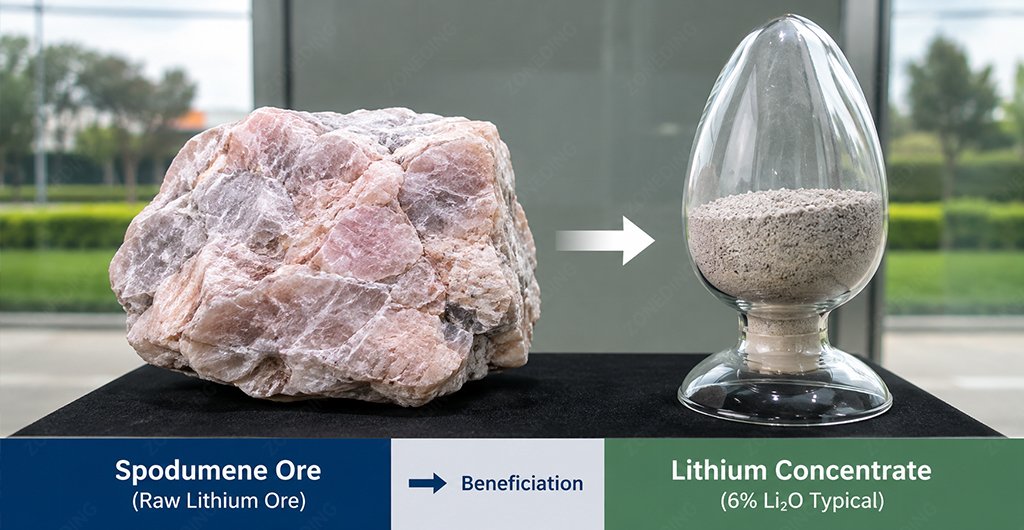
Hard rock spodumene ore processing and beneficiation flow
Even two spodumene ores can require different flowsheets because of differences in:
Mineral grain size
Gangue composition
Degree of intergrowth
Weathering
Impurity content
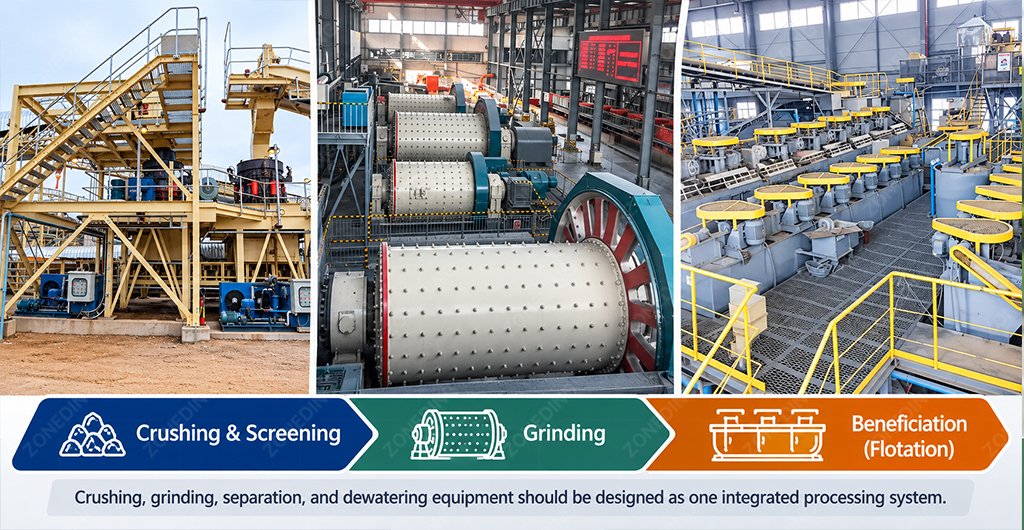
A typical hard-rock beneficiation route may follow:
If the valuable mineral liberates at a relatively coarse size, grinding requirements may be moderate. If the ore is finely intergrown, the plant may require finer grinding, tighter classification, and additional separation stages.
Ore characteristics can therefore change:
Crushing requirements
Grinding power
Classification equipment
Beneficiation complexity
Water demand
Dewatering requirements
Wear-part consumption
What Equipment Does a Lithium Processing Plant Need?
The exact equipment list should follow metallurgical test results, but a hard-rock lithium beneficiation plant commonly includes:
Crushing grinding and beneficiation equipment for lithium ore
Stage
Typical Equipment
Main Function
Feeding
Vibrating feeder
Stable ore feeding
Primary crushing
Jaw crusher
Reduce ROM ore
Secondary crushing
Cone crusher
Prepare feed for grinding
Screening
Vibrating screen
Control crusher product
Grinding
Ball mill
Liberate lithium-bearing minerals
Classification
Classifier / hydrocyclone
Control grinding size
Beneficiation
Test-dependent equipment
Separate valuable minerals
Dewatering
Thickener / filter
Reduce concentrate moisture
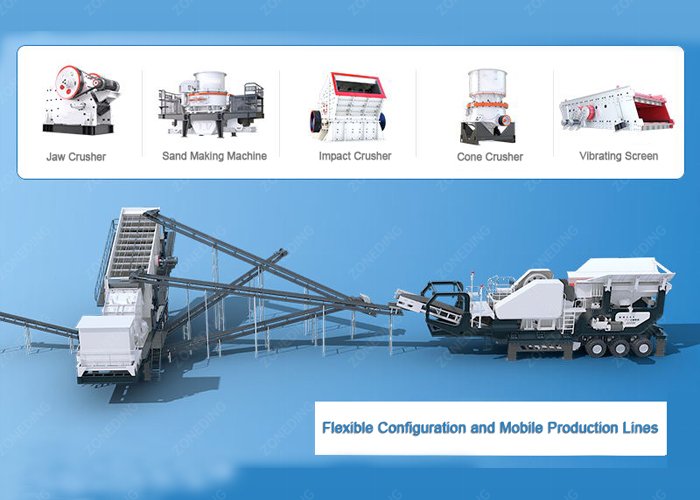
A Jaw Crusher is commonly used for primary hard-rock reduction, while a Cone Crusher can handle secondary crushing before grinding.
The goal is not to crush as fine as possible. Instead, the crushing circuit should provide a stable and suitable feed for the mill.
After grinding and classification, the beneficiation equipment depends on the ore.
Fine lithium-bearing minerals may require a Flotation Machine, while a Magnetic Separator may be appropriate when magnetic impurity removal or mineral separation is supported by testing.
Dewatering should also be included in the overall plant design. A High Efficiency Concentrator can thicken concentrate or tailings slurry and recover process water before downstream filtration or disposal.
The key point is simple: flotation, magnetic separation, and dewatering equipment should be included because the test results require them—not because another lithium plant uses them.
How Does Plant Capacity Affect Equipment and Investment?
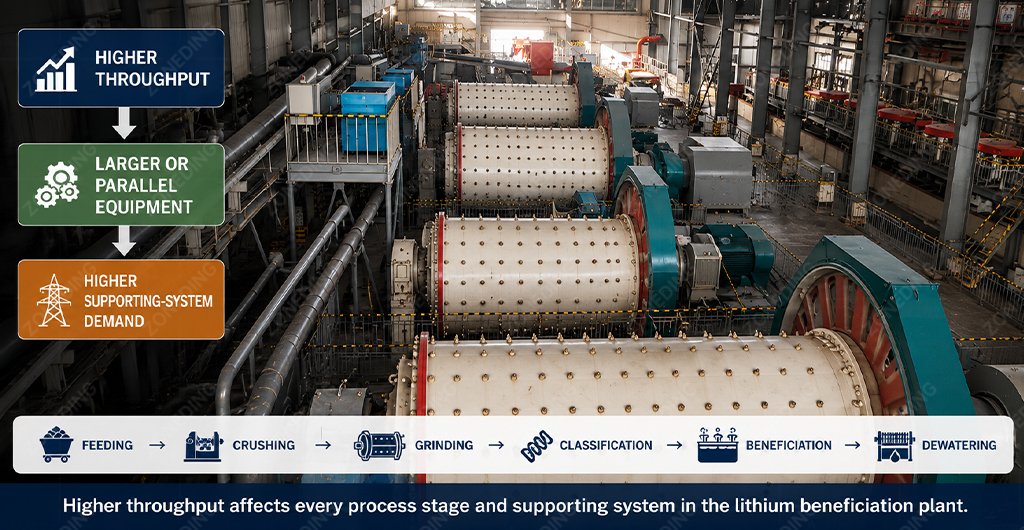
Plant capacity affects the entire processing line, not just crusher size.
Lithium processing plant capacity and equipment sizing
As throughput increases, engineers must check whether the following stages can handle the additional material:
Feeding
Crushing
Screening
Grinding
Classification
Beneficiation
Slurry transport
Dewatering
A larger crusher does not create a higher-capacity plant if the mill or downstream separation stage becomes the bottleneck.
Capacity also affects supporting infrastructure.
Project Condition
Likely Investment Impact
Higher throughput
Larger or additional equipment
Larger ROM feed
Greater primary crushing requirement
Harder ore
More crushing and grinding demand
Finer liberation size
Higher grinding power
Complex beneficiation
More processing stages
Existing infrastructure
May reduce supporting investment
Remote site
Higher logistics and installation demands
For this reason, plant size should match realistic production requirements rather than simply choosing the largest equipment within the budget.
Which Factors Have the Biggest Impact on Lithium Plant Cost?
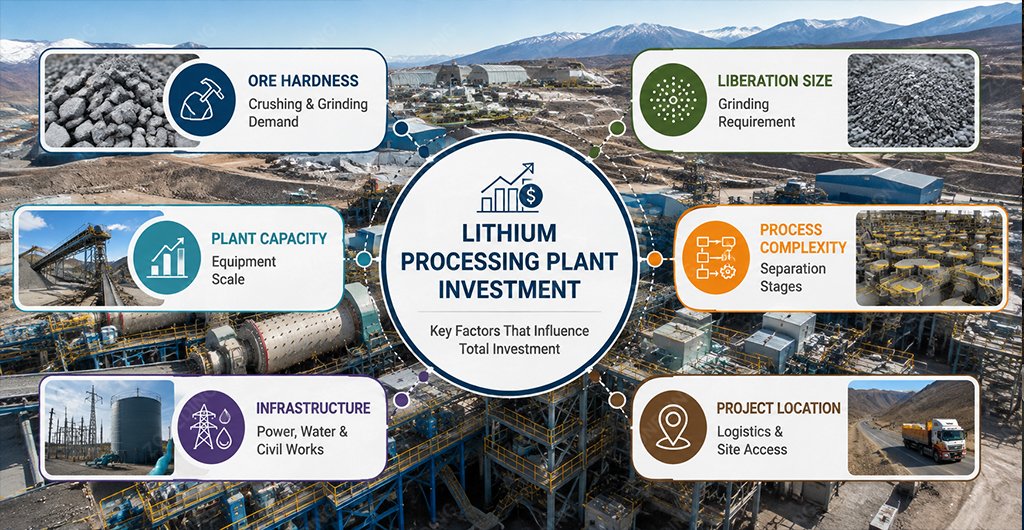
The largest cost differences usually come from ore characteristics, liberation size, beneficiation complexity, and site conditions.
Ore hardness, liberation size, capacity, process complexity, infrastructure, and location influence lithium plant investment
Cost Factor
Why It Matters
Ore hardness
Harder ore increases crushing and grinding demand
Liberation size
Finer targets require more grinding
Ore variability
May require greater process flexibility
Beneficiation complexity
More separation stages increase equipment scope
Capacity
Larger throughput requires larger or parallel equipment
Concentrate specification
Higher quality may require additional cleaning
Water availability
May increase recycling and dewatering requirements
Site infrastructure
Power, roads and foundations affect total scope
Location
Freight and site access influence delivered cost
Grinding deserves particular attention because a mill selected only from catalogue capacity may become expensive to operate if the ore is harder than assumed.
Beneficiation complexity can have an equally large impact. Some ores may require a relatively simple process, while others need multiple separation and cleaning stages.
This is why the complete Lithium Processing Plant should be evaluated as one integrated system rather than as an equipment shopping list.
How Can You Reduce Lithium Processing Costs Without Hurting Recovery?
Cost reduction should focus on process efficiency rather than removing necessary equipment.
One of the best opportunities is matching the crushing circuit to the grinding requirement.
Crushing too fine can increase wear and unnecessary fines. Sending overly coarse material to the mill increases grinding power and may reduce throughput.
A correctly selected Vibrating Screen helps remove qualified material and prevents unnecessary recirculation.
Grinding should follow the same principle. Do not grind finer simply because the mill can achieve a smaller product size.
Overgrinding can cause:
Higher electricity use
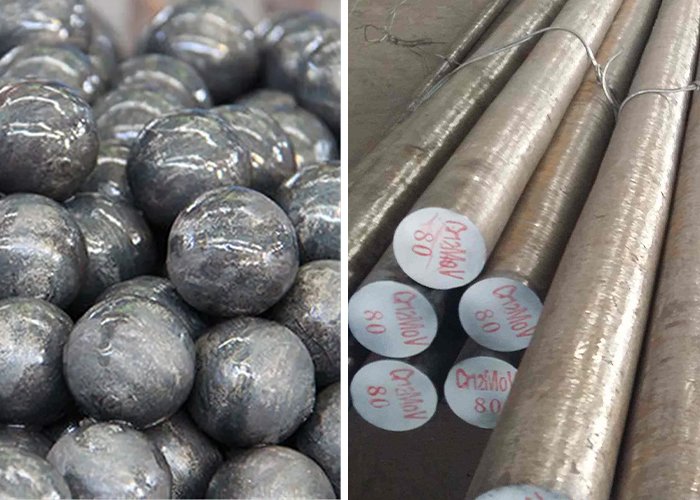
More media wear
Lower throughput
More fines or slimes
Greater downstream separation difficulty
Classification efficiency is equally important. Finished particles should leave the grinding circuit instead of returning repeatedly to the mill.
What Should You Confirm Before Requesting a Lithium Plant Quote?
A quotation becomes more useful when the supplier receives complete project information.
A request such as:
“I need a 100 TPH lithium processing plant.”
is not enough.
Prepare:
Lithium-bearing mineral type
Ore assay or test report
Maximum feed size
Required capacity
Liberation information, if available
Target concentrate specification
Project country and site conditions
Available electricity
Available process water
Existing equipment
Planned operating hours
Future expansion requirement
The quotation should also clearly state whether it includes:
Main processing equipment
Feeders and conveyors
Motors and drives
Pumps and slurry equipment
Electrical controls
Steel structures
Wear and spare parts
Process flow diagram
Plant layout
Installation guidance
Commissioning support
Finally, distinguish between a lithium mineral concentrator and a downstream lithium chemical plant.
Producing spodumene concentrate is not the same as producing battery-grade lithium carbonate or lithium hydroxide. Chemical conversion requires additional thermal, hydrometallurgical, purification, and product-finishing systems.
Frequently Asked Questions
How much does a lithium processing plant cost?
There is no universal price. Cost depends on ore properties, capacity, liberation size, beneficiation method, equipment scope, infrastructure, and location.
What equipment is needed for a spodumene processing plant?
Typical stages include feeding, crushing, screening, grinding, classification, beneficiation, and dewatering. The exact separation equipment should follow metallurgical testing.
Does a larger lithium plant always have a lower cost per ton?
No. Scale can help, but poor equipment utilization, excessive grinding, or an unnecessarily complex flowsheet can increase actual processing cost.
Is flotation required for every lithium ore?
No. The correct beneficiation method depends on mineralogy and liberation characteristics. Testing should determine whether flotation or another separation method is suitable.
Can the same beneficiation plant produce battery-grade lithium carbonate or hydroxide?
No. Mineral concentration and downstream lithium chemical conversion are separate processing stages with different equipment requirements.
Key Takeaways
Lithium processing plant cost cannot be estimated accurately from capacity alone.
Ore hardness and liberation size strongly influence grinding investment and operating cost.
Beneficiation equipment should be selected from test results.
Quotations should be compared using the same scope of supply.
Overgrinding and oversized equipment can raise cost without improving recovery.
Future expansion should be planned without unnecessarily oversizing the initial plant.
Lithium concentrate production and battery-grade lithium chemical production are different project scopes.
About ZONEDING
ZONEDING provides crushing, screening, grinding, classification, separation, material handling, and dewatering equipment for hard-rock lithium beneficiation projects.
Our engineering team develops equipment configurations based on ore characteristics, capacity requirements, target concentrate specifications, and available test results.
For a preliminary process and quotation evaluation, provide:
Investing in a mobile crushing station for mining requires careful equipment selection. Showroom specifications often fail in actual quarry environments. Remote mines lack reliable power grids, clean air, and fast internet. Standard equipment conf...
Selecting between a and a Rod Mill is a critical decision in mineral processing. This choice impacts recovery rates, power use, and overall plant profit. A ball mill uses steel balls to grind ore into fine powder. A rod mill uses long st...
Understanding the mechanical logic of crushing equipment is vital for project profitability. Selecting a machine based solely on capacity ignores the reality of wear and energy costs. Different stones require different mechanical principles—either...
We use cookies to ensure that we give you the best experience on our website. If you continue to use this site we will assume that you are happy with it.
Privacy Policy
Send us a message
We would love to hear from you
Submit your question and our team will respond to the email provided as soon as possible.
 Zoneding Machine