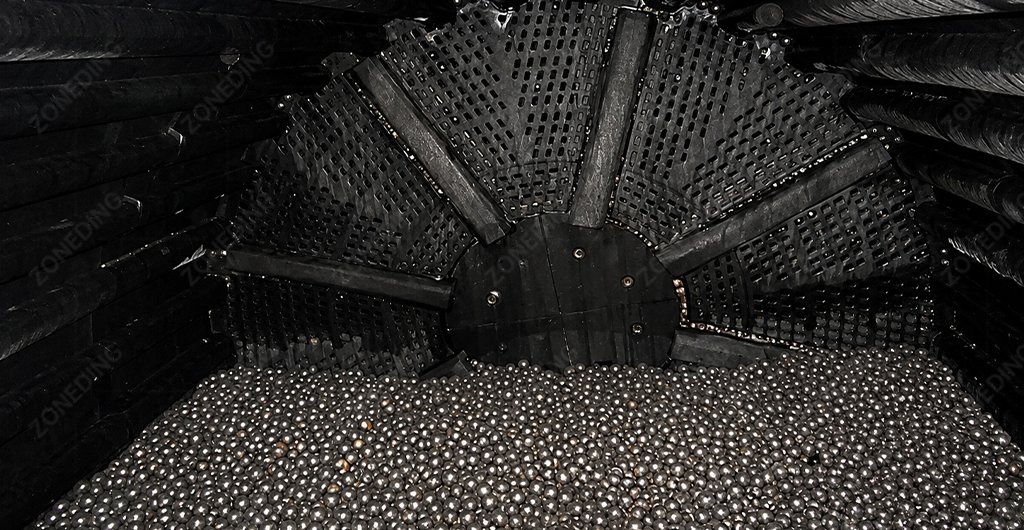
Ball mill liners protect the mill shell, lift the grinding media, and control how grinding energy is transferred to the ore.
Choosing the wrong liner can shorten service life, increase shutdowns, raise power consumption, and reduce grinding efficiency.
Ore hardness is one of the first factors engineers consider during liner selection. However, hardness alone is not enough.
Two ores with similar hardness may create very different wear conditions. One may produce heavy impact loads, while another may cause severe abrasive wear because of sharp quartz or silica-rich particles.
Therefore, effective ball mill liner selection must balance impact resistance, abrasion resistance, liner weight, grinding efficiency, maintenance frequency, and total operating cost.
This guide explains how ore hardness affects liner selection, how to compare common liner materials, and how to avoid mistakes that cause premature liner failure.
Why Does Ore Hardness Matter in Ball Mill Liner Selection?
Ore hardness affects the force required to break particles inside the mill.
Harder ore usually creates stronger contact between grinding balls, ore particles, and the liner surface. This can increase impact loading, liner deformation, surface wear, and power consumption per ton.
As ore hardness increases, the grinding circuit may experience:
Higher grinding resistance
Lower throughput
Longer material residence time
Higher grinding media consumption
Increased liner wear
Greater power demand
However, hard ore does not always damage liners in the same way.
A hard quartz-rich ore may cause severe abrasive wear because sharp particles repeatedly scratch the liner surface. In contrast, a coarse and competent feed may create heavy impact loads that require tougher liner material.
This difference is important.
A liner with excellent abrasion resistance may be too brittle for strong impact. Meanwhile, a highly impact-resistant liner may wear faster in a strongly abrasive environment.
For this reason, liner selection should begin with two separate questions:
How difficult is the ore to break?
How aggressively does the ore wear the liner surface?
Ore hardness helps answer the first question. Ore abrasiveness helps answer the second.
How Do You Evaluate Ore Hardness and Abrasiveness?
Before selecting a liner, engineers should evaluate both ore data and operating conditions.
Ore Hardness
Ore hardness describes how strongly the material resists breakage.
Common references include:
Bond Work Index
Mohs hardness
Uniaxial compressive strength
Laboratory grindability tests
Historical plant performance
The Bond Work Index is widely used for grinding circuit design. A higher value usually means more energy is required to reduce the ore to the target size.
However, Bond Work Index is not a direct liner wear index.
It helps estimate grinding energy, but it does not fully describe how sharp particles interact with liner surfaces.
Ore Abrasiveness
Abrasiveness refers to the ability of the ore to remove material from liners and grinding media.
It is often influenced by:
Quartz content
Silica content
Particle shape
Mineral grain structure
Feed size
Slurry concentration
Wet or dry grinding conditions
An ore may be only medium-hard but still highly abrasive. This is common when the material contains sharp quartz particles.
Impact Conditions
Impact load inside a ball mill depends on more than the ore.
Important factors include:
Mill diameter
Feed particle size
Grinding ball diameter
Lifter height
Mill speed
Ball filling level
Liner profile
Large mills with coarse feed and large grinding balls usually create stronger impact than smaller mills used for fine grinding.
Whenever possible, liner selection should be based on test results, operating data, and wear history rather than ore name alone.
Which Liner Materials Are Used in Ball Mills?
Ball mill liners are manufactured from several materials.
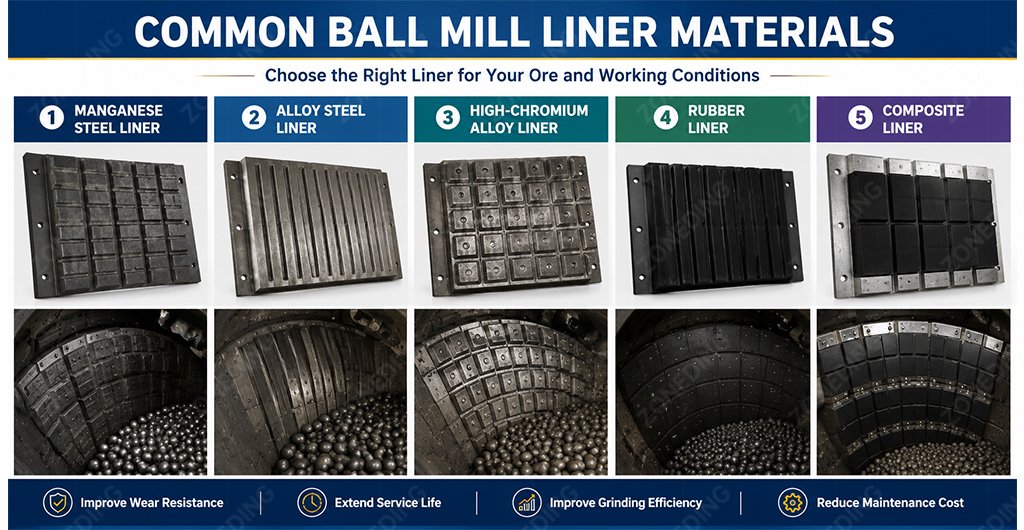
Each material offers a different balance of toughness, abrasion resistance, weight, and cost.
Common ball mill liner materials including manganese steel alloy steel rubber and composite liners
Liner Material
Main Strength
Main Limitation
Typical Direction
High manganese steel
High toughness under impact
May wear faster under low-impact abrasion
Coarse grinding and heavy impact
Alloy steel
Balanced hardness and toughness
Must match the real grinding duty
General hard-ore grinding
High-chromium alloy
Strong abrasion resistance
Lower toughness under heavy impact
Abrasive wear with controlled impact
Rubber liner
Lower weight and noise
Less suitable for severe impact
Fine grinding and lower-impact duty
Rubber-metal composite
Balanced impact and abrasion support
Usually needs customized design
Wet grinding or mixed wear conditions
High Manganese Steel
High manganese steel is known for toughness and work-hardening ability.
When it receives repeated impact, the surface can become harder while the inner structure remains tough. This makes it useful in coarse grinding and high-impact conditions.
However, it may not work-harden effectively when the impact force is too low.
In low-impact but highly abrasive grinding, wear can be faster than expected.
Alloy Steel
They are widely used because their properties can be adjusted for different ore and mill conditions.
The exact alloy design should match feed size, mill diameter, ball size, impact intensity, and abrasive wear pattern.
Alloy steel liners can be designed with different levels of hardness and toughness.
They may suit applications where surface wear is more serious than impact damage.
Still, high hardness usually means lower toughness. Therefore, high-chromium liners should be evaluated carefully before use in large mills with heavy impact loads.
Rubber and Composite Liners
Rubber liners are lighter than steel liners and can reduce noise.
They are commonly considered for small and medium mills, secondary grinding, fine grinding, wet grinding, and lower-impact applications.
Rubber-metal composite liners combine metal lifters with rubber sections. The metal part supports impact and lifting, while the rubber part can reduce weight, noise, and some forms of corrosion-related wear.
What Liners Are Best for Soft and Medium-Hard Ores?
Soft and medium-hard ores usually create lower breakage resistance than highly competent hard rock.
However, this does not automatically mean liner wear will be low.
Some soft ores are sticky, corrosive, or highly abrasive. Others generate large volumes of fine particles that increase sliding wear.
Soft, Low-Abrasive Ore
For relatively soft and low-abrasive material, the liner does not always need maximum impact strength.
Possible options include:
Rubber liners
Composite liners
Medium-hardness alloy steel
Rubber liners may be attractive in wet grinding when feed size is controlled and impact loads are moderate.
Their lower weight can also simplify installation and reduce handling difficulty.
Medium-Hard Ore
Medium-hard ores often require a balance between toughness and wear resistance.
Alloy steel or high manganese steel may be considered depending on feed size, mill diameter, ball size, liner profile, and impact intensity.
If the feed is relatively coarse, toughness becomes more important.
When the mill performs fine grinding with smaller balls, abrasion resistance may become the main concern.
Common Mistake
A common mistake is selecting rubber liners only because the ore is described as soft.
If the feed contains oversized particles, tramp metal, or sharp abrasive minerals, rubber liners may suffer cutting, tearing, or localized damage.
The entire feed condition must be checked before choosing a lighter liner material.
What Liners Are Best for Hard and Abrasive Ores?
Hard and abrasive ores create some of the most demanding liner conditions.
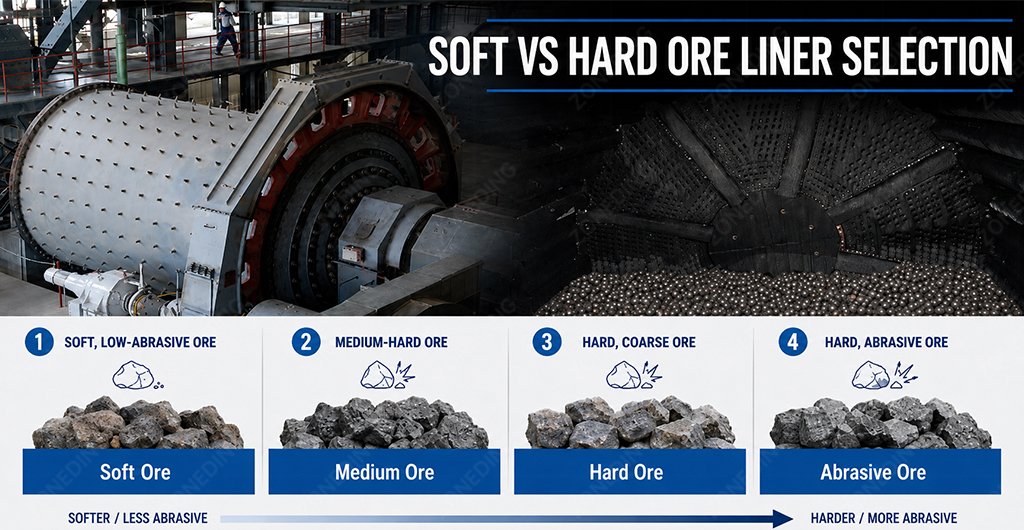
Examples may include quartz-rich gold ore, hard iron ore, siliceous copper ore, and other competent rock types.
Ball mill liner selection for soft medium hard and abrasive ores
Hard Ore with Heavy Impact
When the mill receives coarse, hard feed, liners must absorb repeated impact without cracking.
Possible materials include:
High manganese steel
Tough alloy steel
Composite liners with reinforced metal lifters
In these conditions, selecting the hardest available material is not always safe.
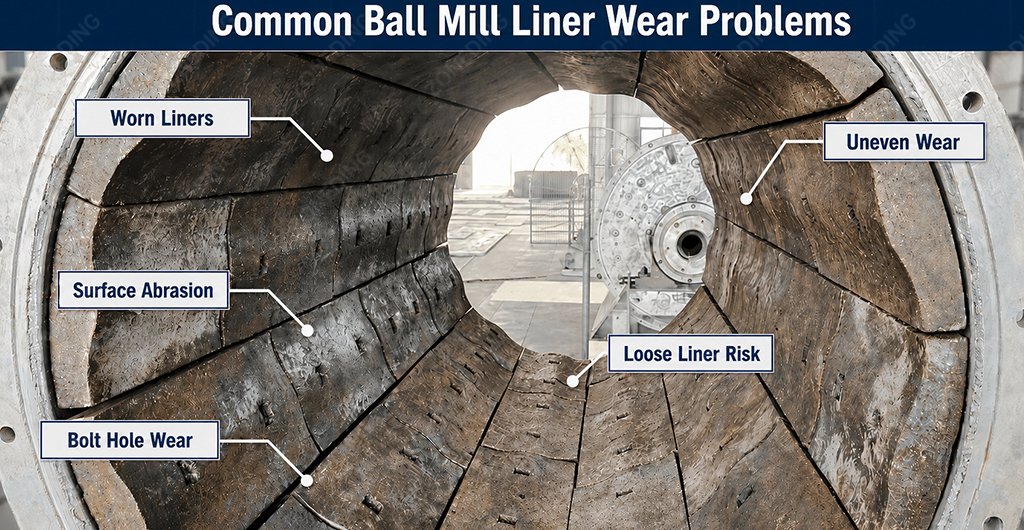
An overly hard but brittle liner may crack around bolt holes, lifter edges, or high-stress areas.
Toughness should take priority where impact loads are severe.
Highly Abrasive Ore
Where surface wear is dominant and impact is controlled, higher-hardness alloy materials may provide longer service life.
Possible options include:
Wear-resistant alloy steel
High-chromium alloy
Specialized composite liners
The liner profile should also reduce unnecessary sliding between the charge and liner surface.
Hard and Corrosive Slurry
Wet grinding can create combined abrasive and corrosive wear.
In this situation, engineers should evaluate slurry pH, chemical composition, temperature, dissolved salts, ore abrasiveness, and existing liner wear pattern.
Rubber-metal composite liners may offer advantages in selected wet-grinding applications because rubber sections resist certain corrosion effects while metal lifters provide structural support.
Ore Condition
Typical Wear Behavior
Preliminary Liner Direction
Soft, low-abrasive ore
Low impact and moderate wear
Rubber or composite liner
Medium-hard ore
Balanced impact and abrasion
Alloy steel or manganese steel
Hard, coarse ore
Strong impact
Tough alloy or manganese steel
Hard, quartz-rich ore
Severe abrasive wear
Wear-resistant alloy steel
Hard, corrosive slurry
Abrasion plus corrosion
Composite or corrosion-resistant design
These recommendations are starting points, not final specifications.
How Do Liner Profile and Lifter Height Affect Grinding?
Liner material is only one part of liner selection.
The liner profile controls how grinding media move inside the mill.
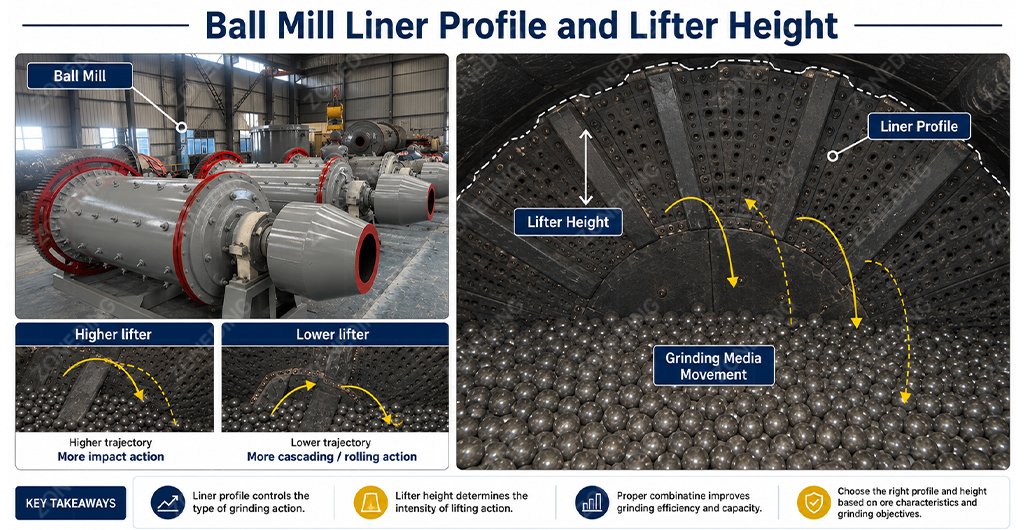
A well-designed lifter raises the media to the correct height and creates a useful combination of impact and cascading action.
Ball mill liner profile and lifter height affecting grinding media movement
Lifter Height
Higher lifters generally raise grinding media higher before release.
This can increase impact energy and help break coarse, hard particles.
However, excessive lifter height may cause strong liner impact, higher ball breakage, faster liner wear, and unstable charge movement.
Lower lifters create more cascading and abrasion.
This may suit finer grinding, but it can also increase overgrinding if the profile does not match the process.
Lifter Angle
The lifter angle influences the release point of the grinding media.
An incorrect angle may cause balls to fall too early, strike the liner directly, slide excessively, or create dead zones.
Wear Changes the Profile
Even when the original design is correct, the liner profile changes during service.
As lifters wear down, media lift decreases, impact energy falls, throughput may decline, and power consumption per ton can increase.
This is why operators should not evaluate liner condition only by remaining thickness.
The remaining shape is equally important.
A liner may still have enough thickness but no longer provide the required lifting action.
What Common Mistakes Shorten Ball Mill Liner Life?
Premature liner wear is often caused by selection and operation errors.
Common ball mill liner wear problems including cracking uneven wear and worn lifters
Selecting by Ore Name Alone
Terms such as gold ore, copper ore, or iron ore do not provide enough information.
Ores from different deposits may have very different hardness, quartz content, grain structure, and abrasiveness.
Choosing the Hardest Material Available
Higher hardness does not always mean longer service life.
If the liner lacks toughness, it may crack under impact before the wear surface is fully used.
Ignoring Feed Size
Oversized feed increases impact loading.
This may cause liner breakage, deformation, bolt-hole damage, or localized wear.
Using the Wrong Ball Size
Large grinding balls increase impact force.
If the liner is not designed for this load, lifter edges and bolt areas may fail.
Operating with Worn Lifters
Worn lifters change media trajectory and reduce grinding efficiency.
The mill may continue running, but power consumption per ton can rise and product size may become unstable.
Poor Installation
Incorrect bolt tightening, uneven contact, damaged backing material, or poor alignment can lead to loose liners, bolt failure, shell damage, cracking, and localized wear.
Bolt condition should be checked after installation and during planned shutdowns.
Running the Mill Under Poor Operating Conditions
Unstable feed, underloading, incorrect slurry density, and poor media grading can all accelerate liner damage.
When raw feed drops sharply, steel balls may strike liners more directly. This increases fatigue and cracking risk.
Wear patterns should be recorded during every shutdown because uneven wear often reveals problems in feed, liner layout, charge movement, or installation.
How Do You Balance Liner Life, Grinding Efficiency, and Cost?
The cheapest liner is not always the lowest-cost option.
A liner should be evaluated based on total cost per ton of ore processed.
Important cost factors include:
Purchase price
Service life
Installation labor
Shutdown time
Liner weight
Mill throughput
Power consumption
Grinding media consumption
Safety requirements
For example, a heavy steel liner may have a lower purchase price but require more installation time and reduce the effective internal volume of the mill.
A lighter composite liner may cost more initially but may offer faster installation, lower handling risk, more internal volume, reduced downtime, or improved energy efficiency in suitable conditions.
The best liner is the one that delivers stable grinding performance at the lowest total operating cost.
Practical Selection Process
A reliable selection process usually follows these steps:
Test ore hardness and abrasiveness.
Review feed size and target product size.
Confirm mill diameter, speed, and ball charge.
Identify whether impact or abrasion is dominant.
Compare suitable liner materials.
Select the correct lifter profile.
Review historical wear patterns.
Monitor performance after installation.
Key Performance Indicators
After installing new liners, record:
Liner service hours
Tons processed
Throughput
Power consumption
Product size
Ball consumption
Shutdown duration
Wear distribution
This information allows engineers to improve liner design during the next replacement cycle.
Engineer Tip
Do not evaluate liner performance only by operating months.
A liner that lasts longer but reduces throughput may have a higher cost per ton than a shorter-life liner that supports better grinding efficiency.
What Information Is Needed for Liner Selection?
For a more accurate recommendation, prepare complete operating information.
Useful data includes:
Ore type
Ore hardness or Bond Work Index
Ore abrasiveness
Quartz or silica content
Maximum feed size
Target product size
Ball mill model
Mill diameter and speed
Wet or dry grinding
Grinding ball size
Ball filling level
Current liner material
Current liner service life
Existing wear pattern
Power consumption
Throughput
Planned maintenance schedule
This information helps engineers match liner material, profile, and installation plan to the real grinding duty.
A Ball Mill should always be evaluated together with the ore, grinding media, feed size, slurry condition, and downstream process.
Frequently Asked Questions
Are steel liners always better for hard ore?
No. Hard ore may require steel liners, but the final choice depends on impact, abrasiveness, mill size, feed size, ball size, and slurry conditions.
Can rubber liners be used for hard ore?
They may be used in selected fine-grinding or lower-impact applications. They are generally less suitable for coarse feed and severe impact.
Why do ball mill liners crack before wearing out?
Common causes include insufficient toughness, excessive ball impact, oversized feed, incorrect installation, loose bolts, and high local stress.
How often should ball mill liners be inspected?
Liners should be checked during planned shutdowns and monitored through operating data, bolt condition, noise, vibration, thickness, and wear pattern.
What information is needed for liner selection?
Typical information includes ore hardness, abrasiveness, feed size, product size, mill dimensions, mill speed, ball size, slurry conditions, throughput, and current liner life.
Final Thoughts
Ball mill liner selection by ore hardness is more complex than matching soft ore with rubber and hard ore with steel.
Ore hardness affects breakage resistance, but abrasiveness, impact loading, feed size, mill diameter, grinding media, slurry conditions, and liner profile often determine the final choice.
A successful liner should provide enough toughness to resist impact, enough wear resistance to control abrasion, and the correct geometry to maintain efficient media movement.
By evaluating liner performance through tons processed, power consumption, throughput, wear pattern, and shutdown time, plant operators can make better decisions and reduce the real grinding cost per ton.
About ZONEDING
ZONEDING manufactures ball mills and mineral processing equipment for ore grinding applications.
Our engineers can evaluate ore properties, feed size, mill specifications, grinding media, and existing liner wear patterns to recommend a suitable liner material and profile.
For a more accurate recommendation, provide your ore type, Bond Work Index if available, maximum feed size, target product size, ball mill model, wet or dry grinding method, grinding ball size, current liner material, and current liner service life.
Decades of experience in the mining sector reveal a common financial drain. Many crushing facilities struggle with high electricity bills and frequent machine failures. Facility owners often attempt to save money by purchasing cheap replacement pa...
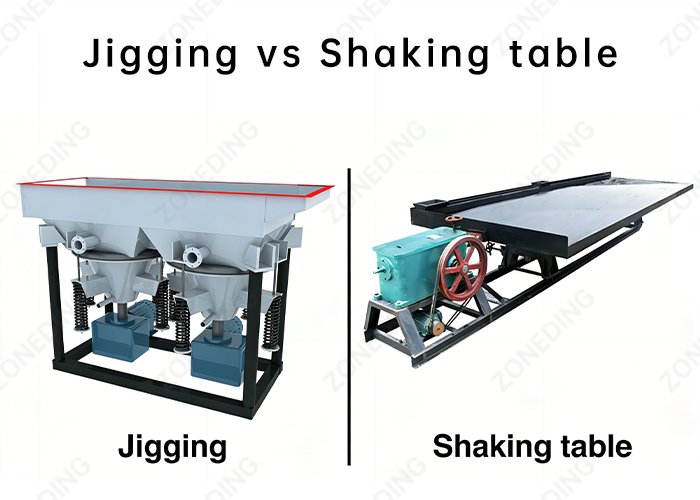
Choosing the right gravity separation method is the most important step for a profitable mine. Both the shaking table and the jigging machine use the weight of minerals to separate them from waste rock. But choosing the wrong one leads to massive ...
We use cookies to ensure that we give you the best experience on our website. If you continue to use this site we will assume that you are happy with it.
Privacy Policy
Send us a message
We would love to hear from you
Submit your question and our team will respond to the email provided as soon as possible.
 Zoneding Machine