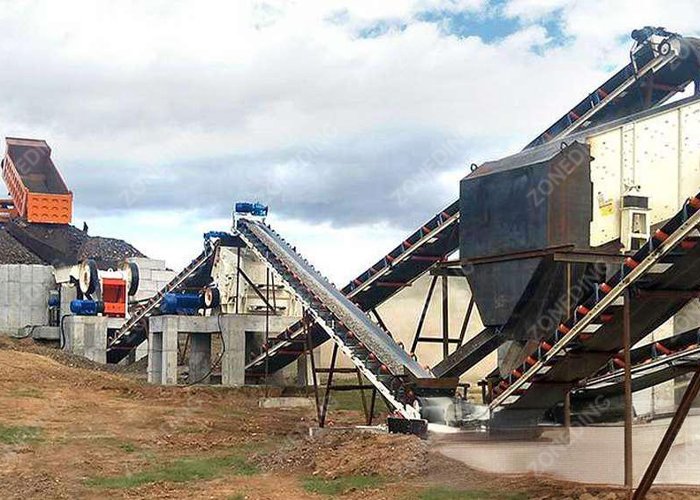
Choosing the right crushing process is one of the most important decisions when designing a quarry or aggregate plant.
The number of crushing stages affects equipment investment, production efficiency, finished product quality, operating cost, and future expansion possibilities.
A two-stage crushing plant usually requires fewer machines, lower investment, and simpler operation. However, a three-stage crushing system can provide better particle shape, improved size control, and higher-quality aggregates when market requirements are stricter.
Therefore, selecting the best crushing configuration requires more than comparing equipment prices.
Raw material characteristics, production capacity, final product requirements, and long-term operating costs all need to be considered.
This guide compares two-stage and three-stage crushing processes to help quarry owners, contractors, and investors choose the most suitable solution.
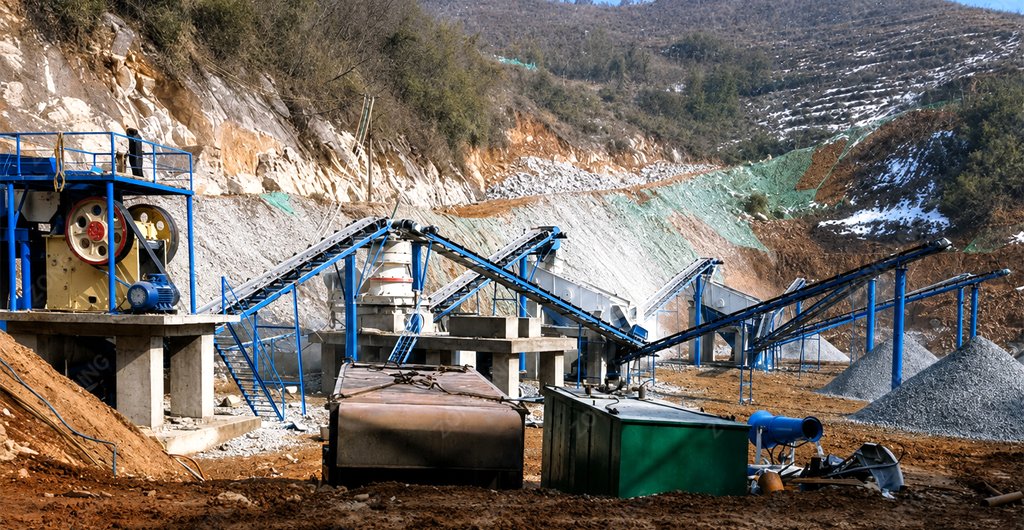
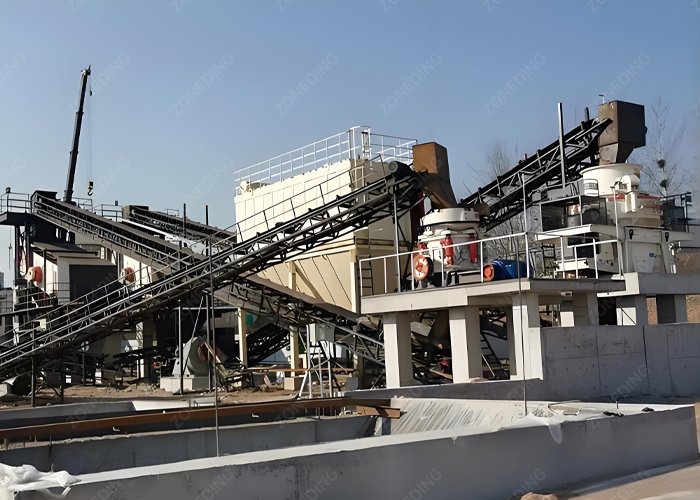
Three-stage crushing plant with primary secondary and tertiary crushing stages
The additional stage provides more control over final product size, grading, and particle shape.
A tertiary crushing stage may use different equipment depending on final product requirements.
For standard aggregate production, a fine crusher can improve size control and reduce oversize material.
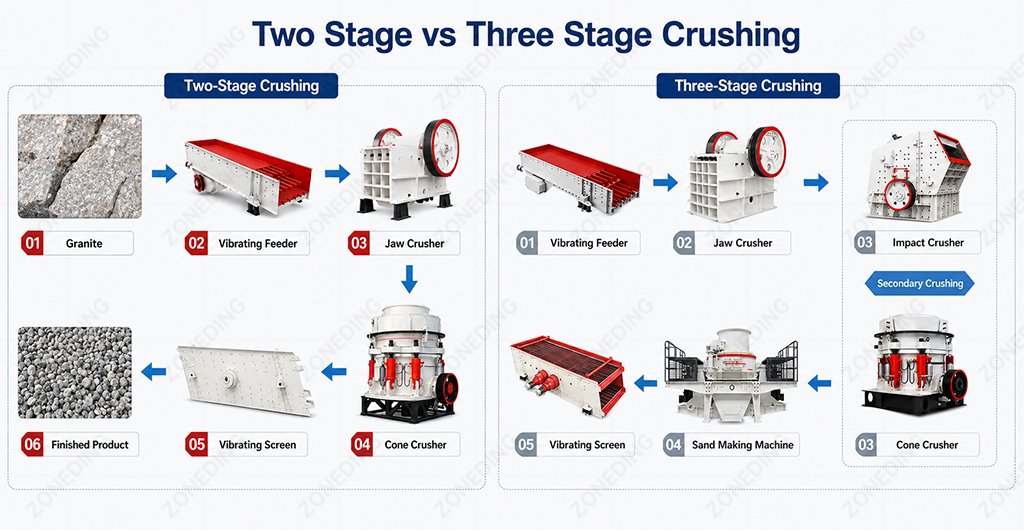
For manufactured sand production or applications requiring better particle shape, a Sand Making Machine is commonly added for additional shaping.
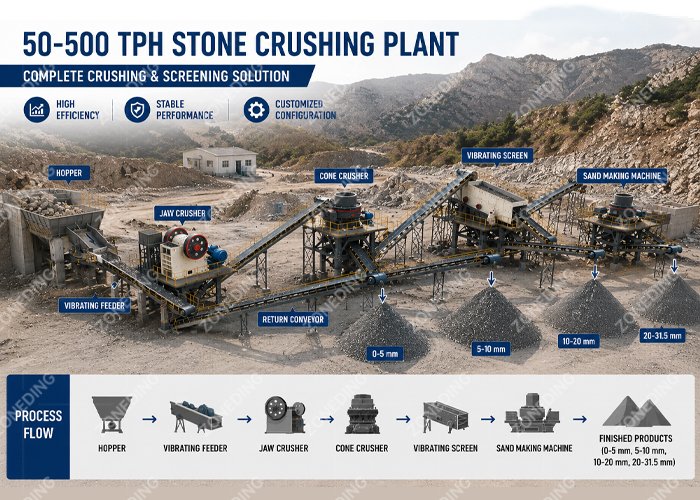
A three-stage crushing system may include:
Jaw crusher
Cone crusher
Tertiary crusher or VSI sand making machine
Multi-deck vibrating screen
Return conveyor
Finished-product conveyors
Benefits of Three-Stage Crushing
Better Aggregate Shape
Multiple crushing stages reduce elongated and flaky particles, producing more cubic aggregates.
This is important for:
High-quality concrete aggregates
Asphalt production
Premium construction materials
Manufactured sand
Improved Product Gradation
Additional crushing and screening stages allow better control of final sizes.
A plant can produce multiple products, such as:
0–5 mm manufactured sand
5–10 mm aggregate
10–20 mm aggregate
20–30 mm aggregate
Higher Production Flexibility
Three-stage systems provide more options when market demand changes.
For example, a quarry may begin with road aggregates and later expand into manufactured sand production.
What Are the Main Differences Between Two-Stage and Three-Stage Crushing?
The main difference is not only the number of crushers.
The real difference is how much control the plant has over the final product.
Factor
Two-Stage Crushing
Three-Stage Crushing
Equipment Quantity
Fewer machines
More machines
Initial Investment
Lower
Higher
Layout Complexity
Simple
More complex
Maintenance
Easier
More demanding
Product Shape
Standard
Better
Fine Aggregate Production
Limited
Higher
Manufactured Sand Production
Difficult
More suitable
Expansion Flexibility
Moderate
Strong
Product Variety
Fewer finished sizes
More finished sizes
Long-Term Market Flexibility
Limited
Better
Two-stage crushing focuses on simplicity and cost control.
Three-stage crushing focuses on product quality, flexibility, and higher-value applications.
The correct choice depends on whether the project prioritizes lower investment or higher product value.
A small quarry serving a local road base market may not need a three-stage system at the beginning.
Meanwhile, a commercial aggregate supplier serving concrete plants, asphalt plants, and manufactured sand buyers may need stronger product control from the start.
Which Crushing Process Produces Better Aggregate Shape?
Aggregate shape has become increasingly important as construction standards improve.
Poorly shaped particles can affect:
Concrete workability
Asphalt performance
Aggregate strength
Customer acceptance
Finished-product selling price
Two-stage crushing can produce acceptable aggregate for many construction applications.
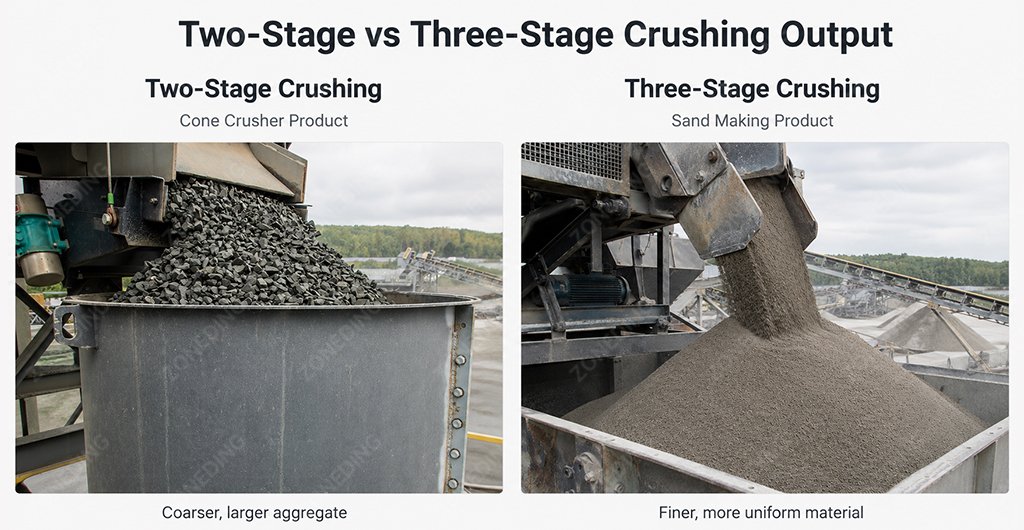
Aggregate particle shape comparison between two-stage and three-stage crushing
However, when the final product requires cubic shape and strict grading control, three-stage crushing usually performs better.
The additional shaping stage reduces flaky particles and improves particle geometry.
A VSI sand making machine is often added because it uses impact crushing to reshape particles rather than only reducing size.
This makes it suitable for:
Manufactured sand production
High-quality concrete aggregate
Premium road materials
Asphalt aggregate
Projects with strict particle-shape requirements
In hard rock applications, a third stage can also reduce the pressure on the secondary crusher.
As a result, the plant may operate more steadily while producing a more consistent final product.
How Do Two-Stage and Three-Stage Crushing Costs Compare?
The lower purchase price of a two-stage plant does not always mean lower total cost.
A complete evaluation should consider:
Equipment Investment + Installation Cost + Power Consumption + Wear Parts + Labor + Maintenance + Product Value = Total Operating Cost
Two-Stage Crushing Cost Advantages
Two-stage plants usually provide:
Lower equipment cost
Lower installation cost
Fewer wear parts
Easier maintenance
Simpler operation
Lower electrical demand
These advantages make them attractive for small and medium quarry projects.
Three-Stage Crushing Cost Considerations
Three-stage plants require higher investment because they include additional equipment.
The additional cost may come from:
Extra crushers
More conveyors
Larger screening systems
Additional maintenance requirements
More complex plant layout
Higher electrical and control requirements
However, the higher investment can be justified when the plant produces higher-value products.
For example, a quarry selling premium aggregates or manufactured sand may achieve better returns from a three-stage system.
The correct question is not:
Which plant costs less?
The better question is:
Which plant produces the lowest cost per saleable ton?
A cheaper plant that produces lower-value material may not be the most profitable solution.
In addition, future modification cost should be included in the decision. A two-stage plant may save money at the beginning, but adding a third stage later can become expensive if the original layout does not leave enough space.
Which Crushing Process Fits Different Quarry Projects?
Different projects require different crushing strategies.
The right choice depends on material hardness, product requirements, capacity, budget, and future market plans.
Small Quarry Projects
Two-stage crushing is often suitable when:
Production capacity is moderate
Product requirements are simple
Investment budget is limited
The market mainly needs standard aggregates
Plant space is limited
This setup can help investors start production faster with lower initial cost.
Road Construction Projects
Two-stage crushing can work well for:
Road base materials
General construction aggregates
Filling materials
Low-to-medium specification products
However, projects requiring asphalt-grade aggregates may require better particle shaping.
In that case, a three-stage system or added shaping stage may be more suitable.
Hard Rock Quarries
Hard granite, basalt, river stone, and other abrasive rocks require careful equipment selection.
A three-stage process may provide advantages because:
Reduction ratios are distributed across multiple machines
Wear load is balanced
Product quality is easier to control
Secondary crusher pressure is reduced
Finished aggregate shape is improved
For hard rock projects with high output targets, three-stage crushing is often a better long-term choice.
Manufactured Sand Production
Manufactured sand production usually requires more control over particle shape and grading.
A common manufactured sand crushing flow is:
Primary Crushing → Secondary Crushing → Tertiary Crushing and Shaping → Screening → Sand Washing or Powder Control → Finished Sand
This type of circuit provides better control over final sand quality.
Can a Two-Stage Plant Be Upgraded Later?
Many investors start with two-stage crushing because it requires lower initial investment.
Future expansion is possible if the original plant layout considers additional equipment space.
Potential upgrades include:
Additional crusher
VSI sand making machine
Larger screening system
Extra conveyors
Additional stockpiles
Return conveyor
Larger electrical capacity
Expanded control system
However, expansion becomes more difficult when the original design leaves no room for future growth.
Therefore, buyers should discuss long-term production goals before selecting the first crushing configuration.
A plant designed only for today’s demand may limit future opportunities.
For projects that may expand from road base into concrete aggregate or manufactured sand, the site layout should reserve space for tertiary crushing and shaping from the beginning.
How Should Buyers Choose the Right Crushing Configuration?
Before selecting two-stage or three-stage crushing, buyers should evaluate several key factors.
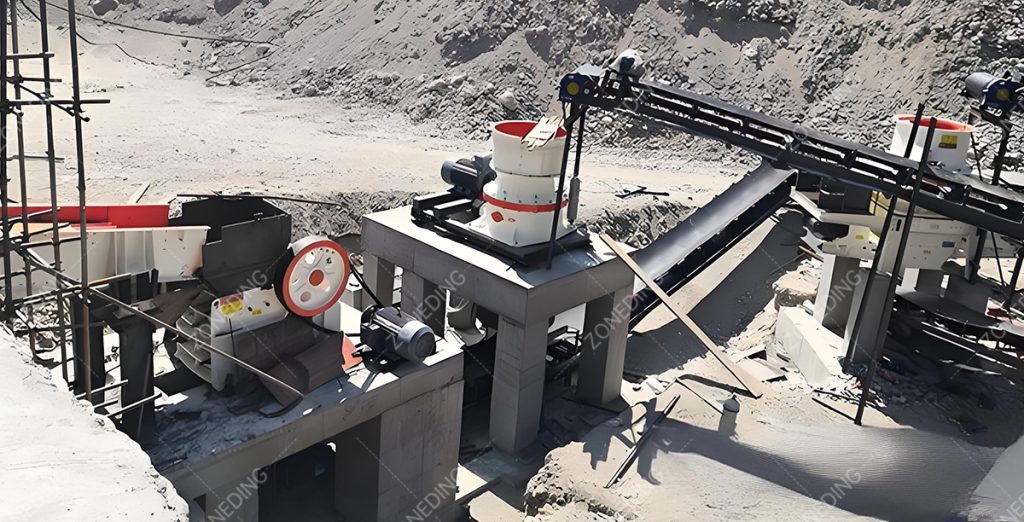
Quarry crushing plant layout design for two-stage and three-stage crushing
Raw Material Characteristics
Important information includes:
Rock type
Hardness
Abrasiveness
Maximum feed size
Moisture condition
Clay or soil content
Expected feed variation
Hard granite and basalt usually require different solutions compared with limestone or soft sandstone.
Final Product Requirements
Consider:
Required aggregate sizes
Particle shape requirements
Manufactured sand demand
Customer specifications
Local market prices
Number of finished products
A plant producing one road base product may not need the same process as a plant producing four commercial aggregate sizes and sand.
Production Capacity
Capacity affects:
Crusher selection
Screening design
Conveyor arrangement
Stockpile planning
Power system
Plant layout
A small quarry and a large commercial aggregate plant should not use the same crushing configuration.
Investment Strategy
A lower initial investment may be suitable for small operations.
However, a larger investment may provide better long-term returns when premium products generate higher margins.
The decision should balance cash flow, market demand, equipment life, and future expansion.
Buyer Checklist
Before ordering equipment, prepare:
Raw material type
Maximum feed size
Required capacity
Finished product sizes
Product shape requirements
Manufactured sand demand
Available site area
Power supply condition
Budget range
Future expansion plan
Clear project information helps engineers design the full crushing circuit instead of selecting crushers one by one.
Frequently Asked Questions
Is three-stage crushing always better than two-stage crushing?
No. Three-stage crushing provides better product control, but it also requires higher investment and more maintenance. The best choice depends on raw material, product requirements, market demand, and project budget.
Which crushing process is cheaper?
Two-stage crushing usually has a lower initial cost because fewer machines are required. However, total operating cost should also include power, wear parts, maintenance, product value, and future modification cost.
Is two-stage crushing suitable for granite?
Yes, but the final choice depends on granite hardness, abrasiveness, capacity, and required product quality. Some granite projects can use two-stage crushing, while higher-quality aggregate or sand projects may require three stages.
When is VSI equipment needed?
VSI equipment is commonly used when producing manufactured sand or high-quality cubic aggregates. It is mainly added for shaping and fine aggregate production rather than simple size reduction.
Can a two-stage crushing plant be upgraded later?
Yes. A two-stage plant can often be expanded if the original layout reserves enough space for another crusher, screen, conveyor, stockpile, and electrical capacity.
Final Thoughts
The choice between two-stage and three-stage crushing is not simply about adding more machines.
Two-stage crushing provides a practical solution for projects that prioritize lower investment, simple operation, and standard aggregate production.
Three-stage crushing offers better particle shape, improved product control, and greater flexibility for high-quality aggregates and manufactured sand.
The best crushing configuration depends on:
Material characteristics
Production targets
Product requirements
Investment capacity
Future expansion plans
A well-designed crushing plant should balance today’s investment with tomorrow’s growth opportunities.
Instead of asking which process is universally better, quarry owners should ask which process best matches their raw material, product market, and long-term business plan.
About ZONEDING
ZONEDING provides complete crushing and screening solutions for quarry, aggregate, and mining projects.
Our engineers evaluate raw materials, production capacity, final product requirements, site conditions, and investment goals to recommend suitable crushing configurations.
Whether a project requires a simple two-stage crushing plant or a complete three-stage aggregate production system, the design should focus on stable operation, reliable output, and long-term profitability.
Contact ZONEDING with your raw material, feed size, required capacity, finished product sizes, and project location to receive a customized crushing plant proposal.
Many investors consider gold cyanidation extraction a simple chemical reaction. Commercial-grade operations face severe mechanical and metallurgical challenges daily. A successful plant demands precise engineering to match the specific ore chemist...
Designing an is fundamentally different from designing an aggregate plant. Iron ore has a very high specific gravity, often between 4.5 and 5.2, and extreme abrasiveness. If you use standard design formulas for limestone, your structures might col...
The cost of a stone crusher plant in 2026 can range from $50,000 to more than $1.5 million depending on capacity, rock type, equipment configuration, automation level, and mobility requirements. Many first-time buyers only compare crusher prices, ...
Buying a stone crusher is a major investment for any quarry, mining, or aggregate production business. The wrong equipment can increase downtime, wear cost, and energy consumption for years. Meanwhile, the right crushing system can improve product...
We use cookies to ensure that we give you the best experience on our website. If you continue to use this site we will assume that you are happy with it.
Privacy Policy
Send us a message
We would love to hear from you
Submit your question and our team will respond to the email provided as soon as possible.
 Zoneding Machine