Recovering lead and zinc efficiently depends on much more than flotation reagents. One of the most influential factors is grinding size, which determines whether valuable minerals are sufficiently liberated before entering the flotation circuit.
If the ore is not ground finely enough, galena and sphalerite remain locked inside gangue minerals and cannot attach effectively to flotation bubbles. On the other hand, excessive grinding creates slimes that reduce flotation selectivity, increase reagent consumption, and raise operating costs.
Finding the optimum grinding size is therefore one of the most effective ways to improve recovery, increase concentrate grade, and reduce energy consumption.
If you are designing or upgrading a Lead and Zinc Processing Plant, understanding the relationship between grinding size and mineral liberation is essential.
Why Does Grinding Size Matter in Lead-Zinc Flotation?
Grinding is the transition stage between crushing and flotation. Its primary purpose is to separate valuable minerals from surrounding waste rock so flotation reagents can selectively collect them.
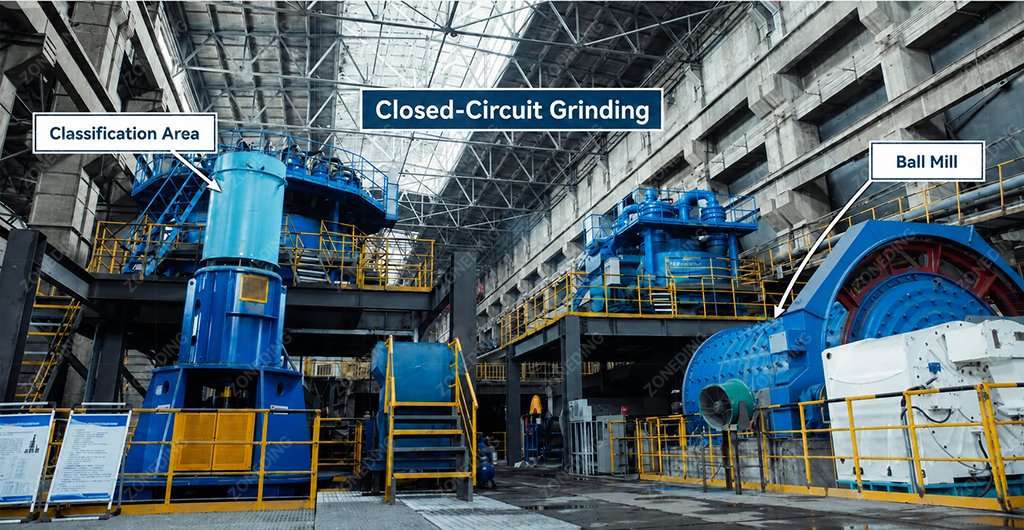
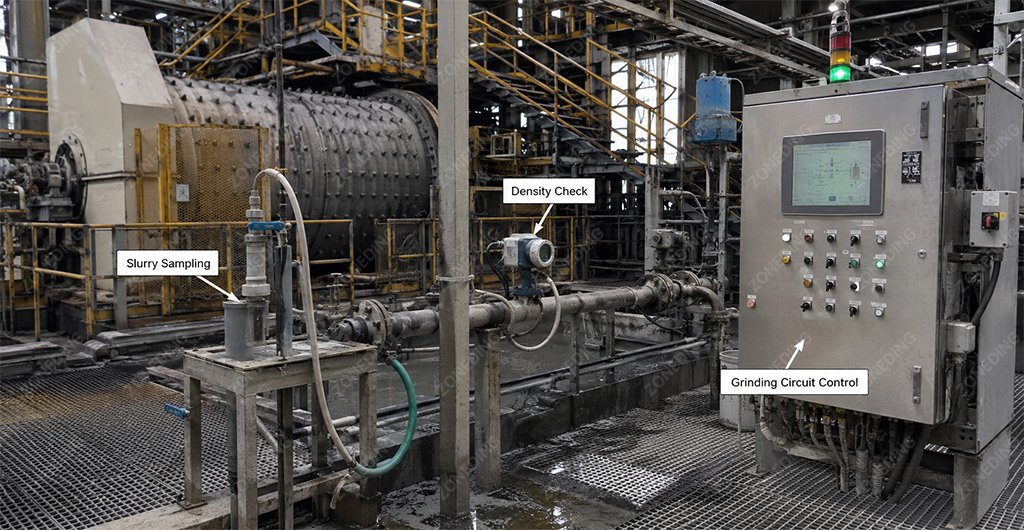
A typical lead-zinc concentrator uses a Ball Mill operating in closed circuit with a Hydrocyclone or Spiral Classifier to control particle size before flotation.
Grinding size influences:
Mineral liberation
Flotation recovery
Concentrate grade
Reagent consumption
Thickening and filtration performance
Overall operating cost
Because grinding often accounts for 35–50% of the total power consumption in a mineral processing plant, even a small improvement in grinding efficiency can significantly reduce production costs.
What Happens If the Ore Is Too Coarse?
Insufficient grinding is one of the most common causes of poor lead and zinc recovery.
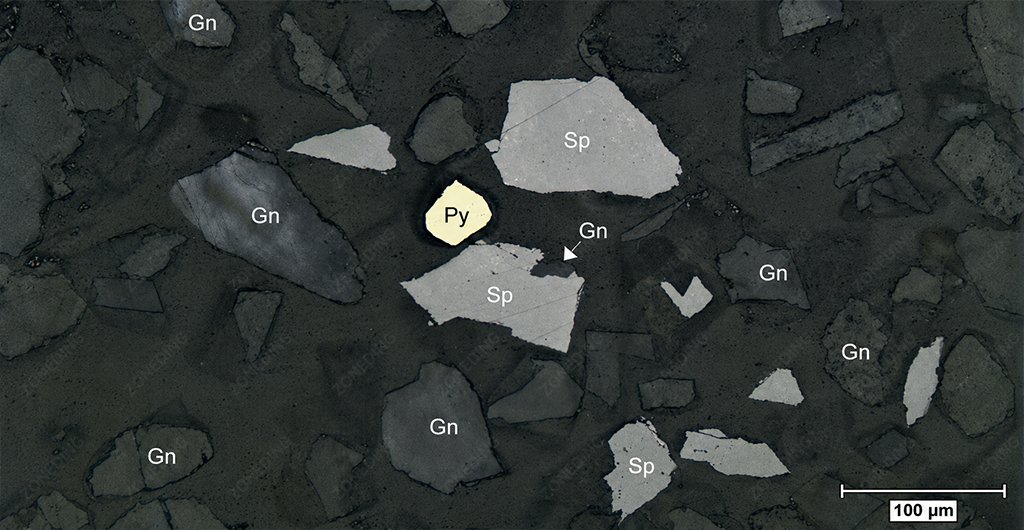
When ore particles remain too coarse, valuable minerals stay locked inside gangue. Although these particles reach the flotation cells, only the exposed mineral surfaces can react with collectors. The enclosed portion behaves like waste rock and is eventually discharged to the tailings.
Lead and zinc minerals locked inside gangue due to insufficient grinding
Typical consequences include:
Lower lead recovery
Lower zinc recovery
Reduced concentrate grade
Valuable minerals lost in tailings
Higher circulating load
For example, a galena crystal encapsulated by quartz cannot be completely recovered because flotation reagents cannot reach the hidden mineral surface.
Common Symptoms of Under-Grinding
Plants experiencing insufficient liberation often report:
Coarse cyclone overflow
Stable reagent dosage but declining recovery
Visible valuable minerals in tailings
Higher recirculating load
Lower flotation efficiency
Before increasing reagent dosage, engineers should first evaluate whether the grinding circuit is producing adequate mineral liberation.
Problem
Impact on Production
Poor liberation
Lower metal recovery
Locked particles
Valuable minerals lost to tailings
Coarse flotation feed
Poor bubble attachment
Unstable particle size
Fluctuating flotation performance
What Happens If the Ore Is Too Fine?
Grinding finer than necessary does not always improve recovery. In many cases, it produces the opposite result.
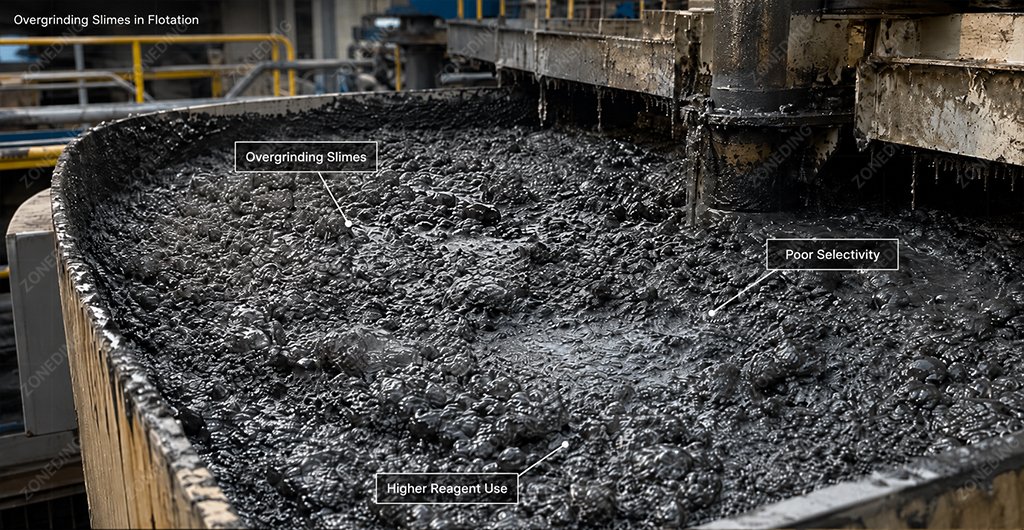
Excessive grinding creates ultrafine particles, commonly known as slimes. These particles have a much larger surface area, increasing reagent consumption while reducing flotation selectivity.
Excessive grinding generates slimes that reduce flotation selectivity and increase operating costs
Very fine gangue particles may also coat the surface of valuable minerals, preventing collectors from attaching efficiently.
Typical problems caused by overgrinding include:
Increased reagent consumption
Lower concentrate grade
Reduced flotation selectivity
Higher concentrate moisture
Greater power consumption
Faster wear of liners and grinding media
Why Slimes Reduce Recovery
Unlike coarse particles, ultrafine particles do not attach easily to flotation bubbles. Instead, they remain suspended in the pulp or become mechanically entrained into the concentrate together with gangue minerals.
This reduces concentrate quality while increasing downstream filtration costs.
Comparison of Different Grinding Conditions
Grinding Condition
Mineral Liberation
Recovery
Operating Cost
Too Coarse
Poor
Low
Moderate
Optimum
Excellent
Highest
Lowest Overall
Too Fine
Excessive
Often Lower
Highest
Field Experience
In many lead-zinc concentrators, operators initially respond to declining recovery by increasing collector dosage. However, plant audits often show that unstable grinding or poor classification—not insufficient reagents—is the real cause. Restoring a stable grinding circuit frequently delivers greater improvements than adding more chemicals.
How Is the Optimum Grinding Size Determined?
There is no universal grinding size suitable for every lead-zinc ore.
The optimum particle size depends on:
Mineral grain size
Degree of mineral intergrowth
Ore hardness
Gangue composition
Flotation flowsheet
Required concentrate grade
Rather than copying another plant’s operating conditions, engineers determine the target grind size through laboratory flotation tests and mineral liberation analysis.
Many modern concentrators combine particle size analysis with mineralogical testing to identify the point where valuable minerals are sufficiently liberated without producing unnecessary slimes.
Plants using this approach generally achieve higher recovery and lower energy consumption than those relying on particle size measurements alone.
Do Different Lead-Zinc Ores Require Different Grinding Sizes?
Absolutely. One of the biggest mistakes in mineral processing is assuming that every lead-zinc ore should be ground to the same particle size.
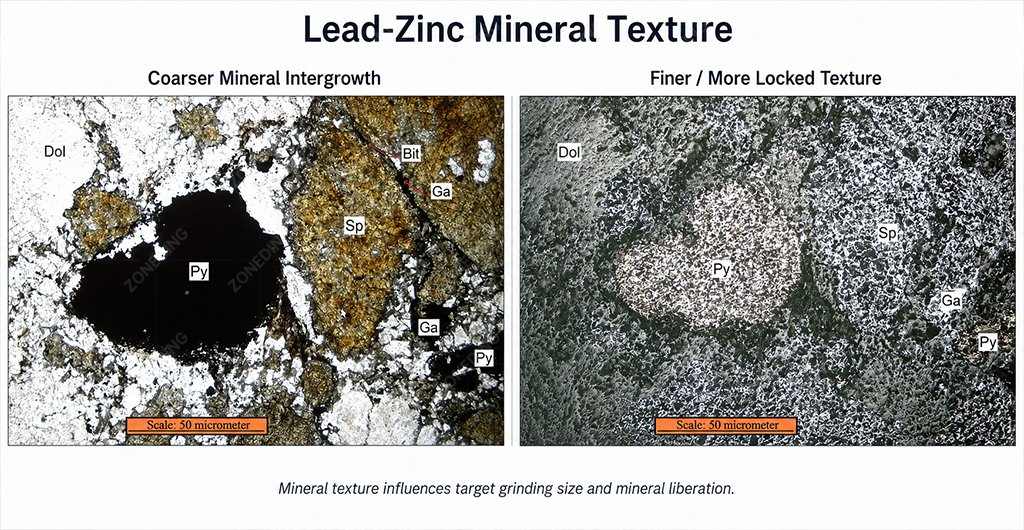
The optimum grinding size depends on how valuable minerals occur within the ore. Two deposits with similar grades may require completely different grinding strategies because of differences in mineral texture and liberation characteristics.
CoDifferent mineral textures require different grinding strategies to achieve optimum liberation
Engineers typically evaluate the following factors before selecting a grinding target:
Mineral grain size
Degree of mineral intergrowth
Ore hardness
Gangue composition
Concentrate quality requirements
Flotation process configuration
For example, fine-grained ores usually require finer grinding to achieve adequate liberation, while coarse-grained deposits may reach maximum recovery with a much coarser product.
Grinding finer than necessary only increases energy consumption without generating additional value.
Fine-Grained Lead-Zinc Ores
When galena and sphalerite occur as microscopic grains, sufficient liberation often requires a relatively fine grinding product.
However, these ores are also more likely to generate slimes, making classification efficiency particularly important.
Maintaining a stable closed-circuit grinding system helps balance liberation and overgrinding.
Coarse-Grained Lead-Zinc Ores
Coarse-grained deposits generally achieve excellent flotation performance without excessive grinding.
Stopping grinding once adequate liberation has been reached can reduce:
Electricity consumption
Steel ball consumption
Mill liner wear
Overall production cost
This is why laboratory flotation testing should always determine the target grinding size instead of relying on fixed P80 values.
How Can You Maintain a Stable Grinding Size?
Finding the optimum grinding size is only the first step. Maintaining it consistently during daily production is equally important.
Even small fluctuations in particle size can reduce flotation recovery and increase reagent consumption.
The following operating practices help maintain a stable grinding circuit.
Stable grinding conditions improve flotation recovery more effectively than increasing reagent dosage
Maintain a Stable Feed
Large variations in feed size or feed rate change the residence time inside the mill.
A stable feed allows the grinding circuit to produce a more consistent flotation product.
If the crushing circuit cannot provide uniform feed, review your primary crushing and screening process before adjusting the mill.
Optimize Classification Efficiency
Grinding and classification should always be considered as one system rather than two separate processes.
A properly operating Hydrocyclone or Spiral Classifier returns coarse particles for further grinding while allowing adequately liberated particles to proceed to flotation.
Poor classification may:
Send coarse particles directly to flotation.
Return already-fine particles to the mill.
Increase circulating load.
Create unnecessary overgrinding.
For a more detailed comparison, see Spiral Classifier vs. Hydrocyclone: Which Is Better?
Monitor Key Operating Parameters
Routine sampling helps identify grinding problems before flotation recovery begins to decline.
Parameter
Recommended Monitoring
Feed size
Stable
P80
Within target range
Ball charge
Regular inspection
Cyclone overflow density
Stable
Circulating load
Controlled
Classification efficiency
High
Engineer Tip
Do not evaluate grinding performance using only particle size.
Whenever recovery changes unexpectedly, compare particle size analysis with mineral liberation analysis. Two samples with the same P80 may perform very differently during flotation.
Common Grinding Mistakes That Reduce Recovery
Many concentrators lose valuable metals because of operational mistakes rather than equipment limitations.
The following issues are frequently observed during plant optimization.
Grinding Finer Than Necessary
More grinding does not always produce higher recovery.
Beyond the optimum liberation size, additional grinding increases costs while generating excessive slimes.
Ignoring Classification Performance
Many operators focus only on the ball mill while overlooking the classifier.
Poor classification often causes unstable grinding products even when the mill itself operates normally.
Copying Another Plant’s Grinding Size
Every ore body has unique mineralogical characteristics.
Applying another mine’s grinding target without metallurgical testing rarely delivers the best economic result.
Adjusting Reagents Before Checking Grinding
Declining recovery does not automatically indicate insufficient reagent dosage.
Grinding and classification should always be evaluated before modifying flotation chemistry.
Decision Guide: Should You Change Your Grinding Size?
The following table provides a practical troubleshooting guide.
Plant Condition
Recommended Action
Recovery decreases
Check mineral liberation first
Reagent consumption increases
Investigate overgrinding
Valuable minerals in tailings
Evaluate under-grinding
Cyclone overflow becomes coarse
Inspect classification system
Circulating load increases
Check hydrocyclone performance
Concentrate grade drops
Review both grinding and flotation
This systematic approach often identifies the root cause faster than simply changing reagent dosage.
Buyer Checklist
Before selecting a grinding size for a lead-zinc project, confirm that:
✓ Ore mineralogy has been analyzed.
✓ Liberation characteristics have been evaluated.
✓ Laboratory flotation tests have been completed.
✓ Grinding equipment has been properly selected.
✓ Classification equipment matches the mill capacity.
✓ Target concentrate grade has been defined.
✓ Future ore variability has been considered.
Frequently Asked Questions
Does finer grinding always improve lead-zinc recovery?
No. Recovery improves only until sufficient mineral liberation is achieved. Grinding beyond this point usually increases slime generation and operating costs.
What is the best grinding size for lead-zinc flotation?
There is no universal value. The optimum grinding size depends on ore characteristics, mineral liberation, flotation requirements, and concentrate specifications.
How can I identify under-grinding?
Common indicators include coarse cyclone overflow, valuable minerals in tailings, and poor recovery despite stable reagent addition.
Which equipment controls grinding size?
Most concentrators use a Ball Mill operating in closed circuit with a Hydrocyclone or Spiral Classifier before flotation.
Should grinding or flotation be optimized first?
Grinding should always be evaluated before changing flotation reagents because mineral liberation directly affects flotation performance.
Key Takeaways
Grinding size controls mineral liberation and flotation performance.
Under-grinding causes valuable minerals to remain locked inside gangue.
Overgrinding creates slimes that reduce recovery and increase operating costs.
Stable classification is just as important as efficient grinding.
Laboratory testing is the most reliable way to determine the optimum grinding size.
Consistent circuit operation usually delivers better results than simply grinding finer.
About ZONEDING
ZONEDING provides complete solutions for lead and zinc processing plants, including crushing, grinding, classification, flotation, dewatering, and tailings treatment.
Our engineering team designs customized grinding circuits based on ore characteristics, production capacity, and flotation targets to maximize recovery while minimizing operating costs.
Whether you are building a new concentrator or optimizing an existing operation, we can recommend the most suitable ball mill, classification equipment, and complete mineral processing flowsheet for your project.
Contact us with the following information for a customized solution:
Operating heavy mining equipment requires a deep understanding of internal mechanics. Many expensive machine failures happen because operators misunderstand basic operational rules. Good equipment can break quickly when handled poorly. This compre...
Many gold miners focus on recovery equipment such as concentrators, sluices, jigs, and shaking tables. However, experienced operators know that recovery begins long before gold reaches those machines. It starts with proper washing, screening, and ...
Fifty years of experience across global mining sites reveals that plant managers frequently struggle with high costs and machine failures. Profitability depends on the selection of the correct mining crushing equipment. Understanding hidden wear p...
When a client asks about the , they usually expect a simple price for tanks, pumps, and conveyors. However, the equipment quote is only the tip of the iceberg. In my experience, the equipment represents only 30% to 40% of the total investment. The...
We use cookies to ensure that we give you the best experience on our website. If you continue to use this site we will assume that you are happy with it.
Privacy Policy
Send us a message
We would love to hear from you
Submit your question and our team will respond to the email provided as soon as possible.
 Zoneding Machine