 Zoneding Machine












Mobile Cone Crusher Price in Chile for Hard Rock Projects
535Compare mobile cone crusher prices, 100–200 TPH setups, feed limits and liner costs for copper ore and hard rock projects in Chile.
View detailsSearch the whole station Crushing Equipment
Producing high-quality aggregate requires more than reaching the target tons per hour.
Quarry operators must also control particle shape and gradation, because flaky particles, excessive fines, and unstable size distribution can reduce concrete, asphalt, and road-base performance.
Many crushing plants can reach similar capacity. However, their final aggregate quality may be very different.
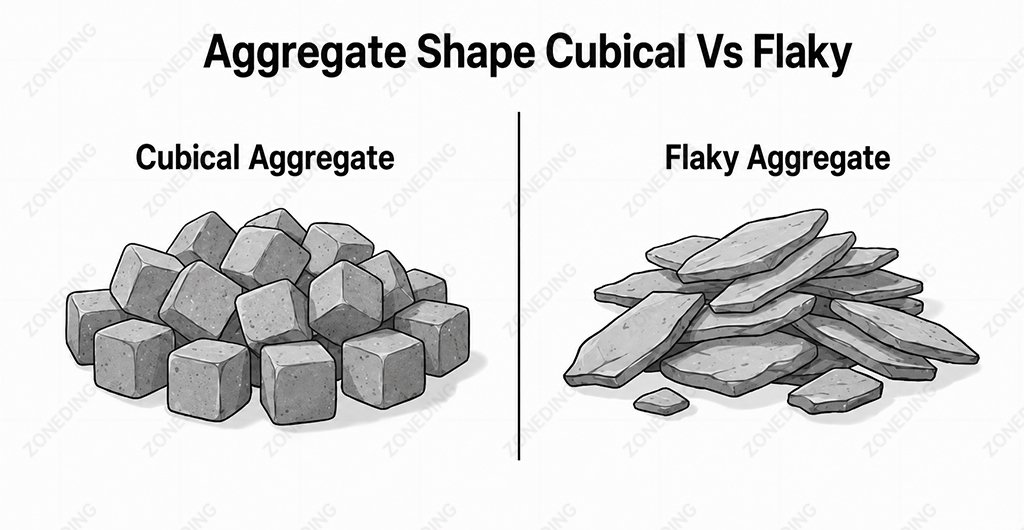
Poor particle shape, inconsistent gravel size, high fines content, or unstable gradation curves are usually caused by crusher selection, crushing ratio, screening efficiency, feed control, and circuit design.
A properly designed stone crushing plant should balance capacity, shape, gradation, wear cost, and final application requirements.
This guide explains how to control aggregate shape and gradation through crusher selection, screening, closed-circuit crushing, daily operation, and process optimization.
Aggregate is a major component of concrete, asphalt, road base, and many construction materials.
Its physical characteristics directly affect how well the final material compacts, carries load, resists wear, and performs in service.
Two quality indicators are especially important:
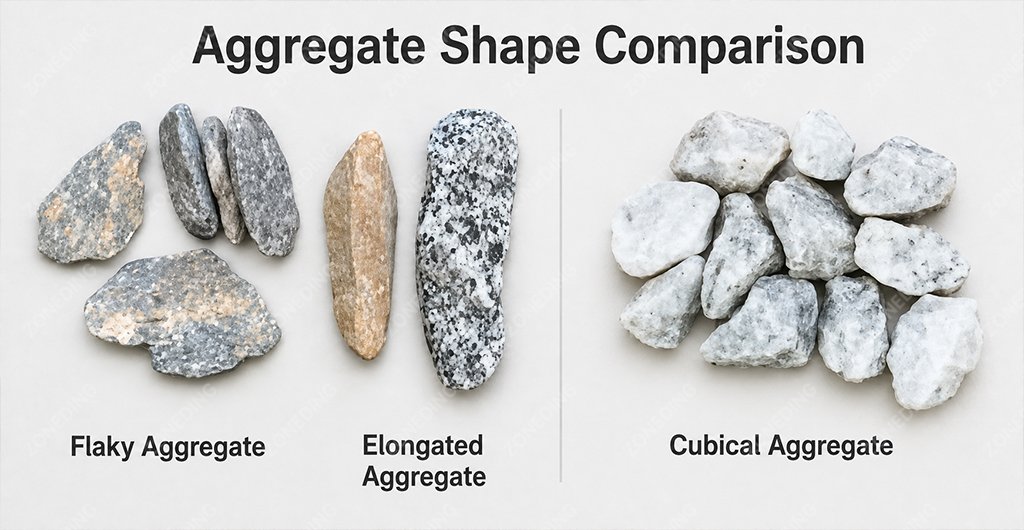
Aggregate shape describes the physical form of individual particles.
High-quality aggregate usually has a cubical structure with good angularity. Poor-quality aggregate often contains too many flaky, elongated, or slivered particles.
Cubical particles can improve:
Flaky and elongated particles create weak points because they do not pack efficiently.
They may also break under pressure during mixing, compaction, or traffic loading.
Aggregate gradation refers to the distribution of different particle sizes in the final product.
A well-graded aggregate contains a balanced combination of large, medium, and fine particles. Smaller particles fill the spaces between larger particles, reducing voids and improving material density.
Poor gradation may lead to:
Therefore, aggregate producers should not focus only on output capacity.
Shape and gradation must be controlled together if the plant needs to supply concrete producers, asphalt plants, road contractors, or premium aggregate markets.
Engineer Tip
Increasing crusher power does not always improve aggregate quality. In many cases, adjusting the crushing ratio, crusher settings, feeding method, and screening efficiency produces better results without replacing the main equipment.
Aggregate shape is determined throughout the full crushing process.
The final particle form depends on raw material properties, crusher type, reduction ratio, closed side setting, chamber condition, feeding method, and the number of crushing stages.
Important factors include:
Hard rocks such as granite, basalt, and gabbro usually need more controlled crushing because they resist breakage.
If the crushing process is not properly designed, these materials may produce irregular particles or a high amount of elongated material.
Softer materials such as limestone are easier to process, but they may generate excessive fines if crushing parameters are too aggressive.
The reduction ratio also affects particle shape.
A high reduction ratio in one crushing stage often creates:
Using multiple crushing stages allows each machine to perform a more controlled size reduction process.
For example, a multi-stage crushing circuit usually gives better aggregate quality than forcing one crusher to achieve excessive reduction.
Crusher operating parameters also have a direct influence on the final product.
Important items include:
Incorrect settings may cause excessive oversize, too many fines, poor particle shape, or unstable production.
Regular monitoring and adjustment are essential for keeping aggregate quality consistent.
For more process comparison, see Two-Stage vs Three-Stage Crushing: Which Is Better?.
Crusher selection is one of the most important decisions in aggregate production.
Different crusher types use different crushing principles. As a result, they produce different particle shapes, fines levels, and size distributions.
Choosing equipment only by capacity may result in acceptable tons per hour but poor aggregate quality.
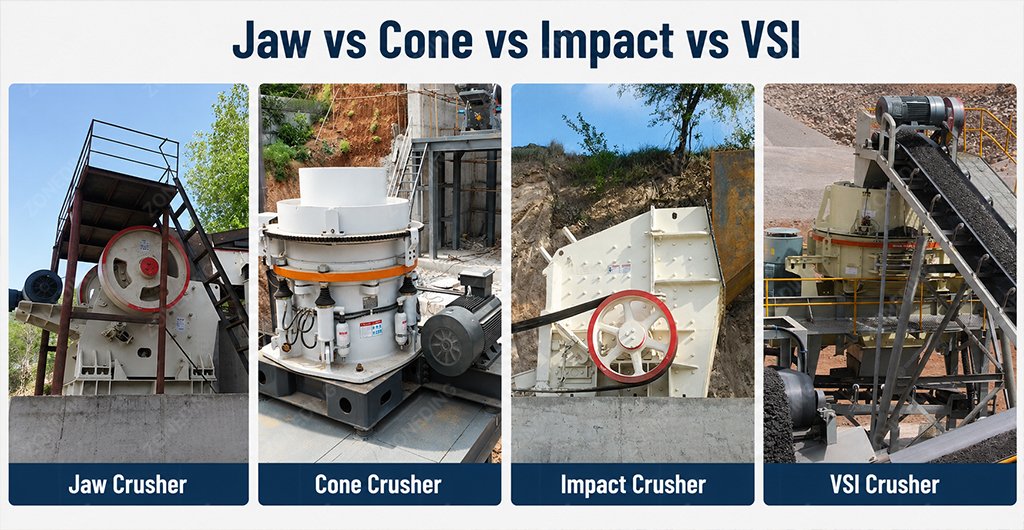
A jaw crusher is commonly used as the primary crushing stage because it has a large feed opening and strong crushing force.
Jaw crushers are suitable for:
However, jaw crushers mainly use compression crushing.
They are excellent for reducing large rocks, but they usually do not produce the most cubical final aggregate by themselves.
For applications requiring better particle shape, secondary or tertiary crushing stages are often needed.
A cone crusher is widely used for secondary and tertiary crushing, especially in hard rock aggregate production.
Cone crushing can provide:
For many hard rock quarries, cone crushers are the core equipment for producing controlled aggregate sizes.
An impact crusher uses impact force to reduce and shape material.
It is commonly used when better particle shape is required, especially for softer or medium-hard materials.
Impact crushers are often applied for:
Impact crushing can produce more cubical particles than compression crushing.
However, wear cost should be evaluated carefully when processing highly abrasive materials.
A sand making machine or VSI crusher may be added when the plant needs additional shaping or manufactured sand production.
This is often useful for:
The right crusher combination depends on the raw material, product size, market requirement, and operating cost target.
Crushing determines how rock is reduced.
Screening determines whether the final product meets the required size specification.
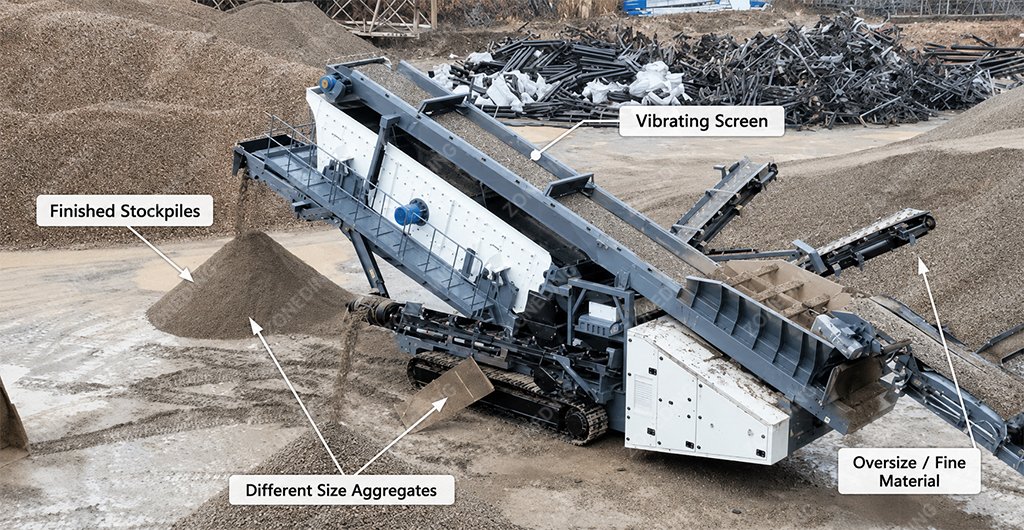
Even with the correct crusher selection, poor screening performance can cause:
A properly designed screening system separates material accurately and keeps qualified aggregate within the required size range.
A complete production line normally combines crushers with a suitable vibrating screen to maintain stable product size distribution.
Screening performance depends on several factors:
When screening efficiency drops, even a well-designed crushing circuit may fail to produce consistent aggregate quality.
How screening improves aggregate quality
Screening has three major functions in aggregate production.
First, it removes oversized particles from the final product.
Oversize material can be returned to the crusher through a closed circuit for additional reduction.
Second, screening controls excessive fines.
Too many fine particles may increase water demand in concrete and reduce asphalt mixture stability.
Third, screening allows producers to create multiple commercial products from one crushing line.
For example, a quarry may produce:
| Product Size | Typical Application |
|---|---|
| 0–5 mm | Manufactured sand and fine aggregate |
| 5–10 mm | Concrete aggregate |
| 10–20 mm | General construction aggregate |
| 20–31.5 mm | Road base material |
Practical screening tips
For sticky or damp feed, polyurethane screen meshes may reduce blinding during wet conditions.
For precise sand grading, screen angle and bed depth should be adjusted according to material flow and product specification.
For high-capacity circuits, feed should be distributed across the full screen width instead of loading only one side.
Engineer Tip
Many aggregate plants try to solve gradation problems by adjusting only the crusher. However, the screen often determines final product quality more directly than the crusher itself.
Even with suitable equipment, daily operating conditions strongly influence aggregate quality.
Small changes in feeding, crusher settings, liner condition, and circuit operation can affect particle shape and product size distribution.
Closed side setting
The closed side setting, or CSS, is one of the most important crusher adjustment parameters.
A smaller CSS generally produces:
A larger CSS may result in:
The correct setting depends on raw material characteristics, required product size, aggregate application, and crusher capacity.
Feed distribution
Feed distribution also affects aggregate quality.
Uneven feeding may cause:
Maintaining a consistent feed rate allows the crusher chamber to work more effectively.
For cone crushers, stable chamber filling is especially important. In many applications, choke feeding helps the material crush against itself instead of relying only on metal-to-rock contact.
This rock-on-rock interaction can help improve particle shape and reduce sharp edges.
Wear condition
Worn liners, blow bars, screens, and discharge components can change the effective crushing chamber or screening opening.
As wear increases, the plant may produce more oversize material, more elongated particles, or less stable gradation.
Weekly inspections are useful for:
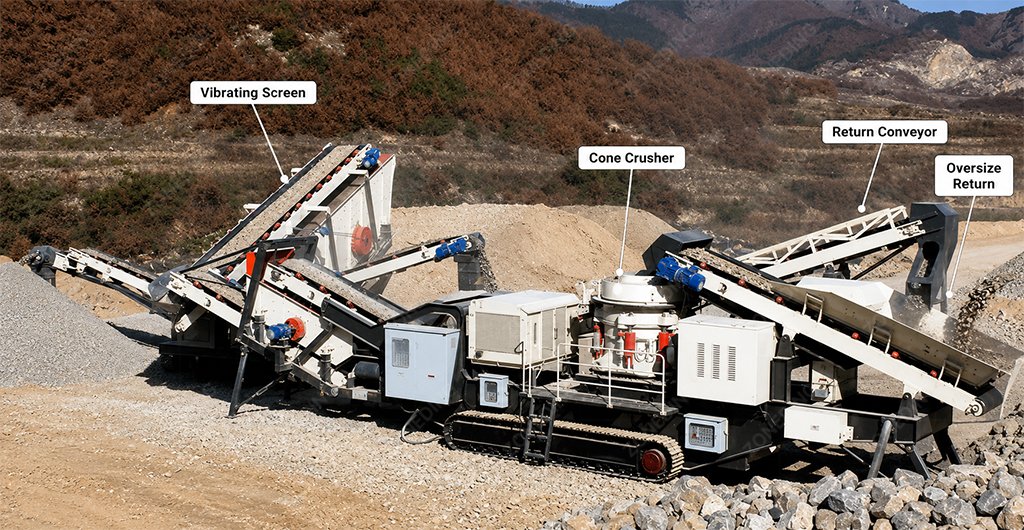
Closed-circuit operation
Closed-circuit crushing is an important method for improving aggregate quality.
In a closed circuit, oversized particles are returned for additional crushing instead of becoming final products.
This improves:
Closed-circuit crushing does not guarantee that every particle will meet specification, but it greatly improves control compared with simple open-circuit operation.
Aggregate quality starts with process design, not with a single machine.
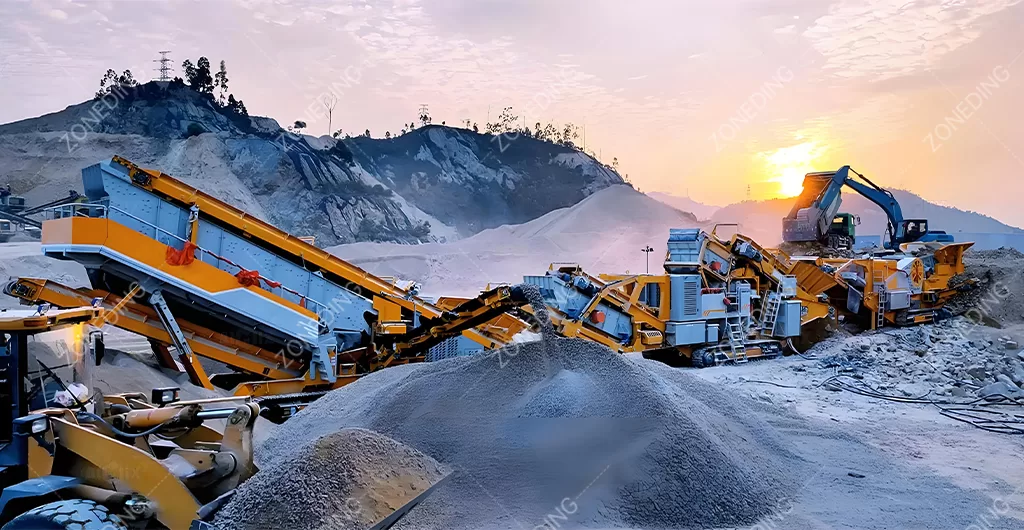
A good crushing circuit must balance:
The ideal configuration depends on the final application.
Road base material may tolerate wider gradation ranges.
Concrete aggregate usually requires better particle shape and controlled fines.
Manufactured sand production often requires additional shaping and classification stages.
A typical aggregate crushing circuit may include:
| Circuit Configuration | Common Application | Aggregate Quality Direction |
|---|---|---|
| Jaw crusher + screen | Basic aggregate production | Moderate |
| Jaw crusher + cone crusher + screen | Hard rock aggregate | Good |
| Jaw crusher + impact crusher + screen | Limestone and road aggregate | Good shape for suitable materials |
| Jaw crusher + cone crusher + VSI + screen | Premium aggregate and manufactured sand | Higher shape and gradation control |
| Multi-stage closed circuit | Strict specification projects | Better consistency |
For large quarry projects, equipment selection should be based on the complete production objective rather than individual machine capacity.
A crusher may have enough rated output, but the full plant may still fail if screening capacity, return conveyor size, discharge arrangement, or stockpile separation is poorly designed.
Useful design questions include:
The best crushing circuit is not always the most complex one.
It should match the raw material, product target, market requirement, site layout, and long-term operating cost.
Many aggregate producers experience quality problems because of incorrect process decisions rather than insufficient equipment capacity.
Selecting equipment only by tons per hour is a common mistake.
A crusher may reach the required capacity but still fail to produce acceptable shape or gradation.
Capacity should always be considered together with:
Another common mistake is using too few crushing stages.
When one crusher is forced to achieve excessive size reduction, it often creates more flaky particles, excessive fines, and poor gradation.
Ignoring screening performance is also a frequent problem.
A high-performance crusher cannot compensate for poor screening. Incorrect screen selection may result in unstable product sizes and increased reprocessing cost.
Finally, replacing equipment before optimizing operation can lead to unnecessary investment.
Many quality problems are caused by:
Use this table as a practical troubleshooting guide.
| Problem | First Check | Practical Fix |
|---|---|---|
| Too many flaky particles | Crusher type and reduction ratio | Add shaping stage or reduce excessive reduction in one stage |
| Excessive fines | Crusher settings and screening efficiency | Adjust CSS, reduce over-crushing, and improve screening |
| Too much oversize | Screen opening and closed-circuit return | Select proper mesh and check return flow |
| Poor gradation | Screen configuration and product split | Adjust deck sizes and improve material separation |
| Unstable product quality | Feed consistency and liner condition | Improve feeding and monitor wear |
| High circulating load | Screening capacity and return conveyor size | Upgrade screen area or balance crusher load |
| Low production efficiency | Equipment matching and process balance | Review full plant layout instead of one machine |
Before investing in new equipment, operators should first evaluate whether the existing plant is being used under suitable conditions.
In many cases, quality can improve through process optimization before a major equipment upgrade is needed.
Improving aggregate quality does not always require purchasing a new crusher or rebuilding the entire plant.
In many cases, operators can start with daily adjustments and maintenance.
Common improvement methods include:
Before selecting or upgrading an aggregate crushing system, confirm these points:
If these items are not clear, a new machine may not solve the quality problem.
The plant should be reviewed as a full production system.
Why is cubical aggregate preferred for construction?
Cubical aggregate particles usually provide better packing, interlocking, and compaction than flaky or elongated particles. This can improve concrete, asphalt, and road-base performance.
Which crusher produces better aggregate shape?
Cone crushers, impact crushers, and VSI sand makers are commonly used to improve particle shape after primary crushing. The right choice depends on rock hardness, abrasiveness, product size, and wear cost.
How can I reduce flaky aggregate particles?
Use suitable crushing stages, avoid excessive reduction in one crusher, maintain stable feeding, check liner wear, and consider additional shaping for strict aggregate requirements.
How does screening affect aggregate gradation?
Screening separates crushed material into required size fractions. Poor screening can create oversize, excessive fines, unstable gradation, and higher recirculating load.
Should I add a VSI crusher to improve aggregate shape?
A VSI crusher or sand making machine can help when the project requires manufactured sand, premium aggregate, or better particle shaping. However, the decision should be based on raw material, product specification, capacity, and operating cost.
ZONEDING provides complete aggregate crushing and screening solutions for quarry, mining, road construction, and concrete aggregate projects.
Our solutions can include jaw crushers, cone crushers, impact crushers, sand making machines, vibrating screens, belt conveyors, mobile crushing plants, stationary crushing plants, and customized production line design.
Before recommending a plant configuration, ZONEDING engineers evaluate raw material characteristics, required capacity, final product sizes, aggregate quality requirements, site layout, operating cost, and future expansion plans.
Whether you need a new aggregate crushing plant or want to improve an existing operation, ZONEDING can provide equipment selection, process design, and technical support.
For a customized solution, please provide raw material type, feed size, required capacity, final product sizes, application requirements, and existing equipment information.
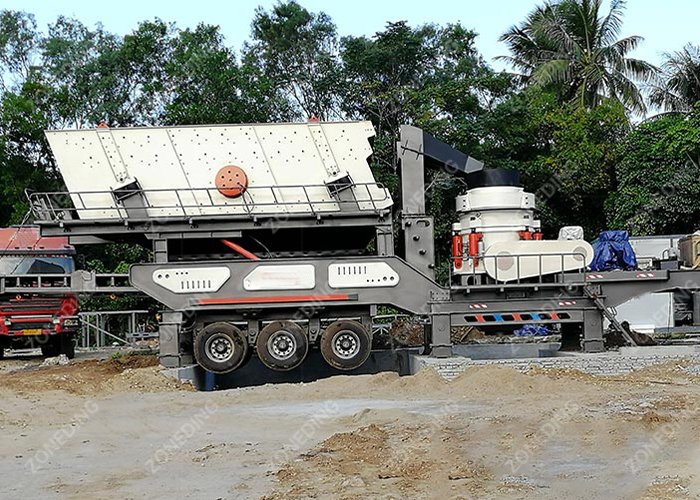
Compare mobile cone crusher prices, 100–200 TPH setups, feed limits and liner costs for copper ore and hard rock projects in Chile.
View details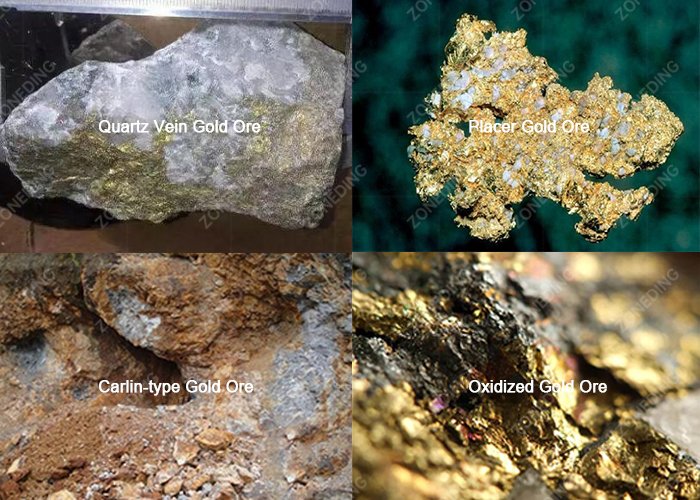
Identifying gold ore accurately determines the absolute survival of any mineral processing plant. A geological report showing 10 grams per ton means nothing if the metallurgical nature prevents extraction. A low-grade oxide gold ore often generate...
View details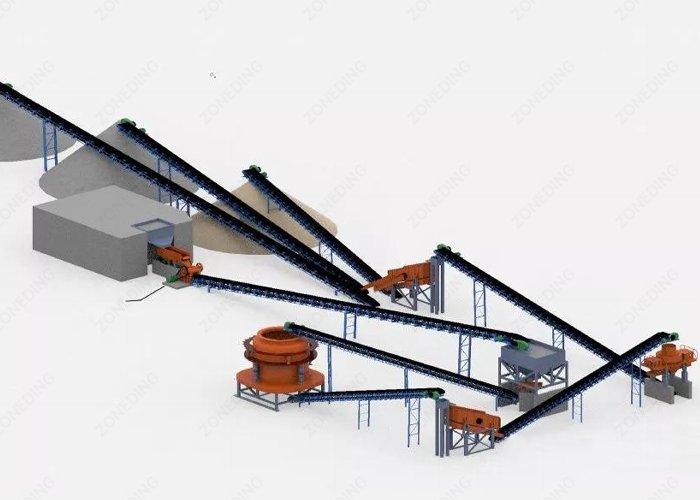
Experience in global quarries reveals common, costly mistakes in equipment selection. Mine owners often consider a crusher just a big hammer that breaks rocks. This mindset destroys profitability. Crushing is a delicate balance of rock mechanics a...
View details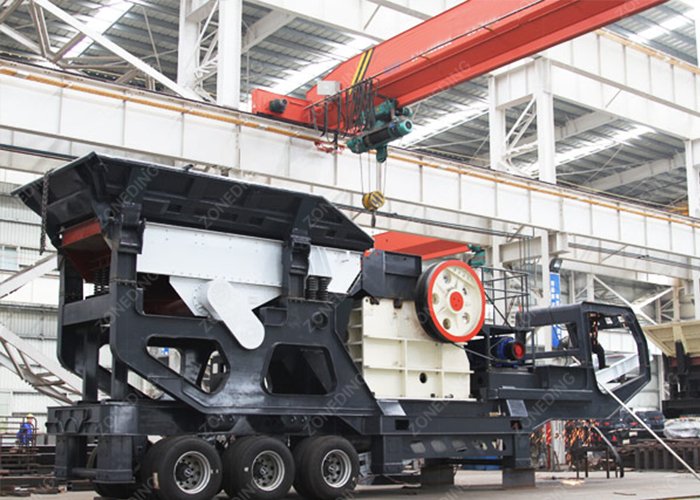
: Compare mobile jaw crusher prices, feed sizes, capacities and configurations for quarry, mining and aggregate projects in South America.
View details