 Zoneding Machine



Mobile Crusher Plant in Chile for Copper Mining and Hard Rock
598Compare mobile crusher circuits, capacity, altitude setup, logistics and wear planning for Chile copper and hard-rock projects.
View detailsSearch the whole station Crushing Equipment
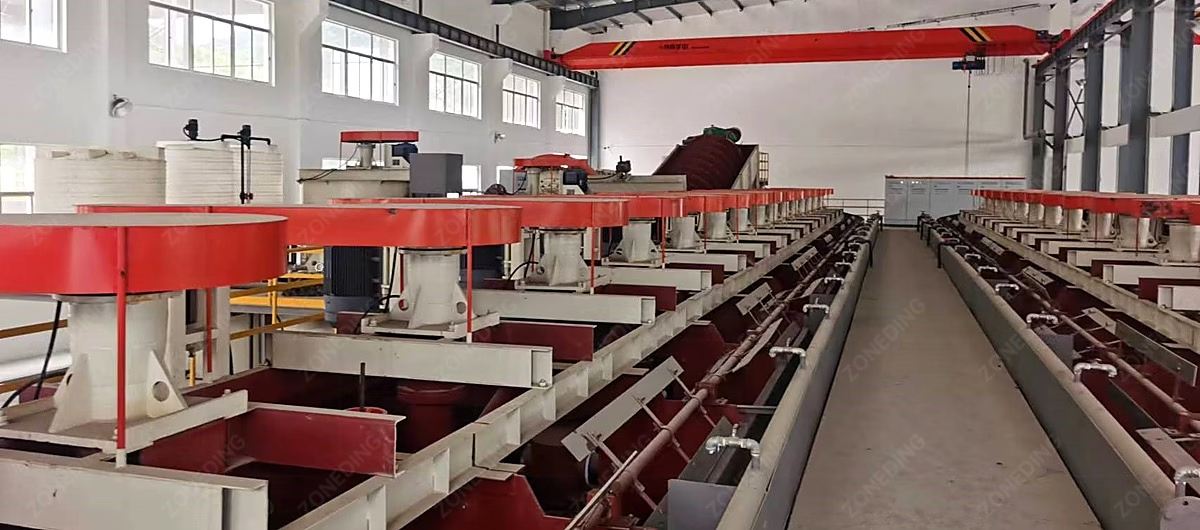
Flotation froth provides valuable information about what is happening inside a mineral processing circuit. Changes in bubble size, froth movement, color, and stability may indicate disturbances in mineral collection or concentrate removal.
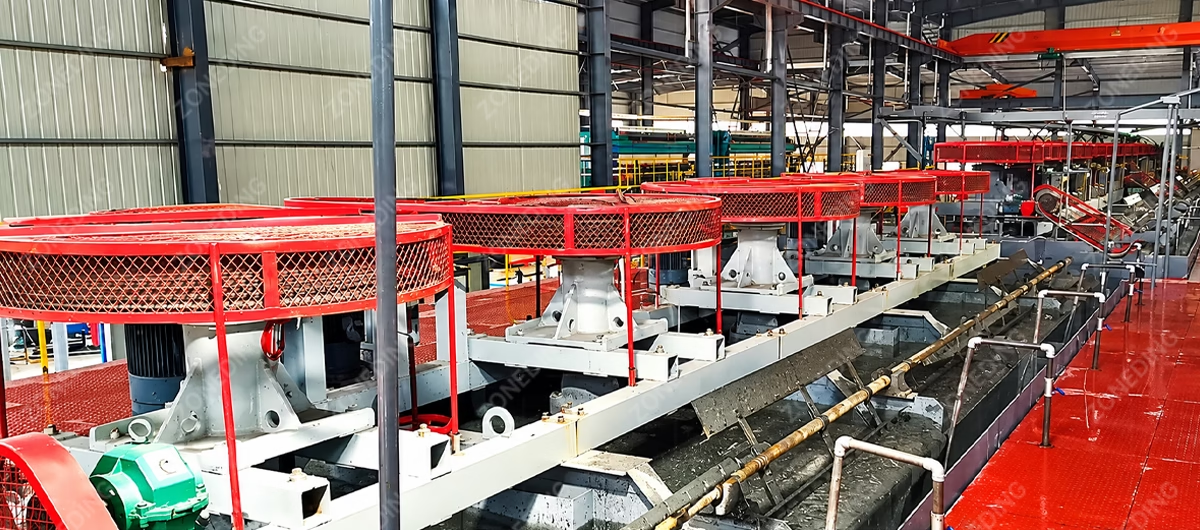
However, a thick froth does not necessarily mean high mineral recovery. Likewise, a rapidly collapsing froth does not automatically prove that the flotation process is failing.
Operators must evaluate froth appearance alongside concentrate grade, tailings assays, mass pull, and operating conditions.
Common flotation froth problems originate from changes in ore characteristics, reagent addition, grinding performance, air supply, pulp level, or equipment condition.
Understanding these relationships helps operators identify the actual cause before changing process settings.
Flotation froth provides valuable information about what is happening inside a mineral processing circuit. Changes in bubble size, froth movement, color, and stability may indicate disturbances in mineral collection or concentrate removal.
However, a thick froth does not necessarily mean high mineral recovery. Likewise, a rapidly collapsing froth does not automatically prove that the flotation process is failing.
Operators must evaluate froth appearance alongside concentrate grade, tailings assays, mass pull, and operating conditions.
Common flotation froth problems originate from changes in ore characteristics, reagent addition, grinding performance, air supply, pulp level, or equipment condition.
Understanding these relationships helps operators identify the actual cause before changing process settings.
There is no universal froth appearance that guarantees successful flotation.
Different minerals, reagent systems, and flotation stages require different operating conditions. A rougher cell designed to maximize valuable mineral recovery may behave differently from a cleaner cell focused on concentrate selectivity.
Instead of judging performance by froth thickness alone, operators should evaluate three functions.
First, mineral-bearing bubbles must rise from the pulp into the froth zone.
Second, the froth must remain sufficiently stable to transport attached particles toward the concentrate launder.
Third, drainage should limit unnecessary water and fine gangue reporting to the concentrate.
The balance between these functions matters more than the visual appearance of any single bubble.
| Froth observation | Possible process issue | What to verify |
|---|---|---|
| Froth collapses rapidly | Insufficient stability or particle detachment | Frother delivery, air supply, water chemistry |
| Froth is excessively persistent | Poor drainage or high water recovery | Frother dosage, fines, froth depth |
| Bubbles become unusually large | Changes in aeration or frother conditions | Air flow, reagent delivery, equipment condition |
| Wet froth and high mass pull | Possible gangue entrainment | Concentrate grade, water recovery |
| Froth appears stable but recovery falls | Poor mineral attachment or liberation | Particle size, chemistry, tailings assays |
These observations are starting points for diagnosis, not proof of a particular fault.
Rapid froth collapse may prevent mineral-bearing bubbles from reaching the concentrate launder.
In some cases, valuable particles detach and return to the pulp. The actual effect on recovery must be confirmed through metallurgical measurements.
Frothers influence bubble formation and froth stability. An insufficient or inconsistent supply can alter the behavior of the froth zone.
Before increasing dosage, check the reagent preparation tank, solution concentration, dosing pump, pipelines, and addition point.
Compare actual reagent consumption with feed tonnage and historical operating records.
A blocked dosing line or incorrectly calibrated pump may produce symptoms that resemble an unsuitable reagent dosage.
A new ore blend can change mineralogy, particle size distribution, and slurry behavior.
Similarly, changes in recycled water quality, dissolved salts, or contamination may affect reagent response and bubble stability.
Review whether the froth problem appeared after a change in ore source, grinding conditions, or water supply.
If several flotation cells become unstable at the same time, investigate these shared upstream conditions before adjusting individual machines.
Unstable air delivery or abnormal agitation can disturb bubble formation and froth transport.
Compare air supply, pulp level, and equipment operation with previously stable conditions.
If the problem occurs in only one cell, prioritize its local air system and mechanical condition.
Avoid increasing air flow automatically. More air does not always produce better particle collection or froth stability.
Excessively persistent froth can be difficult to transport and may retain unwanted water or fine particles.
However, froth persistence, stickiness, and gangue entrainment are related but distinct problems.
A thick froth alone cannot establish whether concentrate quality has declined.
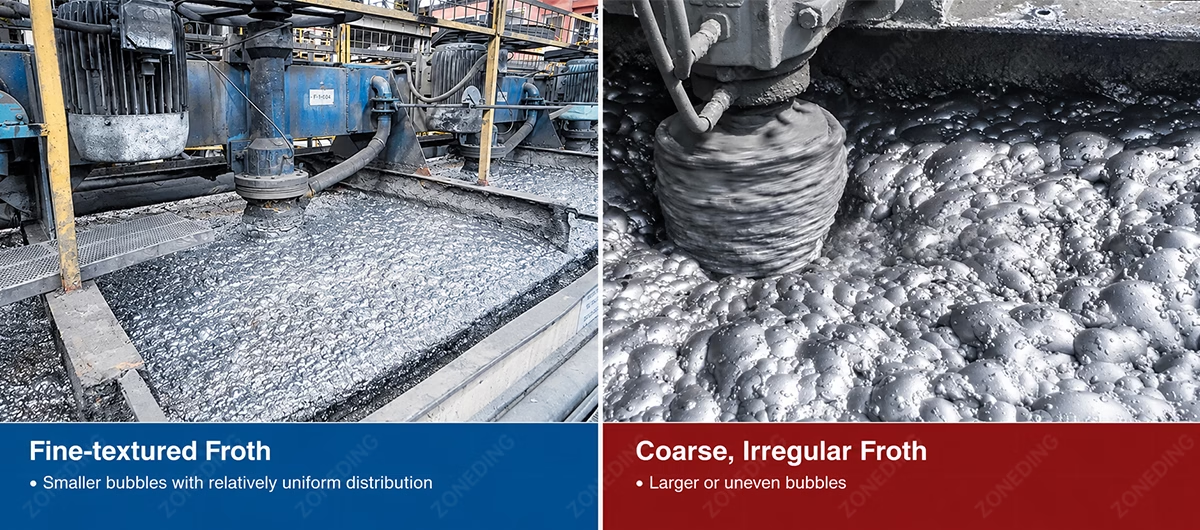
An unsuitable frother dosage may increase froth persistence and alter drainage.
Where water recovery rises, fine gangue particles may enter the concentrate through entrainment.
Review reagent consumption, concentrate grade, mass pull, and water recovery together.
Any adjustment should be tested under controlled conditions rather than based only on froth appearance.
Fine particles can influence froth structure, drainage, and particle transport.
Some clay-bearing ores also change slurry behavior and flotation response.
Review feed particle size distribution, grinding performance, and ore mineralogy when persistent froth appears after a feed change.
Reducing particle size is not always beneficial. Excessive grinding can increase fines and create additional separation difficulties.
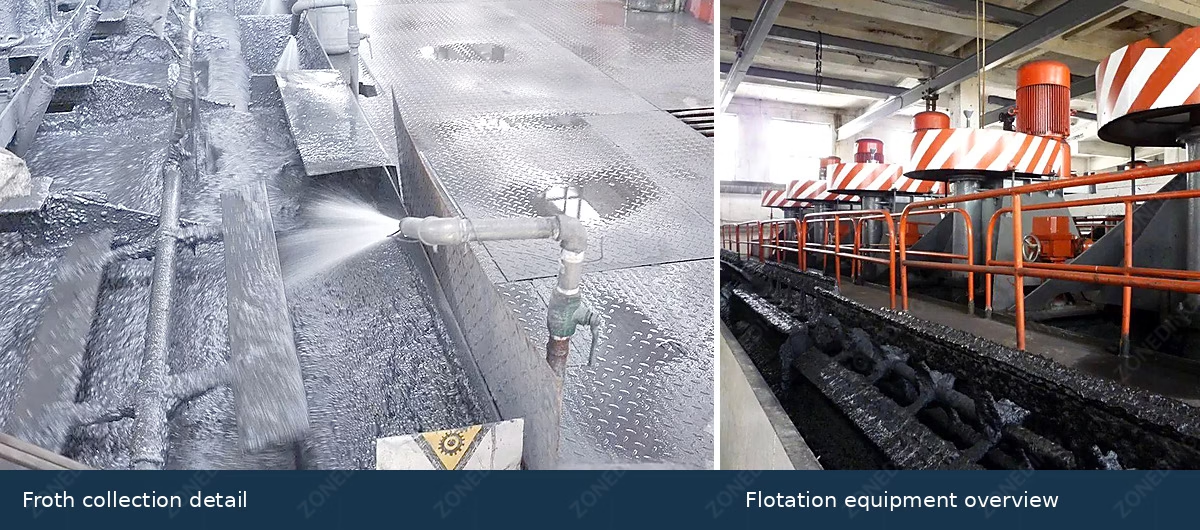
Froth depth, pulp level, air supply, and launder conditions influence how material leaves the flotation cell.
Inspect whether the froth is moving consistently toward the launder or accumulating in specific areas.
When concentrate grade declines, determine whether the cause is increased water and fine gangue recovery, poor mineral selectivity, or another process change.
Do not treat every sticky froth problem as excessive frother dosage.
Bubble size and distribution influence the surface available for particle attachment.
When bubbles suddenly become larger or less uniform, possible causes include changes in frother delivery, air supply, slurry properties, or equipment condition.
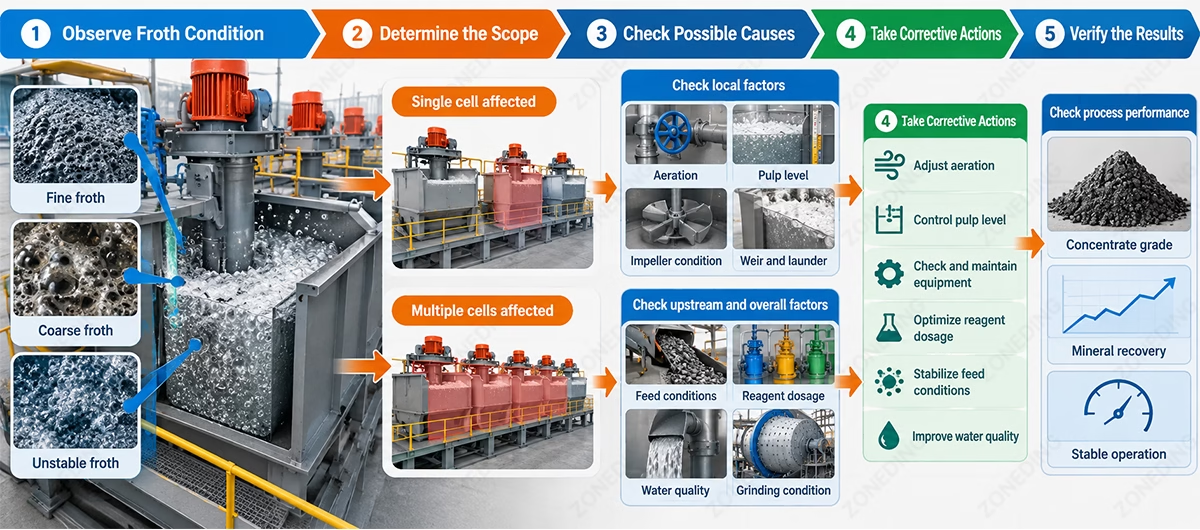
The first diagnostic question is whether the abnormal behavior affects one flotation cell or several cells.
One cell behaves differently: Compare its air supply, pulp level, rotor or aeration system, and reagent distribution with neighboring cells.
Several cells change together: Investigate common factors such as feed mineralogy, process water, reagent preparation, and grinding conditions.
This distinction helps operators avoid unnecessary adjustments across the entire circuit.
Record froth behavior at consistent observation points where practical.
Review air flow, feed solids, pulp level, reagent addition, and recent process changes.
Visual inspection is useful, but bubble size alone cannot establish flotation efficiency.
A cell with relatively uniform bubbles may still perform poorly if valuable minerals are insufficiently liberated or the reagent chemistry is unsuitable.
A flotation cell may produce a substantial froth layer while recovering too little valuable mineral.
This occurs because generating bubbles is not the same as achieving selective mineral attachment and transport.
When recovery declines, operators should examine mineral liberation, surface chemistry, and flotation opportunity.
Valuable minerals locked within gangue particles may not respond effectively to flotation.
Review the grinding product, particle size distribution, and mineralogical test results.
Finer grinding may improve liberation in some ores. However, excessive grinding can create slimes that complicate flotation and concentrate cleaning.
Changes to grinding fineness should therefore be supported by testwork rather than made solely in response to froth appearance.
Collectors, depressants, activators, and pH modifiers influence mineral surface behavior and selectivity.
A change in ore composition can make an existing reagent scheme less effective.
Verify reagent preparation, addition sequence, pH measurements, and actual consumption.
Increasing collector dosage without diagnosis may increase unwanted mineral recovery or create other separation problems.
High feed rates, changing slurry flow, or ineffective cell operation may reduce the opportunity for valuable particles to be recovered.
Review feed solids, slurry throughput, operating levels, and flotation stage arrangement.
Compare concentrate and tailings assays before concluding that more flotation equipment is required.
Where the problem is specific to lead-zinc separation, additional mineral-specific considerations are discussed in Lead-Zinc Flotation Process: How to Improve Separation and Recovery.
Air flow, pulp level, and froth depth interact. Adjusting one setting can change the effect of the others.
Air flow influences bubble generation and gas dispersion. Inappropriate aeration may reduce collection performance or disturb the froth.
Pulp level affects the position of the pulp–froth interface and the available froth zone.
Froth depth influences drainage, particle transport, and the likelihood of mineral-bearing particles returning to the pulp.
A deeper froth may improve selectivity under certain conditions, but it can also increase particle drop-back.
A shallower froth may increase mass pull while allowing more water and unwanted particles into the concentrate.
The appropriate balance depends on ore characteristics, flotation stage, and machine design.
Rougher flotation generally emphasizes recovery of valuable minerals, while cleaner flotation places greater emphasis on concentrate quality.
These objectives can require different operating conditions.
Operators should therefore avoid applying one froth-depth or air-flow setting across all cells without considering their functions.
When one cell behaves abnormally despite similar feed and reagent conditions, inspect its local controls and mechanical components.
For information about the functions of rotors, stators, and related assemblies, see Main Components of a Flotation Machine.
Equipment configuration and available machine types can also be reviewed on the Flotation Machine product page.
Effective troubleshooting starts by identifying the symptom, locating the affected stage, and checking relevant measurements.
Avoid changing several variables simultaneously. Doing so makes it difficult to determine which adjustment caused the result.
The following matrix provides a practical starting point.
| Observed symptom | Priority checks | Recommended diagnostic action |
|---|---|---|
| Froth collapses rapidly | Frother dosing, air stability, water chemistry | Verify reagent delivery and compare operating conditions |
| Excessively persistent froth | Frother addition, fines, water recovery | Review reagent records and froth drainage |
| Large or irregular bubbles | Air supply, frother, rotor condition | Compare affected cells with neighboring cells |
| High mass pull but low concentrate grade | Water recovery, entrainment, froth depth | Check concentrate composition and fine gangue recovery |
| Stable froth but poor mineral recovery | Liberation, reagent chemistry, tailings assays | Investigate grinding results and metallurgical performance |
| Only one cell behaves abnormally | Local air supply, level control, mechanical condition | Inspect cell-specific equipment and controls |
| Several cells change simultaneously | Feed, water, reagent preparation, upstream grinding | Investigate shared process disturbances |
Suppose one flotation cell develops unusually large bubbles while adjacent cells remain stable.
A local air-supply or equipment problem is a reasonable first possibility.
If the same change appears across multiple cells after a new ore blend enters the plant, upstream feed conditions deserve priority.
Neither observation proves the cause, but both help determine where to investigate first.
After identifying a likely cause, make a controlled adjustment where practical.
Allow sufficient time for the circuit to respond, then compare operating data and metallurgical results.
Track concentrate grade, recovery, tailings assays, and mass pull as appropriate.
An improvement in froth appearance without a corresponding process benefit should not automatically be considered a successful correction.
Not every flotation froth problem requires a new reagent scheme or replacement machine.
The appropriate response depends on whether the root cause is chemical, mechanical, or related to circuit design.
Consider reagent testing when problems follow changes in ore mineralogy, process water, or chemical operating conditions.
Consider equipment inspection or repair when abnormal behavior is isolated to one cell or accompanied by inconsistent air delivery, unstable levels, or mechanical symptoms.
Consider circuit evaluation when recovery remains inadequate despite controlled operating conditions and appropriate maintenance.
Before proposing an equipment upgrade, assess mineral liberation, flotation kinetics, feed tonnage, cell configuration, and available processing capacity.
A useful flotation troubleshooting request should include:
These records help engineers distinguish an operating disturbance from an equipment or circuit limitation.
Why does flotation froth suddenly disappear?
Possible causes include interrupted frother delivery, changes in water or feed chemistry, unstable aeration, or equipment disturbances. Compare recent operating changes before adjusting reagent dosage.
Does adding more frother improve flotation recovery?
Not necessarily. Excessive frother may increase froth persistence and water recovery, potentially reducing concentrate selectivity. Evaluate concentrate grade and recovery together.
Why is flotation froth thick but concentrate grade is low?
The froth may contain excessive water or fine gangue, although other selectivity problems are also possible. Check mass pull, concentrate composition, particle size distribution, and drainage conditions.
Can grinding fineness cause flotation froth problems?
Yes. Grinding affects mineral liberation and the production of fine particles. Both insufficient liberation and excessive fines can contribute to poor flotation performance.
When should flotation equipment be replaced?
Replacement should be considered only after evaluating feed conditions, reagent chemistry, aeration, mechanical condition, and circuit capacity. Many froth problems can originate outside the flotation machine.
Unstable froth, excessive foam, or poor mineral recovery can originate from different parts of a mineral processing circuit.
To discuss your flotation equipment requirements, share your ore characteristics, processing rate, flotation cell models, reagent scheme, and recent operating results.
Where available, include concentrate and tailings assays along with photographs or videos of the affected cells.
Contact ZONEDING to discuss flotation equipment selection and circuit requirements.
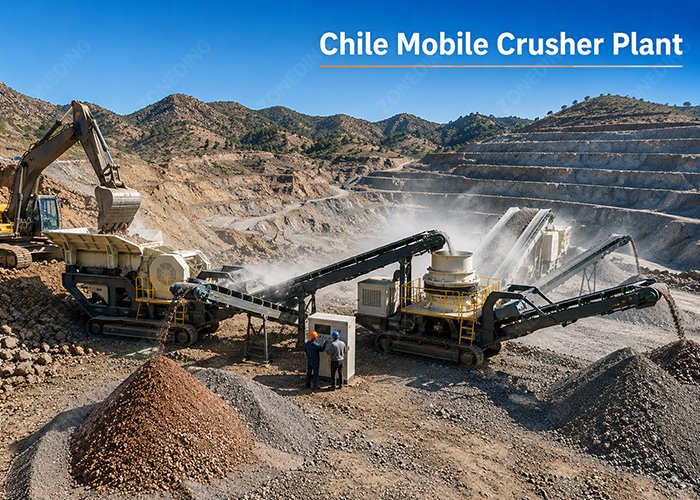
Compare mobile crusher circuits, capacity, altitude setup, logistics and wear planning for Chile copper and hard-rock projects.
View details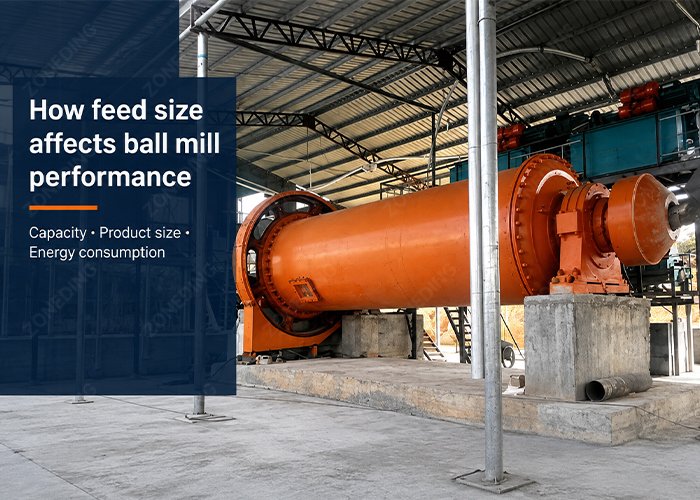
Learn how ball mill feed size affects throughput, kWh/t, grinding efficiency, and the total cost of crushing and grinding.
View details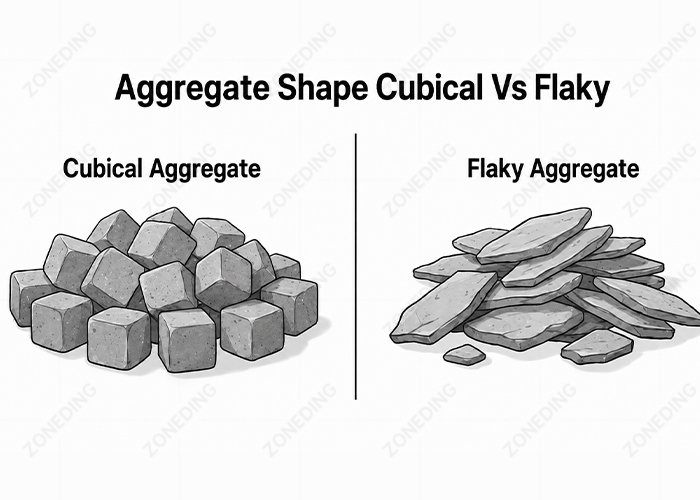
Learn how to control aggregate shape and gradation with crusher selection, screening, closed circuits, and process control.
View details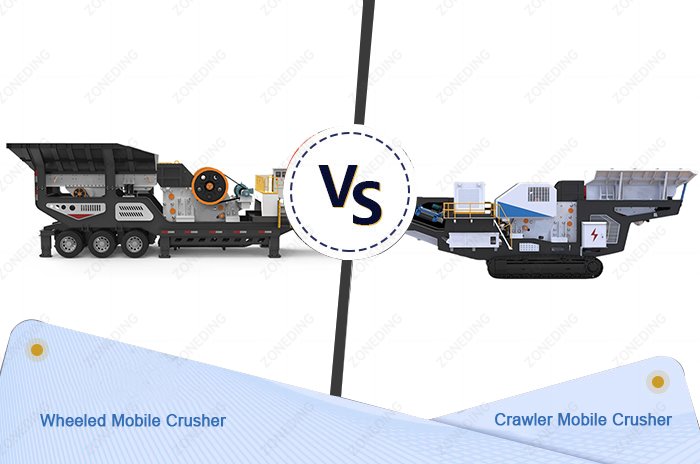
Choosing mobile crushing equipment determines project setup speed and long-term operating costs. Many buyers only look at the transport method. They ignore the hidden costs of site preparation and energy consumption. This guide shows the real diff...
View details