A 50–100 TPH stone crusher plant can supply road base, concrete aggregate, drainage stone, and general construction material without the investment and site requirements of a large commercial quarry.
However, capacity alone does not define the plant. A 70 TPH limestone operation producing one road-base product needs a different process from a 70 TPH granite quarry producing four calibrated aggregate sizes.
This guide focuses on how small quarry owners in South America can determine capacity, select the crushing process, arrange the site, and leave room for future expansion. Buyers comparing budgets across several plant sizes should use the separate 50–500 TPH stone crusher plant price guide.
Do not select plant capacity only from the maximum tons per hour shown in a brochure. Start with expected aggregate sales, available raw material, and realistic operating hours.
A simple planning formula is:
Annual saleable output = hourly output × operating hours per day × operating days × utilization rate
For example, an 80 TPH plant operating eight hours per day for 250 days at 75% utilization would produce approximately:
80 × 8 × 250 × 0.75 = 120,000 tons per year
This calculation is more realistic than assuming the plant will operate at its maximum rating every hour.
A 50–100 TPH line usually fits:
New quarry businesses entering a local aggregate market
Contractors supplying municipal or rural road projects
Small concrete and asphalt producers
Quarries serving one city or regional construction area
Projects with moderate power or site limitations
Investors who plan to expand in stages
The capacity should refer to the required finished aggregate, not only the feed entering the jaw crusher. Screening efficiency, recirculating material, moisture, clay, and equipment downtime all reduce saleable output.
Which Rock and Aggregate Products Define the Process?
Crusher selection must begin with the raw material and the required finished products.
Hardness is important, but abrasiveness, moisture, clay, and feed grading also affect equipment performance. Granite, basalt, river stone, and quartz-rich rock can rapidly consume blow bars in an impact crusher. Limestone and relatively clean recycled concrete normally respond well to impact crushing.
Raw Material
Recommended Process Direction
Typical Products
Limestone
Jaw crusher → impact crusher → screen
Road base and cubical concrete aggregate
Granite
Jaw crusher → cone crusher → screen
Concrete and asphalt aggregate
Basalt
Jaw crusher → cone crusher → screen
High-strength road aggregate
River stone
Jaw crusher → cone crusher → optional shaping
Concrete aggregate and manufactured sand feed
Recycled concrete
Sorting → impact crushing → magnet → screen
Backfill and recycled road base
The product specification can change the entire plant.
A quarry producing only 0–40 mm road base may use a simple circuit. A producer supplying 0–5 mm, 5–10 mm, 10–20 mm, and 20–40 mm products needs a multi-deck screen, separate conveyors, and controlled stockpiles.
Before designing the process, confirm:
Maximum and normal feed size
Percentage of soil, clay, and natural fines
Rock hardness and abrasiveness
Required aggregate sizes
Permitted oversize and fine content
Whether particle shape is commercially important
Hard-rock quarry operators can also review the Brazil stone crusher plant guide, which covers granite, basalt, wear costs, and commercial aggregate production.
Which 50–100 TPH Crusher Configuration Should You Choose?
Most small quarry projects use one of three basic configurations. The correct choice depends on material behavior and product quality—not simply the lowest equipment quotation.
This is the simplest option for soft rock, pre-broken limestone, and projects producing general road base.
A jaw crusher can accept relatively large feed and provide stable primary reduction. However, a single-stage jaw circuit does not normally produce the same cubical shape or tight grading as a two-stage plant.
Choose this layout when:
Capital and site space are limited
The material is soft or moderately hard
One broad product size is acceptable
Local customers do not require premium particle shape
This configuration is suitable for limestone, sandstone, road aggregate, and clean construction waste. The impact crusher provides a high reduction ratio and generally produces more cubical particles than a jaw crusher alone.
A return conveyor can send oversize material back to the impact crusher. This creates a closed circuit and improves product-size control.
For limestone and recycling applications, the detailed mobile impact crusher project guide explains feed preparation, screening, magnetic separation, and wear considerations.
This is normally the better direction for granite, basalt, river stone, and other abrasive rock.
A cone crusher costs more than a simple secondary impact crusher, but compression crushing usually provides better wear control on hard material. Stable and evenly graded feed is important, so a small buffer bin or controlled transfer system is recommended before the cone crusher.
Configuration
Best Application
Main Limitation
Jaw + screen
Low-cost road-base production
Limited particle-shape control
Jaw + impact + screen
Limestone and recycled concrete
Higher wear on abrasive rock
Jaw + cone + screen
Granite, basalt, and river stone
Higher initial equipment requirement
What Equipment, Site Space, and Power Are Required?
A complete small quarry line includes more than the main crushers.
Typical equipment includes:
Vibrating feeder
Primary jaw crusher
Secondary impact or cone crusher when required
Two- or three-deck vibrating screen
Transfer and stockpile conveyors
Electrical control cabinet
Steel supports and maintenance platforms
Dust-suppression or water-spray system
Initial spare and wear parts
The following figures are early planning references rather than final design values.
Plant Type
Reference Installed Power
Practical Production Area
Jaw crusher + screen
80–130 kW
2,000–3,000 m²
Jaw + impact + screen
130–200 kW
3,000–4,000 m²
Jaw + cone + screen
150–230 kW
3,000–5,000 m²
The production area should include truck access, equipment foundations, stockpiles, maintenance clearance, drainage, and safe walkways. It does not represent the full quarry concession.
A compact layout is not always the most efficient layout. Conveyors that are too short may create steep transfer angles. Small stockpiles can force frequent loader movement, while poor maintenance access increases shutdown time.
Confirm the local voltage and frequency before equipment production. South American power standards vary by country and project location. A remote quarry may also require a transformer, generator, or hybrid power arrangement.
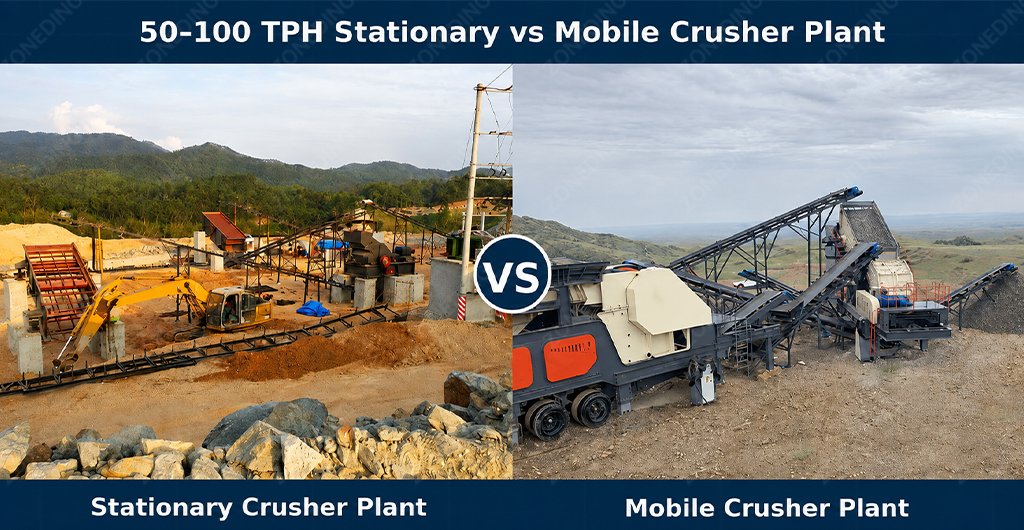
Should a Small Quarry Use a Mobile or Stationary Plant?
A permanent quarry with stable reserves, reliable road access, and several years of planned operation normally benefits from a stationary plant. It provides more freedom for stockpile design, future conveyors, additional screens, and later expansion.
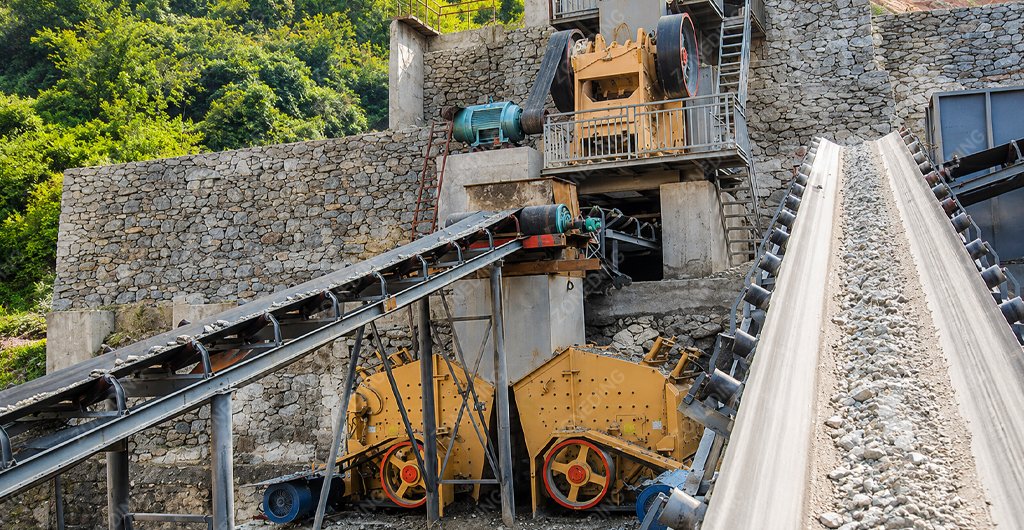
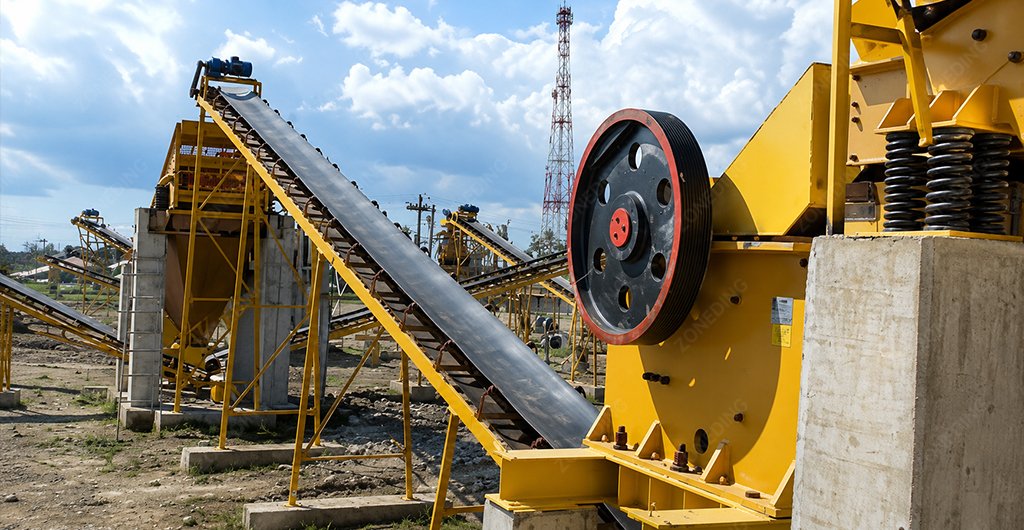
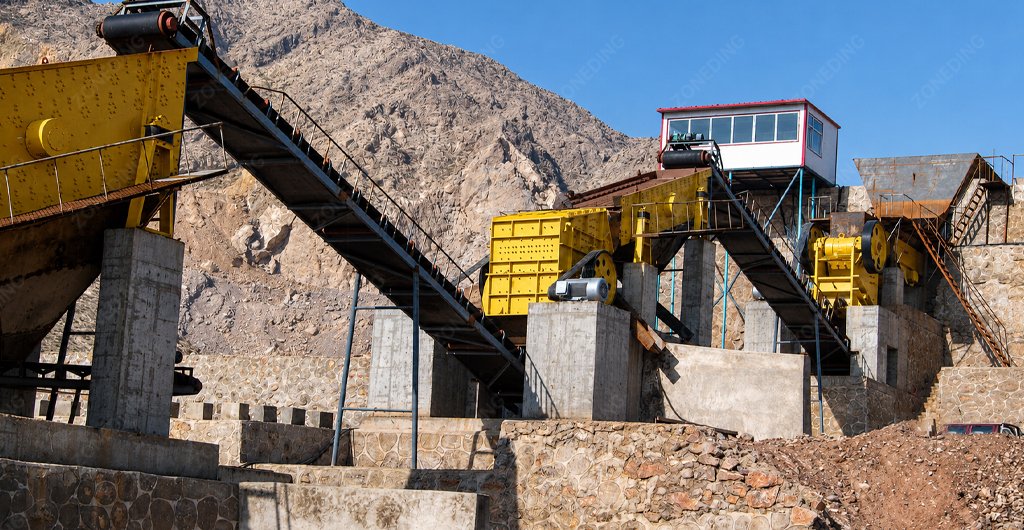
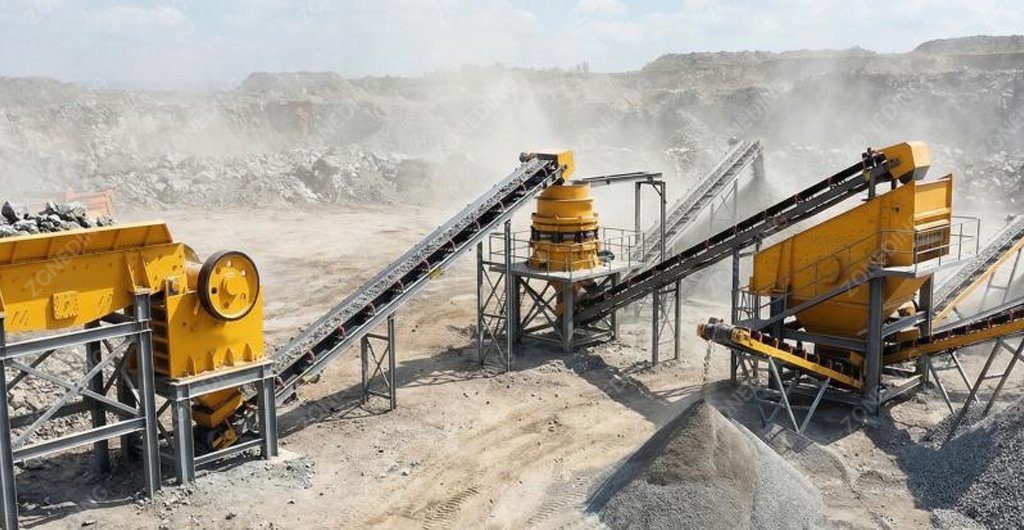
Stationary and mobile 50–100 TPH crusher plants for small quarries
A mobile plant becomes more practical when:
The crusher must move with the quarry face
The project operates at temporary extraction sites
Civil construction must be minimized
The contractor moves between road projects
Permitting or land access limits permanent structures
Mobile does not automatically mean cheaper. The chassis, hydraulic systems, integrated conveyors, and transport dimensions can increase equipment cost. Its value comes from faster relocation and less permanent construction.
The advertised crusher capacity is not the same as continuous saleable output. In a complete plant, actual production may be limited by the feeder, screen, conveyor, secondary crusher, or stockpile arrangement.
Stable output depends on balanced operation across the entire circuit. Material should enter the plant at a controlled and continuous rate rather than in large batches. Soil and excessive fines need to be removed before primary crushing, while oversized rocks should be prevented from blocking the jaw crusher.
When a cone crusher is used, the feed level must remain stable enough to maintain choke-fed operation where required. Jaw plates, cone liners, and impact blow bars should also be inspected regularly so that uneven wear does not reduce capacity or product quality.
Screen performance requires equal attention. Blocked openings reduce separation efficiency, increase recirculating load, and may contaminate finished products. Conveyor loading, transfer-point spillage, and stockpile access should therefore be checked during routine operation. Keeping critical wear and spare parts on site can also shorten unexpected shutdowns.
Screening capacity must be based on the number and size of finished products, not only on total plant throughput. Producing four separate aggregate fractions places a much heavier load on the screen than producing a single road-base product.
Future expansion should be considered before foundations, electrical systems, and conveyor corridors are finalized. The initial layout may need to reserve space and power for:
Secondary crushing equipment
A larger screen or an additional screening unit
Closed-circuit return conveying
Extra finished-product conveyors
Manufactured-sand production equipment
Aggregate washing and water-treatment systems
If market demand later exceeds 100 TPH, the 100–200 TPH aggregate crushing plant guide explains the next production level and the additional equipment it normally requires.
What Information Is Needed for a Workable Proposal?
A useful proposal should be based on quarry conditions, not a standard equipment list.
Provide:
Project Information
Why It Is Required
Country and nearest port
Shipping and electrical planning
Material name and photographs
Initial crusher selection
Maximum feed size
Feeder and jaw-crusher sizing
Required saleable output
Plant capacity and circuit design
Finished product sizes
Screen decks and conveyors
Operating hours per day
Wear, power, and production planning
Site dimensions or drawing
Layout and stockpile design
Voltage and frequency
Motor and control-system design
Mobile or stationary preference
Chassis and foundation planning
Future expansion target
Space and electrical allowance
The proposal should identify the process flow, equipment list, installed power, layout, supply boundary, initial spare parts, shipping method, installation responsibility, and warranty terms.
Price should be evaluated only after the technical scope is clear. Two quotations with the same “80 TPH” label may include different crushing stages, screening capacity, conveyors, steel structures, and control systems.
ZONEDING can use the project information to prepare a preliminary flow diagram, equipment recommendation, layout direction, power list, and quotation for the selected quarry conditions.
50–100 TPH Stone Crusher Plant FAQ
Can a 50–100 TPH plant process granite?
Yes. Granite normally requires a jaw crusher for primary crushing and a cone crusher for secondary crushing. The screen and closed-circuit load must be considered when calculating final saleable output.
Can a single jaw crusher produce finished aggregate?
It can produce broad road-base material in some soft-rock applications. However, a secondary crusher is normally required when the market demands cubical particles, several calibrated sizes, or better control of oversize.
How much land does a 100 TPH crusher plant need?
A practical early allowance is approximately 3,000–5,000 m² for the production area. The final requirement depends on stockpile volume, truck movement, plant configuration, terrain, drainage, and future expansion.
How long does installation take?
A small stationary plant may require several weeks after foundations and electrical work are ready. The actual schedule depends on equipment scope, local construction progress, site access, installation labor, and commissioning requirements. Mobile equipment normally requires less foundation work.
Can a 50 TPH plant be expanded to 100 TPH later?
Yes, if the original feeder, foundations, screen, conveyors, control system, and available power are designed with expansion in mind. Expansion is more difficult when every component was selected only for the minimum initial duty.
A successful 50–100 TPH quarry plant is not simply a smaller version of a large production line. It must match local aggregate demand, rock characteristics, site limitations, power conditions, and the operator’s maintenance capability.
ZONEDING designs and manufactures crushing and screening equipment for quarry, aggregate, mining, road construction, and recycling projects. Support covers process design, equipment selection, manufacturing, shipping guidance, commissioning, operator training, and spare-parts planning.
Starting a gold mine requires a clear budget. Total alluvial gold plant cost ranges from $30,000 for small setups to over $500,000 for industrial lines. Equipment price is only part of the investment. Shipping, power, and labor also impa...
Understanding the mechanical logic of crushing equipment is vital for project profitability. Selecting a machine based solely on capacity ignores the reality of wear and energy costs. Different stones require different mechanical principles—either...
I have worked in the mining and recycling industry for over 50 years. Choosing the best concrete crushing setups is the most important step for your profit. Many owners lose money because they pick the wrong bones for their machine. I will show yo...
Starting a small-scale gold processing plant is one of the most practical ways to enter the gold mining industry. Compared with large mining projects, a small plant requires less investment, shorter construction time, and lower operating costs. Ho...
We use cookies to ensure that we give you the best experience on our website. If you continue to use this site we will assume that you are happy with it.
Privacy Policy
Send us a message
We would love to hear from you
Submit your question and our team will respond to the email provided as soon as possible.
 Zoneding Machine