Limestone quarries, highway contractors, and construction waste recyclers need more than hourly capacity. They also need consistent aggregate shape, fast setup, manageable wear costs, and a plant that can move when the project changes.
A mobile impact crusher combines feeding, impact crushing, conveying, and optional screening on one movable chassis. For limestone, recycled concrete, asphalt, and other medium-hard materials, it can simplify the production process while producing cubical aggregate for road base, concrete, and asphalt applications.
However, an impact crusher is not right for every rock. Material abrasiveness, feed size, product specifications, and movement frequency must be evaluated first. This guide explains where mobile impact crushing fits South American projects.
Why Is a Mobile Impact Crusher Suitable for South America?
Many South American aggregate and recycling projects do not justify a permanent station. Road contracts move between sections, quarry faces advance, and urban recycling sites often have limited space.
A mobile impact crusher can be positioned closer to the raw material. This reduces the distance that loaders or dump trucks must carry unprocessed material. It also limits the foundations, steel structures, and on-site assembly normally required by a stationary plant.
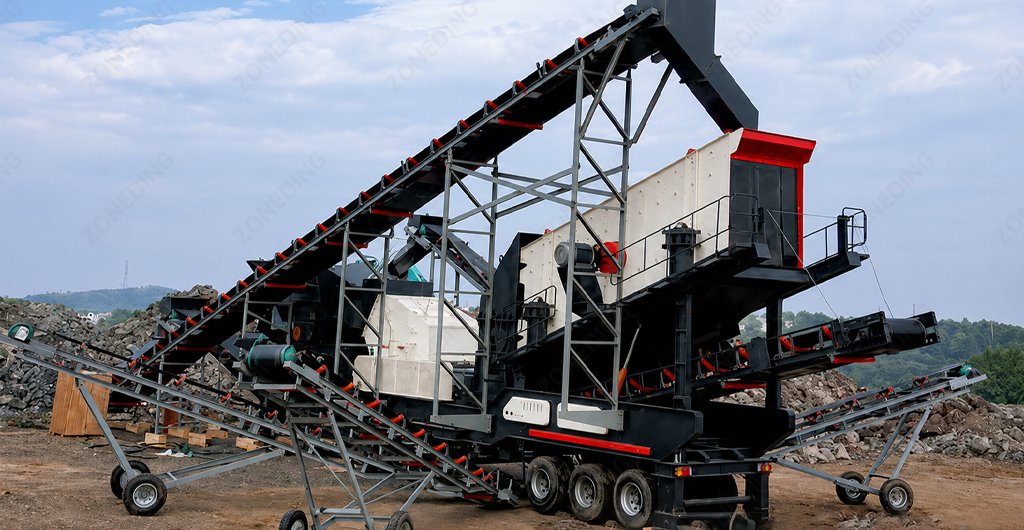
Mobile Impact Crusher
Mobile impact crusher used for crushing construction waste on site.
The main operational advantages include:
Faster installation and commissioning
Easier relocation within or between project sites
Lower dependence on permanent civil construction
A simpler path from raw material to finished aggregate
Flexible expansion with screening and return conveyors
Mobility still depends on the project. Contractors serving temporary sites may benefit substantially, while a long-life quarry may achieve a lower cost per ton with a stationary system.
Regional conditions also differ. Limestone and road projects create opportunities in Brazil and Colombia. The Colombia mobile crusher project guide explains how mobility supports road, quarry, and recycling work. Many Chilean and Peruvian hard-rock projects instead require compression crushing.
Which Materials and Applications Can It Handle?
A mobile impact crusher performs best when the feed material is medium-hard, low to moderately abrasive, and suitable for impact breakage. Its high-speed rotor throws material against impact plates, breaking it along natural fractures and improving particle shape.
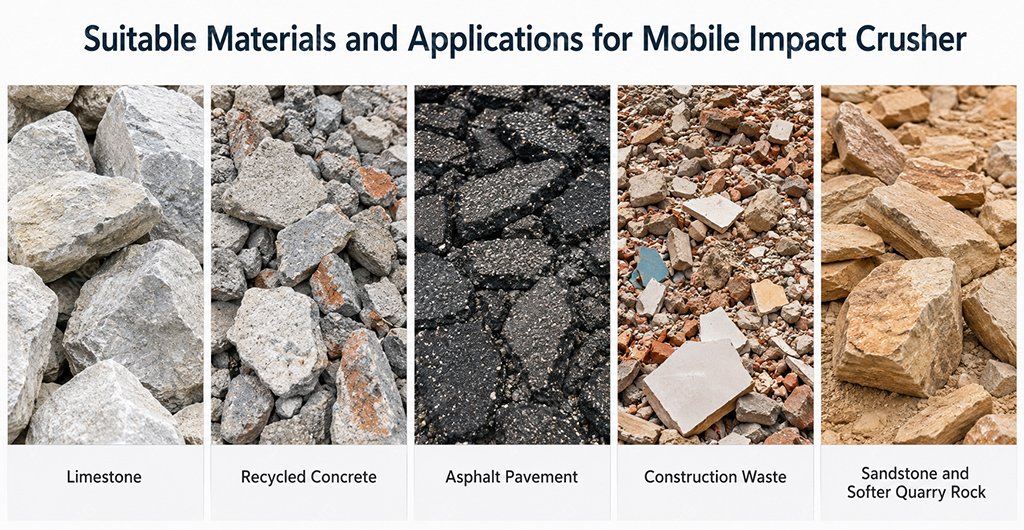
Mobile impact crusher material applications
Material
Suitability
Typical Application
Limestone
Excellent
Road base, concrete aggregate, cement raw material
Recycled concrete
Excellent
Urban recycling, backfill, sub-base aggregate
Asphalt pavement
Excellent
Road rehabilitation and reclaimed asphalt processing
Construction waste
Good
Demolition recycling after sorting contaminants
Sandstone and softer quarry rock
Good
General construction aggregate
Granite and basalt
Usually unsuitable
High abrasiveness increases blow-bar consumption
Copper ore and quartz-rich rock
Usually unsuitable
Compression crushing is normally more economical
Granite, basalt, and quartz-rich rock may pass through an impact crusher, but blow-bar and impact-plate costs can make the process uneconomical. A cone crusher is often better for these materials. Hard-rock buyers can review the Chile mobile cone crusher price guide.
Recycling feed must also be checked for steel, wood, soil, plastic, and oversized concrete. A magnet, pre-screen, and sorting protect the crusher and improve recycled aggregate quality.
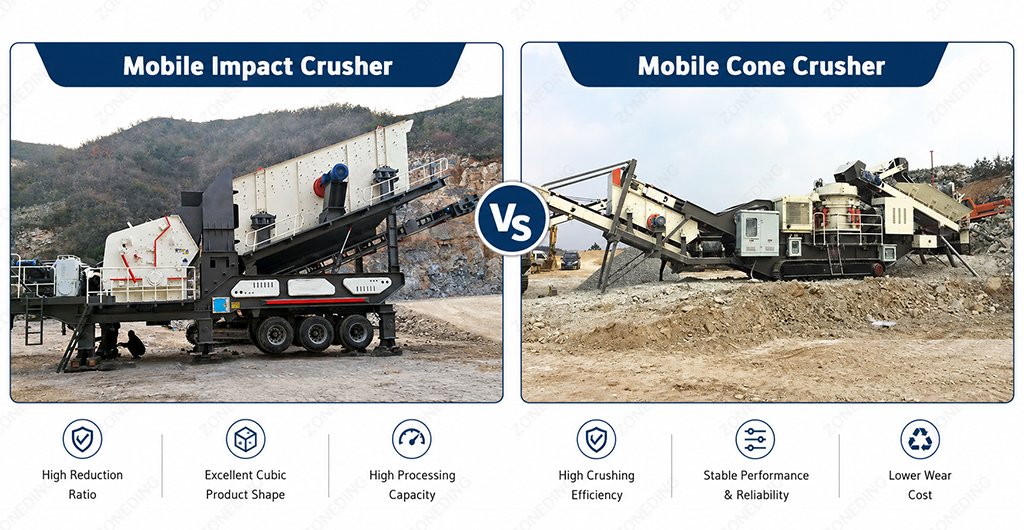
Mobile Impact Crusher vs Mobile Cone Crusher
What Mobile Impact Crusher Configuration Fits the Project?
The correct process depends on feed size, contamination, required products, and whether the plant must work in open or closed circuit. Three configurations cover most limestone, road aggregate, and recycling applications.
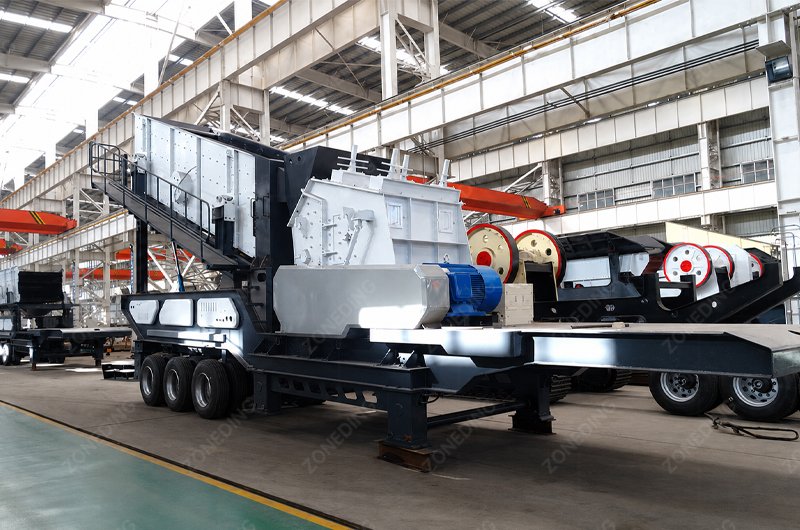
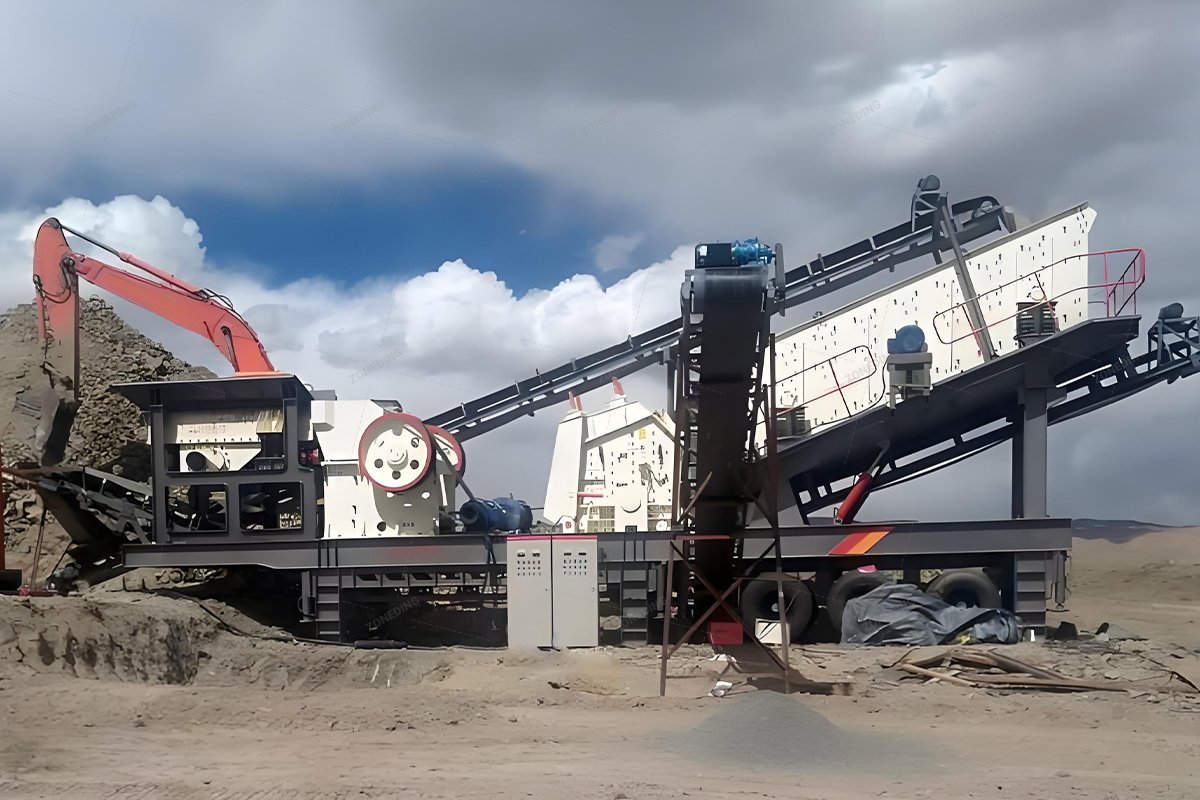
Mobile jaw impact crusher and screening process for road aggregate
Integrated Mobile Impact Crusher
An integrated plant combines a feeder, pre-screen, impact crusher, and discharge conveyor. It suits pre-sized limestone, asphalt, and recycled material while keeping relocation simple.
Mobile Jaw Crusher and Mobile Impact Crusher
Large blasted limestone or bulky concrete normally needs primary reduction. A jaw crusher reduces the feed first, improving control and protecting the impactor from oversize.
Closed-Circuit Crushing and Screening Plant
Commercial producers usually need several controlled sizes. A mobile screen separates finished material, while a return conveyor sends oversize back to the crusher. This closed circuit reduces off-spec aggregate.
A practical process may follow this sequence:
Raw material → feeder and pre-screen → jaw crusher when required → impact crusher → vibrating screen → finished products
For demolition waste, add a magnet to remove exposed steel. For limestone, prioritize stable feeding, accurate screening, and an efficient return circuit.
How Should Capacity and Product Sizes Be Selected?
Capacity should reflect the amount of saleable aggregate the project can use or sell, not the maximum figure printed on a brochure. Actual output changes with feed grading, moisture, contamination, reduction ratio, screen efficiency, and the proportion of material returned for recrushing.
Reference Capacity
Suitable Project Type
Typical Production Goal
50–80 TPH
Small recycling site or municipal contractor
Recycled sub-base and backfill
80–150 TPH
Road contractor or medium limestone quarry
Road base and concrete aggregate
150–250 TPH
Commercial quarry or major infrastructure project
Multiple graded aggregate products
These ranges are planning references, not guaranteed outputs. A plant rated for a high feed throughput may produce less final 10–20 mm aggregate when the circuit carries a heavy recirculating load.
Finished sizes also determine the screen layout. A road project may request a fine fraction, one or two coarse aggregate sizes, and road base material. The screen must have the correct deck arrangement and enough effective area to separate these products at the required rate.
Should You Choose a Tracked or Wheeled Mobile Impact Crusher?
Tracked and wheeled plants can use similar crushing chambers, so the chassis does not directly determine aggregate shape. The choice affects site movement, transport planning, setup work, maintenance, and initial investment.
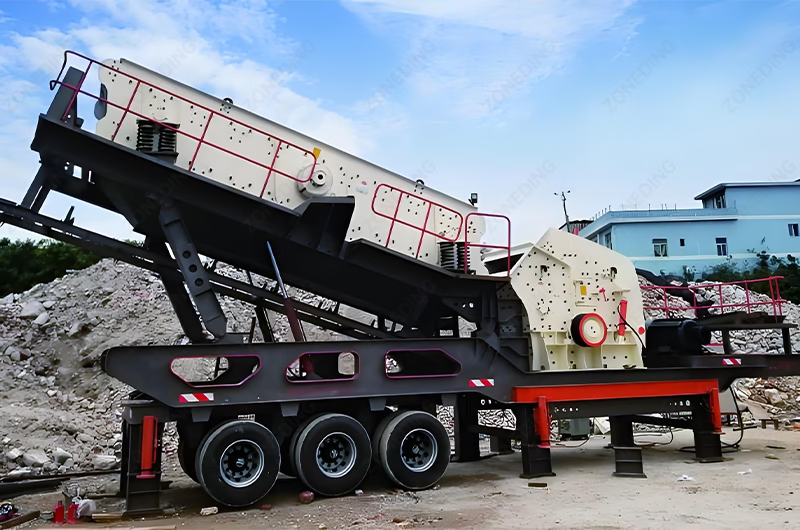
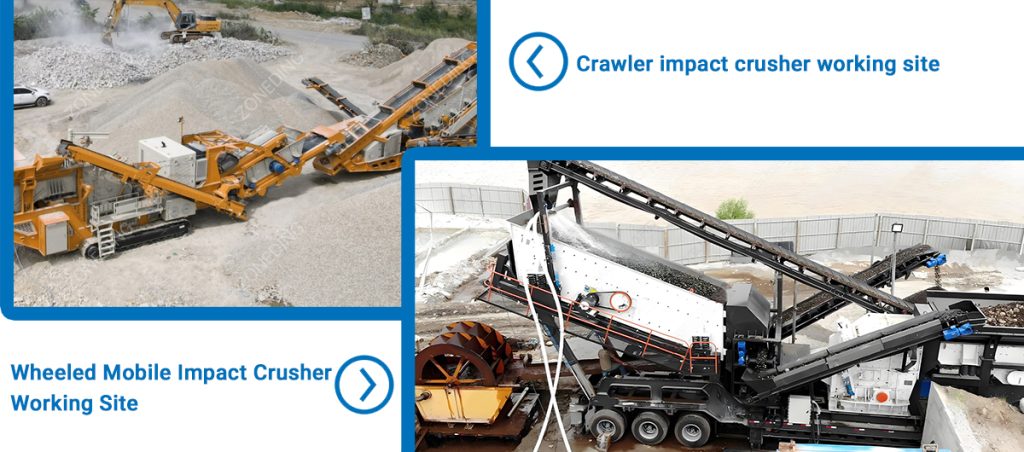
Tracked and wheeled mobile impact crusher comparison
A tracked plant is usually preferred when the crusher must move repeatedly around a quarry, demolition site, or road project. It can follow the material source and reduce internal hauling.
A wheeled plant can be more economical when the operating surface is prepared and movement inside the site is limited. However, “wheeled” does not automatically mean that a complete plant can travel freely on public roads. Machine dimensions, axle loads, towing requirements, and local permits still need to be checked.
How Can the Plant Produce Better Road and Recycled Aggregate?
Good particle shape is a major advantage, but feed control, wear condition, screening, and settings still determine final quality.
Keep the feed continuous across the rotor width. Irregular loading causes unstable power demand and uneven blow-bar wear. A pre-screen removes soil and natural fines before they consume plant capacity.
Set rotor speed and apron clearance for the required reduction. An overly small setting increases recirculation and wear; a wide setting may send excess oversize to the screen.
Inspect blow bars and impact plates before wear becomes uneven. Wear-part material must match feed abrasiveness and metal risk. Cheap parts can cost more when frequent replacement stops production.
Match the screen media to the product. Blocked or damaged openings can return good material or contaminate stockpiles. If the market requires finer manufactured material, a sand making machine can be evaluated after the main circuit is stable.
For recycling, control the incoming waste. Clean concrete can produce useful secondary aggregate, while gypsum, soil, wood, and plastic lower its value.
What Affects Mobile Impact Crusher Price and Operating Cost?
There is no reliable fixed price without project information. Two plants with the same nominal capacity may have different crushers, chassis systems, screening circuits, engines, hydraulic functions, wear packages, and shipping requirements.
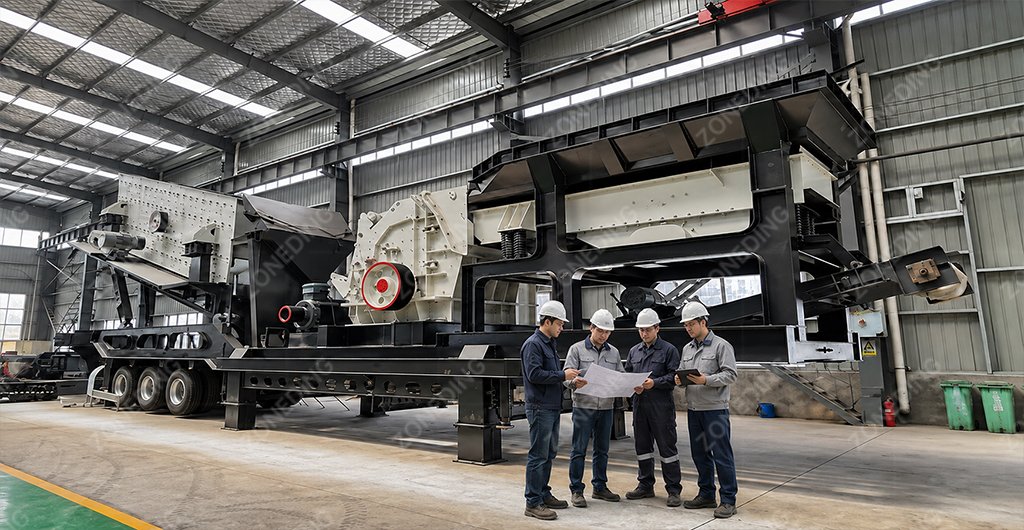
ZONEDING engineers reviewing a mobile impact crusher project
The main quotation factors include:
Feed opening, rotor size, and required capacity
Tracked or wheeled chassis
Diesel, electric, or dual-power arrangement
Integrated screen and return conveyor
Pre-screening and magnetic separation
Dust suppression and control system
Blow-bar and spare-parts package
Shipping method, destination port, and inland transport
Purchase price is only one part of the decision. The more useful measure is the expected cost per ton. Fuel or electricity, blow-bar life, labor, maintenance time, screen media, internal hauling, and equipment utilization all influence this result.
A tracked unit may cost more initially but save money when frequent movement eliminates short-distance hauling. A wheeled plant may offer a lower capital cost for prepared sites. Similarly, a closed circuit costs more than an open circuit but can produce more controlled and saleable aggregate sizes.
Material name, photos, and any available test data
Maximum feed size and normal feed grading
Required production capacity
Final product sizes and intended use
Project country and nearest destination port
Quarry, road, or recycling application
Available power supply
Expected movement frequency and site conditions
ZONEDING can use this information to prepare an equipment recommendation, process flow, quotation, shipping plan, and initial spare-parts list. The objective should be a configuration that fits the project—not simply the largest machine available.
Mobile Impact Crusher FAQ
What materials are best for a mobile impact crusher?
Limestone, recycled concrete, asphalt, sandstone, and other medium-hard, relatively low-abrasive materials are the best candidates. Highly abrasive granite, basalt, quartz-rich rock, and hard metallic ores normally favor compression crushers.
Can one mobile impact crusher produce several aggregate sizes?
Yes. An integrated or separate vibrating screen can divide the crushed material into several products. A return conveyor can send oversize back to the impactor for closed-circuit crushing.
Can reinforced concrete be processed?
Yes, but the feed should be prepared and controlled. A magnetic separator removes exposed steel after crushing, while pre-sorting helps remove wood, plastic, soil, and other contaminants that reduce recycled aggregate quality.
Is a tracked plant always better than a wheeled plant?
No. Tracked plants are better for frequent movement and difficult ground. Wheeled plants can be more economical on prepared sites or for contractors using planned relocation between projects. Local transport limits must be checked for both types.
What information is required for a quotation?
Provide the material, maximum feed size, required capacity, final product sizes, project location, power conditions, mobility requirements, and application. Photos and a representative material analysis improve equipment selection.
A mobile impact crusher can be a strong investment for South American limestone, road aggregate, asphalt, and recycling projects when the material and plant configuration are matched correctly. The best result comes from balancing aggregate quality, wear cost, mobility, and market demand rather than comparing equipment prices alone.
About ZONEDING: ZONEDING designs and manufactures crushing and screening equipment for quarry, aggregate, mining, and recycling projects. Its engineering support covers process design, equipment selection, manufacturing, shipping guidance, commissioning support, operator training, and spare-parts planning.
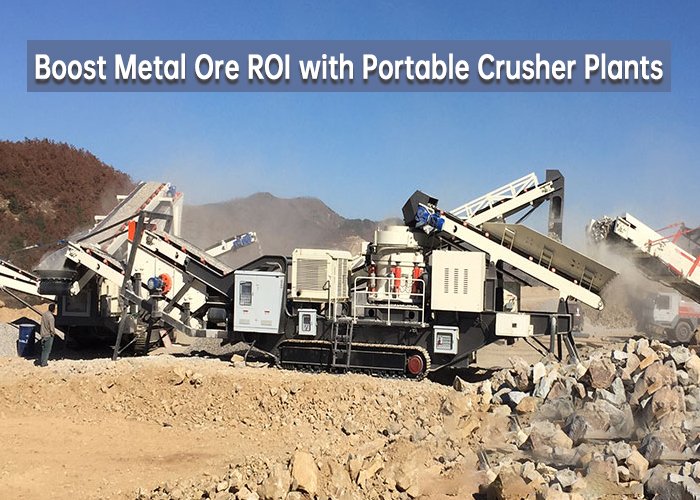
Choosing a high-performance portable crusher plant for metal ore is the fastest way to increase your mining profits in 2026. Many mine owners waste 30% of their budget on truck fuel and road construction. I believe a mobile station solves this by ...
Building a high-recovery gold ore processing plant development project requires a very clear plan. The process starts with the rock and ends with pure gold. Most projects fail because the machinery does not match the mineral type. High recovery ra...
Potassium feldspar is an important industrial mineral widely used in ceramics, glass manufacturing, construction materials, and chemical industries. Before potassium feldspar can be used in these applications, it must first be crushed into suitabl...
For decades, natural river sand was considered the standard material for concrete, mortar, and infrastructure projects. Today, that situation is changing rapidly. Many contractors, concrete producers, and aggregate companies are asking: Is machine...
We use cookies to ensure that we give you the best experience on our website. If you continue to use this site we will assume that you are happy with it.
Privacy Policy
Send us a message
We would love to hear from you
Submit your question and our team will respond to the email provided as soon as possible.
 Zoneding Machine