One of the first questions investors ask before starting a mining project is:
How much does a gold processing plant cost?
Unfortunately, there is no single answer.
A small gravity gold plant may cost less than a luxury house in some countries, while a large CIP or CIL facility can require tens of millions of dollars in investment.
The biggest mistake many investors make is focusing only on equipment quotations.
In reality, crushers, mills, and recovery equipment are only part of the total investment. Civil works, water systems, tailings facilities, installation, and environmental compliance often represent a significant portion of the budget.
This guide explains where the money goes, what factors drive costs, and how successful mine owners evaluate return on investment.
The total investment depends on ore type, plant capacity, recovery method, location, and infrastructure requirements.
As a general guide:
Plant Capacity
Typical Investment Range
10–50 TPD
$50,000 – $500,000
50–100 TPD
$300,000 – $1.5 Million
100–300 TPD
$1 – $5 Million
300–500 TPD
$3 – $10 Million
500–1,000 TPD
$8 – $20 Million+
1,000–5,000 TPD
$20 – $100 Million+
These figures represent complete plants rather than equipment alone.
Actual costs can vary significantly depending on local conditions and project complexity.
Need a Budget Estimate for Your Gold Project?
Send us:
✓ Ore Type
✓ Plant Capacity
✓ Gold Grade
✓ Recovery Target
Our engineers can recommend a suitable process and provide a preliminary investment estimate.
What Factors Have the Biggest Impact on Gold Processing Plant Investment?
Many investors assume capacity is the biggest cost driver.
In reality, ore characteristics often have an even greater impact.
The main factors include:
Cost Driver
Impact on Investment
Ore Type
Very High
Recovery Method
Very High
Plant Capacity
High
Water Supply
High
Tailings Management
High
Infrastructure
High
Automation Level
Medium
Environmental Compliance
Medium to High
Two plants processing the same number of tons per day may have dramatically different investment requirements because of ore characteristics and recovery goals.
How Do Plant Capacity and Ore Type Affect Project Costs?
Different gold ores require different processing methods.
This directly affects equipment selection and plant complexity.
In many projects, the grinding circuit becomes the single largest equipment investment.
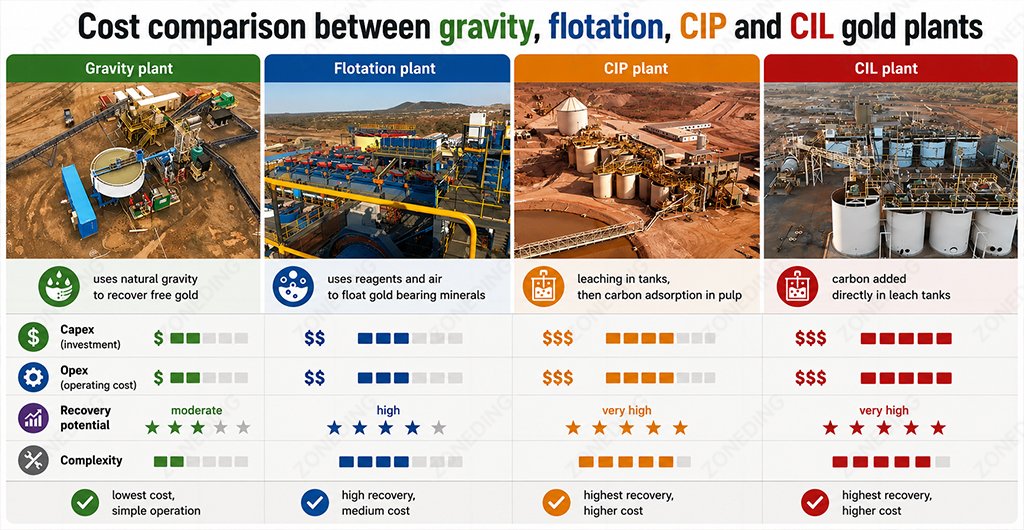
How Do CIP, CIL, Gravity, and Flotation Plants Compare in Cost?
Each processing method has different investment requirements.
Gold processing plant cost comparison
Process Type
CAPEX
OPEX
Recovery Potential
Gravity Plant
Low
Low
Moderate
Flotation Plant
Medium
Medium
High
CIP Plant
High
High
Very High
CIL Plant
High
High
Very High
Gravity plants generally offer the lowest investment and fastest startup.
CIP and CIL plants usually deliver higher recovery, but they require significantly more infrastructure, reagents, and environmental controls.
What Are the Main Operating Costs of a Gold Processing Plant?
Operating costs often determine whether a project succeeds or fails.
Many investors focus on construction costs but underestimate long-term expenses.
Typical operating cost distribution:
Cost Category
Relative Impact
Power Consumption
High
Grinding Media
High
Reagents
Medium-High
Labor
Medium
Maintenance
Medium
Water Management
Medium
Tailings Management
Medium
One industry reality surprises many first-time investors:
Grinding often consumes 40% to 70% of total plant energy.
A poorly designed grinding circuit can increase operating costs for the entire life of the mine.
How Can You Reduce Processing Costs Without Sacrificing Recovery?
Cutting costs does not always mean buying cheaper equipment.
Successful operators focus on efficiency.
Strategies include:
Strategy
Benefit
Proper Metallurgical Testing
Better process selection
Optimized Grinding Size
Reduced energy consumption
Water Recycling Systems
Lower water costs
Automation
Improved stability
Preventive Maintenance
Reduced downtime
Recovery Optimization
Higher gold production
Many profitable operations invest more during design and engineering to reduce costs later.
Real Case
A 300 TPD hard-rock gold plant originally planned to install a larger grinding circuit.
After metallurgical testing, engineers optimized the liberation size and selected a smaller mill.
Results:
Metric
Original Design
Optimized Design
CAPEX
100%
-15%
Power Consumption
100%
-18%
Recovery Rate
Similar
Similar
The project reduced both investment and operating costs without sacrificing gold recovery.
What Hidden Costs Do Many Gold Mining Projects Overlook?
This is where many budgets fail.
Common hidden costs include:
Hidden Cost
Commonly Overlooked
Tailings Facilities
Yes
Water Supply Development
Yes
Spare Parts Inventory
Yes
Commissioning Costs
Yes
Environmental Monitoring
Yes
Cyanide Detoxification
Yes
Site Infrastructure
Yes
Many projects exceed budget not because equipment prices changed, but because supporting infrastructure was underestimated.
How Much Does It Cost to Build a Small vs Large Gold Processing Plant?
The gap between small and large projects is often larger than investors expect.
Plant Size
Typical Investment
Small Gravity Plant (10–50 TPD)
$50,000 – $500,000
Small Commercial Plant (100 TPD)
$1 – $3 Million
Medium Plant (300–500 TPD)
$3 – $10 Million
Large Plant (1000+ TPD)
$20 Million+
Larger plants benefit from economies of scale, but they also require greater investment in infrastructure, utilities, and environmental management.
What Is the Expected ROI of a Gold Processing Plant Project?
ROI depends on several factors:
Gold grade
Recovery rate
Operating cost
Gold price
Plant utilization
Many investors focus on tons processed per day.
Experienced operators focus on ounces recovered per day.
Consider the following example:
Plant
Capacity
Recovery
Plant A
500 TPD
70%
Plant B
300 TPD
92%
Although Plant A processes more ore, Plant B may generate greater profit because it recovers significantly more gold from each ton.
The most successful projects optimize:
Cost per ounce
Recovery rate
Long-term operating stability
rather than simply maximizing throughput.
Frequently Asked Questions
How much does a small gold processing plant cost?
A small gravity gold plant typically costs between $50,000 and $500,000, depending on capacity, ore type, and equipment selection.
What is the most expensive section of a gold processing plant?
In many projects, the grinding circuit represents the largest equipment investment and the highest power consumption.
Are CIP and CIL plants more expensive than gravity plants?
Yes. CIP and CIL facilities require additional tanks, chemical handling systems, carbon management systems, and environmental controls.
Why do gold plant budgets often exceed expectations?
Common reasons include underestimated infrastructure costs, tailings facilities, water systems, installation expenses, and environmental compliance requirements.
What has the biggest impact on project ROI?
Recovery rate, ore grade, operating cost, and plant utilization generally have a greater impact on profitability than plant capacity alone.
Is it better to build the cheapest plant possible?
Not necessarily. The most profitable plants focus on long-term recovery and operating efficiency rather than the lowest initial investment.
Final Thoughts
The cost of a gold processing plant is determined by much more than equipment prices.
Ore characteristics, recovery targets, grinding requirements, water availability, tailings management, infrastructure, and environmental compliance all play major roles in project economics.
The most successful mine owners ask:
What will it cost to produce one ounce of gold profitably over the next ten years?
instead of:
How much does the equipment cost today?
That shift in thinking often separates profitable projects from costly mistakes.
Need Help Estimating Your Gold Processing Plant Cost?
Send us:
✓ Ore Analysis Report
✓ Plant Capacity
✓ Gold Grade
✓ Recovery Target
Our engineering team can recommend the most cost-effective processing solution and provide a preliminary budget estimate.
About ZONEDING
ZONEDING provides crushing, grinding, gravity separation, flotation, cyanidation, and complete mineral processing solutions for gold, copper, iron ore, lithium, and other mining projects worldwide.
Whether you are evaluating a new mining investment or expanding an existing operation, our engineers can help design a customized processing plant that maximizes recovery, controls costs, and improves long-term profitability.
Building a highly profitable mineral processing facility requires a strictly logical equipment sequence. A complete copper-gold ore processing line must follow a precise physical and chemical path. The rock must be crushed, ground, classified, and...
Operating heavy mining equipment requires a deep understanding of internal mechanics. Many expensive machine failures happen because operators misunderstand basic operational rules. Good equipment can break quickly when handled poorly. This compre...
As an expert with decades in the mineral processing industry, I have seen "best-sellers" change many times. In the past, it was all about raw power. In the 2000s, it was about high throughput. But in 2026, the "best-selling" machines are different...
We use cookies to ensure that we give you the best experience on our website. If you continue to use this site we will assume that you are happy with it.
Privacy Policy
Send us a message
We would love to hear from you
Submit your question and our team will respond to the email provided as soon as possible.
 Zoneding Machine