Many quarry operators spend months comparing crusher models, motor power, and production capacity. However, very few spend the same amount of time evaluating the jaw plates that actually perform the crushing.
That oversight can become surprisingly expensive.
In most aggregate and mining operations, jaw plates are among the highest recurring wear-part expenses. More importantly, they directly affect crusher output, energy consumption, downtime, and cost per ton.
Choosing the wrong jaw plate may result in:
Faster wear
Lower production
Higher maintenance costs
Increased power consumption
Frequent shutdowns
Meanwhile, selecting the correct jaw plate can improve crushing efficiency, extend wear life, and reduce overall operating costs.
The challenge is that there is no universal jaw plate that works for every application.
A jaw plate designed for limestone may perform poorly in granite. Likewise, a liner that works perfectly in a small quarry may fail quickly in a high-capacity mining operation.
This guide explains how experienced operators evaluate jaw plates and how you can make a more profitable decision for your crusher.
One of the biggest misconceptions in the industry is that jaw plates are simple wear parts.
Many buyers ask only two questions:
How much do they cost?

How long will they last?
Unfortunately, those questions rarely provide enough information.
A jaw plate that lasts longer is not automatically the better option.
Similarly, the lowest-priced liner is rarely the most economical choice.
The real objective should be:
Achieve the lowest crushing cost per ton while maintaining stable production.
That requires considering:
Rock type
Abrasion level
Feed size
Chamber utilization
Tooth profile
Downtime costs
Ignoring these factors often leads to expensive mistakes.
What Really Determines Jaw Plate Life?
Many operators assume jaw plate life depends entirely on manganese content.
In reality, several factors have an equal or even greater impact.
Rock Hardness
Hard materials create more compression force and abrasion.
Examples include:
Granite
Basalt
Quartz
Iron Ore
These materials generally require more wear-resistant jaw plates.
Silica Content
Silica is one of the most aggressive wear factors.
A material may not appear extremely hard, yet high silica content can rapidly destroy liners.
River stone is a common example.
Many quarry owners are surprised when river stone causes faster wear than granite.
Feed Size
Large feed material generates stronger impact forces.
Oversized feed can:
Crack liners
Create uneven wear
Reduce liner life
Maintaining a consistent feed size is often more important than upgrading manganese grade.
Moisture Content
Wet and sticky materials affect chamber efficiency.
They may cause:
Chamber packing
Reduced throughput
Localized wear
As a result, jaw plates may wear unevenly even when the liner material is appropriate.
Feed Distribution
Material should enter the crusher evenly across the chamber.
Poor feed distribution often causes one side of the liner to wear significantly faster than the other.
In these situations, replacing jaw plates alone rarely solves the problem.
What Are Jaw Plates Made Of?
Most modern jaw plates are manufactured from manganese steel.
Unlike conventional steel, manganese steel becomes harder during operation.
This process is called:
Work Hardening
As rock impacts the liner surface, the material gradually hardens and develops greater wear resistance.
That unique characteristic makes manganese steel ideal for crushing applications.
The most common grades include:
Grade
Manganese Content
Typical Application
Mn13
12–14%
Soft rock
Mn18
17–19%
General quarry use
Mn22
21–23%
Highly abrasive applications
However, selecting the highest manganese content is not always the best decision.
Mn13 vs Mn18 vs Mn22: Which Grade Should You Choose?
This is one of the most common questions from quarry operators.
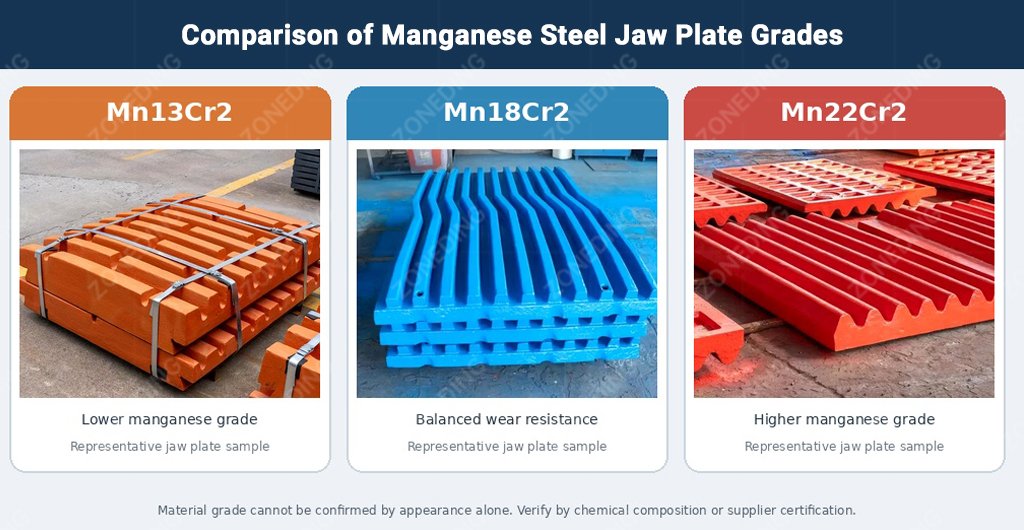
Comparison of Mn13 Mn18 and Mn22 jaw crusher jaw plates
The answer depends on the material being processed.
Mn13
Best suited for:
Limestone
Dolomite
Medium-hard rock
Advantages:
Lower purchase cost
Good toughness
Suitable for moderate wear conditions
Limitations:
Shorter wear life in abrasive applications
Mn18
Mn18 is often considered the most versatile option.
Best suited for:
Granite
River stone
General aggregate production
Advantages:
Balanced wear resistance
Good work hardening
Reliable performance
Many aggregate producers consider Mn18 the best overall choice.
Mn22
Mn22 provides increased wear resistance in severe conditions.
Best suited for:
Basalt
Quartz
Mining applications
Advantages:
Longer service life
Better abrasion resistance
However, Mn22 requires significant impact force to harden properly.
When crushing softer material, it may actually perform worse than Mn18.
The Most Expensive Jaw Plate Is Not Always the Best Choice
Many buyers automatically assume:
Higher Price = Better Value
That assumption often leads to higher operating costs.
Consider the following example.
Option A
Jaw Plate Cost: $2,000
Wear Life: 150,000 Tons
Cost Per Ton: $0.013
Option B
Jaw Plate Cost: $3,500
Wear Life: 450,000 Tons
Cost Per Ton: $0.0078
Although Option B costs significantly more upfront, its operating cost is substantially lower.
This is why experienced quarry managers rarely evaluate wear parts based solely on purchase price.
Instead, they focus on:
Cost per ton
Downtime reduction
Production stability
Maintenance intervals
These factors determine long-term profitability.
Why Cost Per Ton Matters More Than Wear Life
Long wear life is important.
However, wear life alone does not tell the full story.
Imagine two different jaw plates:
Jaw Plate A
Long wear life
Lower throughput
Jaw Plate B
Slightly shorter wear life
Higher throughput
Which one is more profitable?
The answer depends on:
Tons processed
Energy consumption
Maintenance cost
Downtime
A liner that improves production by 15% may generate more profit even if it wears slightly faster.
For this reason, many successful quarry operators evaluate:
Cost per ton
Tons processed per liner
Downtime hours
Crusher utilization
rather than focusing exclusively on wear life.
Industry Insight: Many Quarries Replace Jaw Plates Too Early
One of the easiest ways to reduce wear-part costs is improving replacement timing.
Many operators replace liners based on appearance alone.
However, visual wear does not always indicate the end of useful life.
Experienced maintenance teams monitor:
Chamber profile
Production rate
Product size
Power draw
Crusher efficiency
As long as the chamber continues performing efficiently, additional service life may remain available.
In large aggregate operations, extending liner life by even a few weeks can produce substantial annual savings.
Why Understanding Jaw Plate Selection Helps the Entire Crushing Plant
Jaw plates do not affect only the primary crusher.
They influence the performance of the entire production line.
When jaw plates improve:
Material flow
Chamber utilization
Feed consistency
downstream equipment often performs better as well.
For example:
A properly maintained jaw crusher feeding a Cone Crusher typically improves secondary crushing efficiency.
Likewise, stable feed material entering a Stone Crushing Plant helps reduce recirculation and increase overall productivity.
This is why jaw plate selection should be viewed as a plant optimization decision rather than simply a wear-part purchase.
Which Jaw Plate Profile Should You Choose?
Selecting the correct manganese grade is important. However, jaw plate profile often has an even greater impact on crusher performance.
Many operators upgrade from Mn13 to Mn18 or Mn22 but see very little improvement. In many cases, the problem is not the material. Instead, the tooth profile does not match the application.
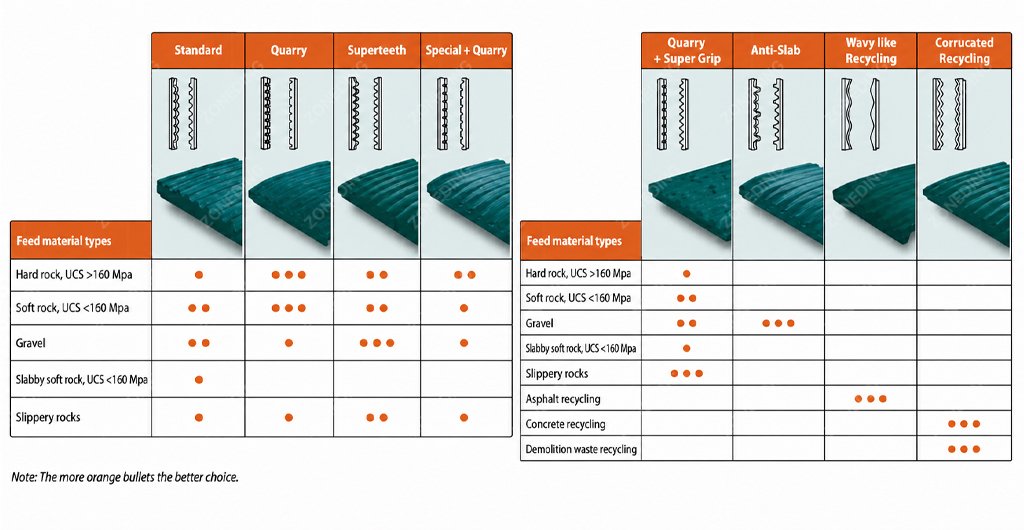
Jaw plate profile types
A jaw plate profile affects:
Material grip
Chamber utilization
Throughput
Wear distribution
Energy efficiency
The wrong profile can reduce production and increase wear, even when premium manganese steel is used.
Meanwhile, a properly selected profile can improve both wear life and crusher output.
Understanding the Most Common Jaw Plate Profiles
Different crushing applications require different tooth designs.
The most common profiles include:
Standard Profile
This is the most widely used jaw plate design.
Best suited for:
Limestone
Dolomite
Medium-hard rock
General aggregate production
Advantages:
Stable operation
Balanced wear
Lower purchase cost
For many smaller quarries, the standard profile provides reliable performance at a reasonable cost.
Quarry Tooth Profile
The quarry profile features deeper and more aggressive teeth.
Best suited for:
Granite
Hard limestone
Large feed material
Advantages:
Better rock grip
Improved chamber utilization
Higher throughput
Many commercial aggregate producers prefer quarry profiles because they balance productivity and wear life.
Super Tooth Profile
Super tooth designs provide even stronger material retention.
Best suited for:
Granite
Basalt
River stone
Highly abrasive materials
Advantages:
Reduced slippage
Better crushing efficiency
Improved chamber loading
For hard-rock operations, this profile often delivers noticeable production gains.
Heavy-Duty Mining Profile
Mining operations frequently process extremely abrasive material.
Heavy-duty profiles are designed for:
Iron ore
Copper ore
Quartz
Mining applications
Advantages:
Longer wear life
Higher durability
Improved abrasion resistance
Although the initial cost is higher, the long-term operating cost is often lower.
How Do Tooth Patterns Affect Crushing Efficiency?
Many operators view tooth patterns as a wear-life decision.
In reality, they directly affect productivity.
A properly designed tooth pattern helps:
Pull rock deeper into the chamber
Reduce material slippage
Improve crushing force distribution
Increase throughput
When material slips rather than being gripped, crusher efficiency decreases significantly.
This issue is especially common when processing:
River stone
Rounded gravel
Wet material
Smooth rock surfaces
In these applications, aggressive tooth patterns usually outperform standard designs.
Why Crusher Chamber Utilization Matters More Than Most Operators Realize
One of the least discussed topics in crusher maintenance is chamber utilization.
However, it often determines whether a jaw plate performs efficiently or fails prematurely.
A well-utilized chamber provides:
Uniform wear
Stable throughput
Lower energy consumption
Better liner life
Poor chamber utilization creates:
Localized wear
Lower capacity
Increased operating costs
More frequent replacements
Before changing liner material, operators should evaluate whether the chamber is being used correctly.
What Does Good Chamber Utilization Look Like?
Good chamber utilization means material is distributed evenly throughout the crushing zone.
Several factors contribute to this:
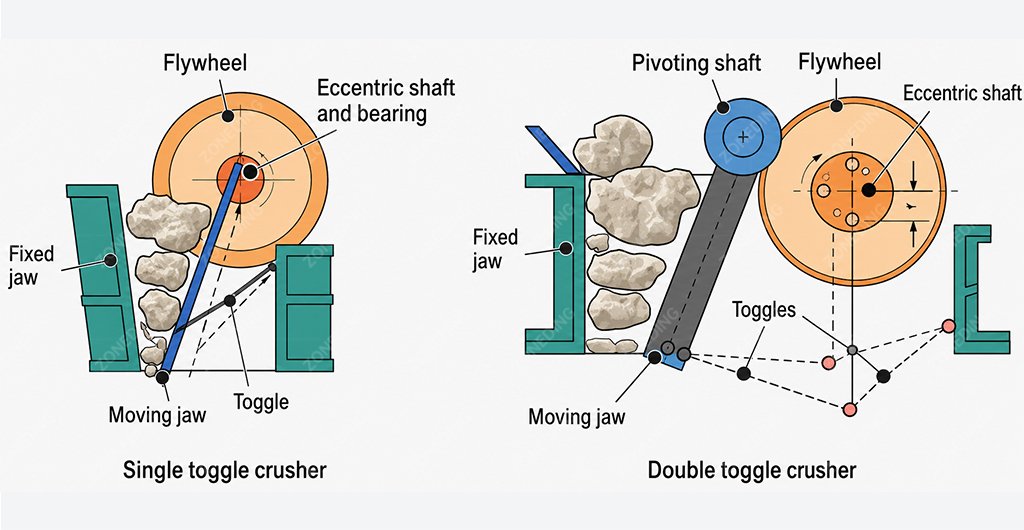
Jaw crusher chamber utilization showing proper material distribution
Consistent Feed Rate
A properly selected Vibrating Feeder helps maintain stable chamber loading.
Large feed surges followed by empty chamber conditions accelerate wear and reduce productivity.
Proper CSS Adjustment
Incorrect CSS settings often reduce chamber efficiency.
A chamber that is too tight or too open can negatively affect:
Throughput
Wear life
Product quality
Balanced Feed Size
The crusher performs best when feed material is evenly graded.
Excessively large feed creates impact loading. Meanwhile, excessive fines reduce chamber utilization.
Uneven Wear Is Often a Feeding Problem, Not a Jaw Plate Problem
One of the most common complaints in aggregate plants is uneven liner wear.
Many operators immediately blame:
Jaw plate quality
Manganese grade
Manufacturing defects
However, the root cause is often poor feeding conditions.
Common causes include:
Off-Center Feeding
Material enters one side of the chamber.
Result:
One side wears faster
Throughput decreases
Chamber efficiency drops
Material Segregation
Large rock accumulates on one side while smaller material flows through the other.
Result:
Uneven crushing forces
Localized wear
Reduced liner life
Poor Feeder Design
Some feeders distribute material unevenly.
As a result:
One jaw plate receives significantly more wear
Capacity becomes unstable
Many wear issues disappear once feeding conditions are corrected.
Why Most Jaw Plate Failures Are Not Actually Caused by the Jaw Plate
This may be surprising, but many jaw plate failures originate elsewhere in the crushing circuit.
Common causes include:
Oversized Feed Material
Large rocks create excessive impact forces.
Result:
Cracked liners
Broken teeth
Reduced wear life
Tramp Metal
Unexpected metal objects entering the crusher can damage jaw plates instantly.
Examples include:
Excavator teeth
Drill steel
Scrap metal
Poor Crusher Maintenance
Worn components elsewhere in the crusher may create abnormal loading conditions.
Examples include:
Loose jaw dies
Worn cheek plates
Improper CSS settings
Chamber Packing
Wet and sticky material may accumulate inside the crusher.
This creates:
Excessive pressure
Uneven wear
Reduced throughput
In these situations, replacing jaw plates without solving the underlying problem simply repeats the cycle.
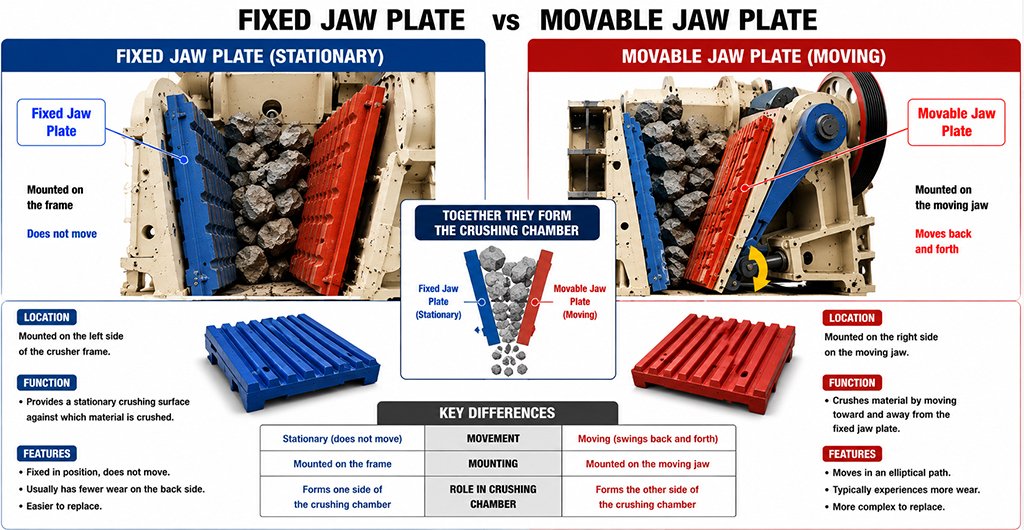
Fixed Jaw Plate vs Movable Jaw Plate: Why Do They Wear Differently?
Many operators notice that one jaw plate wears faster than the other.
Fixed Jaw Plate vs Movable Jaw Plate
This is completely normal.
The fixed jaw plate and movable jaw plate experience different forces during crushing.
Fixed Jaw Plate
Typically experiences:
Higher compressive loading
More concentrated wear
Movable Jaw Plate
Typically experiences:
Greater sliding action
Different wear distribution
Because wear patterns differ, replacement schedules may also vary.
Some operations replace both plates together.
Others replace only the more heavily worn component.
The best approach depends on:
Wear pattern
Production requirements
Maintenance strategy
Regular inspections help identify the most economical replacement interval.
How Can the Right Jaw Plates Increase Crusher Output?
Many buyers focus exclusively on wear life.
However, jaw plates can also improve productivity.
The right profile can:
Increase material grip
Improve chamber utilization
Reduce slippage
Enhance crushing efficiency
Production improvements of 10–20% are not uncommon when switching to a profile that better matches the material.
For example:
A granite quarry using standard plates may struggle with material slippage.
Changing to a quarry or super tooth profile often improves throughput immediately.
Industry Insight: Better Jaw Plates Can Improve the Entire Crushing Circuit
Jaw plates affect more than the primary crusher.
When feed consistency improves:
Secondary crushers perform better
Screens separate material more efficiently
Recirculation loads decrease
Energy consumption falls
For example, a well-maintained jaw crusher feeding a Cone Crusher often improves the efficiency of the entire crushing circuit.
Likewise, operators producing manufactured sand frequently notice better downstream performance in their Sand Making Machine when primary crushing remains consistent.
This is why experienced plant managers view jaw plate selection as a production optimization decision rather than simply a wear-part purchase.
Why Downtime Cost Matters More Than Jaw Plate Price
Many buyers compare jaw plates based on purchase price alone.
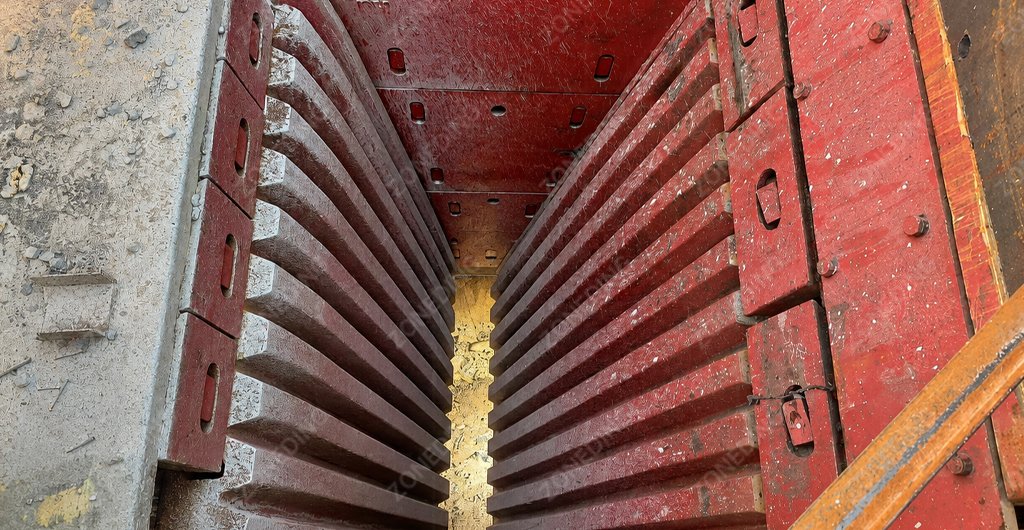
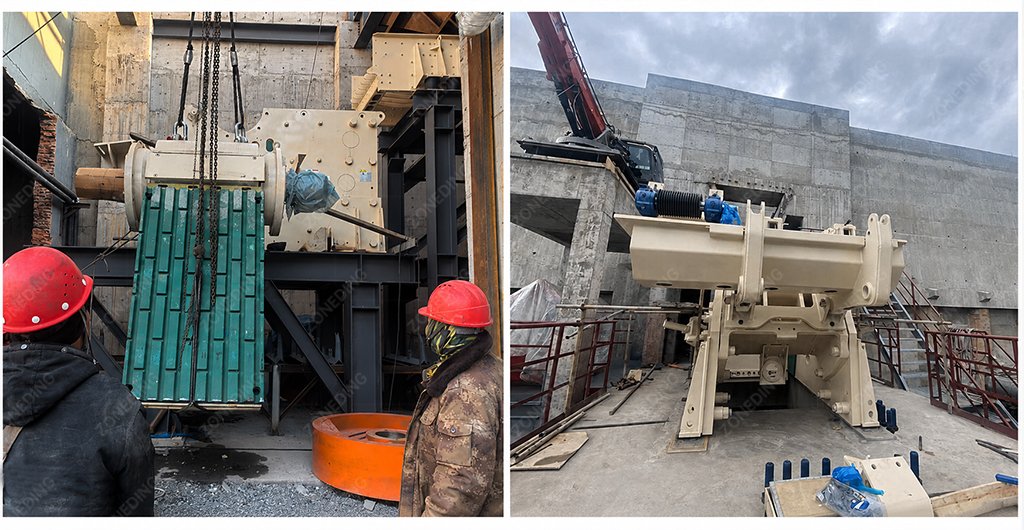
Jaw plate replacement process
That approach ignores one of the largest hidden costs in crushing operations:
Production downtime.
A jaw plate replacement does not only involve the cost of the liner itself.
It also includes:
Labor
Lost production
Equipment downtime
Reduced plant utilization
In high-capacity quarries, downtime often costs more than the jaw plates.
Consider the following example.
Quarry Example
Plant Capacity: 250 TPH
Jaw Plate Change Time: 8 Hours
Production Loss: 250 × 8 = 2,000 Tons
Aggregate Selling Price: $12 Per Ton
Potential Revenue Loss: $24,000
Meanwhile, the jaw plates themselves may cost only: $3,000–$5,000
This example highlights why liner life is only one part of the equation.
Reducing replacement frequency often generates far more savings than reducing jaw plate purchase costs.
How to Calculate the Real Cost Per Ton
Experienced quarry operators evaluate wear parts using a simple metric:
Cost Per Ton
Formula:
Cost Per Ton =
(Total Wear Part Cost + Downtime Cost)
÷ Tons Processed
Example:
Jaw Plate A
Purchase Cost: $2,500
Wear Life:180,000 Tons
Downtime Cost: $10,000
Total Cost:$12,500
Cost Per Ton: $0.069
Jaw Plate B
Purchase Cost: $4,000
Wear Life: 450,000 Tons
Downtime Cost: $10,000
Total Cost: $14,000
Cost Per Ton: $0.031
Although Jaw Plate B costs more initially, it reduces crushing costs by more than 50%.
This is why leading aggregate producers rarely buy wear parts based on price alone.
Which Jaw Plates Work Best for Different Applications?
Different applications create different wear patterns.
Selecting the right liner for the job often produces the greatest savings.
Limestone Crushing
Recommended:
Mn13
Standard Profile
Benefits:
Lower cost
Adequate wear life
Stable production
Granite Crushing
Recommended:
Mn18
Quarry Tooth Profile
Benefits:
Better grip
Longer wear life
Improved throughput
Many operators processing granite also use a complete Granite Crushing Plant to optimize wear performance throughout the circuit.
Basalt Crushing
Recommended:
Mn18 or Mn22
Super Tooth Profile
Benefits:
Increased abrasion resistance
Better chamber utilization
River Stone Crushing
Recommended:
Mn18
Aggressive Tooth Pattern
Benefits:
Reduced slippage
More efficient crushing
Mining Applications
Recommended:
Mn22
Heavy-Duty Profile
Benefits:
Maximum durability
Lower replacement frequency
Which Jaw Plates Work Best for Different Crusher Models?
One mistake many buyers make is ordering the same profile for every crusher.
Different machines often perform better with different jaw plate designs.
PE400×600
Recommended:
Standard Profile
Mn13 or Mn18
Typical Application:
Small quarry
Limestone
Construction waste
PE500×750
Recommended:
Quarry Tooth Profile
Mn18
Typical Application:
Aggregate production
Medium-hard rock
PE600×900
Recommended:
Quarry Tooth Profile
Mn18
Typical Application:
Granite
River stone
Commercial quarry
PE750×1060
Recommended:
Quarry or Super Tooth Profile
Mn18
Typical Application:
Large aggregate operations
PE900×1200
Recommended:
Super Tooth Profile
Mn18 or Mn22
Typical Application:
Hard-rock crushing
Large Mining Jaw Crushers
Recommended:
Heavy-Duty Profile
Mn22
Typical Application:
Iron ore
Copper ore
Mining projects
Always consult the crusher manufacturer before changing profile designs, as chamber geometry varies between models.
Case Study: How a Granite Quarry Increased Jaw Plate Life by 35%
One of our customers operated a 300 TPH granite quarry.
The plant included:
Jaw Crusher
Cone Crusher
Vibrating Screen
Conveyor System
Originally, the quarry used:
Mn13 Standard Jaw Plates
Problems included:
Rapid wear
Frequent replacements
Production interruptions
The maintenance team initially assumed the jaw plate quality was poor.
However, further analysis revealed two issues:
Granite hardness exceeded the original liner specification.
Material distribution inside the chamber was uneven.
Most importantly, the solution did not involve purchasing a new crusher.
Instead, it focused on optimizing wear-part selection and chamber utilization.
Why OEM Specifications Are Not Always the Best Option
Many buyers automatically choose OEM liners.
OEM products often provide:
Reliable fitment
Proven chamber design
Consistent quality
However, OEM specifications are usually designed for average conditions.
Your quarry may not be average.
For example:
A granite operation may achieve better results with a more aggressive tooth profile than the original factory recommendation.
Likewise, a limestone producer may reduce costs by selecting a lower manganese grade.
The best jaw plate is not necessarily the one supplied with the crusher.
It is the one that delivers the lowest operating cost under your specific conditions.
Industry Insight: The Best Jaw Plate Is the One That Maximizes Profit
Many discussions focus on:
Wear life
Manganese content
Tooth design
Those factors are important.
However, they are not the ultimate objective.
The real goal is:
Maximum profit per ton produced.
Sometimes that means:
Longer wear life
Higher throughput
Reduced downtime
Other times it means:
Better chamber utilization
Lower energy consumption
Improved maintenance efficiency
The most profitable jaw plate is not always the hardest, the most expensive, or the longest-lasting.
Instead, it is the one that delivers the best overall operating economics.
Jaw Plate Selection Checklist
Before ordering replacement jaw plates, take a few minutes to review the following checklist.
Many costly wear problems can be avoided simply by matching the liner to the application.
Material Analysis
✓ What material are you crushing?
✓ What is the rock hardness?
✓ What is the silica content?
✓ Does the material contain clay or moisture?
✓ Is the feed blasted rock or natural river stone?
Crusher Information
✓ Crusher model
✓ Feed opening size
✓ Current CSS setting
✓ Chamber design
✓ Production target
Operating Conditions
✓ Tons processed per day
✓ Operating hours per shift
✓ Feeding consistency
✓ Chamber utilization
✓ Existing wear pattern
Wear Part Evaluation
✓ Current manganese grade
✓ Current tooth profile
✓ Average liner life
✓ Replacement downtime
✓ Cost per ton
Plant Performance
✓ Crusher throughput
✓ Power consumption
✓ Product size consistency
✓ Downstream crusher performance
✓ Overall plant efficiency
Completing this checklist before purchasing new liners often prevents expensive trial-and-error decisions.
Quick Reference Guide: Which Jaw Plate Should You Choose?
Application
Recommended Grade
Recommended Profile
Limestone
Mn13
Standard
Dolomite
Mn13 / Mn18
Standard
Granite
Mn18
Quarry Tooth
Basalt
Mn18 / Mn22
Super Tooth
River Stone
Mn18
Aggressive Tooth
Quartz
Mn22
Heavy Duty
Iron Ore
Mn22
Heavy Duty
Copper Ore
Mn22
Heavy Duty
This table provides a useful starting point. However, actual performance may vary depending on feed conditions and crusher configuration.
Common Jaw Plate Wear Patterns and What They Mean
Wear patterns often reveal more about crusher performance than maintenance records.
Excessive Top Wear
Possible causes:
Oversized feed
Large rock concentration
Poor blasting practices
Excessive Bottom Wear
Possible causes:
Small feed size
Chamber underutilization
Incorrect CSS setting
One-Sided Wear
Possible causes:
Off-center feeding
Material segregation
Uneven chamber loading
Center Wear
Possible causes:
Feed concentrated in the center
Inadequate feed distribution
Cracked Jaw Plates
Possible causes:
Tramp metal
Oversized material
Incorrect installation
Understanding wear patterns helps identify root causes before replacing liners.
Frequently Asked Questions
What is the best manganese grade for jaw plates?
There is no single best grade.
Mn13 works well for softer materials. Mn18 is often the preferred choice for aggregate production. Mn22 is commonly used in highly abrasive mining applications.
The correct grade depends on the material and operating conditions.
Why are my jaw plates wearing out so quickly?
Rapid wear is often caused by:
Incorrect liner selection
Poor chamber utilization
Uneven feeding
High silica content
Oversized feed material
The jaw plate itself is not always the root cause.
How often should jaw plates be replaced?
Replacement intervals vary widely.
Some limestone operations may run for a year on a set of liners. Meanwhile, highly abrasive basalt applications may require replacement within a few months.
Most operators monitor:
Tons processed
Cost per ton
Crusher performance
rather than replacing liners on a fixed schedule.
Is Mn22 always better than Mn18?
No.
Mn22 requires sufficient impact force to work-harden properly.
In softer applications, Mn18 often provides better performance and lower operating costs.
Can jaw plate profile affect crusher capacity?
Absolutely.
The right tooth profile improves:
Material grip
Chamber utilization
Crushing efficiency
Many operators experience measurable throughput improvements after switching to a profile better suited to their material.
Should I replace both jaw plates at the same time?
Not always.
Some operations replace only the more heavily worn plate.
However, replacing both plates together often simplifies maintenance and restores optimal chamber geometry.
The best approach depends on wear patterns and operating strategy.
How can I extend jaw plate life?
Several practices help:
Maintain consistent feeding
Avoid oversized material
Monitor CSS settings
Improve chamber utilization
Inspect liners regularly
Remove tramp metal before crushing
Small improvements often generate significant savings over time.
What is the biggest mistake when buying jaw plates?
Focusing only on purchase price.
The true cost includes:
Wear life
Downtime
Throughput
Energy consumption
Cost per ton
The cheapest jaw plate is rarely the most profitable one.
Related Resources
If you are evaluating jaw crusher performance, the following resources may also be useful:
These resources provide additional information about crusher performance, plant design, and production optimization.
Final Recommendations
When selecting jaw plates, avoid making decisions based solely on:
Purchase price
Manganese content
Supplier claims
Instead, evaluate the complete operating picture.
The most successful quarry operators focus on:
Cost per ton
Chamber utilization
Throughput
Downtime reduction
Overall plant efficiency
A properly selected jaw plate can improve productivity throughout the entire crushing circuit.
In contrast, the wrong liner can quietly increase operating costs for months before the problem becomes obvious.
For this reason, jaw plate selection should be viewed as a strategic maintenance decision rather than a routine spare-parts purchase.
Conclusion
Choosing the right jaw plates is one of the simplest ways to improve crusher performance and reduce operating costs.
The ideal jaw plate depends on:
Material type
Abrasion level
Crusher model
Tooth profile
Production targets
There is no universal solution.
However, by understanding wear patterns, chamber utilization, manganese grades, and cost-per-ton analysis, operators can make better decisions and achieve significantly lower crushing costs.
Ultimately, the best jaw plate is not the cheapest one.
It is the liner that delivers the highest profitability over its entire service life.
About ZONEDING
ZONEDING specializes in crushing equipment, wear parts, and complete aggregate processing solutions for quarry, mining, and construction applications.
Our product range includes:
Jaw Crushers
Cone Crushers
Impact Crushers
Mobile Crushers
Vibrating Feeders
Vibrating Screens
Sand Making Machines
Stone Crushing Plants
Crusher Wear Parts
With projects operating in more than 120 countries, we help customers optimize production, reduce maintenance costs, and maximize long-term return on investment.
Whether you need replacement jaw plates, complete crushing solutions, or technical support for an existing plant, our engineering team can help you identify the most cost-effective solution for your operation.
Concrete recycling is a fast-growing industry. It turns old building waste into high-value products. Choosing the right machine is the most important part of the business. Different machines handle different materials and budgets. This guide compa...
Choosing a high-performance portable crusher plant for metal ore is the fastest way to increase your mining profits in 2026. Many mine owners waste 30% of their budget on truck fuel and road construction. I believe a mobile station solves this by ...
Operating heavy mining equipment requires a deep understanding of internal mechanics. Many expensive machine failures happen because operators misunderstand basic operational rules. Good equipment can break quickly when handled poorly. This compre...
Cone crushers are among the most widely used machines in the aggregate, mining, and quarry industries. They are especially popular for processing hard and abrasive materials such as granite, basalt, river stone, and iron ore. However, many buyers ...
We use cookies to ensure that we give you the best experience on our website. If you continue to use this site we will assume that you are happy with it.
Privacy Policy
Send us a message
We would love to hear from you
Submit your question and our team will respond to the email provided as soon as possible.
 Zoneding Machine