Cone crushers are among the most widely used machines in the aggregate, mining, and quarry industries. They are especially popular for processing hard and abrasive materials such as granite, basalt, river stone, and iron ore.
However, many buyers understand what a cone crusher does without fully understanding how it actually works.
Learning the working principle of a cone crusher helps operators:
Select the right equipment
Improve production efficiency
Reduce wear costs
Troubleshoot common problems
Increase plant profitability
In this guide, we’ll explain how a cone crusher works, its main components, and why it plays such an important role in modern crushing plants.
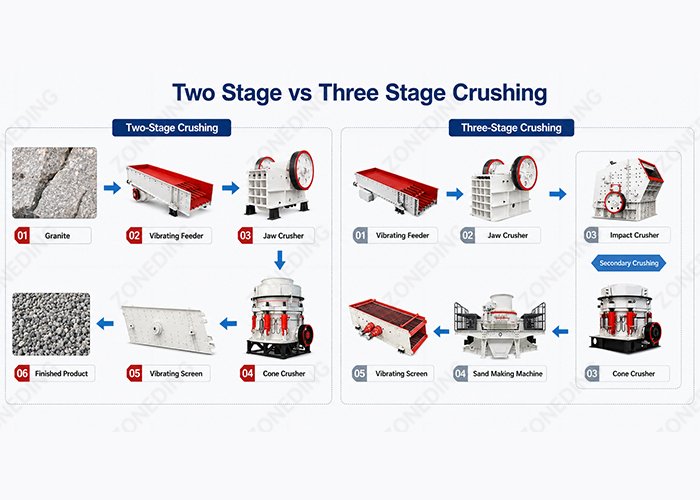
A cone crusher is a secondary or tertiary crushing machine designed to reduce medium-sized rock into smaller aggregates.
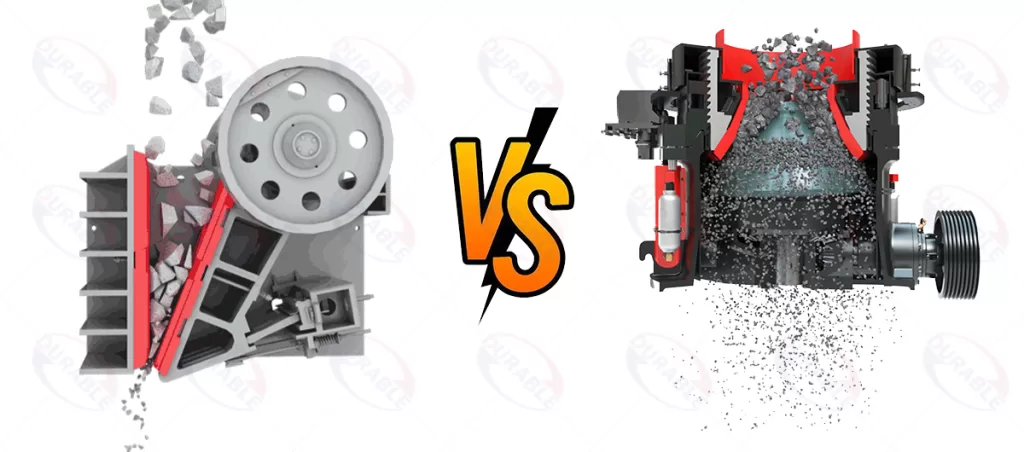
Unlike a Jaw Crusher, which uses compressive force between two jaw plates, a cone crusher uses a rotating mantle inside a stationary concave liner.
The crushing action occurs continuously as material moves downward through the crushing chamber.
This design allows cone crushers to:
Produce high output
Handle hard rock efficiently
Maintain consistent product size
Operate with lower wear costs
As a result, they are widely used in aggregate production and mining operations worldwide.
What Are the Main Parts of a Cone Crusher?
Before understanding the crushing process, it is important to know the main components.
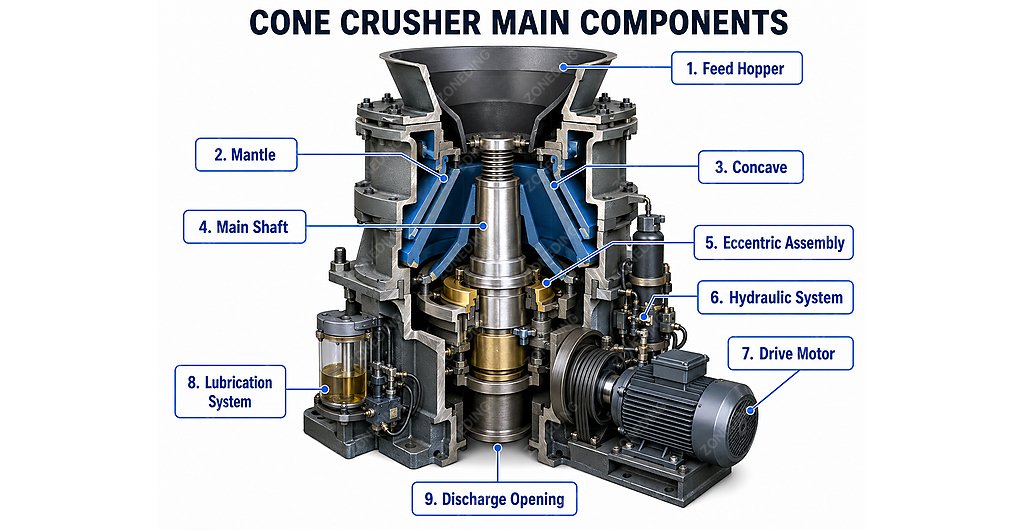
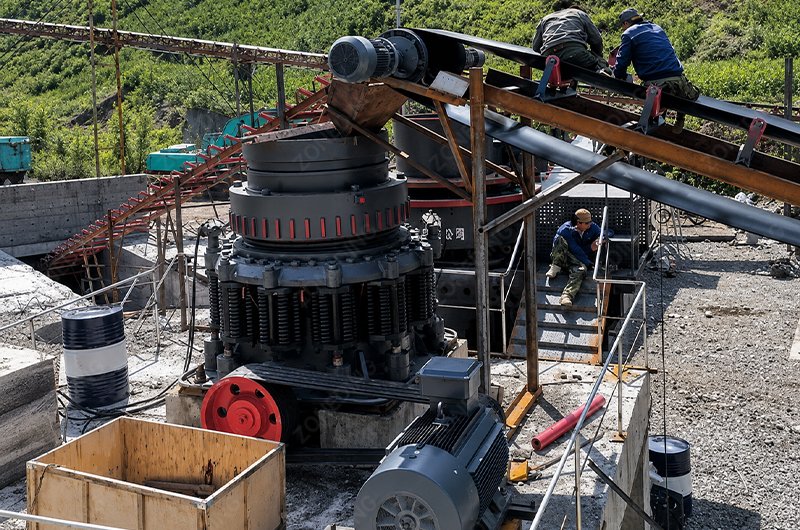
Main Components Include:
Main parts of a cone crusher including mantle concave shaft and eccentric assembly
Feed Hopper
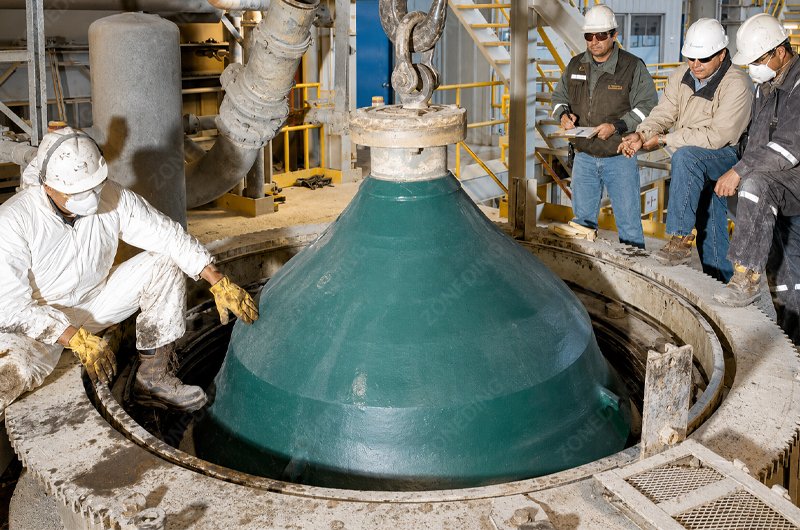
Mantle
Concave
Main Shaft
Eccentric Assembly
Hydraulic System
Drive Motor
Lubrication System
Discharge Opening
Each component plays a critical role in crushing efficiency and machine reliability.
How Does a Cone Crusher Actually Work?
The basic principle is surprisingly simple.
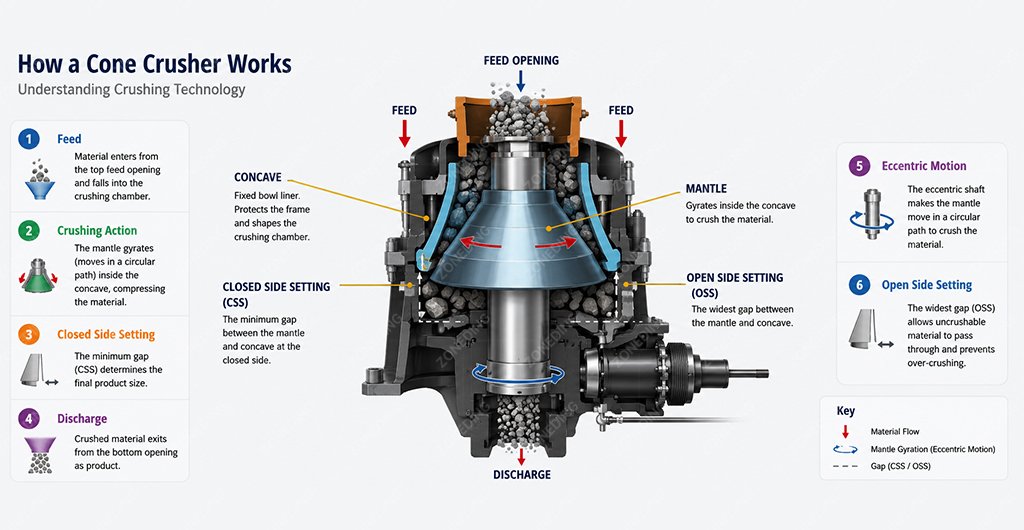
A cone crusher crushes rock by squeezing material between two surfaces:
The moving mantle
The stationary concave
The mantle is mounted on the main shaft and moves in an eccentric circular motion.
Meanwhile, the concave remains fixed.
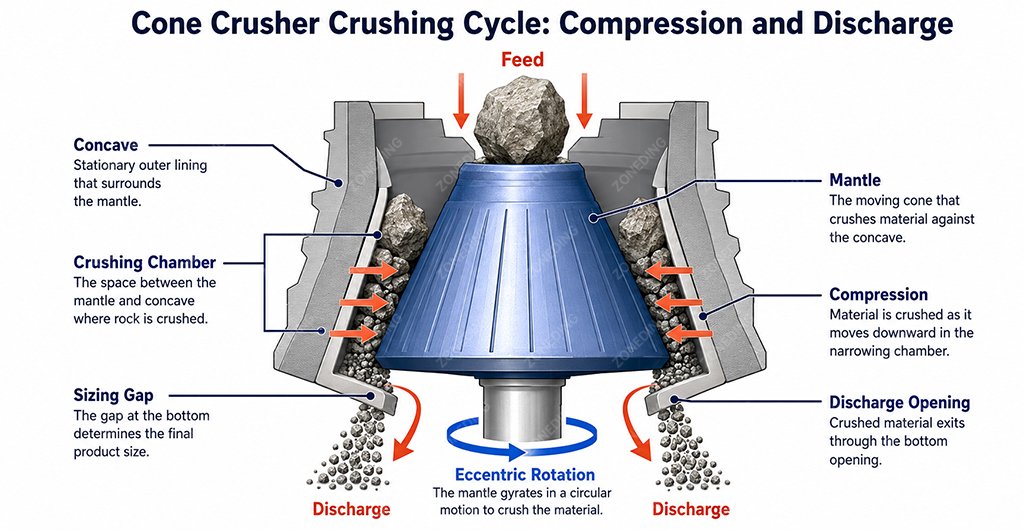
As the mantle moves closer to the concave, rock is compressed and crushed.
When the mantle moves away, the crushed material falls lower into the chamber.
This process repeats continuously until the material becomes small enough to exit through the discharge opening.
Simplified Crushing Cycle
Cone crusher crushing cycle showing material compression and discharge
Material Enters ↓ Mantle Moves Toward Concave ↓ Rock Is Compressed ↓ Material Breaks ↓ Mantle Moves Away ↓ Material Falls Lower ↓ Process Repeats ↓ Finished Product Discharges
Because crushing occurs continuously, cone crushers often achieve higher production efficiency than intermittent crushing systems.
What Is the Role of the Eccentric Assembly?
The eccentric assembly is the heart of the cone crusher.
It creates the eccentric movement that causes the mantle to swing.
Without this motion, crushing would not occur.
As the eccentric rotates:
The mantle moves closer to the concave
Compression force is generated
Material breaks into smaller particles
The eccentric speed directly affects:
Capacity
Product size
Power consumption
Wear rate
Therefore, proper eccentric design is critical for crusher performance.
How Is Material Crushed Inside the Chamber?
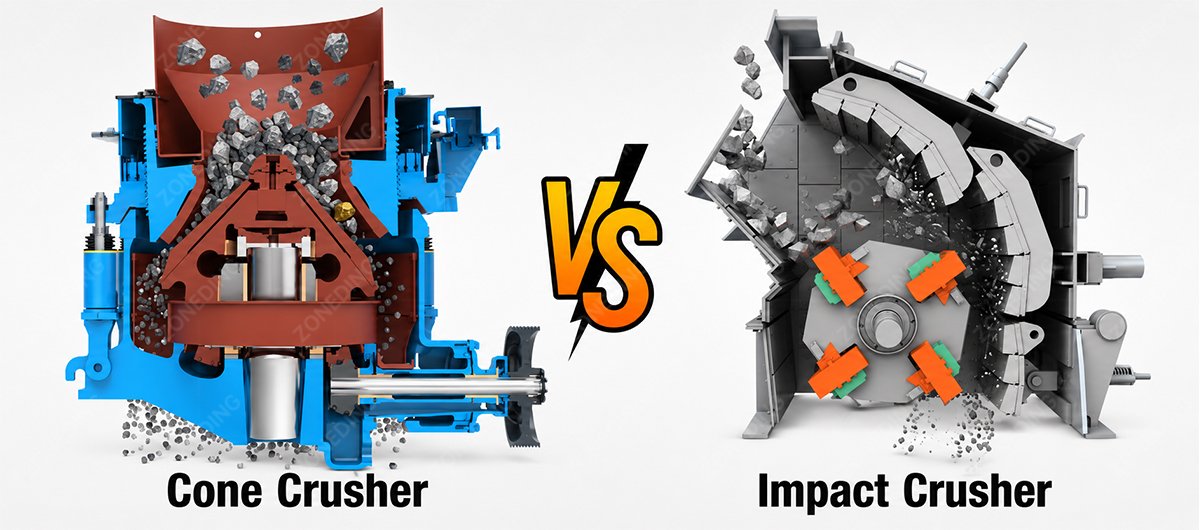
Unlike impact crushers that break material through collision, cone crushers primarily use compression.
This means rock particles are squeezed until they fracture.
Compression crushing offers several advantages:
Lower wear cost
Better hard-rock performance
Reduced dust generation
Improved energy efficiency
This is one reason why Cone Crushers are often preferred for granite and basalt applications.
What Happens to Material After Crushing?
As particles become smaller, gravity causes them to move downward through the crushing chamber.
Each time the material passes through a narrower section, additional crushing occurs.
Eventually, the particles become smaller than the Closed Side Setting (CSS).
At that point, they exit the machine through the discharge opening.
This gradual reduction process helps create:
Uniform particle size
Stable product quality
High production efficiency
What Is CSS in a Cone Crusher?
CSS stands for:
Closed Side Setting
This refers to the minimum distance between:
Mantle
Concave
when they are closest together.
CSS directly controls:
Product size
Crusher capacity
Power consumption
Smaller CSS
Results in:
Finer product
Lower capacity
Higher energy demand
Larger CSS
Results in:
Coarser product
Higher capacity
Lower energy demand
Finding the correct CSS is essential for balancing productivity and product quality.
Why Are Cone Crushers So Efficient?
Several design features contribute to their efficiency.
Continuous Crushing
Unlike some crushers that crush intermittently, cone crushers operate continuously.
This increases:
Throughput
Energy efficiency
Production consistency
Multi-Layer Crushing
Material is compressed multiple times before discharge.
This configuration is commonly used in commercial aggregate production worldwide.
Frequently Asked Questions
What is the working principle of a cone crusher?
A cone crusher works by compressing rock between a moving mantle and a stationary concave liner.
Why is a cone crusher used after a jaw crusher?
Jaw crushers perform primary crushing, while cone crushers further reduce material size and improve product quality.
What materials can a cone crusher process?
Cone crushers are ideal for granite, basalt, river stone, iron ore, and other hard materials.
What is CSS in a cone crusher?
CSS stands for Closed Side Setting, which controls the final product size and crusher capacity.
Is a cone crusher better than an impact crusher?
For hard rock applications, yes. Cone crushers generally offer lower wear costs and longer service life.
How often should cone crusher liners be replaced?
Replacement depends on material hardness, feed conditions, and production volume. Regular inspections are recommended.
Can a cone crusher produce sand?
Yes. However, many sand production lines also include a Sand Making Machine for improved particle shape.
How can I increase cone crusher output?
Stable feeding, proper CSS adjustment, regular maintenance, and optimized chamber selection all help improve productivity.
Final Thoughts
A cone crusher works by continuously compressing material between a moving mantle and a stationary concave. This simple yet highly effective design makes it one of the most efficient machines for hard-rock crushing.
When properly configured and maintained, cone crushers deliver:
High production capacity
Excellent product quality
Lower operating costs
Long service life
That is why they remain a critical part of modern aggregate, quarry, and mining operations worldwide.
About ZONEDING
ZONEDING provides complete crushing and screening solutions for aggregate, quarry, and mining projects worldwide. Our product range includes jaw crushers, cone crushers, impact crushers, vibrating feeders, vibrating screens, sand making machines, and complete stone crushing plants.
With projects operating in more than 120 countries, we help customers improve production efficiency, reduce operating costs, and maximize long-term ROI.
The magnetic separation method is a crucial technique to improve mineral purity and recover valuable metals. This process uses the physical property of magnetism to divide iron-bearing minerals from waste rocks. A high-efficiency ensures that a mi...
Anti-clogging screening equipment provides the most reliable way to handle sticky materials in 2026. Traditional vibrating screens often fail when clay moisture exceeds 10%. This leads to frequent downtime and high cleaning costs. Our technic...
What is a concrete crusher and how to select the best model? This industrial manual covers technical parameters, types, and maintenance for recycling projects. Effective debris management requires precise machine choice to ensure high-quality aggr...
We use cookies to ensure that we give you the best experience on our website. If you continue to use this site we will assume that you are happy with it.
Privacy Policy
Send us a message
We would love to hear from you
Submit your question and our team will respond to the email provided as soon as possible.
 Zoneding Machine