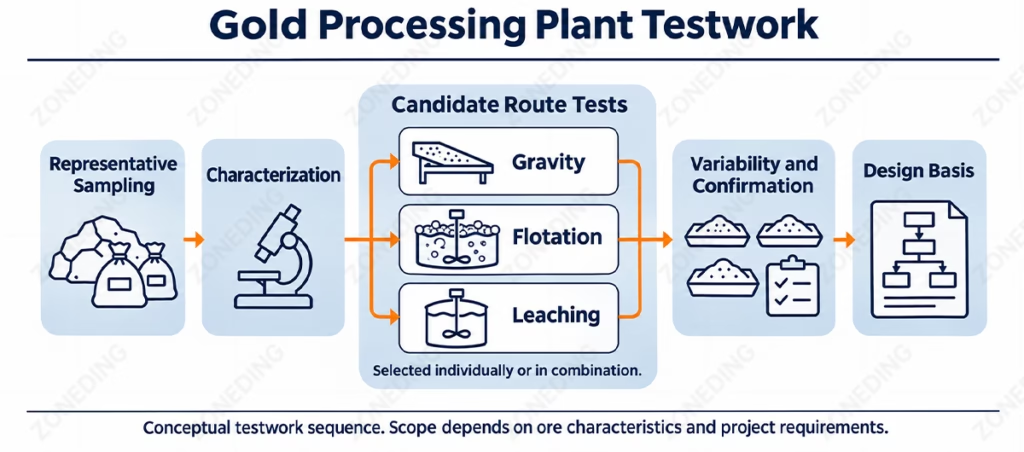
Before buying a gold processing plant, establish how the ore responds to the proposed treatment route. Gold grade alone cannot determine whether the project needs washing, gravity concentration, flotation, leaching, or a combination of processes.
A useful testwork program connects representative samples to a documented flowsheet and equipment design basis. It should explain where the gold occurs, how it can be recovered, what conditions affect the process, and which uncertainties remain.
The required program depends on the deposit and the stage of project development. Not every ore needs every test. Before final equipment selection, confirm that the available testwork supports the proposed processing route and equipment duties. Record any unresolved assumptions and the additional work needed to address them.
An assay measures gold content in the tested sample. It does not explain whether that gold can be recovered economically by a particular process.
Gold may occur as liberated particles, within other minerals, or in associations that require further investigation. Clay, sulfides, carbonaceous material, and other constituents can also influence processing behavior.
Before choosing a gold processing plant, the testwork should address three questions:
Where is the gold, and how is it associated with other minerals?
Which treatment routes recover it under the tested conditions?
What operating and equipment requirements follow from those results?
A plant selected only from head grade and production capacity may have the wrong process arrangement even if the machines are mechanically suitable.
How Should Representative Samples Be Prepared?
Sample selection is the foundation of the program.
Samples prepared for routine grade analysis may not be suitable for every metallurgical test. Confirm the required particle size, sample condition, quantity, and preservation method with the laboratory before preparation or shipment.
Discuss the sampling plan with the project geologist and metallurgist before collecting or combining material. Samples should reflect the ore types expected in the mine plan, including variations that could affect processing.
Relevant differences may include:
Oxidized, transitional, and fresh material.
Different mineralized zones or rock types.
Changes in gold distribution and associated minerals.
Variations in hardness, weathering, and clay content.
Material expected during initial operations and later production.
A composite sample can support initial flowsheet investigation, but combining material too early may conceal important differences between ore types.
Retain sample identities and document collection locations, preparation methods, storage, and splitting procedures. The laboratory should specify the sample quantity and preparation needed for each test.
What if the ore contains coarse gold?
Coarse or unevenly distributed gold can complicate sampling and assay interpretation. The laboratory should evaluate whether the preparation, subsampling, and analytical methods adequately address that distribution.
Visible gold in a selected rock is not proof that the bulk ore will respond well to gravity concentration.
What Should the Initial Characterization Include?
Initial characterization helps determine which recovery tests are justified.
Investigation
Main question
Potential design relevance
Head assays
What valuable and potentially problematic constituents are present?
Establishes the analytical basis for testing
Mineralogical examination
Which minerals occur, and how are they associated?
Helps identify candidate processing routes
Gold deportment investigation
Where and in what form does the gold occur?
Supports liberation and recovery assessment
Particle size analysis
How is the sample distributed by size?
Supports preparation and separation planning
Physical characterization
How does the material behave during handling and size reduction?
Supports equipment and materials-handling assessment
The scope should follow the project’s questions. Detailed gold deportment work may be especially useful when initial recovery results are poor or difficult to explain.
Characterization and recovery testing should inform each other. Mineralogy helps interpret test results, while the results can identify areas requiring further examination.
When Is Gravity Recovery Testing Needed?
Gravity testing is relevant when characterization indicates that some gold may be recoverable through density-based separation.
The program should investigate the response at suitable preparation stages and account for the gold remaining in the gravity tailings.
Useful outputs include:
Concentrate and tailings masses.
Gold grades and distribution.
Recovery calculated from a reconciled material balance.
The preparation and separation conditions used.
The treatment required for concentrate and tailings.
A high concentrate grade alone does not establish a successful process. It must be considered together with concentrate mass, recovery, and the quantity of gold left behind.
For hard rock ore, gravity testing may be evaluated as part of a combined flowsheet. For alluvial material, washing, scrubbing, sizing, and clay behavior may need investigation before the gravity stage.
Laboratory gravity response is not automatically the expected plant recovery. The result must be interpreted against the proposed circuit arrangement and operating conditions.
When Should Flotation Be Investigated?
Flotation may be worth investigating when gold is associated with minerals that can be concentrated by flotation.
Testing should assess more than the recovery obtained in an initial rougher stage. Depending on the proposed route, concentrate quality, cleaning requirements, mass pull, and downstream treatment can all matter.
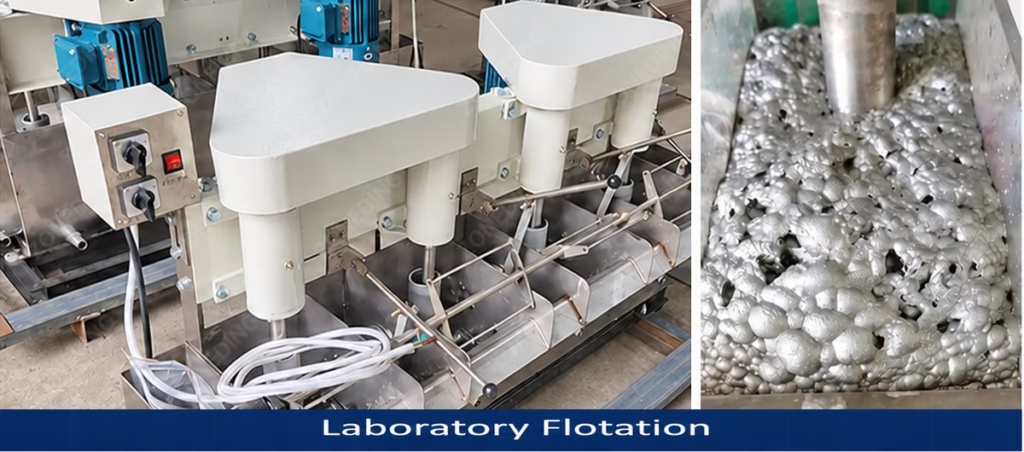
Laboratory flotation equipment and froth detail
Ask the laboratory to report:
Feed, concentrate, and tailings assays.
Concentrate mass and gold distribution.
Test conditions and reagent additions.
Recovery and concentrate-grade relationships.
Evidence supporting any proposed regrinding or cleaning stages.
Selecting a flotation machine requires a defined duty. Equipment sizing should follow an appropriate interpretation of the testwork, rather than copying laboratory vessel volume directly.
A flotation concentrate also needs an identified destination. Producing a concentrate does not, by itself, establish overall gold recovery to a saleable final product.
What Should Leaching Testwork Establish?
Where leaching is a candidate route, the laboratory program should evaluate its suitability for the actual material and intended process.
Relevant investigations may include extraction over time, preparation size, reagent consumption, solution conditions, and the behavior of constituents that interfere with recovery.
Distinguish gold dissolved during leaching from gold recovered through the complete plant. If the proposed circuit includes adsorption and subsequent recovery stages, those duties need an appropriate technical basis as well.
Poor extraction should be investigated before selecting larger tanks or longer treatment times. Mineralogical locking, preg-robbing behavior, or other ore characteristics may require a different approach. Preg-robbing occurs when constituents in the ore adsorb dissolved gold and interfere with its recovery.
Leaching testwork should be carried out by a suitably equipped laboratory. Chemical handling, residue treatment, and environmental requirements form part of the project assessment.
What if heap leaching is being considered?
Agitated laboratory leach results alone do not establish heap performance. A heap-leach assessment requires suitable investigation of percolation, permeability, preparation requirements, and leaching behavior under conditions relevant to the proposed heap.
How Does Grinding Testwork Support Equipment Selection?
For a hard rock route requiring grinding, the design needs evidence about both size reduction and metallurgical response.
Comminution testing supports assessment of the duty required to prepare the ore. Recovery tests at appropriate preparation sizes help determine whether further grinding provides a useful processing benefit.
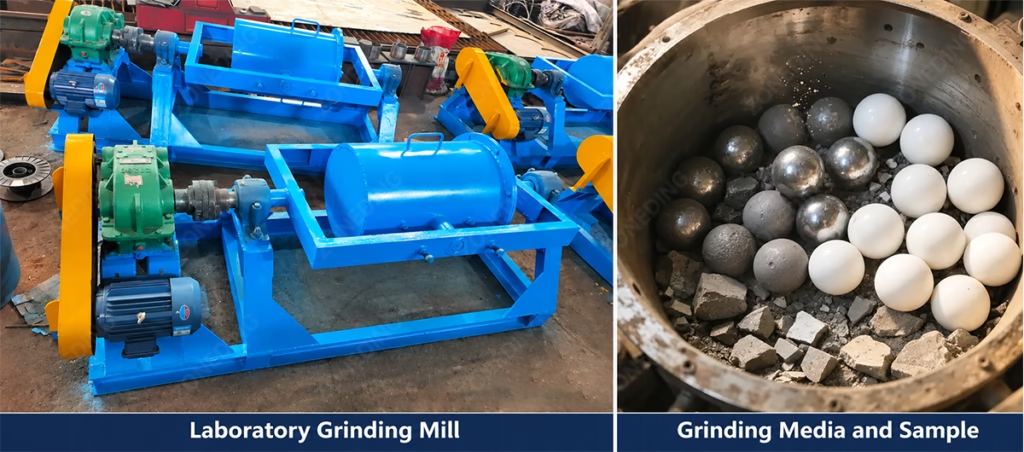
Laboratory grinding equipment and grinding media
A selected ball mill should therefore be based on a defined feed, required product distribution, material characteristics, and circuit arrangement.
Ask the design team to distinguish:
Feed preparation and grinding requirements.
Evidence for the selected product size.
Classification and circulating-load assumptions.
The method used to scale test results to the proposed equipment.
Expected variations between ore types.
The finest tested grind is not automatically the preferred design point. Compare the metallurgical benefit with the resulting grinding, handling, and downstream processing requirements.
Why Are Water and Tailings Tests Part of Plant Planning?
The recovery circuit does not operate independently of water and residue management.
Where relevant, evaluate the effect of the intended water source and recycled water on separation, reagent response, and slurry handling.
Depending on the flowsheet, supporting tests may include:
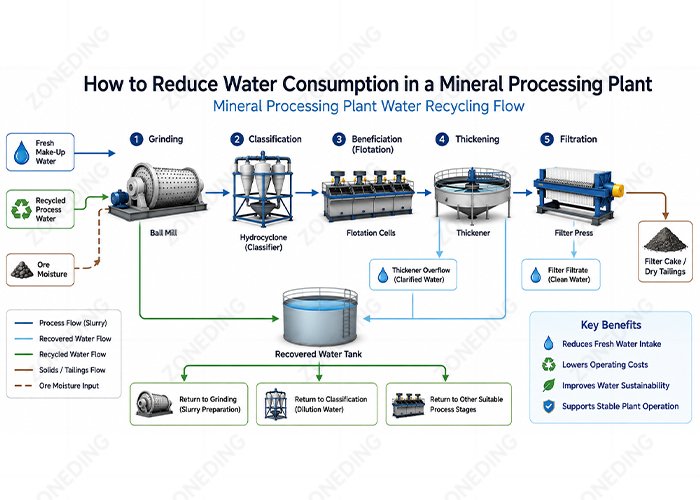
Settling and thickening response.
Filtration and moisture behavior.
Slurry rheology.
Process-water chemistry.
Residue characterization.
Treatment requirements for process solutions and tailings.
These results support the design of equipment and infrastructure around the recovery circuit.
Good laboratory recovery does not compensate for an unresolved water balance or an unsuitable tailings-handling arrangement.
When Are Variability and Confirmation Tests Needed?
An initial composite can help identify a promising route. It cannot demonstrate that every ore type will behave the same way.
Variability testing checks how the proposed process responds across the material expected during production.
The program should investigate differences that could affect recovery, throughput, reagent consumption, or residue handling. Where necessary, it should also assess expected blends.
Confirmation work should address the assumptions most important to the equipment purchase. Depending on the project, this may involve repeat testing, locked-cycle testing, continuous trials, or pilot work.
The appropriate level of testing depends on process complexity, variability, scale-up uncertainty, and the significance of the purchasing decision. Pilot testing is not a universal requirement, but its omission should be technically justified where uncertainty remains.
What Should a Useful Testwork Report Contain?
A report should allow the buyer and design team to understand how conclusions were reached.
Report component
What to look for
Sample description
Origin, preparation, identity, and representativeness
Analytical methods
Methods used and relevant quality-control information
Test procedures
Conditions, equipment, and sequence of operations
Results
Feed and product masses, assays, and measured responses
Material balance
Reconciliation of valuable material across relevant streams
Interpretation
Reasons for selecting or rejecting candidate routes
Limitations
Untested material, uncertainty, and scale-up considerations
Design recommendations
Proposed duties and further work required
A summary stating only that the ore is “suitable for processing” is not enough to support equipment selection.
Ask for the relationship between the reported results and the proposed flowsheet. Any design parameter derived from testing should have a traceable basis.
Testwork findings support gold processing equipment selection
How Should Testwork Be Used When Comparing Plant Quotations?
Provide suppliers with the same technical information and ask them to identify how they have used it.
The proposal should distinguish confirmed inputs, engineering interpretations, and assumptions requiring further work.
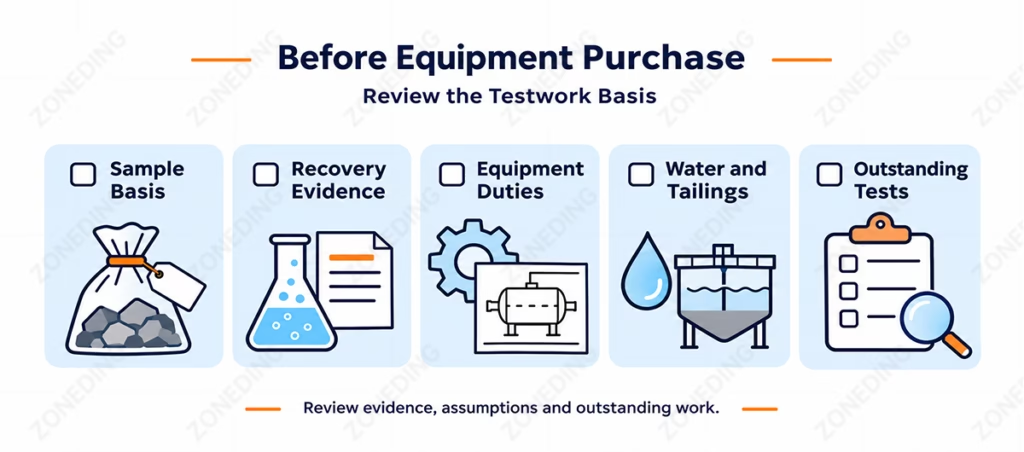
Review the testwork basis before equipment purchase
Before committing to equipment, check:
Whether the proposed route matches the tested material.
Whether the quoted feed and product duties are defined.
How laboratory results have been scaled to plant equipment.
Whether supporting water, residue, and materials-handling systems are included.
Which performance conditions and exclusions apply.
What additional testing is needed before final design.
A supplier’s equipment list should follow the process assessment. An available machine package should not determine the treatment route before the ore has been evaluated.
Can Another Project Replace Your Own Testwork?
No. A project reference can illustrate an equipment application, but it does not establish how your ore will respond.
When reviewing ZONEDING’s project cases, first identify whether the material and treatment route are relevant to your project. Request supporting information where the published description does not provide enough detail.
A similar head grade or matching equipment type does not prove that the same flowsheet will suit another deposit.
Use project references to prepare questions about implementation. Use representative testwork to establish the process basis for your own project.
Frequently Asked Questions
Do all gold projects need gravity, flotation, and leaching tests?
No. Initial characterization and the project objectives should guide the choice of candidate routes. Additional tests are justified when they resolve a relevant processing question.
Can a gold assay report be used to select a complete plant?
An assay is an important input, but it does not establish gold occurrence, liberation, recovery response, or equipment duties. Further investigation is normally needed.
How much sample should be sent to the laboratory?
The laboratory should specify the required quantity after reviewing the proposed tests, material characteristics, and sampling objectives. There is no single sample quantity suitable for every program.
Does laboratory recovery equal plant recovery?
No. Plant performance also depends on scale-up, circuit configuration, feed variability, operating control, and losses across the complete process.
Is pilot testing always required before purchasing equipment?
No. Its value depends on the process and remaining uncertainty. The project team should determine whether the available evidence adequately supports the proposed design and purchase.
Prepare Your Gold Plant Purchase with ZONEDING
Effective gold processing plant testwork turns ore information into a documented basis for selecting a flowsheet and defining equipment duties.
Share your sample descriptions, mineralogical information, laboratory reports, production objectives, and site conditions with ZONEDING’s team.
These inputs support a review of candidate processing routes, equipment requirements, and the additional evidence needed before final selection.
Operating heavy mining equipment requires a deep understanding of internal mechanics. Many expensive machine failures happen because operators misunderstand basic operational rules. Good equipment can break quickly when handled poorly. This compre...
Many gold miners focus on recovery equipment such as concentrators, sluices, jigs, and shaking tables. However, experienced operators know that recovery begins long before gold reaches those machines. It starts with proper washing, screening, and ...
Aggregate plants face challenges with hard rock processing daily. Cone crushers in the aggregates industry solve this exact problem efficiently. High-grade construction projects require perfectly shaped stones constantly. These machines handle ext...
We use cookies to ensure that we give you the best experience on our website. If you continue to use this site we will assume that you are happy with it.
Privacy Policy
Send us a message
We would love to hear from you
Submit your question and our team will respond to the email provided as soon as possible.
 Zoneding Machine