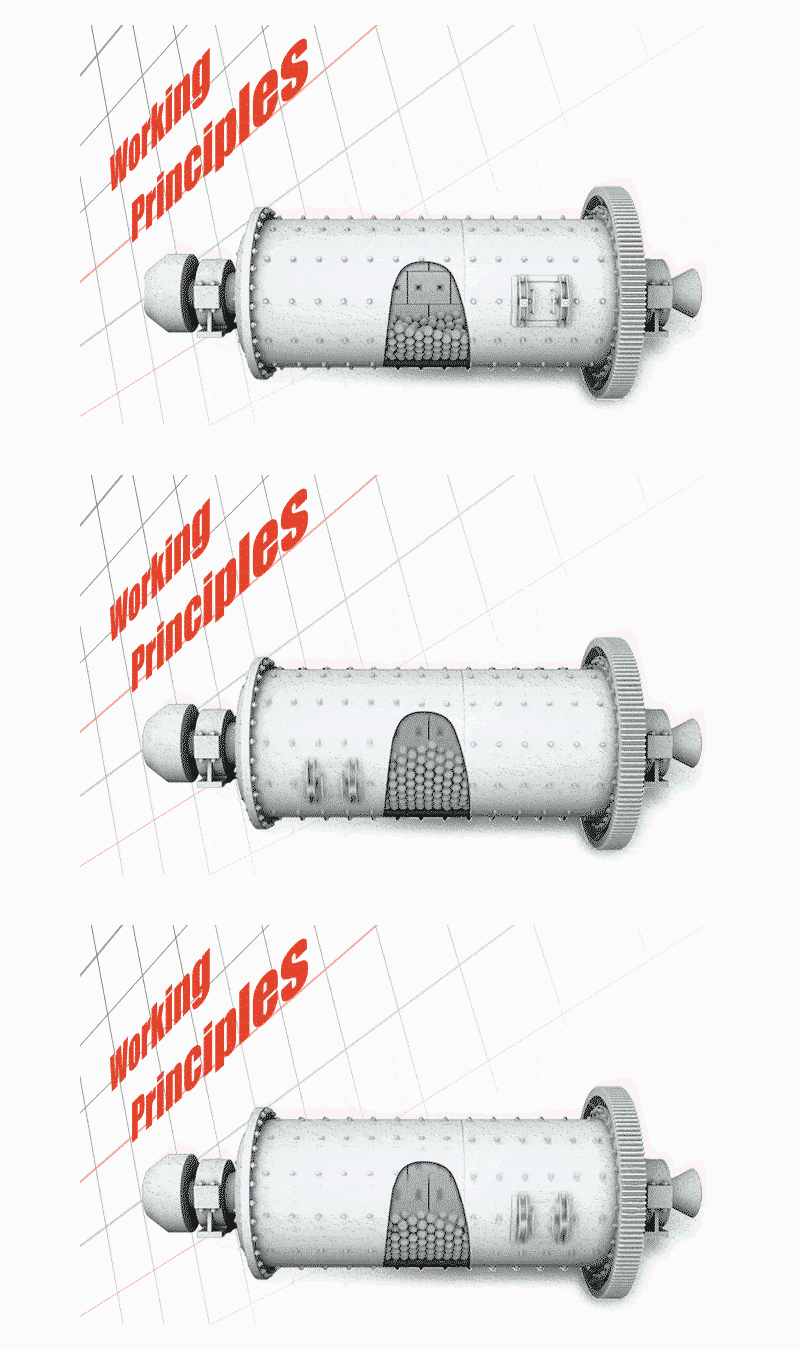
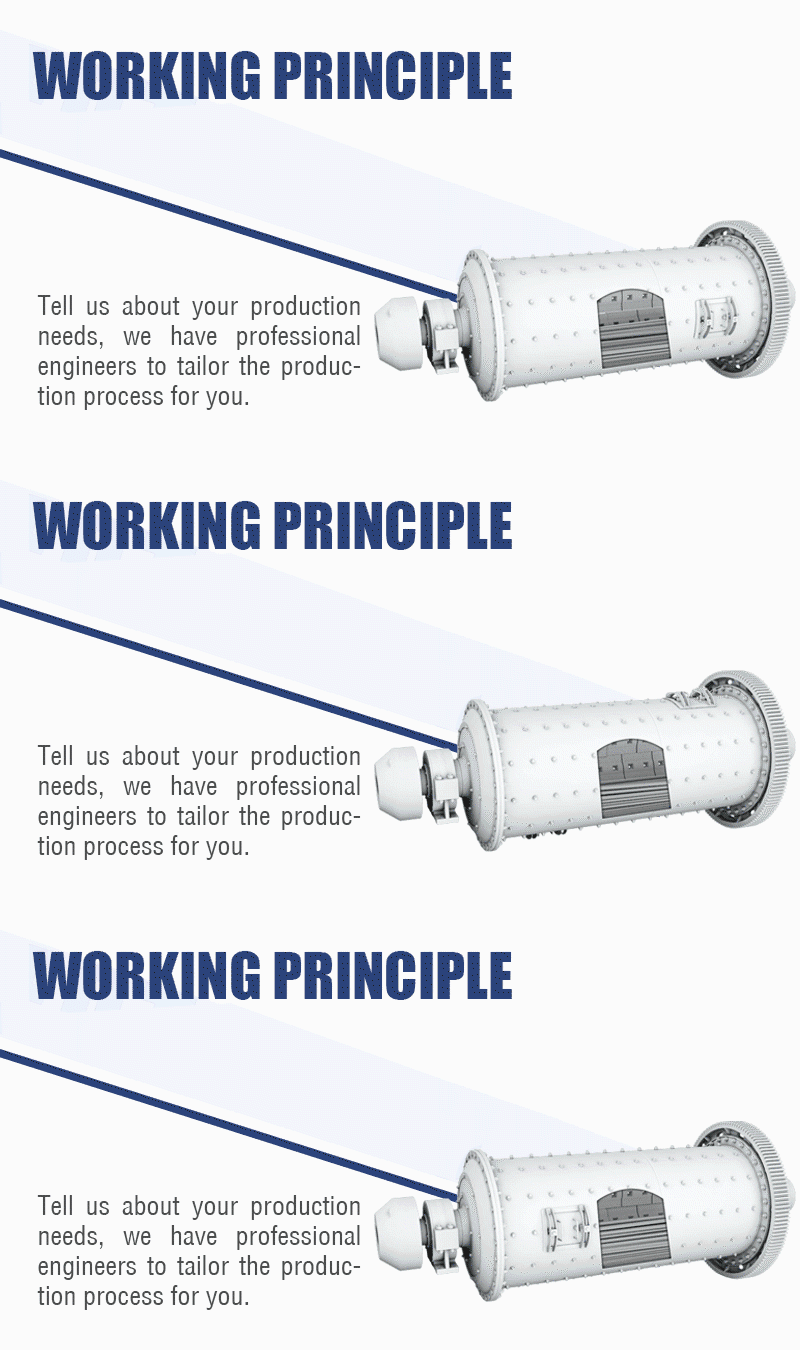
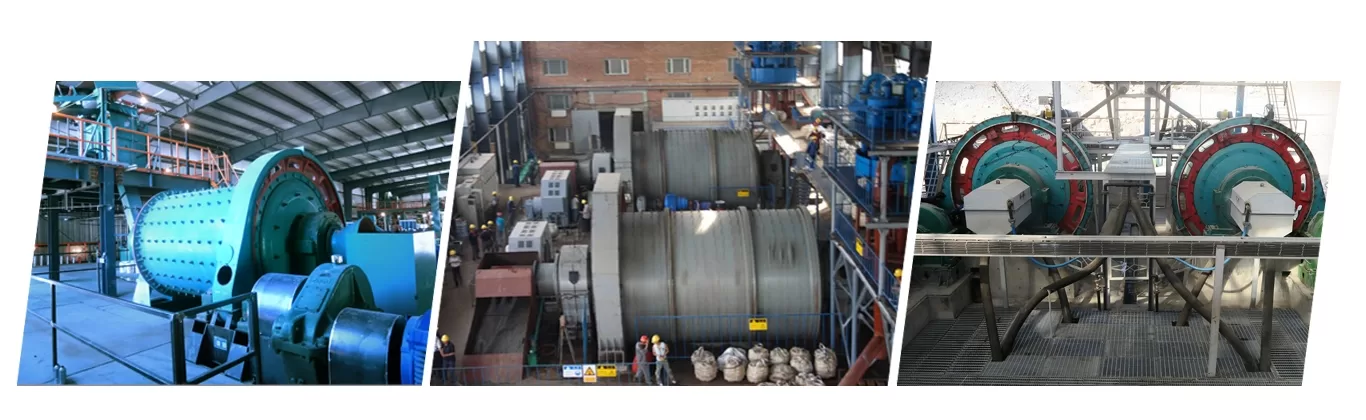
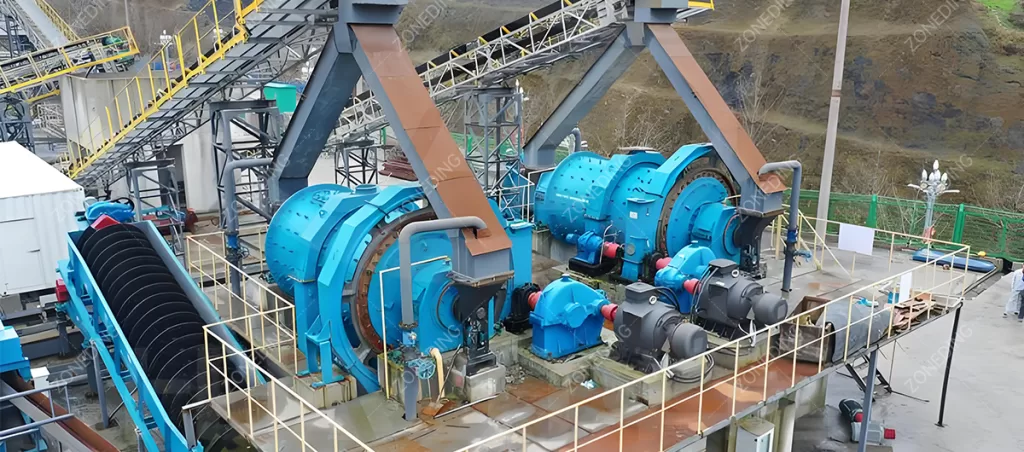
Choosing the right grinding mill is one of the most critical investment decisions you will make. This choice affects not just your initial capital but your operating costs and final product quality for decades. It’s a decision that can either streamline your process or cripple it with inefficiency.
The choice between a Ball Mill and a Rod Mill depends on your target product size and process requirements. A Rod Mill is for coarse grinding and producing a uniform product with minimal fines, while a Ball Mill is for fine and ultra-fine pulverizing.
These two machines may look similar from the outside, but their internal mechanics are fundamentally different. Understanding this difference is the key to selecting the right tool for your specific job. This is not just about picking a machine; it’s about defining the entire philosophy of your grinding circuit.
I’m Most Concerned About Over-grinding. Which Mill Produces More Uniform Particles?
Over-grinding is a major problem in many mineral processing plants. It creates ultra-fine particles, or “slimes,” which consume expensive reagents, are difficult to handle, and often carry valuable minerals away to the tailings pond.
The Rod Mill produces a much more uniform particle size with significantly less over-grinding. Its grinding action is selective, meaning it primarily breaks down the largest particles while protecting the smaller ones, resulting in a granular product with a narrow size distribution.
The secret lies in the physics of the grinding media.
Point Impact vs. Line Contact
This is the fundamental difference that dictates everything else.
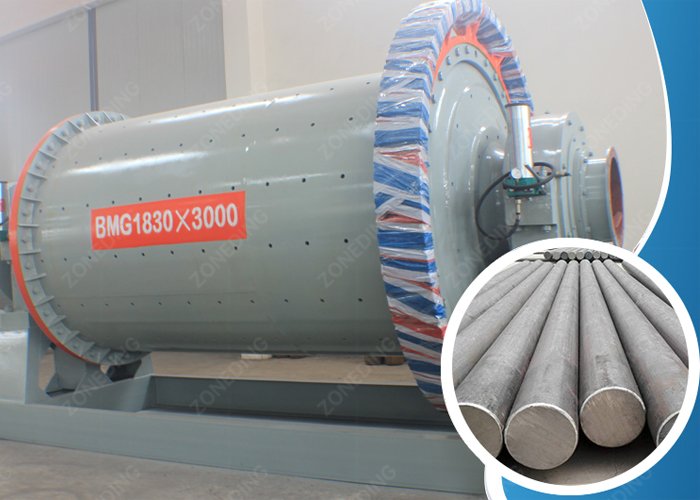
A Ball Mill is Chaos: Inside a ball mill, thousands of steel balls cascade and tumble, creating countless points of impact. It is a chaotic, brutal environment where particles are hit from all angles. This action relentlessly grinds everything—coarse and fine particles alike. This inevitably leads to the over-grinding of a portion of the material.
A Rod Mill is Order: Inside a rod mill, long steel rods remain parallel as the mill turns. They roll over each other, creating “line contact.” The largest particles in the feed hold the rods apart, so they are the ones that get crushed. Finer particles are shielded in the gaps between the rods and pass through without being broken further. This selective grinding is why rod mills are the best machines for minimizing the production of slimes, making them ideal for preparing feed for processes like gravity separation that are sensitive to fines.
I Need to Grind Material Below 200 Mesh. Should I Choose a Ball Mill or a Rod Mill?
Many processes, particularly flotation for mineral liberation, require a very fine final product. Achieving this target size efficiently is critical for maximizing recovery and profitability.
For grinding material finer than 200 mesh (74 microns), the Ball Mill is the only correct and efficient choice. Rod mills are physically incapable of achieving this level of fineness effectively because their grinding action is not designed for pulverizing.
ball mill
The mechanical limitations of each mill define their effective grinding range.
The Finisher’s Tool
A Ball Mill is the undisputed champion of fine and ultra-fine grinding.
High-Energy Impact: The cascading and cataracting motion of the steel balls creates the intense, high-energy point impacts necessary to break small particles down into a fine powder.
Closed-Circuit Operation: Ball mills are almost always operated in a “closed circuit” with a classification system, such as Hydrocyclones. The cyclones separate the mill discharge, sending the correctly sized fine particles to the next process stage and returning the oversized coarse particles to the ball mill for further grinding. This setup provides precise control over the final product size, which is essential for downstream recovery.
In contrast, a Rod Mill‘s action becomes very inefficient as particles get smaller. The rods are held apart by the particle bed, preventing the intense attrition and impact needed for fine pulverization.
Where Does a Rod Mill Typically Fit in a Process, and Where Does a Ball Mill Fit?
You never select a mill in isolation. You must choose it based on the specific role it will play in the overall circuit. One machine does the heavy lifting, and the other does the finishing work.
A Rod Mill is typically used as a primary grinding mill, often in an open circuit. A Ball Mill is used as a secondary grinding mill in a closed circuit to achieve the final, fine product size.
The classic and highly efficient grinding circuit for many small to medium-sized plants demonstrates their distinct roles.
The “Pacer” and the “Finisher”
Think of them as two different types of runners in a race.
The Rod Mill as the “Pacer”: The rod mill is a superb machine for the first stage of grinding. It takes coarse feed from a crusher (e.g., -25mm) and, in a single pass (open circuit), efficiently grinds it down to an ideal feed size for a ball mill (e.g., -2mm). It does the coarse, heavy work reliably and prepares a perfect, consistent feed for the next stage.
The Ball Mill as the “Finisher”: The ball mill takes the prepared feed from the rod mill (or a SAG mill in larger plants) and does the fine finishing work. Its purpose is to grind the material down to the final target size required for mineral liberation, typically working in a closed circuit for precise control. This Rod Mill -> Ball Mill combination leverages the strengths of both machines to create a highly efficient and controllable grinding circuit.
For the Same Ore, Which Mill Has Lower Energy and Steel Consumption Costs?
Operating costs, particularly energy and grinding media consumption, are a primary concern for any plant manager. The efficiency of a mill is directly tied to its suitability for the specific grinding task.
For coarse grinding applications, a Rod Mill is generally more energy-efficient because it does not waste energy creating unwanted fine particles. For fine grinding, a Ball Mill is more energy-efficient. Steel consumption is application-specific. There is no single “cheaper” mill; the cost depends on the job you are asking it to do.
Comparing Operational Costs
Energy Consumption: A rod mill applies its energy selectively to the coarsest particles. It avoids wasting power on over-grinding material that is already fine enough. A ball mill’s indiscriminate action means it uses energy on all particles, making it less efficient for coarse grinding but more effective for the high energy demands of fine pulverization.
Steel (Media) Consumption: This cost is more complex. Steel rods are generally more expensive per ton than steel balls. Rods can also suffer from issues like tangling or breaking, which can cause operational headaches. However, in the right coarse-grinding application, the wear rate of rods can be very favorable. Ball consumption is generally more predictable and manageable. The abrasiveness of the ore is the largest factor in determining the final steel consumption for either mill.
My Crusher Produces a Relatively Coarse Product. Which Mill Is Better at Handling It?
The output from a secondary or tertiary crushing circuit can still contain relatively large particles. The grinding mill that follows must be able to accept this feed size and grind it efficiently without issues.
A Rod Mill is far better suited to handle coarse feed directly from a crushing circuit. It can accept feed sizes up to 50mm (2 inches) because the lifting and crushing action of the heavy rods can effectively break larger particles.
The design of the mill’s grinding media directly impacts its ability to handle different feed sizes.
Feed Size Limitations
Rod Mill Capability: The large diameter and length of the steel rods provide the mass and leverage needed to trap and break coarse feed particles. The selective nature of the grinding action ensures these large particles are targeted first. This makes the rod mill an excellent bridge between the crushing and fine grinding stages.
Ball Mill Limitation: A Ball Mill is less efficient when fed with very coarse material. The smaller grinding balls may not have sufficient individual mass or energy to effectively fracture the largest particles in the feed. This can lead to an accumulation of coarse pebbles in the mill, reducing throughput and overall grinding efficiency. A ball mill operates best when it is fed a consistently finer product, which is a job perfectly suited for a rod mill or a tertiary crusher.
How Can I Use a Checklist to Finally Decide Between a Ball Mill and a Rod Mill?
Making the final investment decision requires a clear summary of the key differences. This checklist distills the information into a practical, head-to-head comparison to guide your choice.
Use this checklist to match your specific process needs to the capabilities of each mill. Your final product size requirement is the most important factor in this decision.
Evaluate your project against these five critical criteria to make the right choice.
Final Decision Checklist: Ball Mill vs. Rod Mill
Feature / Requirement
Choose a Rod Mill If…
Choose a Ball Mill If…
1. Final Product Size
Your target is a coarse, granular product (4-35 mesh / 4.75mm – 425µm).
Your target is a fine, powdered product (finer than 35 mesh / < 425µm).
2. Over-grinding / Fines
Minimizing fines (slimes) is critical for your process (e.g., gravity separation).
A moderate amount of fines is acceptable or manageable (e.g., flotation).
3. Feed Size from Crusher
You have a coarser feed (e.g., up to 50mm / 2 inches).
You have a finer, well-controlled feed (e.g., < 15mm / 0.6 inches).
4. Circuit Position
You need a primary grinding stage to prepare feed for another mill or process.
You need a secondary or regrind stage for fine finishing.
5. Main Application
Preparing feed for gravity circuits, magnetic separation, or ball mills; making manufactured sand.
Preparing feed for flotation, cyanidation, or any process requiring high liberation.
Conclusion
The choice between a ball mill and a rod mill is not about which is “better,” but which is the right tool for the job. The rod mill is a specialist for coarse, uniform grinding. The ball mill is a generalist for fine pulverizing.
A rod mill working principle differs from other grinding tools because it uses long steel rods instead of balls. This machine is the best choice for preventing "over-grinding," which ruins fragile minerals. Many plants lose profit becaus...
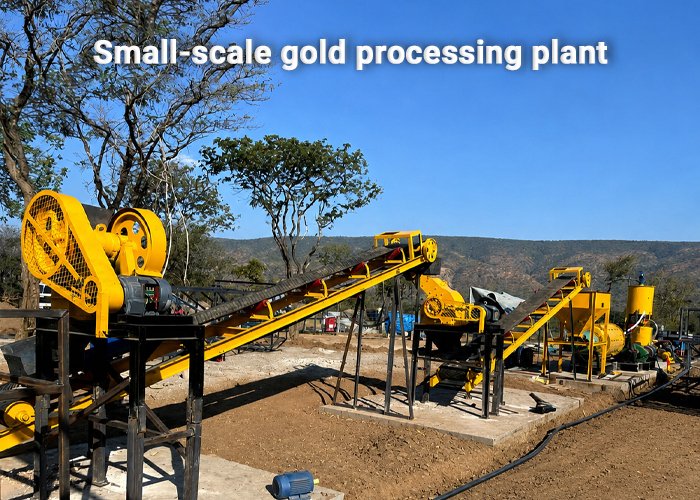
Starting a small-scale gold processing plant is one of the most practical ways to enter the gold mining industry. Compared with large mining projects, a small plant requires less investment, shorter construction time, and lower operating costs. Ho...
A rock quarry can be very profitable if you control production costs, transportation distance, and equipment efficiency. In many regions, aggregate demand keeps growing because of roads, housing, and infrastructure projects. But quarry profit does...
We use cookies to ensure that we give you the best experience on our website. If you continue to use this site we will assume that you are happy with it.
Privacy Policy
Send us a message
We would love to hear from you
Submit your question and our team will respond to the email provided as soon as possible.
 Zoneding Machine