When coarse aggregate is the target product, excessive fines reduce saleable coarse aggregate yield. They can also overload screens, increase recirculating load, accelerate wear, and make final product gradation difficult to control.
However, the crusher is not always the source of the problem.
Fine particles may already exist in the raw feed. They may also be generated by an unsuitable reduction ratio, a tight crusher setting, worn liners, repeated crushing, or inefficient screening. Changing one crusher parameter without locating the source can make the problem worse.
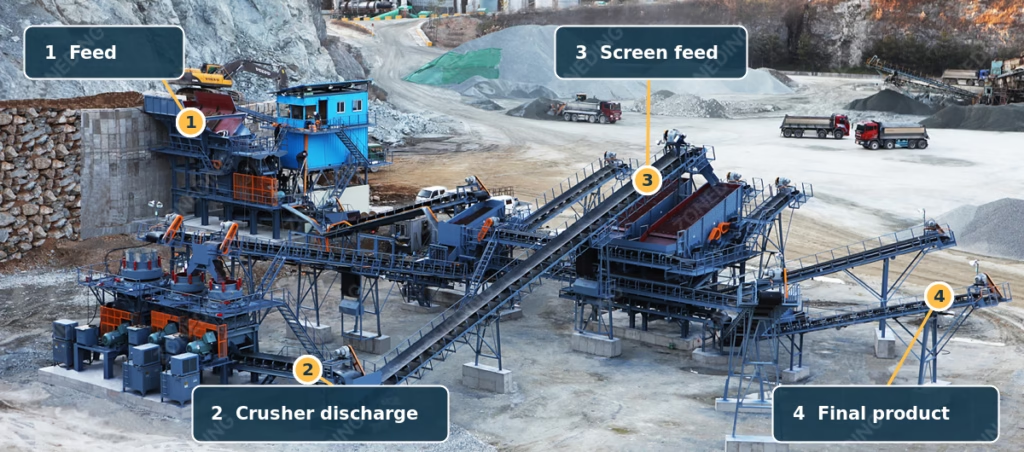
The correct approach is to sample the circuit, identify where the fines increase, and then adjust the relevant stage. This guide explains how to carry out that diagnosis in a complete stone crushing plant.
What Counts as Excessive Fines in an Aggregate Plant?
Not every small particle is a production problem.
Many aggregate specifications require a controlled fine fraction. Crusher fines may also be sold for road base, backfill, manufactured sand, or other applications. Therefore, the objective is not to eliminate every fine particle.
Fines become excessive when the percentage below the specified sieve size is higher than the product requirement or the plant’s normal operating baseline.
Before changing the crusher, confirm three points:
Which sieve size defines the unwanted fine fraction?
How much fine material is already present in the raw feed?
At which point in the circuit does the fine fraction increase?
A visual inspection of the stockpile is not enough. Dust, moisture, segregation, and lighting can make one product appear finer than another. Representative sampling and sieve analysis provide more reliable evidence.
The same plant may also have different acceptable limits for concrete aggregate, asphalt aggregate, road base, railway ballast, or manufactured sand. Always judge the result against the final product specification.
First Confirm Where the Fines Are Generated
Start by collecting samples from several points in the circuit instead of sampling only the final stockpile.
Feed, crusher discharge, screen products, and recirculating material should be sampled separately
Recommended sampling points include:
Raw material before primary crushing
Primary crusher discharge
Secondary or tertiary crusher discharge
Screen undersize products
Screen oversize or recirculating material
Final product conveyors
Compare the particle-size distribution from each location.
If the raw feed already contains a large fine fraction, changing the secondary crusher may have little effect. Pre-screening or scalping may be more effective.
A sharp increase after a crusher points toward its settings, chamber profile, wear condition, or reduction ratio. Meanwhile, excessive fines in the recirculating material may indicate poor screening or repeated crushing of particles that are already close to the required size.
Record throughput, power draw, crusher setting, liner condition, screen condition, and feed moisture when taking each sample. Otherwise, two samples collected under different operating conditions may not be directly comparable.
How Feed Properties Increase Fine Material
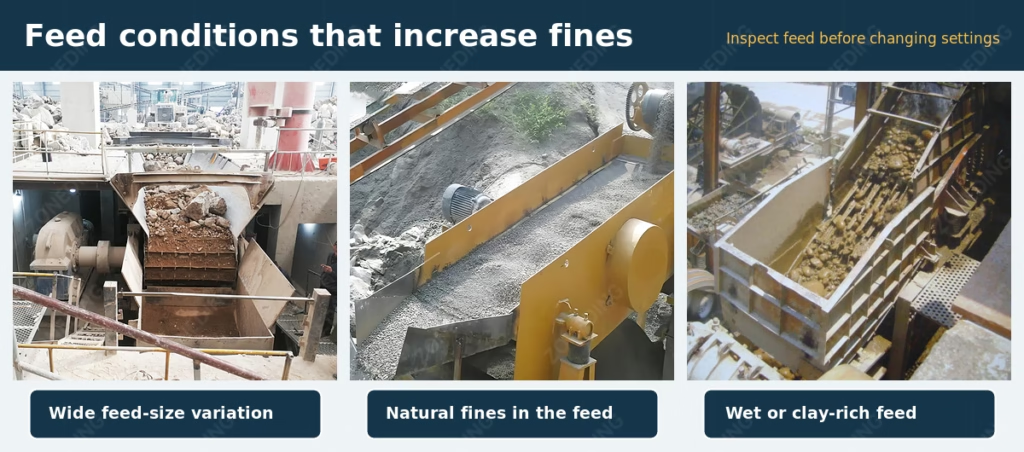
Crusher settings may remain unchanged while the product gradation shifts because the quarry feed has changed.
Weathered rock, fractured stone, and soft material usually break more easily than competent rock. A deposit may contain several geological zones, so material taken from a new bench can produce a different result.
Feed and discharge gradation tests reveal whether fines already exist or are generated during crushing
Important feed variables include:
Rock hardness and crushability
Natural fractures and weathering
Moisture and clay content
Feed particle-size distribution
Percentage of natural fines
Maximum lump size
Material shape and abrasiveness
Wet fines and clay may pack inside a crushing chamber or blind the screen media. This reduces classification efficiency and sends more near-size material back into the closed circuit.
Feed segregation creates another problem. Large stones may enter one side of the crushing chamber while smaller material enters the other. The chamber is then loaded unevenly, which can cause unstable power draw, inconsistent gradation, and irregular liner wear.
A correctly selected vibrating feeder helps maintain a more stable feed rate. A feed bin or surge pile can also absorb short-term variations from upstream loading equipment.
Where the raw feed contains substantial material already below the target crusher setting, a grizzly or pre-screen can remove it before crushing. This prevents product-sized particles from occupying chamber volume and being crushed again.
How Crusher Type and Reduction Ratio Affect Fines
Each crusher breaks rock differently. As a result, crusher selection directly affects the amount and shape of the fine fraction.
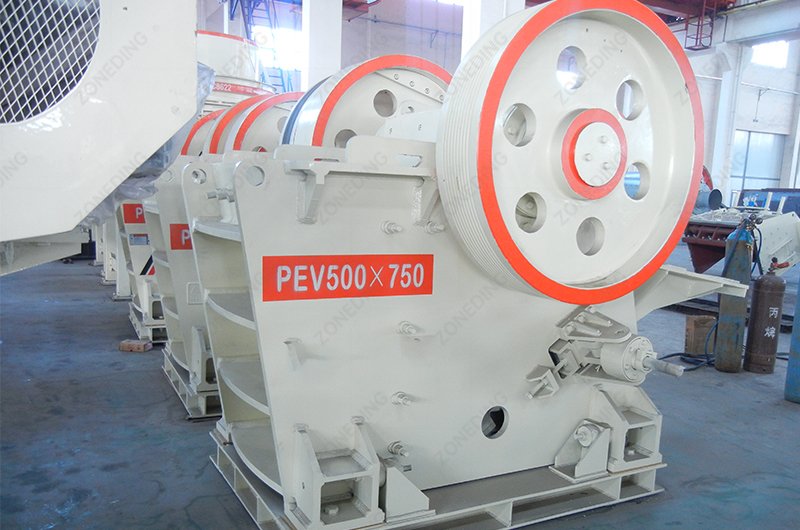
Jaw Crusher
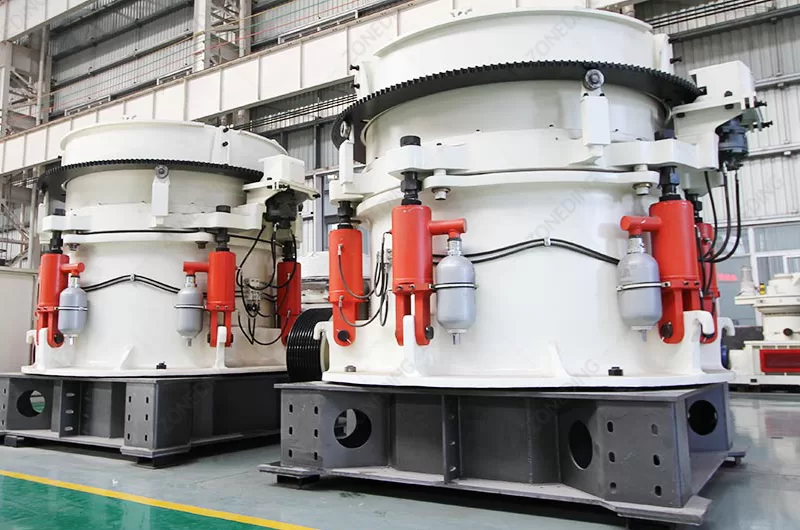
Cone Crusher
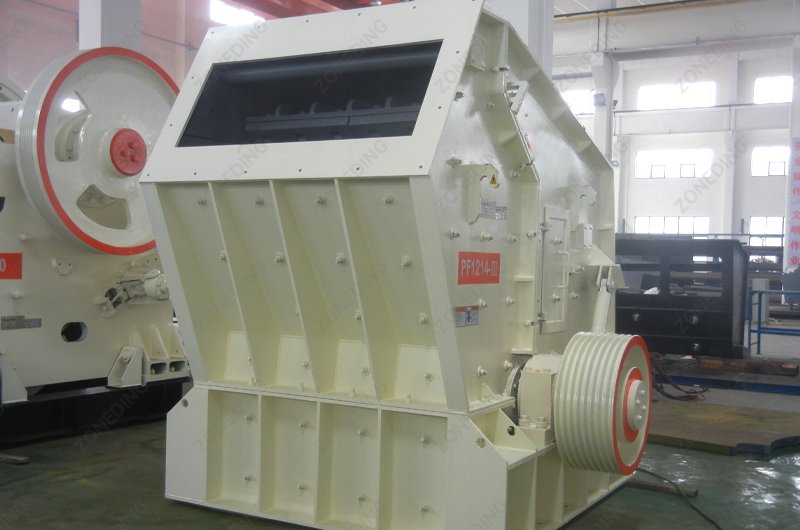
Impact Crusher
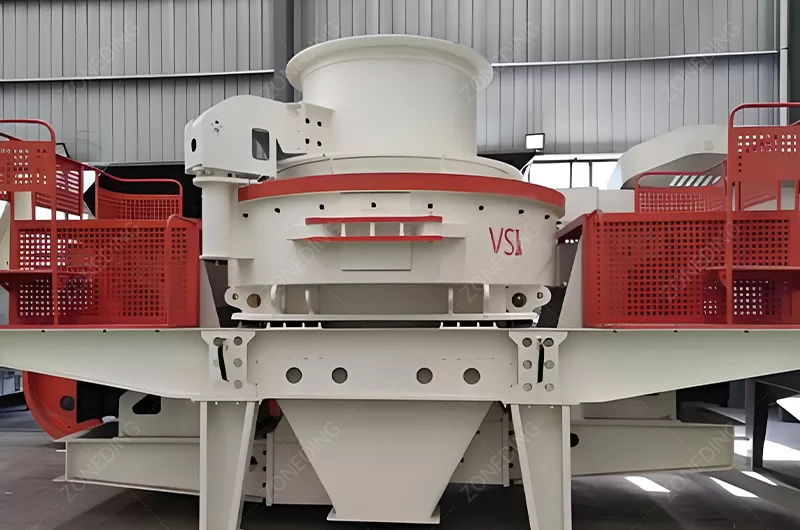
VSI crusher
Crusher type
Main crushing action
Typical role
Fines consideration
Jaw crusher
Compression
Primary crushing
Excessive reduction or repeated crushing can increase fines
Higher rotor speed and tighter curtain gaps can generate more fines
VSI crusher
Rock-on-rock or rock-on-anvil impact
Tertiary shaping and sand production
Often increases the fine fraction when used for shaping or manufactured sand production
The reduction ratio is the relationship between the feed size and the discharge size. Asking one crusher to perform too much size reduction in a single stage increases the probability of overcrushing.
A plant that needs both coarse aggregate and fine sand may benefit from separate crushing stages. The secondary crusher can produce the required aggregate sizes, while a controlled portion of the material enters the tertiary or sand-making stage.
This arrangement provides more control than forcing all material through one aggressive crusher setting.
Crusher type must also match the rock. A cone crusher is generally better suited to hard, abrasive aggregate. An impact crusher can provide excellent particle shape in softer or less abrasive rock, but its operating settings must be controlled when excessive fines are a concern.
How to Reduce Fines in a Cone Crusher Circuit
Do not immediately widen or tighten the closed-side setting without checking the complete circuit.
Several cone crusher conditions can increase fines.
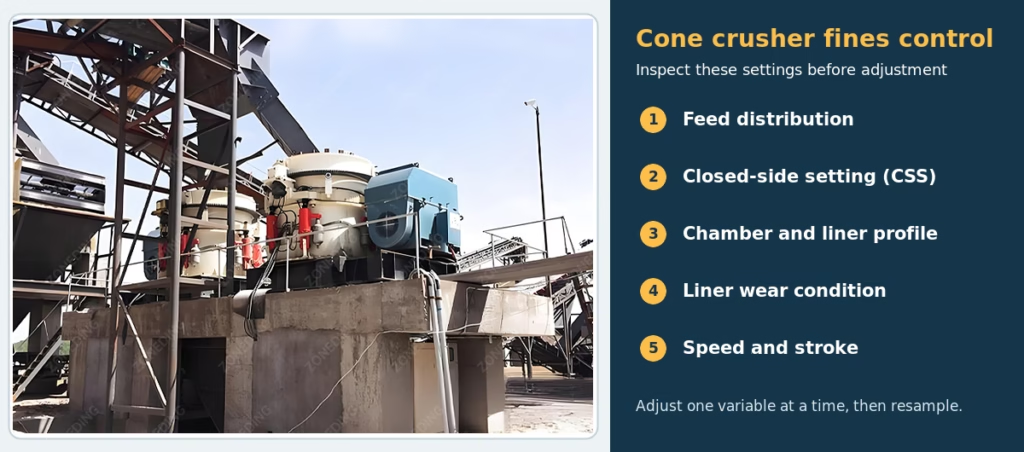
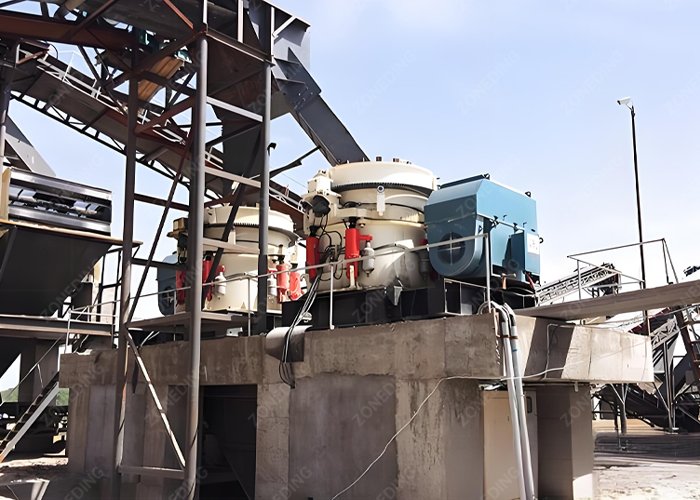
CSS, chamber profile, liner wear, speed, and feed distribution influence cone crusher product gradation
Closed-Side Setting
A tighter CSS normally produces a smaller product. However, setting the crusher too tight may create unnecessary reduction and increase the fine fraction.
Measure the actual setting instead of relying only on the control display. Mechanical wear, hydraulic conditions, and calibration errors can cause the real setting to differ from the displayed value.
CSS should be selected together with the screen apertures and required product sizes. The crusher and screen must operate as one circuit.
Crushing Chamber and Liner Profile
The chamber must match the feed size, target product, and operating stage.
A chamber selected for aggressive reduction may not be suitable when the main objective is to protect coarse aggregate yield. Worn liners also change the chamber geometry. This may shift the product gradation even when the nominal CSS remains unchanged.
Monitor:
Liner wear pattern
Crusher power draw
Throughput
Product gradation
Hydraulic pressure
Frequency of setting adjustment
Replace or rotate wear parts according to the machine design and measured wear condition.
Feed Distribution
Cone crushers require stable and evenly distributed feed.
Off-center or intermittent feeding leaves some areas of the chamber underloaded while other areas experience excessive crushing. Use suitable feed conveyors, bins, and distribution devices to keep the chamber properly loaded.
Choke feeding can improve chamber utilization and particle shape when it is appropriate for the crusher model and application. However, choke feeding does not mean overloading the crusher with wet fines or unsuitable material.
Speed and Stroke
Higher operating speed can shift the product toward a finer gradation. Stroke also changes the crushing action, capacity, and product curve.
These parameters should remain within the manufacturer’s specified operating range. Make one controlled adjustment at a time and then repeat the gradation test.
How to Reduce Fines from an Impact Crusher
An impact crusher breaks material through repeated high-speed collisions. This produces a cubical product, but unsuitable settings can create more fines than the market requires.
Check the following areas.
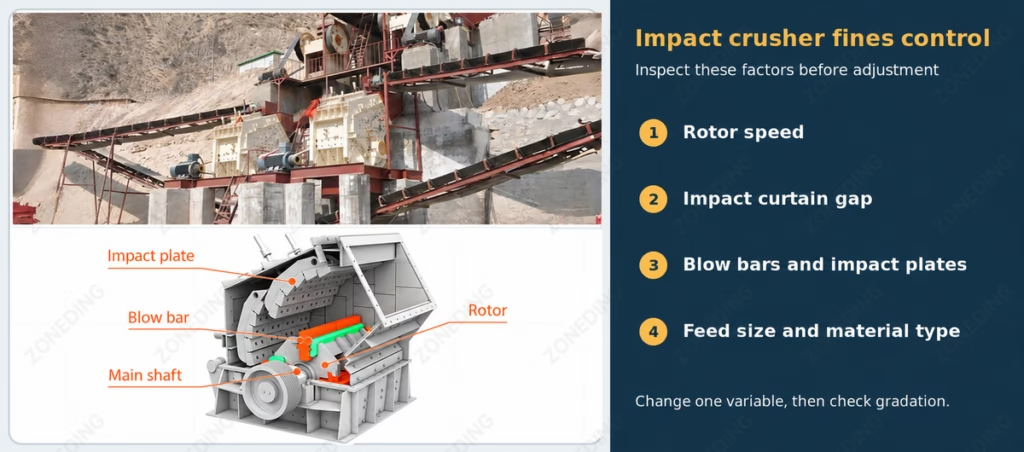
Rotor speed, curtain gap, wear condition, and feed grading influence impact crusher fines production
Rotor Speed
Increasing rotor speed raises impact intensity and may shift more material into smaller size fractions.
If the plant is producing excessive fines, review whether the rotor is operating faster than required for the target product.
Impact Curtain Gap
A small gap between the blow bars and impact curtains increases reduction. When the gap is unnecessarily tight, already reduced particles may experience additional impacts before leaving the chamber.
Set the gap according to the required top size and actual feed condition.
Blow Bars and Impact Plates
Unevenly worn blow bars can change the impact pattern. Worn curtains may also reduce control over product size.
Inspect wear profiles rather than judging parts only by total operating hours. Rock abrasiveness, feed size, tramp metal, and operating speed all affect wear.
Feed Size and Material Type
A high proportion of small feed entering the impact crusher may receive more impacts than necessary. Pre-screening can remove material that already meets the required size.
Rock properties must also be considered. A friable limestone behaves differently from hard granite. If a hard, abrasive material requires low fines and predictable wear costs, a compression crusher may be more suitable.
How Screening and Recirculation Cause Overcrushing
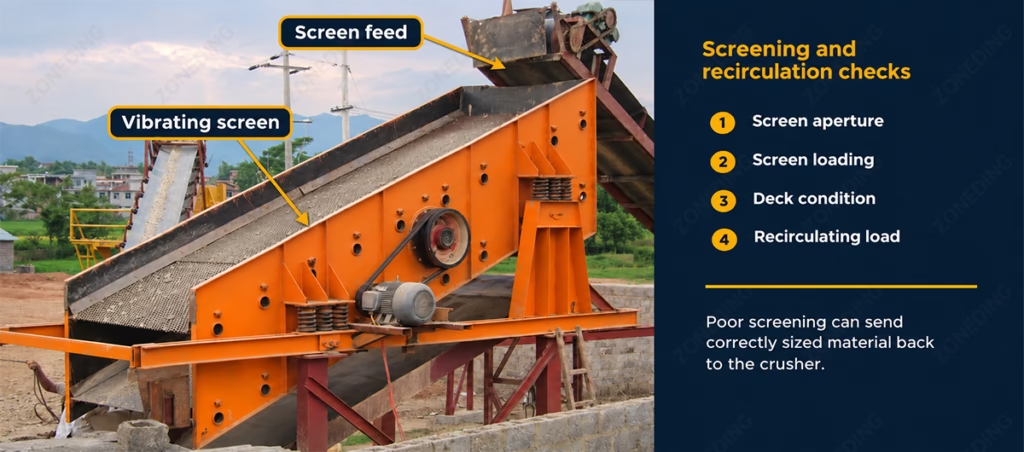
A crusher may appear to produce excessive fines even when the main problem is the vibrating screen.
In a closed circuit, the screen determines which particles leave as finished product and which particles return to the crusher. If the screen sends product-sized material back into the circuit, that material is crushed again.
Inefficient screening can return product-sized particles for repeated crushing and increase fines
Common screening problems include:
Incorrect aperture size
Worn or damaged screen media
Pegging
Blinding caused by wet fines or clay
Excessive bed depth
Uneven feed distribution
Insufficient screening area
Incorrect stroke, speed, or inclination
Overloaded screen decks
Repeated crushing creates a self-reinforcing problem. Poor separation increases the return load. The higher return load raises the crusher burden and generates more small material. That additional fine material then makes screening more difficult.
Measure the mass flow and gradation of the return conveyor. Do not judge recirculating load only by the visible quantity of material.
If the return stream contains a high percentage of particles that should have passed through the screen, correct the screening problem before making aggressive crusher adjustments.
Use a controlled diagnostic sequence instead of changing several machine settings at once.
Confirm the Product Specification
Identify the exact sieve size and percentage that is outside the required range. Check whether the issue affects one product or every product from the screen.
Sample the Raw Feed
Measure how much fine material already enters the plant. Record moisture, clay content, rock condition, and feed size.
Sample Each Crusher Discharge
Compare the particle-size distribution before and after each crushing stage. This identifies the stage where the fine fraction increases most sharply.
Inspect the Crusher
Check:
Actual CSS or discharge gap
Chamber or curtain configuration
Liner, blow bar, and impact plate wear
Feed distribution
Operating speed
Power draw
Throughput stability
Inspect the Screen
Look for blocked apertures, damaged media, excessive bed depth, uneven loading, and product carryover.
Measure the Recirculating Load
Sample the return conveyor and determine whether product-sized particles are returning to the crusher.
Make One Adjustment
Change one major parameter at a time. For example, adjust CSS before changing speed, or repair the screen before changing the crushing chamber.
Repeat the Test
Collect new samples under stable conditions. Compare throughput, product gradation, power consumption, and return load with the previous baseline.
ZONEDING supplies individual crushing equipment and complete crushing circuits. However, the final configuration should always be based on feed properties, required product sizes, capacity, and measured plant data.
Frequently Asked Questions
What percentage of fines is acceptable in aggregate production?
There is no universal acceptable percentage. The limit depends on the product specification, application, local standard, and customer requirement. Judge fines against the specified sieve limits rather than a general industry percentage.
Does a tighter cone crusher CSS always produce more fines?
A tighter CSS normally shifts the product toward smaller sizes, but the final result also depends on feed gradation, chamber profile, liner condition, speed, stroke, and screening efficiency. Measure the complete product curve after adjustment.
Can pre-screening reduce excessive crusher fines?
Yes. When the raw feed contains material already smaller than the required crusher setting, pre-screening can bypass that material and prevent unnecessary crushing. Its effectiveness depends on moisture, clay, feed gradation, and screen performance.
Why does fines production increase as crusher liners wear?
Liner wear changes the crushing chamber geometry and the way material moves through the crusher. This can alter reduction, capacity, pressure, and product gradation even when the displayed crusher setting remains unchanged.
Should I replace an impact crusher with a cone crusher to reduce fines?
Not automatically. The decision depends on rock hardness, abrasiveness, required shape, target gradation, capacity, and wear cost. First optimize the existing feed, settings, wear parts, screening, and recirculating load. Then compare alternative crusher types using actual plant data.
Excessive fines should be treated as a circuit problem rather than a single-machine problem. Start with representative sampling, identify where the particle-size curve changes, and correct the relevant stage.
If you provide the raw feed gradation, required product sizes, rock type, capacity, current crusher settings, and screen configuration, ZONEDING can evaluate the complete circuit and recommend a suitable crushing and screening arrangement.
Operating heavy mining equipment requires a deep understanding of internal mechanics. Many expensive machine failures happen because operators misunderstand basic operational rules. Good equipment can break quickly when handled poorly. This compre...
Designing a profitable high-purity quartz sand production line requires strict adherence to physical and chemical principles. Quartz ore processing follows a strict sequence. Operators must crush, grind, classify, and purify the raw rock in order....
Many investors consider alluvial operations simple dirt-washing tasks. However, commercial-grade operations face severe technical challenges daily. A successful demands precise engineering to match the physical ore characteristics. This guide reve...
We use cookies to ensure that we give you the best experience on our website. If you continue to use this site we will assume that you are happy with it.
Privacy Policy
Send us a message
We would love to hear from you
Submit your question and our team will respond to the email provided as soon as possible.
 Zoneding Machine