Recirculating load is necessary in many closed crushing circuits because screen oversize must return for another pass. The problem begins when too much material returns or when correctly sized particles enter the oversize stream.
High internal load can consume capacity, accelerate wear and destabilize the plant. Simply tightening the crusher setting may create excess fines without solving the restriction. The crusher, screen, conveyors and required product gradation must therefore be evaluated as one circuit.
What Does Recirculating Load Mean in a Crushing Circuit?
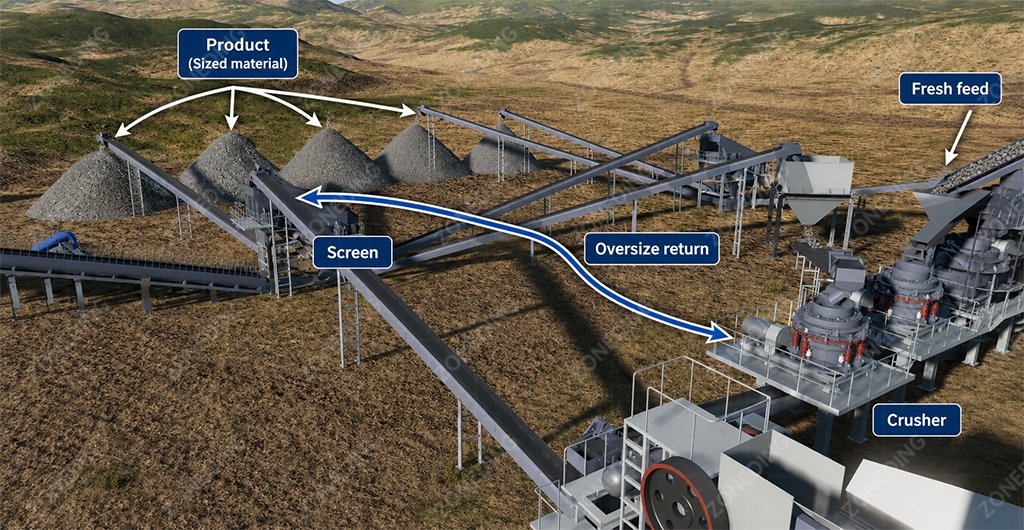
In a basic closed circuit, fresh feed enters the crusher and then travels to a screen. Material passing through the selected screen apertures becomes one or more finished products. Oversize material returns to the crusher for another pass.
This return stream is the recirculating load. It is not automatically evidence of poor performance. Returning genuine oversize allows a closed circuit to produce a more controlled product than an open circuit.
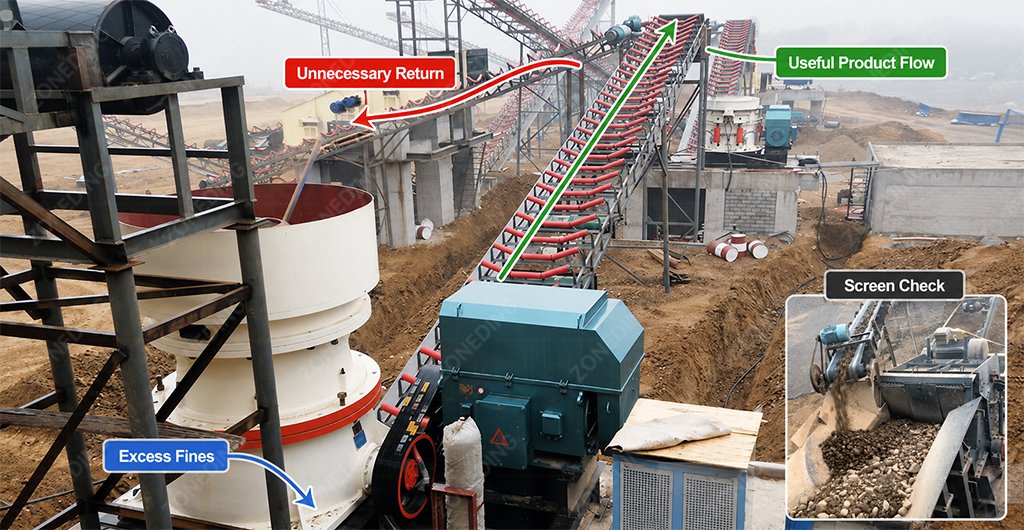
Closed circuit material flow from crusher to screen and back through the return conveyor
The operational problem is unnecessary recirculation. Product-size particles carried into the screen oversize return through the crusher, occupying capacity but providing little useful reduction.
Operators can compare return-stream tonnage with fresh-feed tonnage, but the resulting percentage is not a universal target. Acceptable internal load depends on feed, crusher product, screen aperture, required products and connected equipment capacity.
For an overview of how these machines work together, see the rock crushing guide.
Why Does Recirculating Load Become Too High?
High return tonnage has several possible causes. The crusher may produce a coarse discharge because of its setting, liners, chamber or feed distribution. Alternatively, the crusher product may be acceptable while the screen fails to remove qualified material.
Changes in feed size, hardness, moisture, clay or fines can also affect crushing and screening. Excess fresh feed may increase screen bed depth, reduce separation efficiency and create more return.
Possible cause
What to inspect
Evidence to look for
Crusher discharge is too coarse
CSS, chamber, liners and feed distribution
Excess true oversize in crusher discharge
Screen separation is inefficient
Media, aperture condition, loading and distribution
Product-size particles in screen oversize
Feed has changed
Feed PSD, moisture, clay and hardness
Performance changed without a planned setting change
Circuit capacity is unbalanced
Crusher, screen, conveyor and transfer-point loading
One component remains overloaded while others have spare capacity
Operation is unstable
Feeder output, crusher power and surge patterns
Return tonnage fluctuates with uneven feed
The most useful first question is therefore: Is the crusher creating too much oversize, or is the screen failing to remove correctly sized material? These conditions require different corrective actions.
How Does Screen Efficiency Affect Oversize Return?
The screen is the main classification point in a closed crushing circuit. A correctly selected and operated vibrating screen should give product-size particles enough opportunity to pass while carrying true oversize to the return conveyor.
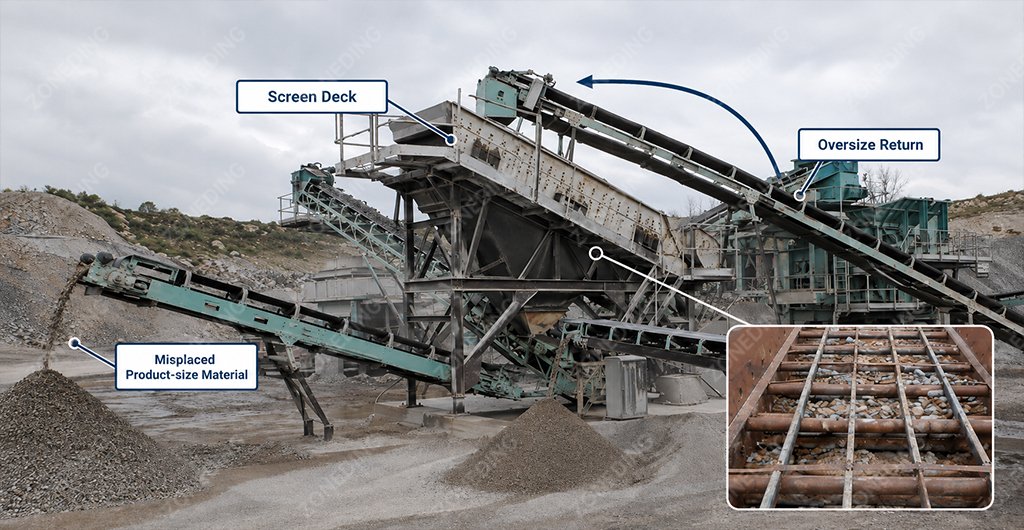
Screen deck showing blinding pegging and misplaced product-size particles
Excessive bed depth, uneven distribution, damaged media, unsuitable apertures, blinding, pegging or unstable feed can reduce efficiency. Wet fines may cover open area, while near-size particles can block apertures. Material that should pass then remains in the oversize stream.
Do not diagnose the screen by looking only at the return conveyor. Sample the screen feed, undersize and oversize where practical. If the return stream contains a significant amount of material already below the required cut size, improving separation may reduce internal load without forcing the crusher to make a finer product.
Possible improvements include distributing feed across the screen width, controlling surges, restoring damaged media, selecting suitable media or adding screening area where justified. Change angle, stroke or speed only within manufacturer limits and after confirming the separation problem.
How Do Crusher Settings and Chamber Conditions Change the Return Load?
Once screening performance has been checked, inspect the crusher. This is particularly important in secondary and tertiary circuits using a cone crusher.
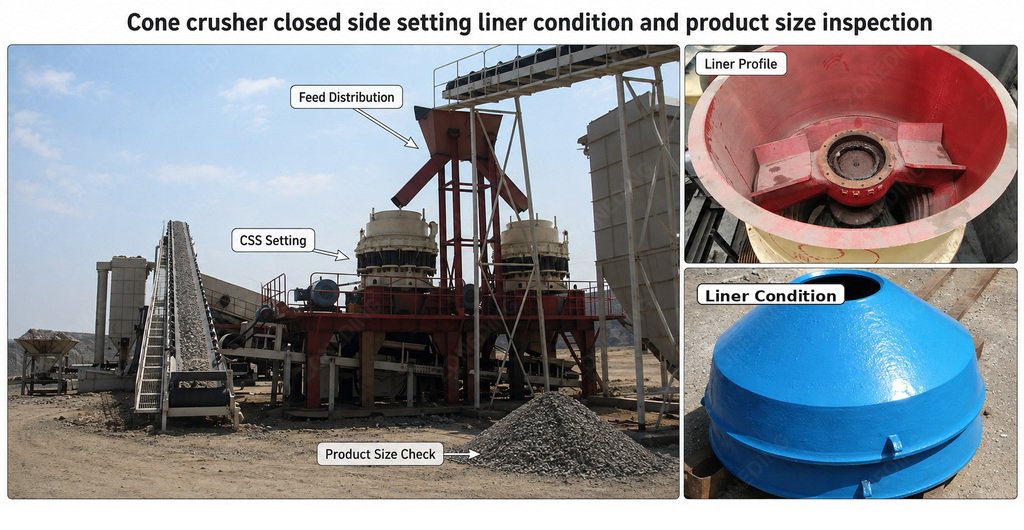
Cone crusher closed side setting liner condition and product size inspection
Closed side setting. A wider CSS generally produces a coarser discharge. Tightening it can reduce oversize, but an unsuitable CSS may increase power, wear and fines or reduce throughput.
Liner and chamber condition. Product distribution changes as liners wear. Compare actual discharge PSD, wear pattern, power and throughput with the operating baseline rather than relying only on the displayed setting.
Feed distribution. Cone crushers require stable and well-distributed feed suited to the chamber. Segregated, off-centre or intermittent feed reduces effective chamber utilization and makes both crusher discharge and return flow unstable.
Excess fines. Material already meeting the target size should be removed before crushing where the flowsheet allows it. Fine material can occupy chamber capacity without delivering useful reduction.
When checking whether the crusher is the bottleneck, compare actual duty with the ranges discussed in the cone crusher capacity guide, but treat published capacity as a reference rather than a guaranteed site result.
When Should You Change the Crushing and Screening Circuit?
Sometimes the crusher and screen are individually serviceable, but the flowsheet asks them to perform an unbalanced duty. A larger crusher will not increase finished output if the screen or return conveyor is already the restriction.
Compare the capacities of the crusher, screen, transfer points and conveyors at the same duty. Screen overloading may require better distribution, more effective area, different media or earlier fines removal. An overloaded return conveyor can cause accumulation, spillage and feed surges.
Another crushing stage may help when one machine must achieve excessive reduction. Redistributing duty can reduce repeated passes, but adds cost, maintenance and transfer points. Base the decision on complete flowsheet performance, as outlined in the crushing production line equipment configuration guide.
Capacity planning should also include the required number of saleable fractions and realistic screen duty. The 100–200 TPH aggregate crushing plant cost guide illustrates why equipment size, conveyors, screening and civil work must be evaluated as a system rather than as isolated purchases.
How Can You Reduce Return Load Without Creating Too Many Fines?
Reducing CSS may lighten the return conveyor, but it is useful only if saleable output improves. Excessive fine crushing can raise wear and power, reduce desired coarse fractions and overload downstream fines handling.
Protect product gradation first. Crusher settings and screen apertures must work together, particularly when the plant sells several fractions. See controlling aggregate shape and gradation for equipment and product-quality considerations.
Reduce return load without excess fines
Prioritize measures that remove qualified material as early as practical:
Prescreen natural fines before the closed crushing stage where justified.
Improve screen feed distribution and effective open area.
Prevent product-size particles from entering the return stream.
Stabilize fresh feed instead of operating through repeated surges.
Match CSS to the feed, chamber, screen aperture and required gradation.
Confirm that product and return conveyors can handle the resulting flow.
Evaluate each adjustment using final product tonnes per hour, product PSD, return tonnage, crusher power, wear and operating stability. A lower return percentage is not an improvement if saleable production falls or excess fines increase.
How Do You Diagnose and Optimize the Complete Closed Circuit?
Establish a stable baseline before changing major settings. Record fresh-feed rate and PSD, crusher discharge PSD, screen feed and oversize PSD, product PSD, return tonnage, CSS, power draw, liner condition, screen condition, moisture and visible feed-distribution problems.
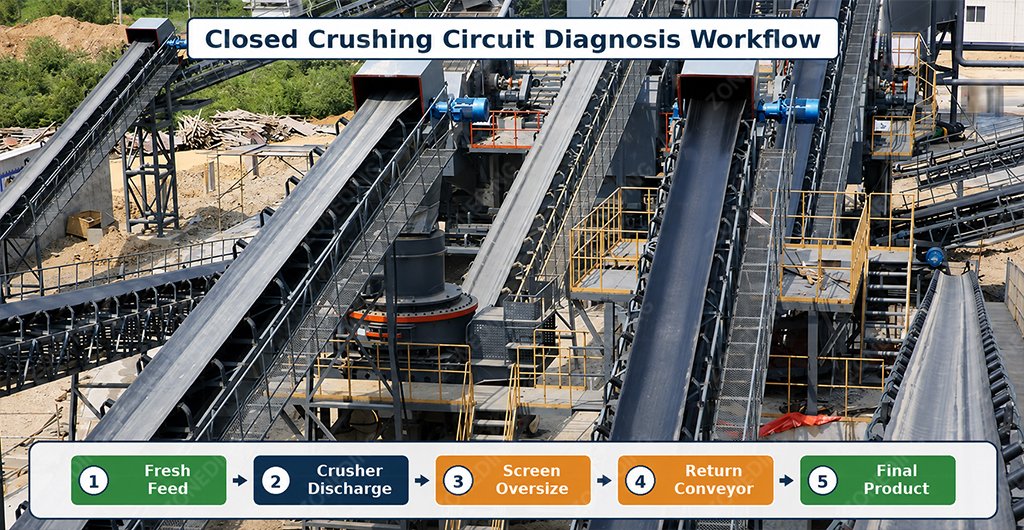
Step-by-step closed crushing circuit diagnosis and optimization workflow
Then work through the circuit in a fixed sequence:
Confirm fresh feed. Separate genuine production from high internal movement.
Measure and sample the return stream. Determine whether it consists mainly of true oversize or contains misplaced product-size material.
Sample crusher discharge. If it is too coarse, investigate CSS, chamber selection, liner wear, feed size and distribution.
Check screen performance. Inspect media, open area, loading, blinding, pegging and feed distribution.
Stabilize feed. Reduce large variations so that comparisons are meaningful.
Compare connected capacities. Locate the actual restriction across the crusher, screen, conveyors and transfer points.
Change one major variable at a time. Record the effect before making another adjustment.
Verify the final result. Confirm saleable throughput, gradation, power, wear and stability—not return tonnage alone.
Automation can monitor feed, power, belt loading and particle-size trends, but does not replace sampling. Keep control changes within equipment limits and verify them against product data. A stationary crushing plant redesign should include screening, conveying and return capacity as well as crusher selection.
Frequently Asked Questions
What is a normal recirculating load in a crushing plant?
There is no universal ideal percentage. A workable return load depends on feed PSD, crusher product, screen aperture and efficiency, required product gradation, material characteristics and the capacities of all connected equipment.
Does high circulating load mean the crusher is too small?
Not necessarily. A small or overloaded crusher can contribute, but poor screening, worn liners, changing feed conditions or an undersized return conveyor can produce the same symptom. Sample the crusher discharge and screen oversize before identifying the bottleneck.
Can poor screening increase crusher circulating load?
Yes. Product-size particles that fail to pass the screen return with the oversize and consume crusher and conveyor capacity even though they may not need further reduction.
Will reducing CSS always lower recirculating load?
No. A tighter CSS may reduce true oversize, but it can also increase fines, wear and power demand or reduce crusher throughput. It should be evaluated together with the chamber, screen and product specification.
How can I tell whether the crusher or screen is the bottleneck?
Compare crusher discharge PSD with screen oversize PSD. Excess true oversize points toward crushing or feed conditions. A large amount of correctly sized material in the oversize points toward screening. Then compare actual loading across all equipment.
Key Takeaways
Recirculating load is a normal part of closed-circuit crushing.
The objective is to eliminate unnecessary return, not all return material.
Sample crusher discharge and screen oversize before changing settings.
Screen inefficiency can return already-qualified material to the crusher.
CSS, chamber condition, liner wear and feed distribution affect true oversize generation.
Judge changes by stable saleable throughput, gradation, power, wear and fines.
Evaluate the crusher, screen, conveyors and transfer points as one circuit.
About ZONEDING
ZONEDING designs and supplies crushing, screening and conveying equipment for quarry, mining and aggregate projects. For circuit evaluation, provide the material, feed and product PSDs, required capacity, crusher settings, screen configuration, return tonnage and operating limitations. These details help locate crushing, screening, feed or capacity problems.
Proper crushing production line equipment configuration determines the final aggregate quality and daily operational cost. Correct aggregate equipment selection prevents material blockages and reduces wear part consumption. A scientific crushing s...
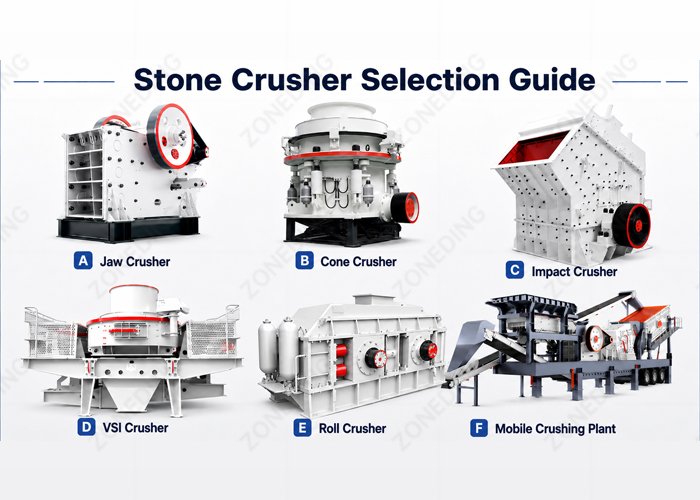
Choosing the right stone crusher is one of the most important decisions in aggregate production and quarry operations. The wrong machine can increase wear cost, reduce production efficiency, and create long-term maintenance problems. Meanwhile, th...
Building a highly profitable mineral processing facility requires a strictly logical equipment sequence. A complete copper-gold ore processing line must follow a precise physical and chemical path. The rock must be crushed, ground, classified, and...
We use cookies to ensure that we give you the best experience on our website. If you continue to use this site we will assume that you are happy with it.
Privacy Policy
Send us a message
We would love to hear from you
Submit your question and our team will respond to the email provided as soon as possible.
 Zoneding Machine