Overflow and grate ball mills use the same basic grinding principle, but they discharge ground material differently. This difference affects slurry level, material transport, residence time, throughput, power draw, and how the mill works with the rest of the grinding circuit.
A common rule says that overflow mills are for fine grinding, while grate mills are for coarser grinding and higher capacity. This is useful as a starting point, but it is too simple for final equipment selection.
Actual performance also depends on ore hardness, feed F80, target P80, mill operating conditions, circulating load, classification efficiency, and downstream processing.
The better question is therefore not simply:
Which ball mill produces a finer product?
Instead, ask:
Which discharge design can achieve the required P80 and throughput with stable operation, acceptable energy use, and practical maintenance?
What Is the Main Difference Between an Overflow and Grate Ball Mill?
The main difference is the discharge mechanism.
Both ball mills use a rotating cylindrical shell and grinding media to reduce ore through impact and abrasion. What changes is how ground slurry leaves the mill.
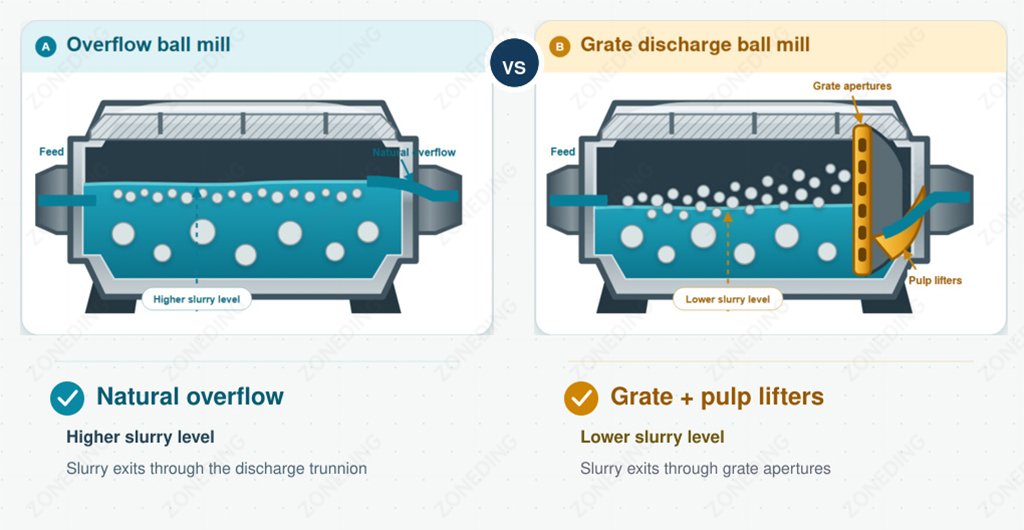
Overflow and grate ball mill discharge design comparison
In an overflow ball mill, material remains inside until the slurry level is high enough to flow naturally through the discharge trunnion.
This design has a relatively simple discharge structure and generally operates with a higher internal slurry level.
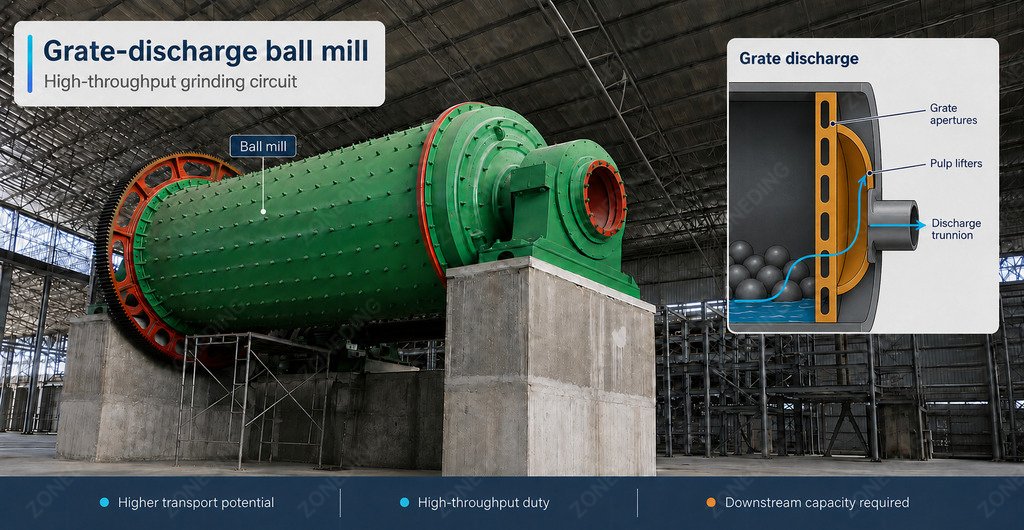
A grate ball mill has a grate assembly at the discharge end. Ground slurry passes through openings in the grate, while pulp lifters help move it toward the outlet.
This arrangement generally allows faster material transport and lower slurry hold-up.
Feature
Overflow Ball Mill
Grate Ball Mill
Discharge mechanism
Natural overflow
Grate + pulp lifter
Internal slurry level
Generally higher
Generally lower
Material discharge
Slower tendency
Faster tendency
Discharge structure
Simpler
More complex
Additional wear parts
Fewer
Grates and pulp lifters
The grinding principle is therefore similar. The main engineering difference is how material leaves the grinding chamber.
How Does the Discharge Method Affect Grinding Performance?
Grinding performance depends not only on particle breakage but also on how efficiently ground material moves through the mill.
If particles that already meet the required size remain in the grinding chamber too long, they continue interacting with grinding media. This may consume additional energy and generate unnecessary fines.
Overflow mills generally have a higher slurry level and a longer material-retention tendency because discharge depends on natural overflow.
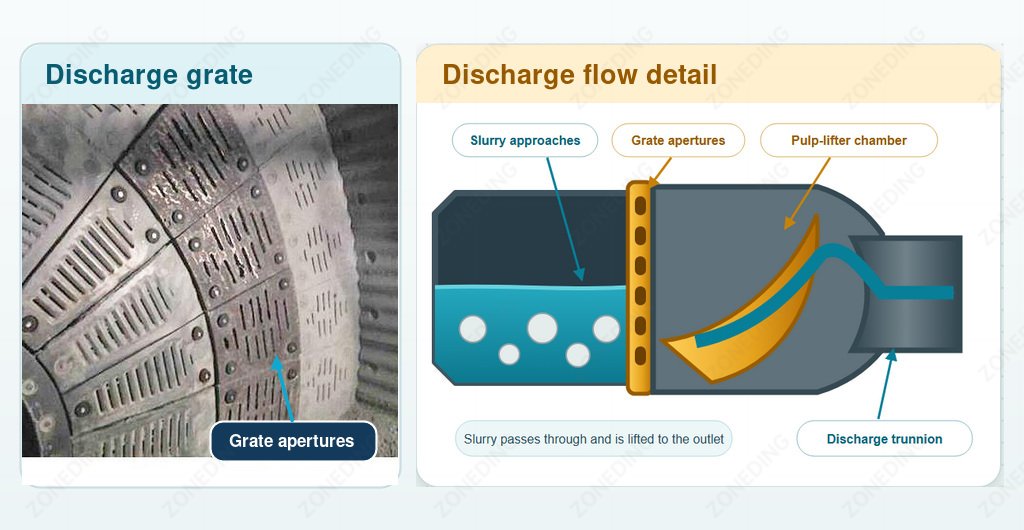
Grate mills provide another path. Slurry passes through grate openings and is transported by pulp lifters, which can reduce excessive slurry hold-up and accelerate material discharge.
Grate ball mill discharge grate and pulp-lifter system
This affects three important operating factors:
Residence time: Material retained longer has more opportunity for grinding, but excessive retention can contribute to overgrinding.
Material transport: Faster discharge can help move qualified material out of the mill instead of repeatedly exposing it to grinding media.
Circuit load: Faster mill discharge also means the sump, pump, and classifier must be capable of handling the resulting flow.
should be treated as a general tendency rather than a fixed engineering law.
Final grinding performance depends on the complete circuit.
Overflow vs Grate Ball Mill: How Do Their Performance Characteristics Compare?
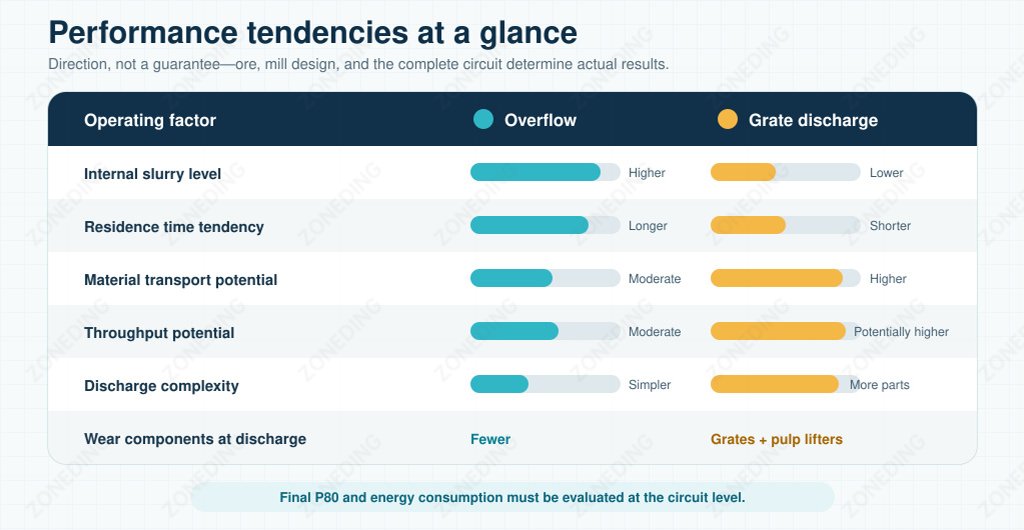
The main operating tendencies can be summarized as follows:
Overflow and grate-discharge ball mill performance tendencies
Factor
Overflow Ball Mill
Grate Ball Mill
Discharge method
Natural overflow
Grate + pulp lifter
Slurry level
Generally higher
Generally lower
Residence time
Longer tendency
Shorter tendency
Discharge rate
Generally lower
Generally higher
Throughput potential
Moderate
Often higher
Slurry hold-up
Higher tendency
Lower tendency
Overgrinding tendency
Can be higher
Can be reduced
Discharge structure
Simpler
More complex
Discharge wear parts
Fewer
Grates and pulp lifters
Maintenance
Generally simpler
More components to inspect
Blockage concern
No grate openings
Grates require attention
The words generally, often, and tendency matter.
Actual performance depends on mill size, ore properties, operating conditions, grate and pulp-lifter design, circulating load, available power, and classification performance.
Therefore, a grate ball mill should not automatically be described as producing a coarser product, nor should an overflow mill automatically be considered the better fine-grinding machine for every application.
Which Ball Mill Is Better for Throughput, Product Size, and Energy Use?
These are usually the three most important performance questions for a buyer.
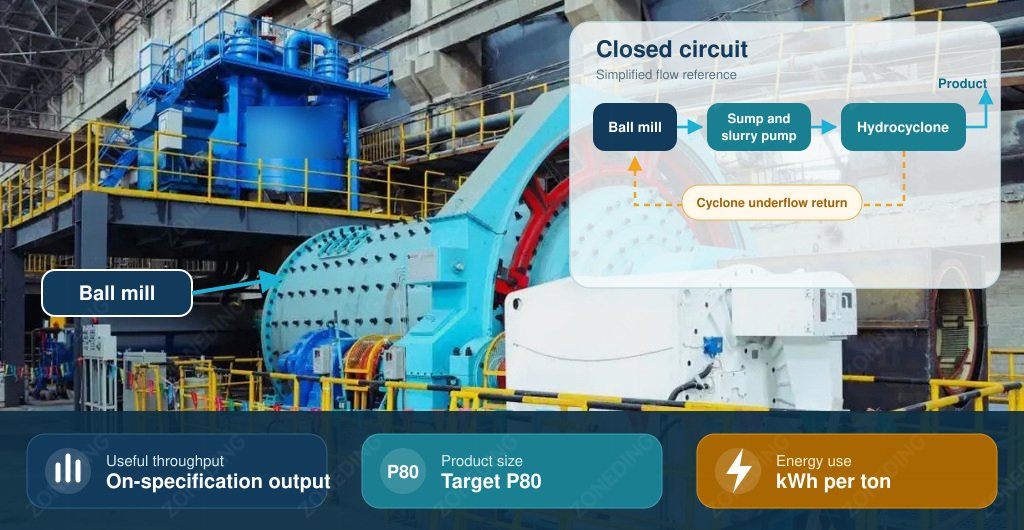
Closed ball mill circuit for throughput product size and energy optimization
Throughput
Grate discharge generally provides higher material-transport potential because slurry can leave through the grate and pulp-lifter system instead of waiting for natural overflow.
This can be valuable when mill discharge behavior limits production.
However, increasing discharge rate only helps if the rest of the circuit can handle it.
The following may become bottlenecks:
Motor power
Sump capacity
Slurry pump
Hydrocyclone or classifier
Downstream beneficiation equipment
A grate mill therefore has higher throughput potential, not guaranteed higher plant production.
When sizing a new grinding circuit, capacity should be evaluated together with feed size, ore characteristics and target product size rather than from mill dimensions alone. Our ball mill capacity guide explains these relationships in more detail.
Product size
Overflow mills are often associated with finer grinding, while grate mills are frequently used where faster discharge is required.
But discharge type alone does not determine final P80.
Product size also depends on:
Feed F80
Ore hardness
Target liberation size
Grinding media and operating conditions
Residence time
Classification efficiency
Circulating load
In a closed grinding circuit, classification equipment determines which particles leave the circuit and which return for additional grinding. The crushing and grinding equipment selection guide explains how hydrocyclones and spiral classifiers fit into closed grinding circuits.
Therefore:
Discharge type influences grinding behavior, but it does not independently determine final circuit P80.
Energy use
Energy should be evaluated at circuit level rather than from mill power alone.
A grate discharge may allow greater effective power draw and higher throughput under suitable conditions. This does not automatically mean poorer energy efficiency.
Likewise, lower power draw does not automatically make an overflow mill more economical if excessive residence time causes unnecessary regrinding.
A more useful operating metric is:
Energy consumed per ton of acceptable grinding product
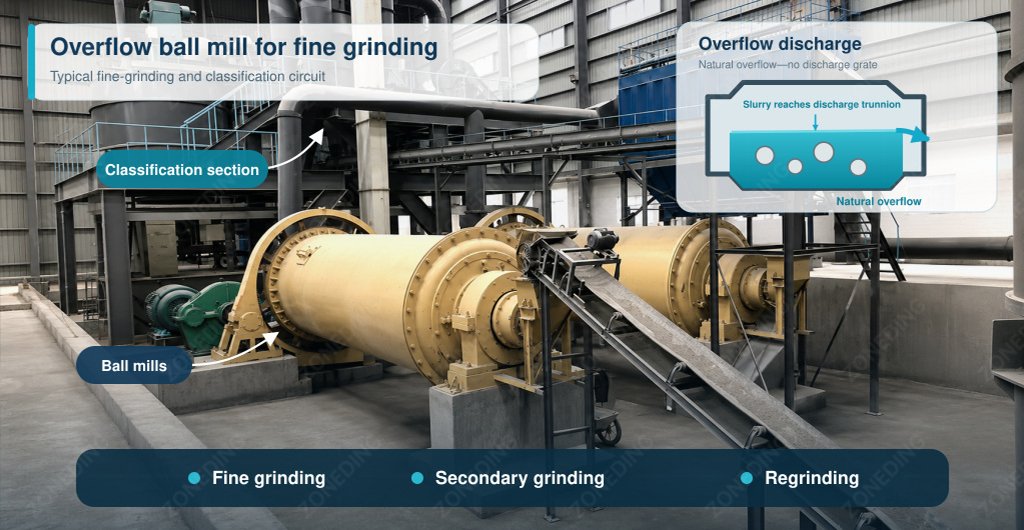
An overflow ball mill deserves consideration when the grinding duty favors a simpler discharge system and the required production rate can be achieved without a grate and pulp-lifter arrangement.
Overflow ball mill in a fine-grinding and classification circuit
Typical applications include:
Fine grinding duties
Secondary grinding
Regrinding
Circuits requiring a controlled fine product
Projects prioritizing simpler discharge construction
Sites where maintenance simplicity is important
Applications where maximum discharge rate is not the main priority
One clear advantage is mechanical simplicity.
Without discharge grates and pulp lifters, there are fewer discharge components to inspect and replace. This can be useful for remote projects where maintenance access and spare-part availability matter.
However:
Fine product required ≠ Always choose overflow
Target P80 should come from mineral liberation and downstream processing requirements.
For example, in a flotation circuit, grinding should achieve sufficient mineral liberation without creating unnecessary slimes.
An overflow design is therefore most attractive when:
If material transport or slurry hold-up is limiting production, grate discharge may deserve stronger consideration.
When Should You Choose a Grate Ball Mill?
A grate ball mill is particularly attractive when material discharge and throughput potential are important.
Grate-discharge ball mill in a high-throughput grinding circuit
Typical conditions include:
Higher material transport is required
Throughput is a major priority
Primary grinding duty is involved
Excessive slurry hold-up is undesirable
Unnecessary residence time is a concern
Overgrinding or slime generation needs attention
Available mill power can support the duty
The downstream classification circuit can handle the discharge
Because material can pass through the grate instead of waiting for natural overflow, qualified particles may leave the grinding chamber sooner.
However, this benefit comes with additional components:
Discharge grates
Pulp lifters
Associated liners
Fasteners and wear components
These parts require inspection and eventual replacement. Grate openings can also require attention where unsuitable material or operating conditions interfere with discharge.
Liner condition also affects media lifting, impact behavior, wear and mill performance. For projects comparing internal configurations, see Ball Mill Liners.
For maintenance planning, ZONEDING also lists major ball mill spare parts and wear parts, including liners, shells, grinding media and trunnions.
Therefore:
Higher throughput potential does not automatically make a grate ball mill the better choice.
The sump, slurry pump, classifier, and downstream process must also be able to handle the resulting material flow.
Otherwise, increasing mill discharge simply moves the bottleneck elsewhere.
How Do You Choose the Right Ball Mill for Your Ore and Grinding Circuit?
Final selection should begin with process requirements rather than with the labels “overflow” or “grate”.
Use the following questions:
Selection Factor
Question to Answer
Ore properties
How hard, dense, and abrasive is the ore?
Feed F80
What particle size actually enters the mill?
Target P80
What size does downstream processing require?
Throughput
How many tons per hour must the circuit process?
Liberation
How fine must the ore be ground for effective separation?
Classification
Will the mill operate open circuit or with a classifier?
Energy
What power is available and what kWh/t is acceptable?
Maintenance
Can the site maintain grates and pulp lifters?
Bottleneck
Is mill discharge actually limiting plant production?
A simplified first-stage comparison is:
Project Requirement
Usually Favors
Simpler discharge structure
Overflow
Fine grinding duty
Often overflow
Secondary grinding or regrinding
Often overflow
Higher material discharge rate
Grate
Higher throughput potential
Often grate
Reduced slurry hold-up
Grate
Fewer discharge wear components
Overflow
Reduced unnecessary residence time
Often grate
Maintenance simplicity
Overflow
Strong material transport requirement
Grate
These tables are screening tools, not substitutes for process design.
Is a grate ball mill always more efficient than an overflow ball mill?
No. Grate discharge can improve material transport and may provide higher throughput potential, but overall efficiency depends on ore properties, target grind size, power use, classification, circulating load, and the complete grinding circuit.
Does an overflow ball mill always produce a finer product?
No. Overflow mills are commonly associated with fine grinding, but discharge type alone does not determine product size. Feed size, ore hardness, mill operation, classification, residence time, and circulating load also affect P80.
Why does a grate ball mill usually have a higher discharge rate?
Slurry can pass through grate openings and be transported toward the outlet by pulp lifters. This generally allows faster material movement than relying on natural overflow.
Can an overflow ball mill be converted to grate discharge?
Some mill designs may allow conversion, but it should not be treated as a simple liner change. The discharge system, pulp lifters, motor power, operating conditions, classification system, and downstream capacity should all be evaluated first.
Which ball mill is better for a flotation grinding circuit?
Either design can be suitable. The better choice is the mill that achieves the required liberation size and throughput while operating efficiently with the classification and flotation circuit. Target P80 should be defined before selecting the discharge type.
Key Takeaways
Overflow and grate ball mills use the same basic grinding principle but different discharge systems.
Overflow mills use natural discharge through the trunnion; grate mills use grates and pulp lifters.
Grate discharge generally provides faster material transport and lower slurry hold-up.
Overflow discharge offers a simpler structure with fewer discharge wear components.
Overflow mills are often used for fine grinding, while grate mills are often considered where throughput and material transport are priorities.
These are tendencies, not absolute rules.
Overflow does not automatically mean finer product, and grate does not automatically mean coarser product.
Final P80 depends on the complete grinding and classification circuit.
Energy performance should be evaluated using useful throughput and kWh/t rather than mill power alone.
Maintenance requirements and the actual plant bottleneck should be considered before final selection.
Need help selecting a ball mill?
ZONEDING supplies ball mills and mineral processing equipment for different ores, grinding duties, and beneficiation flowsheets.
For ball mill selection, useful project information includes:
Ore type and hardness
Feed F80
Required throughput
Target P80
Mineral liberation requirement
Wet or dry grinding requirement
Open or closed grinding circuit
Classification method
Downstream beneficiation process
Available power
Site and maintenance conditions
These inputs allow the mill discharge type, grinding duty, classification system, and downstream process to be evaluated together rather than selecting an overflow or grate ball mill from product fineness alone.
What is a concrete crusher and how to select the best model? This industrial manual covers technical parameters, types, and maintenance for recycling projects. Effective debris management requires precise machine choice to ensure high-quality aggr...
Understanding the main components of flotation machine is mandatory for maximizing profits in mineral processing plants. A flotation cell acts as a highly precise separation instrument. The internal mechanical structure dictates the exact slurry s...
Small aggregate plants are growing rapidly in 2026 because many investors want lower startup risk, faster ROI, and simpler operations. A well-designed small crushing plant can generate stable profits with relatively low investment if the equipment...
Many quarry operators spend months comparing crusher models, motor power, and production capacity. However, very few spend the same amount of time evaluating the jaw plates that actually perform the crushing. That oversight can become surprisingly...
We use cookies to ensure that we give you the best experience on our website. If you continue to use this site we will assume that you are happy with it.
Privacy Policy
Send us a message
We would love to hear from you
Submit your question and our team will respond to the email provided as soon as possible.
 Zoneding Machine