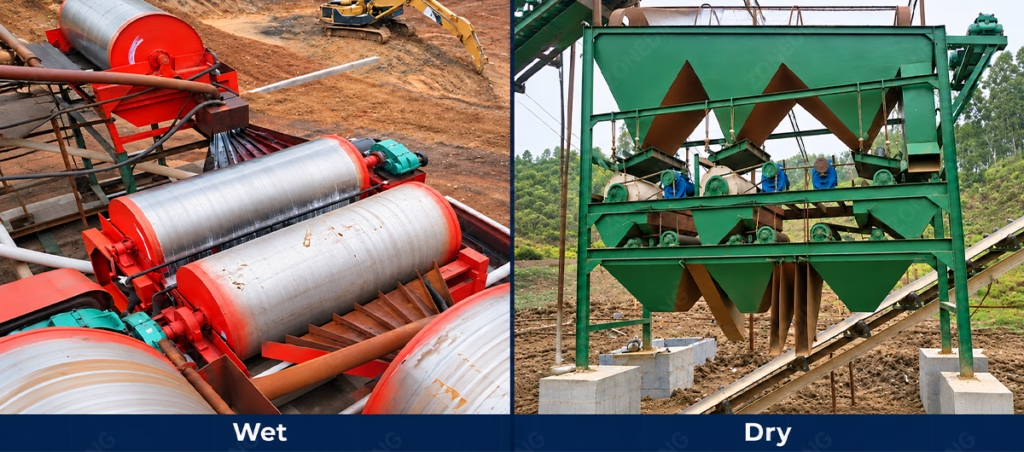
Choosing between wet and dry magnetic separation for iron ore starts with the minerals, their liberation, and the condition of the feed. Water availability matters, but it cannot establish whether either process will achieve the required separation.
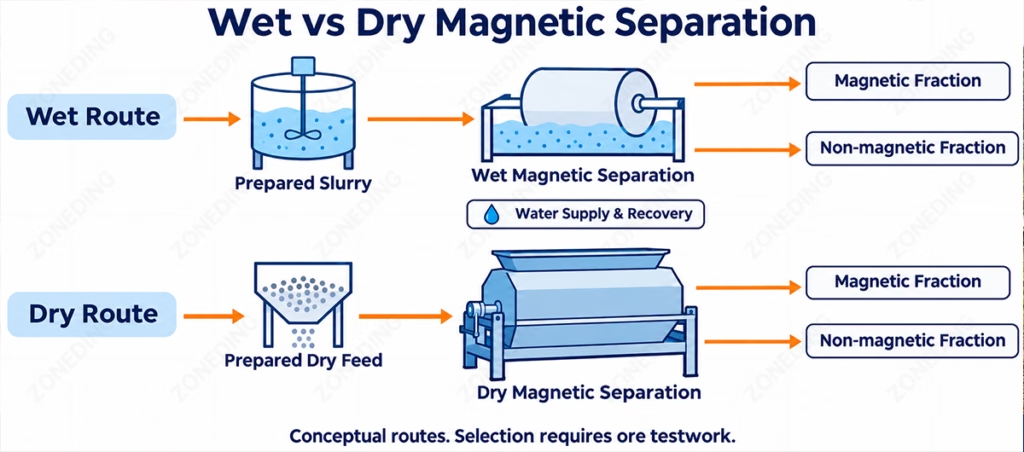
Dry separation treats material without adding process water at the separation stage. Wet separation treats a slurry. Both require equipment matched to the magnetic response and physical characteristics of the particles.
For a new plant, the decision is therefore broader than choosing a separator. Feed preparation, concentrate handling, tailings treatment, and the evidence from representative ore testing must be considered together.
What Is the Difference Between Wet and Dry Magnetic Separation?
The main difference is the medium through which particles move during separation. Dry equipment handles a prepared particulate feed, while wet equipment handles particles suspended in water.
That difference changes feed preparation and the supporting systems.
Match the separation route to the ore and process duty
Evaluation factor
Dry magnetic separation
Wet magnetic separation
Feed condition
Material prepared for controlled dry feeding
Slurry prepared for controlled flow and solids loading
Feed preparation
May require screening, moisture control, or drying
May require grinding, slurry preparation, or classification
Separation environment
Particle movement is affected by feed presentation, adhesion, and mechanical forces
Particle movement is affected by slurry flow, concentration, and hydraulic conditions
Supporting systems
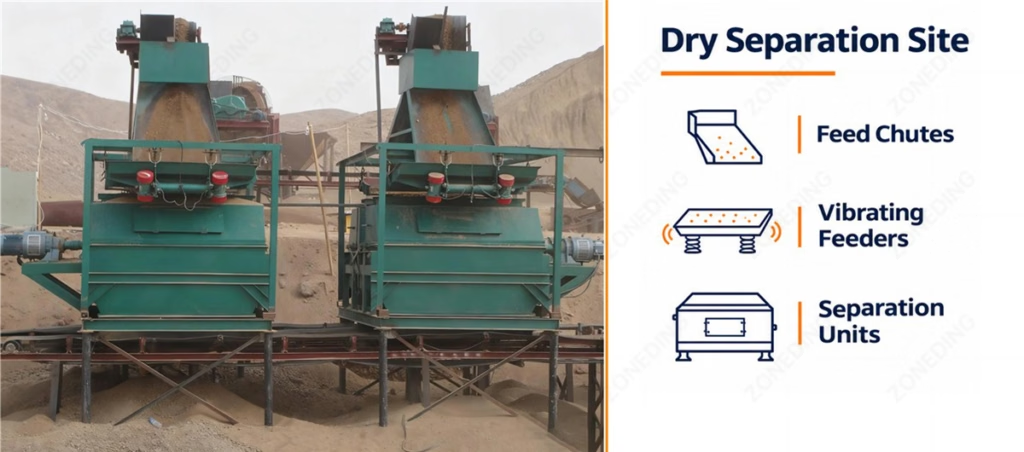
Feeders, transfer equipment, and dust control as required
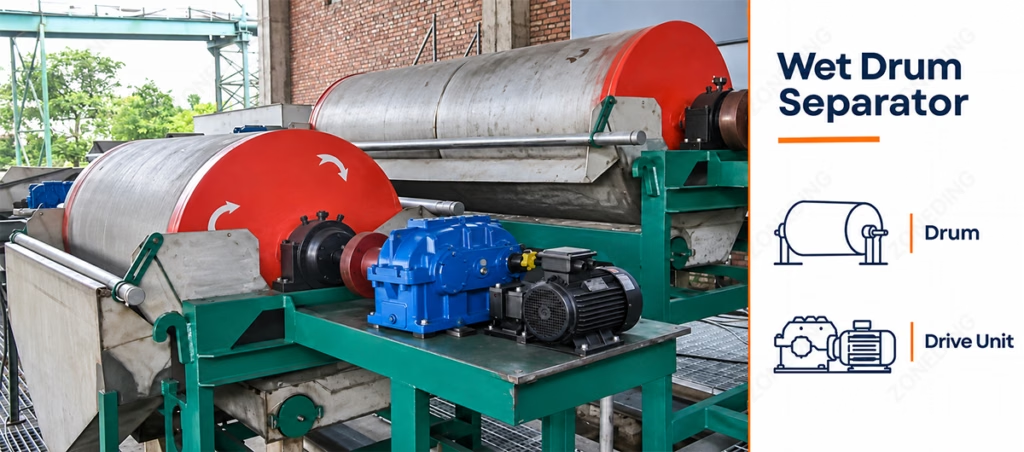
Pumps, sumps, water supply, and water recovery as required
Product handling
Separated streams remain in a dry-process route
Separated streams may require thickening or dewatering
Main selection evidence
Tests using representative feed size and moisture conditions
Tests using representative slurry and particle conditions
Neither route guarantees a particular concentrate grade or recovery. Results depend on the ore, equipment, and operating conditions.
ZONEDING’s magnetic separator range should therefore be reviewed against a defined process duty rather than selected only by nominal capacity.
Identify the Iron Minerals Before Choosing the Process
Total iron content alone does not describe how an ore will respond to magnetic separation.
Magnetite is strongly magnetic, while hematite and goethite generally have weaker magnetic responses. An ore may contain several iron-bearing minerals, along with gangue and particles in which those minerals remain locked together.
Before selecting a route, establish:
Which minerals contain the iron.
How those minerals are associated with the gangue.
Their magnetic response.
How liberation changes with particle size.
Which impurities must be controlled in the concentrate.
Wet versus dry and low versus high magnetic intensity are separate decisions.
A wet separator is not automatically a high-intensity machine, and a dry separator is not automatically a low-intensity machine. The equipment configuration must match the minerals and the intended separation.
When Should Dry Magnetic Separation Be Evaluated?
Dry magnetic separation is worth evaluating when the feed can be presented in a controlled condition and testing demonstrates a useful separation.
One possible duty is preconcentration before grinding. If a crushed fraction contains particles that can be rejected without unacceptable valuable-mineral loss, early separation may reduce the mass entering downstream treatment.
However, this opportunity must be demonstrated. Removing material before adequate liberation can also reject iron-bearing composite particles.
Material described as “dry” may still contain enough moisture or clay to affect feeding and separation.
Inspect whether particles:
Flow consistently through the feeder.
Form agglomerates.
Adhere to equipment surfaces.
Carry coatings of fine material.
Change behavior between weather conditions or ore sources.
If drying or additional preparation is necessary, include those operations in the comparison. A dry separator does not make the complete flowsheet independent of moisture management.
Check the Particle Size Distribution
Do not choose the process from maximum particle size alone. A broad size distribution can create different particle behaviors within the same feed.
Testing should establish whether separate size fractions require different preparation or separation conditions. There is no universal particle-size boundary that divides all dry and wet magnetic applications.
When Should Wet Magnetic Separation Be Evaluated?
Wet magnetic separation is worth evaluating when the separation duty is suited to slurry treatment, including suitable applications after wet grinding.
For magnetite-bearing ore, the magnetite beneficiation process may include grinding followed by magnetic separation to recover liberated magnetic material. The necessary stages depend on the actual ore and product requirements.
Water provides a transport medium, but successful separation still requires control of the feed.
Evaluate wet separation with its water-handling system
Review:
Particle size distribution and liberation.
Slurry flow and solids concentration.
Clay and fine-particle behavior.
Feed distribution across the separator.
The effect of return water.
Concentrate and tailings discharge conditions.
Adding water does not correct insufficient liberation. If valuable minerals remain locked with gangue, the separation may require a different preparation duty or an alternative process route.
Include Water Recovery and Dewatering
A wet separator must be evaluated with its connected systems.
Depending on the project, the arrangement may require slurry pumps, sumps, clarification, concentrate dewatering, and tailings handling. Return-water quality should also be assessed where it can affect slurry behavior or connected equipment.
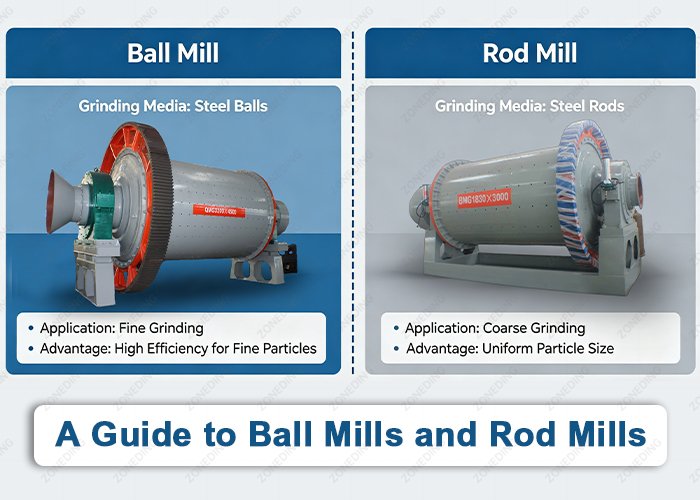
When considering a ball mill ahead of wet magnetic separation, define the required liberation and particle distribution first. The mill and separator should be selected as connected process duties.
Does Wet Separation Always Produce a Better Concentrate?
No. A wet circuit may suit a particular liberation and separation duty, but water alone does not establish selectivity or recovery.
Concentrate quality also depends on mineral associations, feed preparation, magnetic conditions, loading, and the way magnetic and non-magnetic particles leave the equipment.
Compare grade and recovery together. A higher concentrate grade can accompany a lower recovery if more iron-bearing material is rejected.
Also check the product specification beyond total iron. Relevant impurity limits, particle distribution, and moisture requirements may affect whether the concentrate is acceptable.
The correct question is:
Which tested route produces an acceptable product at an acceptable recovery, with workable supporting systems?
Can Dry and Wet Separation Be Used Together?
Yes. Dry and wet separation can perform different duties within one flowsheet.
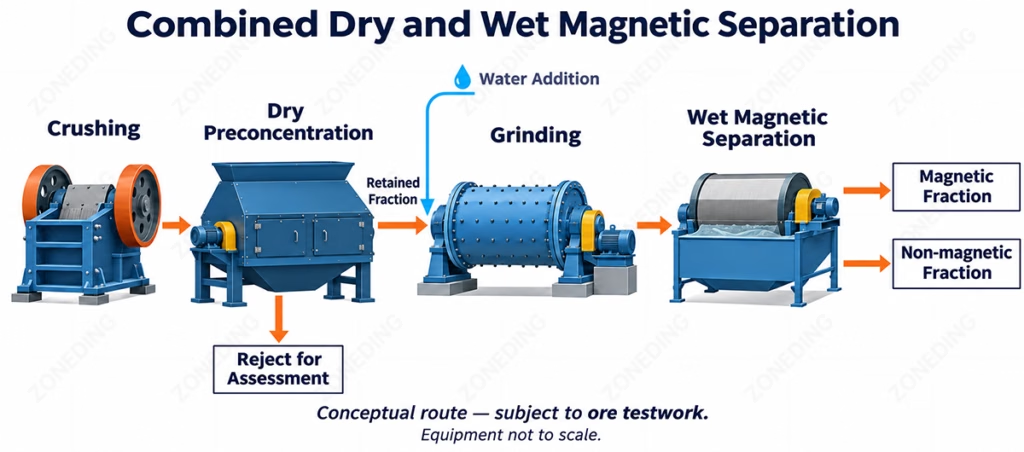
A conceptual arrangement for a suitable ore might be:
Crushing → Dry Preconcentration → Grinding → Wet Magnetic Separation
Dry and wet stages can perform different duties
In this arrangement, the dry stage assesses an opportunity to reject material before grinding, while the wet stage treats the prepared slurry.
This is a possible route, not a standard configuration for every iron ore.
Before adopting it, confirm:
How much mass the dry stage rejects.
How much iron leaves with the rejected material.
Whether ore variability changes that result.
How the retained material behaves during grinding.
Whether the downstream wet circuit meets product requirements.
A reduction in grinding feed mass should not be treated as a benefit without accounting for valuable-mineral losses and additional equipment requirements.
What Testwork Should Support the Decision?
Use representative samples covering the ore types and conditions expected during operation. A favorable result from one selected sample does not establish performance across the deposit.
The test program should be designed around the actual decision.
Testwork question
Evidence required
Selection purpose
Which minerals contain the iron?
Mineralogical characterization and chemical analysis
Identify suitable separation mechanisms
At what preparation size is useful liberation achieved?
Liberation assessment supported by size analysis
Define crushing or grinding requirements
Can a dry stage reject material acceptably?
Product masses and assays under representative feed conditions
Assess preconcentration potential
Can a wet stage meet the required product quality?
Concentrate and tailings results under defined slurry conditions
Assess separation performance
How sensitive is the route to variability?
Tests across representative ore and feed conditions
Identify operating limits and further work
What supporting treatment is required?
Relevant water, settling, dewatering, or feed-preparation assessments
Define the wider equipment scope
Compare results on a consistent dry-mass basis. Record the feed, concentrate, and reject masses and assays so that the mass balance and iron recovery can be checked.
Laboratory results also require engineering interpretation before equipment selection. Scale-up, feed distribution, operating variability, and continuous material handling must be addressed separately.
Compare the Complete Flowsheet Before Comparing Prices
A separator quotation alone cannot establish which route has the lower project cost.
For a dry route, assess the equipment and services needed for feed preparation, moisture management, transfer, and dust control.
For a wet route, assess slurry delivery, water supply and recovery, concentrate dewatering, and tailings handling.
For both routes, include the required product quality, recovery, maintenance access, wear exposure, and capacity of connected equipment.
Avoid comparing a dry separator purchase price with a complete wet processing circuit. Ask suppliers to state the same scope boundaries and identify assumptions that still require confirmation.
What Information Should You Send to ZONEDING?
For a preliminary equipment and process review, provide:
Representative ore descriptions and available mineralogical results.
Feed grade and relevant impurity analyses.
Feed particle size distribution.
Moisture, clay, and handling observations.
Required throughput and product specifications.
Available magnetic separation test results.
Water availability and return-water information.
Existing upstream and downstream equipment.
Site layout, power supply, and product-handling requirements.
ZONEDING can use these inputs to discuss suitable magnetic separation equipment and its connected processing duties. Final selection should follow the evidence for the specific ore rather than a general preference for wet or dry operation.
FAQ
Is dry magnetic separation always cheaper than wet separation?
No. Drying, feed preparation, dust control, recovery losses, and downstream requirements can change the comparison. Evaluate the complete flowsheet using consistent scope boundaries.
Does limited water availability mean dry separation will work?
No. Limited water makes dry processing worth investigating, but the ore must still respond adequately under practical dry-feed conditions.
Can hematite use the same separator as magnetite?
Not automatically. The minerals have different magnetic responses, and the required configuration depends on mineralogy, liberation, and test results.
Is there a fixed particle size for switching from dry to wet separation?
No universal boundary applies to every ore and separator. Use tests on the relevant particle distributions and equipment configurations.
Can dry and wet magnetic separation be used together?
Yes. A dry stage may reject suitable waste before grinding, while a wet stage treats the prepared slurry afterward. Confirm the combined route through representative testing and account for iron losses in every reject stream.
Choosing the right grinding equipment is the most critical decision for any mineral processing plant. Ball mills and rod mills serve different roles in size reduction. This guide provides a deep comparison of their advantages and applications. In ...
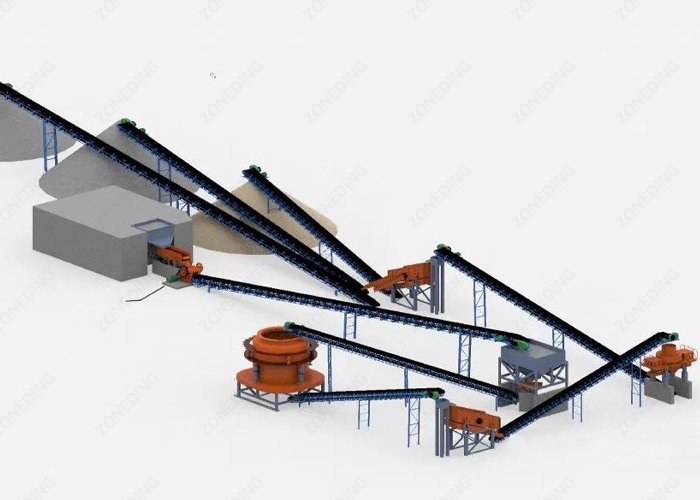
Experience in global quarries reveals common, costly mistakes in equipment selection. Mine owners often consider a crusher just a big hammer that breaks rocks. This mindset destroys profitability. Crushing is a delicate balance of rock mechanics a...
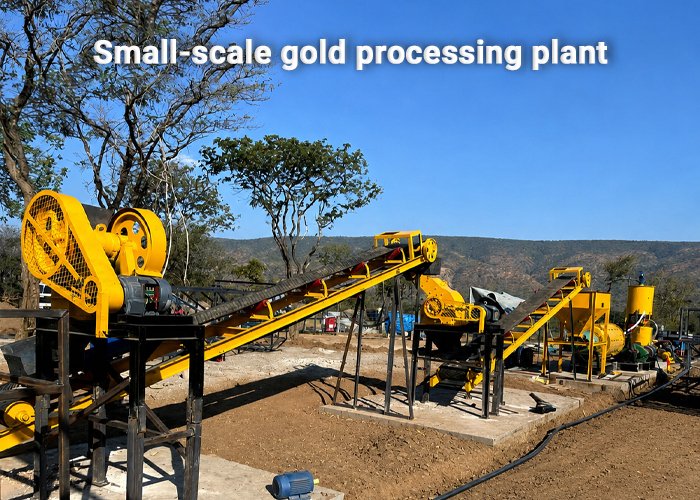
Starting a small-scale gold processing plant is one of the most practical ways to enter the gold mining industry. Compared with large mining projects, a small plant requires less investment, shorter construction time, and lower operating costs. Ho...
Operating heavy mining equipment requires a deep understanding of internal mechanics. Many expensive machine failures happen because operators misunderstand basic operational rules. Good equipment can break quickly when handled poorly. This compre...
We use cookies to ensure that we give you the best experience on our website. If you continue to use this site we will assume that you are happy with it.
Privacy Policy
Send us a message
We would love to hear from you
Submit your question and our team will respond to the email provided as soon as possible.
 Zoneding Machine