Hydrocyclone overflow carrying coarse particles is a common problem. It occurs often in mineral processing. This issue affects grinding circuit classification. It also impacts concentrate regrind circuits. I have handled countless troubleshooting and optimization cases like this. My career spans fifty years. This problem seems simple. Yet, it affects the entire beneficiation process. It impacts efficiency and cost.
Many times, people only check the hydrocyclone’s size parameters. They look at operating pressure and feed concentration. These factors are important. However, deeper, less obvious factors are often overlooked. Solving this problem requires a systematic approach. It needs understanding the hydrocyclone’s “pulse” within the whole process.
Why Does Hydrocyclone Overflow Carry Coarse Particles? These are the Core Reasons!
Hydrocyclones separate particles by size and density. They use centrifugal force. Feed slurry enters tangentially. This creates a swirling motion. Coarse, heavy particles move to the wall. They travel downwards. They exit through the underflow. Fine, light particles move to the center. They travel upwards. They exit through the overflow. When coarse particles appear in the overflow, the classification efficiency is compromised. This can significantly impact downstream processes. It also affects product quality. This section explores the fundamental reasons behind this issue. It highlights factors that disrupt the ideal classification process. Understanding these reasons is the first step toward effective problem-solving. This knowledge is essential for maintaining optimal hydrocyclone classification efficiency.
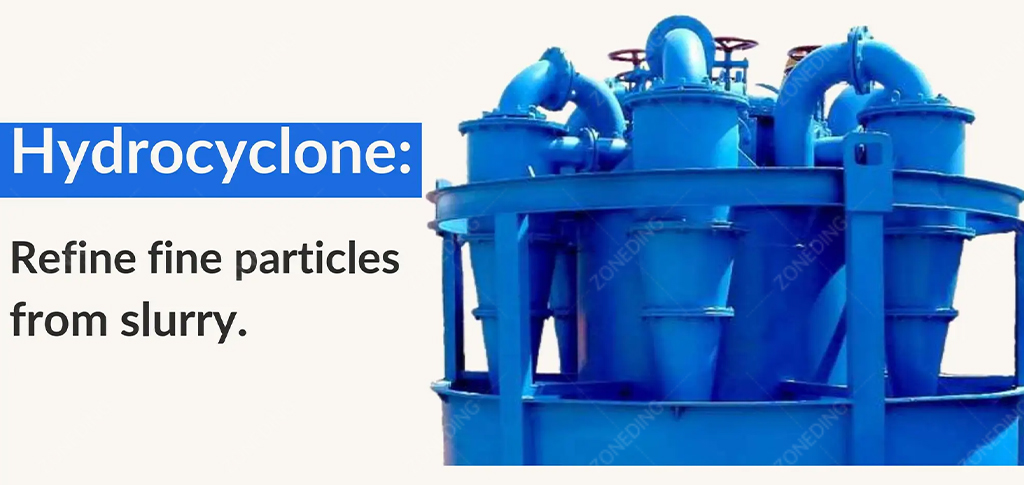
Hydrocyclone cluster used for desliming fine ore slurry
Equipment Wear: Worn Vortex Finder and Apex Spigot
The physical condition of a hydrocyclone directly affects its performance. Critical components are the vortex finder and the apex spigot. These parts control the flow paths. Their wear is a primary cause of coarse particles in the overflow. In my five decades in this field, I have seen many problems linked to wear. A worn vortex finder becomes larger. This allows more slurry to bypass the classification zone. Coarse particles get carried directly into the overflow. A worn apex spigot wear also impacts performance. It might become too large. This causes more fines to report to the underflow. It also reduces the centrifugal force. This force is needed for effective separation. Such wear issues might seem minor. But they significantly degrade hydrocyclone classification efficiency. Regular inspection and replacement of these worn parts are essential. ZONEDING offers wear-resistant components. They are designed for longer service life.
Hydrocyclones operate optimally within a narrow range of parameters. Deviations from these parameters lead to poor classification. Feed pressure, concentration, and flow rate are critical. I have learned that unstable feed is a hidden destroyer. Many think feed is stable if the pump runs fine. This is often wrong. Pump wear, pipeline design, or even slight blockages cause small, hard-to-see fluctuations. I call these “feed pulses.” A hydrocyclone relies on centrifugal force. It is sensitive to feed velocity and pressure. Small pulses instantly disturb the flow field. This makes coarse particles rise into the overflow. This is a significant factor in hydrocyclone troubleshooting. Maintaining stable feed pressure stability and consistent feed concentration is crucial. This directly impacts classification accuracy.
Structural Mismatch: Incorrect Model or Components
Choosing the right hydrocyclone is vital. The correct model must match the application. The components must also fit. Incorrect selection leads to persistent problems. From my experience, no single hydrocyclone fits all. A hydrocyclone meant for fine sand recovery might fail in a primary grinding circuit. The hydrocyclone selection process must consider various factors. These include feed particle size, desired cut point, and capacity. Using a hydrocyclone with an incorrect body diameter or cone angle leads to poor performance. Components like the vortex finder and spigot also need to be correctly sized. A mismatch results in inefficient separation. It causes coarse material in the overflow. This means lost efficiency for the entire mineral processing equipment system.
The properties of the slurry have a profound effect on hydrocyclone performance. These properties include particle size distribution, solids density, and slurry viscosity. Slurry viscosity is often underestimated. It changes dynamically. Factors include solids content, particle shape, and clay mineral content. Temperature also plays a role. Few monitor or control it in real-time. High slurry viscosity reduces particle settling velocity. It lowers classification efficiency. It increases fluid resistance. This inhibits centrifugal separation. Coarse particles find it harder to settle. They are more likely to enter the overflow. This is especially true with high clay content. Operating with improper slurry viscosity for long periods leads to low classification efficiency. It also increases wear on hydrocyclones and pumps. Such mineral processing optimization requires careful attention to slurry characteristics.
Internal Flow Disorder: Short Circuits, Air Core, Blockage
The internal flow dynamics of a hydrocyclone are delicate. Any disturbance leads to poor classification. This includes short circuits, unstable air cores, or blockages. A stable air core is critical for efficient separation. If the air core is unstable or breaks, it disrupts the flow pattern. This allows coarse particles to migrate to the overflow. Short circuits occur when some feed bypasses the classification zone. This directly sends coarse particles to the overflow. Blockages, even small ones, alter the flow. They create turbulence. This reduces the centrifugal force. Coarse particles fail to separate. They end up in the overflow. Such issues require careful flow field control and maintenance. This ensures the hydrocyclone operates as designed.
When Overflow Carries Coarse Particles, How to Quickly and Accurately Diagnose the Problem?
Diagnosing the source of coarse particles in the overflow requires a systematic approach. One must observe, check, and analyze key parameters. Quick and accurate diagnosis saves time and reduces downtime. This section details practical steps for effective hydrocyclone troubleshooting.
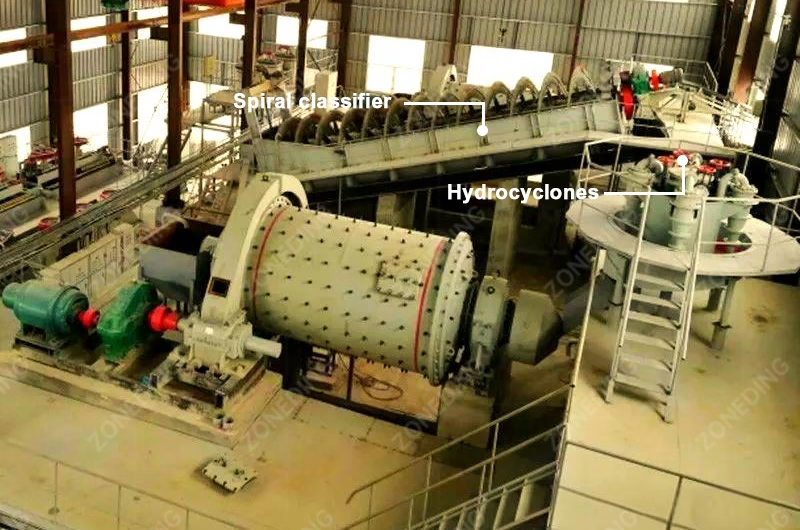
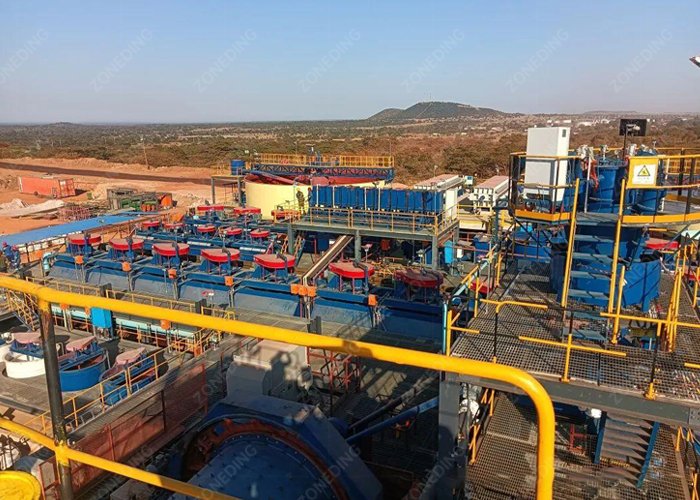
Hydrocyclones customer site
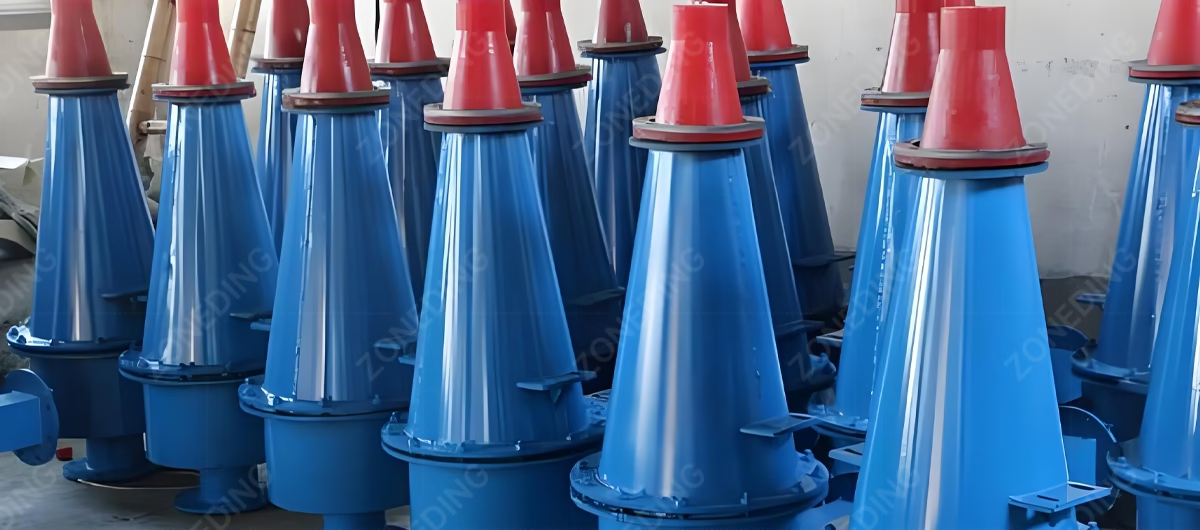
Hydrocyclones
Check Key Components: Visual and Measurement
Regular inspection of critical wear parts is essential. The vortex finder and the apex spigot are key. One must regularly check the vortex finder for wear. It should maintain its smooth internal surface. If it wears unevenly, or its diameter increases, replacement is necessary. Many focus on the spigot wear. But they overlook the vortex finder’s hidden wear. The vortex finder is the hydrocyclone’s “heart.” It sets the overflow size and shape. It guides the centripetal fluid path. Uneven wear here, or thinning, increases its diameter. This pushes more coarse particles into the overflow. Most importantly, people adjust only the spigot diameter. They do not optimize the diameter ratio between the spigot and the vortex finder. This ratio is crucial for classification efficiency and overflow particle size. ZONEDING recommends precise measurement. This detects deviations from original dimensions.
Analyze Feed Parameters: Stability Check
Feed conditions are paramount for hydrocyclone performance. Unstable feed parameters lead to significant classification issues. Invest in high-precision pressure sensors and flow meters. Implement advanced PID control. This ensures ultra-stable feeding. Check feed pipes for smooth internal walls and no blockages. Pump sump design must avoid short circuits. Ensure stable pump suction conditions. Sometimes, a small buffer tank after the feed pump helps a lot. Monitor feed pressure stability. Check feed concentration and flow rate against baseline data. Significant fluctuations often point to problems upstream. This could be in the grinding circuit or the pumping system. Rapid changes in feed pulp density or flow volume disrupt the delicate balance. They lead to coarse particles bypassing the separation process.
Observe Product States: Overflow and Underflow
Visual inspection of the overflow and underflow provides immediate clues. These observations are valuable. They guide further investigation. Observe the underflow pattern. It is more than just “rope” or “umbrella.” The “angle” or “spread” of the underflow jet contains rich classification information. An ideal underflow is stable. It has a certain “umbrella” shape. If the underflow is a thin, long “rope,” the spigot might be too small. Or, the feed concentration might be too high. This “chokes” coarse particles inside. Some coarse particles are forced into the overflow. If the underflow is too spread out, the spigot might be too large. Or, the slurry concentration is too low. This sends many fines and water to the underflow. At the same time, coarse particles might escape to the overflow. Real-time observation of the underflow shape is a key empirical judgment. This helps identify issues.
For Different Causes, What Immediate Hydrocyclone Solutions Can Fix Coarse Overflow?
Addressing coarse particles in the overflow requires targeted solutions. These solutions vary based on the diagnosed cause. This section provides actionable steps. They offer immediate improvements in hydrocyclone classification efficiency.
Replace and Upgrade Worn Parts
Prompt replacement of worn components is crucial. Choosing the right materials extends equipment life. Replace worn vortex finders and spigots when their dimensions deviate. They should not exceed a certain tolerance. This ensures optimal flow dynamics. Invest in components made from highly wear-resistant materials. Options include polyurethane, ceramics, or specialized rubber linings. These materials offer longer service life. They reduce maintenance frequency. This is particularly important for the apex spigot wear. Regular inspection of the vortex finder’s wear is also important. Keep its inner wall smooth. This means choosing more durable materials. ZONEDING provides a range of high-quality, wear-resistant parts. They are designed to withstand abrasive slurries.
Optimize the Feeding System
A stable and consistent feed is the foundation of efficient hydrocyclone operation. Optimizing the feeding system directly improves classification. Invest in high-precision pressure sensors and flow meters. Implement advanced PID control systems. This ensures the feed is ultra-stable. Check the feed pipeline interior. It must be smooth. No material should build up. Design the pump sump to avoid short circuits. The pump needs stable suction conditions. Sometimes, a small surge tank after the feed pump can stabilize flow. This prevents feed pressure and flow fluctuations. This ensures feed pressure stability. These measures prevent the formation of “feed pulses.” These pulses disrupt the separation process.
Adjust Hydrocyclone Parameters
Adjusting hydrocyclone parameters is a common solution. It fine-tune performance. These adjustments are made based on specific operational needs. Systematically test to find the optimal vortex finder to spigot diameter ratio. This is based on ore characteristics. It also depends on classification goals. This often means replacing components. It is not just repairing them. Fine-tuning the feed pressure can improve separation. Increasing pressure enhances centrifugal force. This improves separation of finer particles. However, excessive pressure can lead to increased wear. It might cause short-circuiting. The vortex finder size and spigot diameter are interconnected. Adjusting one often requires adjusting the other. The goal is to achieve the desired cut point and classification efficiency.
Adapt to Slurry Property Changes
Slurry properties are rarely constant. Flexible adjustment strategies are needed to maintain efficiency. Monitor slurry properties in real-time. This includes particle size, density, and viscosity. Adjust the hydrocyclone parameters accordingly. For example, if slurry viscosity increases, feed pressure might need adjustment. Or, the spigot size might need alteration. When ore contains high clay content, adjust grinding aids or flocculants. This optimizes slurry rheology. This approach requires ongoing data analysis. It also needs accumulated operational experience. These adjustments are crucial for consistent product quality control.
Clear Blockages and Optimize Flow
Blockages and turbulent flow fields disrupt hydrocyclone performance. Effective measures clear blockages and stabilize flow. Regularly flush the hydrocyclone. This prevents build-up and blockages. Check the feed inlet. It is often neglected. If the feed inlet becomes oval or irregular, it creates turbulence. This prevents proper centrifugal separation. Replace worn inlet liners. Even small changes can affect the flow. Maintain a stable air core. Ensure no air ingress into the feed pump. Keep the overflow pipe submerged. This prevents air entrainment. These actions ensure the hydrocyclone operates under stable flow field control. This maximizes classification efficiency.
How to ensure hydrocyclone overflow remains fine for stable, efficient operation?
Prevention is always better than cure. Proactive measures ensure hydrocyclones operate efficiently. This avoids the problem of coarse particles in the overflow. One must regularly inspect and maintain all hydrocyclone components. This includes the vortex finder, spigot, and inlet. Establish a schedule for equipment maintenance. Replace worn parts promptly. Use wear-resistant materials. Implement a robust feeding system. This ensures stable pressure, concentration, and flow rate. This helps prevent “feed pulses.” Monitor slurry properties in real-time. Make necessary adjustments to maintain optimal conditions. Train operators thoroughly. They must understand hydrocyclone principles. They must also know how to make fine adjustments. ZONEDING recommends integrating process control systems. These automatically adjust parameters. This maintains peak performance.
Choose the Right Hydrocyclone
Selecting the correct hydrocyclone is the first step to preventing problems. It ensures long-term efficient operation. Consider the desired cut point. This is the particle size that separates. Consider the feed solids concentration. Look at the flow rate and particle size distribution. The hydrocyclone’s diameter, cone angle, and size of the vortex finder and spigot are crucial. These parameters define its classification characteristics. Do not choose based on price alone. Invest in quality mineral processing equipment. Work with reputable manufacturers. They provide technical support and customization. ZONEDING offers a range of hydrocyclones. They are designed for various applications. They can be tailored to specific ore characteristics.
Frequently Asked Questions
Question 1: What is the most common cause of hydrocyclone overflow coarse? The most common cause of hydrocyclone overflow coarse is usually worn components. This includes the vortex finder or apex spigot. Also, unstable feed pressure or concentration causes this problem. Question 2: How often should one inspect hydrocyclone wear parts? Inspection frequency depends on slurry abrasiveness and operating hours. A general guideline is weekly visual checks. Detailed measurements should occur monthly. This is part of routine equipment maintenance. Question 3: Can high slurry viscosity cause coarse particles in the overflow? Yes, high slurry viscosity significantly reduces classification efficiency. It increases fluid resistance. This makes it harder for coarse particles to settle. They then get carried into the overflow. Question 4: What is the importance of feed pressure stability for hydrocyclones? Feed pressure stability is critical. Hydrocyclones rely on consistent centrifugal force. Fluctuations disrupt the internal flow field. This leads to poor separation and coarse particles in the overflow. Question 5: How does ZONEDING ensure optimal hydrocyclone performance for its clients? ZONEDING provides expert consultation. It analyzes specific ore characteristics and process requirements. It offers customized hydrocyclone solutions. This includes high-quality equipment. It also provides wear-resistant components and technical support.
Summary and Recommendations
Hydrocyclone overflow coarse is a solvable problem. It requires a deep understanding of the equipment. It demands knowledge of the process. It also needs consistent monitoring. Core reasons include worn parts. They include improper operation, structural mismatches, and slurry property changes. Internal flow disturbances also contribute. Effective solutions involve replacing worn components. They require optimizing feeding systems. They mean adjusting parameters. Adapting to material variations is also key. Clearing blockages helps. Prevention is crucial. This includes careful selection and routine equipment maintenance. ZONEDING recommends a systematic approach. One must continuously monitor performance. Take proactive steps. This ensures hydrocyclones operate at peak hydrocyclone classification efficiency. This leads to better product quality. It also lowers operating costs.
About ZONEDING
ZONEDING MACHINE is a leading Chinese mineral processing equipment manufacturer. It specializes in B2B solutions. ZONEDING has provided reliable equipment since 2004. The factory covers 8,000 square meters. It produces over 500 units annually. The product range is comprehensive. It covers crushing, grinding, beneficiation, screening, and drying. ZONEDING offers full-service support. This includes design, manufacturing, installation, training, and after-sales service. Products export to over 120 countries. ZONEDING commits to delivering high-quality, customized, and efficient solutions. These help operations achieve their goals. Contact ZONEDING today to discuss your hydrocyclone needs.
High-yield tin ore recovery depends on a design that respects the brittle nature of cassiterite. Traditional plants often lose over 40% of metal because they grind the ore into useless dust. A scientific tin processing flow design i...
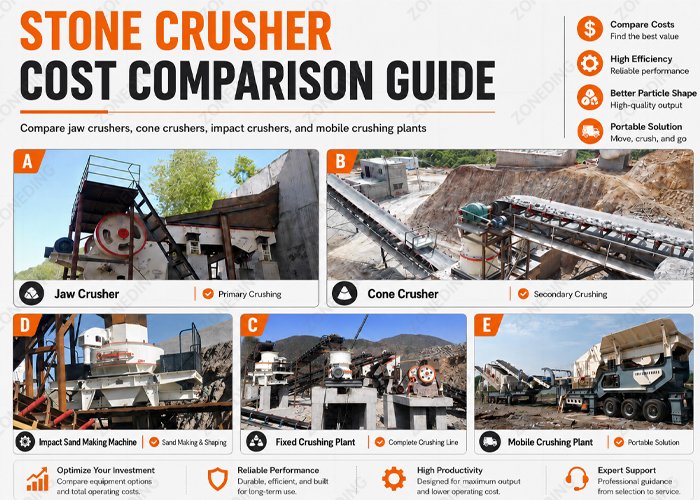
Stone crusher costs can vary dramatically even when two plants have the same production capacity. In real quarry operations, the final investment depends on rock hardness, equipment quality, automation level, mobility, and long-term operating cost...
Stone crushing is the first step in producing aggregates for roads, buildings, bridges, railways, and concrete plants. Every successful quarry or aggregate operation depends on choosing the right crushing method and equipment. However, many invest...
Concrete recycling is a fast-growing industry. It turns old building waste into high-value products. Choosing the right machine is the most important part of the business. Different machines handle different materials and budgets. This guide compa...
We use cookies to ensure that we give you the best experience on our website. If you continue to use this site we will assume that you are happy with it.
Privacy Policy
Send us a message
We would love to hear from you
Submit your question and our team will respond to the email provided as soon as possible.
 Zoneding Machine